
Algae, Algorithms, and the Edge of the Strait
Reading the Week’s News with Greenspan, Minsky, Braudel, Wallerstein, and Gramsci.

Introduction
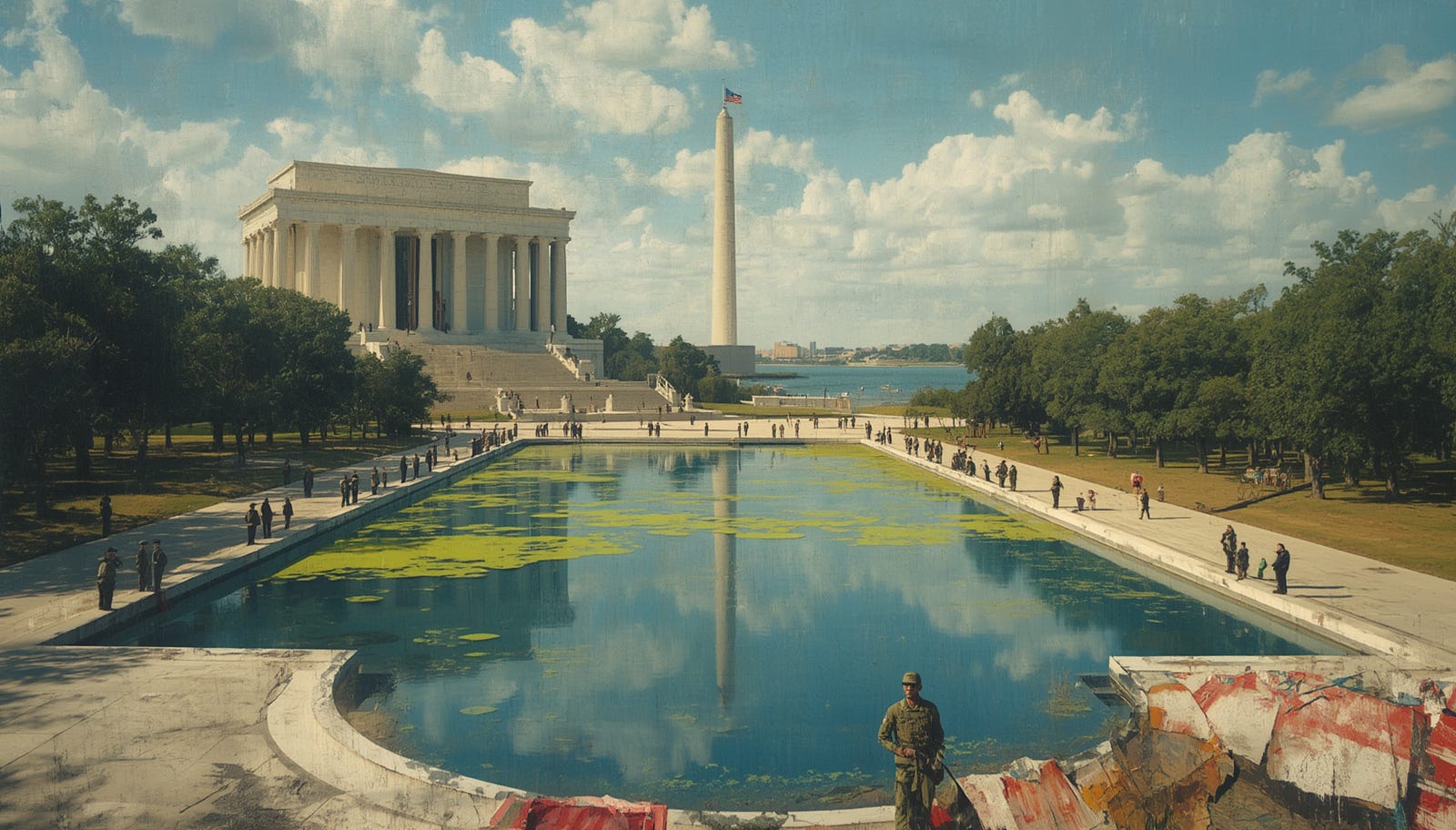
This week, a walk past the Lincoln Memorial reveals a surreal tableau: a $16.4 million renovation, awarded via no-bid contract, has left the Reflecting Pool coated in a peeling “American flag blue” liner. The water is blooming with green algae, and the National Guard has been called in to keep tourists away from the mess. Thousands of miles away, a different body of water is testing the limits of unilateral will. In the Swiss Alps, US and Iranian negotiators agreed to a 60-day roadmap for peace, but the underlying reality is that Iran intends to “administer” the Strait of Hormuz, effectively creating a tollbooth over the world’s most vital energy artery.
The hubris of the Reflecting Pool is the same hubris that blinds hegemons to the structural realities of the Persian Gulf. Fernand Braudel, in his monumental The Mediterranean and the Mediterranean World in the Age of Philip II, taught us that history is ultimately dictated by the longue durée of geography and maritime trade routes, not the fleeting decrees of monarchs or presidents. You cannot paint over material reality, whether it is a pool in Washington or a strategic chokepoint in the Middle East. Geography always reasserts itself over the projection of power.
Alan Greenspan died this week at the age of 100. On the same day, the screens in Seoul flashed red as South Korea’s Kospi plunged 10 percent, wiping out billions in what analysts dubbed a “chip-wreck.” SpaceX, barely days removed from its record-breaking IPO, shed $600 billion in market value as it prepared a massive bond sale to fund its AI ambitions.
Greenspan’s legacy was defined by the “Greenspan Put”—the implicit guarantee that the Federal Reserve would always step in to rescue asset prices. But as the new Fed chair, Kevin Warsh, signals a hawkish turn, that put is expiring. The AI boom is beginning to resemble what Hyman Minsky, in his Stabilizing an Unstable Economy, identified as the transition from hedge to speculative, and finally to Ponzi finance. The market is slowly realizing that the colossal capital expenditure required for AI data centers may not yield immediate, commensurate returns. The era of algorithmic irrational exuberance is colliding with the gravity of capital.
On Monday, Keir Starmer stood outside 10 Downing Street and delivered an emotional resignation speech, just two years after leading the Labour Party to a landslide victory. Across town, Andy Burnham—the “King of the North”—boarded a delayed train to London to claim the mantle, promising to defeat the surging populist right.
Ten years after the Brexit referendum, the United Kingdom is cycling through its seventh prime minister. The structural malaise of stagnant growth, a fractured social contract, and a hollowed-out public sphere cannot be solved by swapping charismatic figures. Antonio Gramsci, writing from a fascist prison in the 1930s, diagnosed the “crisis of authority” where the old world is dying and the new cannot be born, resulting in an interregnum of “morbid symptoms.” Westminster is currently a laboratory for this exact pathology. The center is hollowing out, and the masses have detached from the traditional settlements that once governed them.
Lionel Messi scored his 17th World Cup goal this week, breaking the all-time men’s record. The stadium erupted. But behind the sensor-fitted ball, the real-time tracking, and the AI-assisted offside calls lies a hidden geography of labor. Thousands of data annotators in Manila, Cairo, and Chennai are manually tagging every pass and tackle, turning the beautiful game into structured data for the AI economy.
Simultaneously, the Iran war has caused Gulf remittances to drop by 18 percent, severing a vital financial lifeline for families across Africa. The spectacle of the core relies entirely on the invisible, precarious substrate of the periphery. Immanuel Wallerstein’s world-systems theory reminds us that the accumulation of wealth and technological triumphs in the core is always subsidized by the volatility and exploitation at the edges. Guy Debord’s Society of the Spectacle warned that the spectacular presentation of reality masks its brutal material foundations. The AI-powered World Cup and the geopolitical maneuvering in the Gulf are both spectacles that obscure the exhausted bodies and fractured economies that make them possible.
Geography always reasserts itself over the projection of power.
The era of the central bank put is over; the algorithmic boom must face the gravity of capital.
Charisma cannot substitute for a social contract; the center is hollowing out.
Every spectacular triumph of the core is subsidized by the invisible precarity of the periphery.
A Dispatch on the Week That Was
I. The Green Pool
On the National Mall, the Reflecting Pool has turned the color of swamp water. The $16.4 million renovation—completed in haste for the 250th anniversary celebrations—has peeled and bloomed with algae. National Guard troops patrol the perimeter. A dead duckling floated past the cameras. The President blames vandals, though no evidence supports this; the contractor, a campaign donor whose company is literally named Greenwater Services, appears to have done the damage himself.
This is not a metaphor. It is simply what competence looks like when it collapses into spectacle. The pool was meant to be a mirror—deep blue, “American flag blue,” a surface for national self-regard. Instead it reflects something else entirely: a system that can no longer execute the basic functions of maintenance, that substitutes narrative for engineering, threat for repair, and “vandalism” for the consequences of no-bid contracting.
The Reflecting Pool fiasco sits at the exact frequency of the week’s larger events. In Switzerland, Vice President Vance negotiates with Iranian officials at the Bürgenstock Resort while the President tweets threats from Washington: “You won’t even make it back to your fucking country.” The 60-day peace roadmap, signed with fanfare, already unravels over conflicting claims about nuclear inspectors and unfrozen funds. In Britain, Keir Starmer resigns—sixth prime minister in a decade since Brexit—while Andy Burnham, the “King of the North,” prepares to inherit a state that has forgotten how to govern for more than two years at a stretch.
These are not separate stories. They are the same story told in different registers: the story of institutions that have lost the capacity for repair.
II. The Minsky Moment, Updated
The markets delivered their own verdict this week. SpaceX, which had soared past $2 trillion in its IPO, shed 23% in three trading sessions—more than $600 billion erased. South Korea’s Kospi plunged 10%, triggering circuit breakers. The Nasdaq fell 3.3%. The “chip-wreck,” as Bloomberg called it, spread from Seoul to Taipei to New York in hours.
Hyman Minsky’s financial instability hypothesis—developed in the 1970s and 1980s, largely ignored until 2008—describes exactly this trajectory. Minsky argued that capitalism is endogenously unstable: periods of stability breed complacency, complacency breeds speculation, speculation breeds Ponzi finance, and Ponzi finance ends in crisis. “Stability is destabilizing,” he wrote. Success breeds excess which leads to collapse.
The AI bubble follows Minsky’s script with uncanny precision. We have moved from hedge finance—where tech giants funded AI investment from current profits—through speculative finance, where revenue projections justify massive leverage, toward something approaching Ponzi territory. SpaceX, unprofitable and burning cash through 2029, raised $25 billion in bonds this week, paying “a relatively wide premium over Treasuries.” The greatest demand was for the shortest-dated, least risky tranche—a signal that even creditors are hedging their bets.
The circularity is what distinguishes this bubble from earlier ones. NVIDIA sells GPUs to Microsoft, Google, and Amazon; these firms use them to sell cloud AI services; the revenue funds more NVIDIA chips; TSMC manufactures them; the hype drives valuations higher; the valuations justify more investment. It is a self-reinforcing loop that requires no external validation—no profits, no productivity gains, no customers willing to pay. As one analyst noted: “Why do you need like $100 billion in cash?”
Minsky’s framework, updated by scholars at the Levy Institute, warns that we are approaching what he called “Money Manager Capitalism”—a phase where financial practices themselves generate instability, detached from the real economy of production and employment. This week’s selloff may be a tremor before the larger earthquake, or merely a correction. But the structure of the AI trade—leveraged ETFs in South Korea, retail borrowing frenzies in Taiwan, jumbo bond issuances by unprofitable rocket companies—suggests that the “Minsky moment” is not a question of if but when.
III. The Greenspan Paradox
Alan Greenspan died this week at 100, and the timing could not be more apt. The “Maestro,” who once seemed to have tamed the business cycle, has become the symbol of a deeper failure: the belief that monetary policy could substitute for institutional competence, that the Federal Reserve could insure against all downside risk, that markets would self-regulate if only the government stayed out of the way.
The “Greenspan put”—the expectation that the Fed would cut rates to rescue any market decline—created what economists Marcus Miller, Paul Weller, and Lei Zhang identified as “moral hazard and the US stock market.” Investors came to believe they were “insured against downside risk,” leading to “exaggerated faith in the stabilizing power of Mr. Greenspan.” The put option was implicit but powerful: it privatized gains while socializing losses, encouraged leverage, and ultimately produced the conditions for the 2008 financial crisis.
Greenspan himself admitted the failure. Testifying before Congress in 2008, he said: “Those of us who have looked to the self-interest of lending institutions to protect shareholders’ equity, myself included, are in a state of shocked disbelief.” The ideology of market self-regulation, which he had championed, had collapsed along with Lehman Brothers.
Yet here we are again. The new Fed chair, Kevin Warsh, is explicitly “Greenspan-ian” in his communication style—minimalist, Delphic, refusing to offer the “dot plot” guidance that markets have come to depend on. The “Powell put” has become the “Warsh put,” or perhaps simply the permanent put—the assumption that central banks will always intervene, that asset prices will always recover, that the downside is always covered. This is not stability. It is the systematic cultivation of fragility.
The parallel to politics is exact. Just as the Greenspan put encouraged financial recklessness, the political equivalent—the promise that elections can be overturned, that norms can be violated without consequence, that institutional guardrails are merely suggestions—encourages democratic recklessness. The “Trump put” in politics, like the Greenspan put in markets, creates moral hazard at the level of the state itself.
IV. The Revolving Door
Britain’s crisis is the purest expression of this institutional exhaustion. Keir Starmer won a landslide majority in 2024, the largest since the postwar era. Two years later, he is gone—sixth prime minister since Brexit, seventh in a decade. The cycle has become mechanical: electoral mandate, policy paralysis, internal rebellion, resignation, replacement. As one FT columnist noted, “the British are cursed by their exaggerated self-importance”—the belief that they deserve better governance than they are willing to build.
Andy Burnham, the former mayor of Manchester, now prepares to enter Downing Street. He has charisma, a northern accent, and a reputation for standing up to Westminster. But he faces the same constraints as his predecessors: a bond market that punishes fiscal expansion, a welfare state consuming more than half of government income, an aging population, a housing crisis, and a populist opposition—Nigel Farage’s Reform UK—that has captured the anti-immigrant energy that Starmer’s tougher policies failed to neutralize.
The political scientist Daniel Ziblatt, in his work on democratic backsliding, has argued that conservative parties are “central to democracy”—not because conservatives are inherently democratic, but because their early organizational development determines whether a political system can absorb conflict without collapse. Where conservative parties organized before full democratization—Britain, Sweden, the Netherlands—democracy proved more stable. Where they remained weak or radical—Italy, Germany, Spain—instability prevailed.
Britain’s Conservative Party, once the model of institutional conservatism, has been captured by Brexit radicalism and is now led by Kemi Badenoch, who called Starmer “terrible” but offers no alternative program. Labour, meanwhile, has become a revolving door for leaders who cannot deliver. The center cannot hold because there is no center—only a succession of personalities promising to fix what the system has made unfixable.
This is what Steven Levitsky and Daniel Ziblatt, in How Democracies Die, call “democratic backsliding”: not coup or revolution, but the gradual erosion of norms, the substitution of personality for procedure, the normalization of crisis. Britain is not Hungary or Poland—there are no constitutional captures, no court-packing schemes. But the turnover itself is the pathology. A democracy that cannot produce stable government is a democracy that has lost its capacity for collective action.
V. The Peace That Is Not Peace
In Switzerland, the Iran negotiations follow a parallel logic. The 60-day roadmap, signed at the Bürgenstock Resort, is less a peace agreement than a framework for managing continued conflict. Vice President Vance claims “major progress”; Iranian officials deny having made “no new commitments” on nuclear inspections. Trump threatens to “hit Iran very hard again” while his negotiators plead with Tehran to ignore the threats as “trash talk.” The Strait of Hormuz, nominally reopened, remains clogged with mines and conflicting instructions to shipowners.
This is not diplomacy. It is the simulation of diplomacy—the performance of negotiation without the substance of agreement. The mediators, Qatar and Pakistan, have become props in a theater of great-power management. The “de-confliction cell” established to monitor Lebanon is less a peacekeeping mechanism than a recognition that the war will continue in proxy form.
The pattern is familiar from the literature on “forever wars” and frozen conflicts. What the U.S.-Iran interim agreement resembles most closely is the 2015 JCPOA that Trump himself tore up—a deal that deferred hard choices rather than resolving them. The difference is that this time, the deferral is explicit. The 60-day window is not a bridge to permanent peace but a holding pattern, a way of keeping oil flowing and bombs paused while both sides prepare for the next round.
The economic consequences are already baked in. Bank of Canada Governor Tiff Macklem, in Paris this week, warned that “large, persistent imbalances are once again fueling tensions—through trade, capital flows and financial markets.” The U.S. absorbs global capital to fund its AI boom and budget deficit; Europe and China export savings they cannot invest productively at home. This is the “global imbalances” problem that preceded the 2008 crisis, now amplified by war-driven energy shocks and the AI investment spiral.
VI. The Art of Withdrawal
Against this backdrop of institutional failure, the art world offered two small acts of integrity. Helen Cammock, the Turner Prize-winning artist, removed her video work from the National Portrait Gallery after pressure from Churchill’s family and 50 signatories who objected to its claim that the former prime minister willfully starved Indians during the 1943 Bengal famine. “There is an incredible pressure on artists and arts institutions to bend to external pressure,” she said. “I do not accept this pressure.” The museum, caught between artist and donors, accepted the removal with diplomatic regret.
David Hockney, meanwhile, had asked that only two people attend his funeral: his partner and his great-nephew. The rest of the world would have to wait for memorial services in London, Yorkshire, Paris, and Los Angeles. It was a final act of aesthetic control—the artist who spent a lifetime managing perception managing even his own death.
These are not merely cultural footnotes. They are responses to the same pressure that deformed the Reflecting Pool and the Iran negotiations: the pressure to perform, to produce spectacle, to substitute visibility for substance. Cammock’s withdrawal and Hockney’s minimalism are refusals of this logic. They assert that some things—artistic integrity, personal death—are not available for public consumption.
Marc Spiegler, the former head of Art Basel, made the economic case for withdrawal in a different register. “Art galleries are not ok,” he wrote in the New York Times. The art market has expanded its supply of dealers, fairs, and artworks without expanding its base of collectors. “There just aren’t enough collectors, especially new collectors, to make the math of this supersized art world add up.” FOMO, he concluded, “is not a business model.” The solution is to “stay closer to home”—to build local markets rather than chasing the “chimera of globalization.”
This is the wisdom of retreat in an age of overextension. The art world, like the financial markets, like the British state, like the U.S.-Iran negotiations, has pursued growth without foundations. The correction, when it comes, will not be gentle.
VII. The Heat Dome
Over Europe, a heat dome settled in. France recorded its hottest day ever. At least 40 people drowned seeking relief in unsupervised lakes and canals. London schools closed. The 2003 heat wave, which killed 70,000 across the continent, became the reference point—the benchmark against which this week would be measured.
The heat is not separate from the other crises. It is their atmospheric expression. Climate change operates on the same timescale as institutional decay: slow enough to ignore, fast enough to overwhelm. The European heat wave, the Iran war’s disruption of energy markets, the AI boom’s electricity demands, the British state’s inability to maintain basic infrastructure—these are not distinct phenomena but aspects of a single “polycrisis,” in the term that has gained currency among systems theorists.
A systematic review of 2,299 publications on the polycrisis concept found “multiple co-occurring, causally entangled crises with synergistic and cascading effects on multiple systems degrading humanity’s prospects.” The interconnections, however, remain “underexplored”—we see the symptoms but not the systemic disease. The heat dome and the chip-wreck and the revolving door of Downing Street are treated as separate stories because our institutions lack the capacity for systemic thought.
VIII. Thesis
The week teaches three things, and they are the same thing stated three ways.
First: Stability breeds its own destruction. The Greenspan put, the Brexit settlement, the AI investment loop—all promised to eliminate risk and instead concentrated it. Minsky’s hypothesis is not a theory of markets alone but of institutions generally. The longer a system appears stable, the more fragile it becomes.
Second: Spectacle substitutes for function until the function collapses. The Reflecting Pool, the Iran negotiations, the British premiership—all have become performances of their own failure. The simulation of governance has replaced governance; the simulation of diplomacy has replaced diplomacy; the simulation of markets has replaced markets.
Third: The correction, when it comes, will not respect the boundaries we have constructed between politics and economics, between war and climate, between art and money. The polycrisis is not a metaphor. It is the shape of the present.
The algae in the pool is the algorithm in the market is the resignation in Downing Street is the heat in the atmosphere. They share a single cause: the belief that we could grow without maintaining, promise without delivering, speculate without consequence. The week has shown us the bill.
The Maestro’s Last Note: Six Scenes from the End of an Old Week
There is a photograph I keep returning to, even though I cannot find it in this week’s pile. It is the image of Alan Greenspan walking, slowly, behind the chair he has occupied for nineteen years. He was the conductor of the orchestra of money; he was also the man who, on a December afternoon in 1996, uttered two words the markets would not forgive him for: irrational exuberance. The S&P fell two and a half percent in three days on the phrase, then forgot it, and forgot it again every quarter for the next thirty years until it was no longer a phrase but the weather. Greenspan died last Tuesday at 100. By Wednesday morning the headline writers at Semafor had already titled their wrap “Irrational Exuberance,” and by Thursday the only chorus left in global markets was the literal one. Wall Street called it, in its laconic brogue, the chip-wreck — the day Asia’s AI selloff reached New York and the Nasdaq futures began, with a kind of weary inevitability, to slip.
I want to keep that photograph in the corner of my eye as I walk through the week, because this is what a dispatch does: it refuses to let one day pass for one thing. The Greenspan death, the chip-wreck, Keir Starmer’s resignation, the removal of a video about Churchill from the National Portrait Gallery, Iran’s quiet announcement that it would “administer” the Strait of Hormuz, Parisians frying under zinc roofs in forty-degree heat — these are not six items. They are six scenes from the same room. Read together, they describe the long, undignified moment when the late-twentieth-century settlement admits, at last, that it has ended.
Let me take them one at a time. Concrete first. Then what they are doing.
I. The Maestro and the Chip-Wreck
On Tuesday Bloomberg’s evening brief ran under the headline “SpaceX Keeps Falling, Takes Market Down With It,” and the morning after ran “Wall Street ‘Chip-Wreck’ Triggers AI Bubble Fear.” Semafor led its Wednesday edition with the same story as a global rout — “Tech rout goes global” — and noted that South Korea’s SK Hynix, the world’s memory champion, had become the country’s most valuable company even as its stock was busy reversing the trajectory. SpaceX, freshly public, had shed roughly four hundred billion dollars of market value in days. The Atlantic carried a piece on the same morning by David Graham, headlined “Trump can’t spin his way out of his two latest crises,” in which he put the rout beside the National Mall demonstrations and called them, in effect, two symptoms of the same disease. Across the Pacific the FT’s Greenspan, reassessed newsletter sat next to a piece about the death of the Maestro, and the page accidentally became a perfect editorial coincidence.
This is, of course, what Charles Kindleberger described, in Manias, Panics, and Crashes, as the moment at which a long speculative displacement crosses into the territory where the central bank can no longer pretend to be a discreet accompanist rather than a participant. Greenspan was the patron saint of the displacement. He took office in 1987, six weeks before Black Monday, and proceeded to spend the next eighteen years managing the appearance that the conductor did not matter because the music was the music. His great, quiet trick was to substitute confidence for prudence. Investors should feel free, he said in effect, because the Fed would be there to catch them if they fell. Irrational exuberance was the one sentence in which he let the truth slip past his teeth, then climbed back onto the podium and kept waving. Hyman Minsky, who had died in 1996 and so missed the speech by months, would have recognized the entire pattern. The Market Times of 2026 is exactly Minsky’s hedge-fund economy — calm on the way up, fragile on the way down.
What is new, and what the chip-wreck is genuinely about, is not the bubble itself but the substrate. The 1996 bubble was a bubble in companies that, in the main, sold things. The 2026 bubble is a bubble in the machines that are supposed to replace the companies that sell things. Sam Altman’s web of investments, OpenAI’s putative hundred-billion-dollar ad bet, Microsoft’s AI restart, Nvidia, TSMC, the Korean memory cycle — these are not companies in the older sense. They are the platforms on which the next economy is supposed to be built; they are also, and not coincidentally, the assets on which the pension funds and sovereign wealth funds of the late-American era are leveraged. Greenspan at 100 was being read this week, as John Authers put it in his Points of Return newsletter, through “a legacy as convoluted as his words.” The convolution is that the system he built was designed to manage a capitalism of producers, and is now being asked to manage a capitalism of models. It is the same podium. The orchestra has been replaced by a synthesizer.
The Maestro has died. The synthesizer is making the same sounds.
II. The Seventh Conductor in a Decade
Keir Starmer stood outside 10 Downing Street on Tuesday morning and made the speech a prime minister makes when he has decided, and his party has decided, that the speech is the only door left. By evening he had resigned; by Wednesday morning the FT’s lead was “Oh dear, Keir,” and Andy Burnham was being tipped to succeed him, and the FT’s After Starmer ran with a question underneath the fold about whether Meloni had turned on Trump and whether Germany could learn to spy again. The New York Times’ The World was more direct: “Charisma alone can’t fix Britain.” By Thursday Starmer’s successor was being read as the seventh prime minister in a decade — an extraordinary churn rate for a country that used to consider a decade a reasonable tenure for a sovereign.
This is what the British political scientist David Runciman, in The Confidence Trap (2013), warned the democracies about: that the longer a system runs on the fumes of legitimacy, the more violently it thrashes when the fumes thin. The United Kingdom has not had a stable government in the sense that the term was understood at the time of the Maastricht Treaty; it has had a sequence of governments, each of which has been asked to perform a confidence trick on an electorate that has stopped believing in the trick. Brexit was the moment the trick was named. Starmer was the man who was supposed to make the trick work again, having promised the voters that he would not do the trick the way the previous men had done it. He was undone, in the end, by the same thing that undid the others — by being asked to be a steward of an arrangement whose premises his own voters had revoked.
What Burnham inherits is not Britain. It is the management of Britain’s retirement from being Britain. The Sunday Times’ Geoscape carried a piece, on the day of the resignation, called “Never the diplomat,” with the subheading “Britain’s Starmer quits”; the broader Geoscape from the next day was titled “Britain’s unpopularity test” and paired the news with the growing isolation of Crimea, as if to ask which of these was the more obvious irrelevance. The South China Morning Post ran a parallel piece — “The end of history has come and gone for Europe” — in which the editorial board argued that the EU bureaucrats who thought they had left power politics behind were about to be reminded otherwise. It is a striking coincidence, and probably not a coincidence, that two papers, on the same Tuesday, in two different languages, used the same metaphor: the post-Cold-War settlement is over.
Fukuyama’s thesis, in his 1989 essay in The National Interest, was not that the future would be peaceful; it was that there would be no more serious ideological competition to liberal democracy. That thesis had been half-ash for some time before Fukuyama himself conceded, in a 2014 essay marking the twenty-fifth anniversary, that the concession was overdue. What this week shows is not that the thesis has been definitively falsified — that has been the case since the global financial crisis at the latest — but that the institutions built around the thesis are now openly refusing to apologize for it. The Oh dear, Keir piece, the Charisma alone piece, the end of history has come and gone piece — these are not political commentary, they are political goodbyes. The maestro has stepped down. The orchestra is tuning up, but no one is yet sure who the conductor is.
III. The Painting and the Plaque
On Tuesday, in the National Portrait Gallery in London, the artist Helen Cammock removed her own video from the wall. The work, which had been on display, claimed that Winston Churchill was personally responsible for the starvation of Indians during the Bengal famine of 1943. The Gallery confirmed the removal; the artist confirmed the artist had done it; the press ran the story under headlines about censorship and self-censorship and who controls the British memory of empire. This is a small event in the physical sense — a video off a wall in a single London gallery — and it is also, in the sense Walter Benjamin would have meant, a historical-theses event. It is a fight about who gets to put what next to whose face.
Benjamin, in his 1940 Theses on the Philosophy of History, described the historical materialist as someone who brushes history against the grain, the way a painter brushes against the canvas. The bourgeois historian paints a continuous line; the materialist notices the breaks, the cut edges, the places where the canvas has been patched. Cammock’s video, before she took it down, was a brush against the grain. The dispute around it is what happens when a country that has decided, for thirty years, that the canvas was finished is told that the painting is being worked on in front of it.
The week had another memorial moment, and it is worth pairing them. The New York Times Magazine ran on Wednesday a piece titled “The many founders of the United States,” in which seven historians told the stories of America’s lesser-known revolutionaries on the approach to the 250th anniversary. The piece is, in its quiet way, the same gesture. A nation is being asked to update its founding canvas. And on Monday, the South China Morning Post’s Opinion section ran an interview with the Harvard-trained scholar Nie Huihua about the “non-Westernness” of the Chinese government and the challenge to innovation; the SCMP piece, like the many founders piece, refuses the consensus that any single painting has the final word.
This is the third scene from the same room. The maestro has died. The conductor of the orchestra is being auditioned. And the playlist — the very songs the orchestra is allowed to play — is being rewritten. Britain is renegotiating Churchill. America is renegotiating Madison and Hamilton and the lesser revolutionaries. China is renegotiating the entire question of Western. The energy of the moment is not conservative or progressive; it is the energy of late-medieval altarpieces being pried open by the iconoclasts, except that this time the iconoclasts are working from inside the museum.
IV. Hormuz and the Quiet Hand-Over
On Monday morning, in a room somewhere in Switzerland, the United States and Iran sat down for what Bloomberg called “major progress” talks. By Tuesday, the Treasury had temporarily lifted Iranian oil sanctions. By Wednesday, Iran was announcing that it would “administer” the Strait of Hormuz. By Thursday, Donald Trump was clarifying that any unfrozen Iranian funds could be used only for food and medical supplies. And on Wednesday the US Senate voted 50 to 48 to limit the President’s ability to conduct military operations against Iran without congressional authorization.
The through-line is not peace. The through-line is legitimation. Iran, in the space of four days, became a sanctioned state whose sanctions were conditionally lifted, whose frozen assets were conditionally returned, and whose principal strategic waterway it was now authorized, in its own telling, to administer. The United States, in the same four days, suspended its own forty-year policy on Iranian oil, failed to win a procedural vote on the war, and found itself publicly arguing with shipowners about whose orders applied inside the strait. This is what Robert Gilpin, in War and Change in World Politics (1981), spent his career describing: a slow, expensive rearrangement in which the older power concedes the management of a region and the rising power assumes it — without the corrective that, in Gilpin’s reading of earlier transitions, was historically provided by a great war. The whole apparatus is dignified, in the meantime, by the vocabulary of talks and progress and sanctions easing.
The Economist, on Wednesday, called the American move “a huge concession to Iran,” and noted that the Treasury’s waiver of sanctions “upended four decades of policy.” The word upended is doing work. The forty-year policy was the policy of the late Cold War settlement; its central commitment was that the United States would police the energy flows of the Persian Gulf because the United States had, since 1945, policed the energy flows of the Persian Gulf. To administer the strait is, in Iranian English, the language of a steward; it is also, in any other English, the language of a sovereign. Iran has been claiming the language of a sovereign for forty years. It is now being granted the language of a sovereign by the very power that spent forty years refusing it. The maestro has died. The orchestra, in the Persian Gulf section, is being conducted by someone whose name the program does not yet list.
The Israeli press, as the Economist also noted, immediately wondered aloud whether Israel would now move to undermine America’s peace. The question is its own answer.
V. Zinc Roofs, Sodium Batteries, and the Substrate
On Wednesday morning, Le Monde in English ran a piece headlined “Living under Paris’s zinc roofs in 40°C heat: ‘One day, the people living there will look for those responsible.’” In the same week the FT carried, under the headline “Accidental climate saviours,” the argument that Chinese green-tech spending and the Trump oil-price shock had together supplanted the EU’s own emissions efforts. SCMP ran “Asia’s shaky food supply shudders as ‘super’ El Niño arrives,” and a separate piece on China’s CATL investing $742 million in sodium-ion batteries as lithium prices swung. The NYT’s Morning newsletter carried “Bread and roses” — its title borrowed from the 1912 Lawrence textile strike — and put the heat wave and the Greenspan obituary in the same Tuesday digest. The Economist ran a piece called “How China still outworks the West,” which described the labor medals handed out each year in China to “celebrate and motivate beleaguered workers.” The PM Albanese was being heckled by the Australian Greens over the NDIS while a super El Niño took shape in the Pacific. South Korea’s memory champion was being repriced; subsea cables were being modeled for supercurrents more common than realized. The Long March rocket was getting a super fuel to lift ten percent more payload.
The single word is super. The single fact under the word is that the physical substrate of the late-twentieth-century arrangement — its weather, its energy, its food, its minerals, its shipping lanes, its undersea cables — is no longer cooperating. Vaclav Smil has argued, in Energy and Civilization (2017), that the deep grammar of any economic era is set by the energy regime underneath it; and that when the energy regime changes, the grammar changes with it. The chip-wreck is happening underneath a shift away from lithium toward sodium. The Hormuz transition is happening underneath a heat wave that has made the Persian Gulf, in summer, a place that air-conditioning alone keeps habitable. The labor medals are being given in a China whose growth model is no longer driven by cheap migrant labor from the interior, because the interior is no longer cheap. The super El Niño is happening because the Pacific, like everything else, has been altered.
This is not, exactly, climate collapse as it is usually reported. It is what the geographers call coupling — the moment at which two systems, previously separate, begin to determine each other. The energy system and the food system. The political system and the weather system. The markets and the straits. The maestro died on Tuesday, but the orchestra has been tuning to a different acoustic for thirty years, and this is the week in which the difference became, briefly, audible.
VI. The Long Goodbye
Let me put the six scenes in order now and say what they together say.
A maestro dies at 100. Irrational exuberance, the phrase he apologized for in 1996, becomes the headline of the day his estate publishes the obituary. A selloff in Asian memory chips crosses the Pacific and meets the American selloff in American rockets, and the FT names the meeting the chip-wreck. A prime minister resigns on Tuesday so that his successor can be auditioned on Wednesday, and the seventh British prime minister in a decade inherits the management of Britain’s retirement from being Britain. An artist removes her own video from a national gallery because the painting of empire cannot hold; a magazine commissions seven historians to revise the painting of the founders; a Chinese scholar explains that Western is a regional adjective. Iran, in the language of the Treasury and the language of the Supreme National Security Council, becomes a sanctioned power that is also the administrator of the world’s most important energy waterway. Paris melts under zinc; lithium wobbles and sodium steps in; a super El Niño takes shape over the Pacific; Chinese rockets get a super fuel.
The pattern is the pattern of an end. The pattern is not the pattern of a catastrophe. A catastrophe is a single event; an end is a long, distributed process in which the institutions of the previous era continue to function, at higher and higher cost, and the institutions of the next era begin, in the margins and the footnotes, to take their shape. Joseph Schumpeter, in Capitalism, Socialism and Democracy (1942), called this creative destruction, and his word has been so abused by management consultants that it has lost the original horror, which was that the destruction comes first and the creative follows, sometimes decades later, sometimes never. Kindleberger, in Manias, Panics, and Crashes, called the same thing a displacement, and his word has the advantage of being physically accurate. The orchestra does not stop. The orchestra continues. The conductor, however, has retired.
What I want to mark, for this dispatch, is not the death of the conductor. Conductors die. What I want to mark is that the music, this week, did not slow down for the funeral. The chips kept falling. The seventh prime minister kept being auditioned. The strait kept being administered. The zinc roofs kept absorbing the heat. The market did not pause for the maestro’s departure because the market, by 2026, has not been the maestro’s instrument for thirty years. The maestro was the instrument of the market.
Yeats, in The Second Coming, wrote that “things fall apart; the centre cannot hold.” He was, in 1919, talking about the end of the first European settlement. The line is over-quoted; it is over-quoted because it is correct. The settlement of 1945 — American, financialized, confident, technological — is not falling apart this week. It is having fallen apart this week, in the way a chandelier falls apart: slowly, in the air, while the orchestra below it continues to play, and only when it hits the floor does anyone look up.
The end of an era does not arrive in a single week. It arrives in the week that people begin, at last, to say so.
After the Maestro, the Pool
The water was green. There is no other way to begin.
On the National Mall, the Lincoln Memorial Reflecting Pool — resurfaced at a cost of $16.4 million with what President Trump described as a deep “American flag blue” — is now, in the words of The Atlantic’s David A. Graham, “beset with algae” and “coming off in big chunks.” The White House blames vandals. There is no evidence of vandals. There is evidence of a no-bid contract awarded to Greenwater Services, a company tied to Trump donor John Cafaro, who was previously convicted of conspiracy to bribe. National Guard troops patrol the perimeter. A dead duckling was photographed floating past. MSNBC convened a panel on what the end of splashing in the Reflecting Pool “represents.” A cyclist was arrested for touching the liner. Jeanine Pirro, the U.S. attorney for Washington, promised to throw the book at vandals, which seems mostly like a way for her to extend her record of failing to get D.C. grand juries to green-light tenuous prosecutions.
It is tempting to treat the pool as farce. It is not farce. It is the visible failure of a particular kind of governance, the kind that has run on spin and spectacle for a decade and is now colliding with material reality. “In the past,” Graham wrote, “Trump has spun setbacks as victories, lying prodigiously to do so.” But the water is green. Anyone can see it. The ducklings are dead. The ships are bottlenecked in the Strait of Hormuz. The chip stocks cratered on Tuesday. The seventh British prime minister in a decade is preparing to enter Downing Street. The Maestro died at 100. The heat came down on Europe and killed forty people in five days in France alone.
This is the week the bubbles stopped being theoretical.
I kept returning, while reading the dispatches, to Adam Curtis’s 2016 film HyperNormalisation, which argued that the late twentieth century delivered a kind of Soviet vodka for the West: a compulsory fake-narrative, a story everyone knew was untrue but no one could quite abandon, because the alternatives were more frightening. Hannah Arendt, in her 1967 essay “Truth and Politics,” drew the distinction between factual truth and opinion. Factual truth — the water is green, the duckling is dead, the inflation number is 3.8 percent — is “despised” by those in power, Arendt wrote, because it is “obstinate,” it cannot be talked away, it sits there demanding to be acknowledged. Opinion can be shaped. Factual truth can only be denied.
The week’s dispatches, read in sequence, are a record of factual truths reasserting themselves across the domains where spin had previously held: monetary policy, British politics, the Iran war, the AI trade, the energy transition, the contest with China. Each domain had its own narrative. Each narrative is now leaking. What follows is an attempt to map the leaks.
I. The Maestro Dies at 100
Alan Greenspan died at his home on June 22, aged 100, of complications from Parkinson’s disease. Bob Woodward’s 2000 hagiography was titled Maestro: Greenspan’s Fed and the American Boom. “All the roads to explaining the great American economy of the 1990s,” Woodward wrote, “led to Greenspan.” As Bloomberg’s John Authers observed in his Points of Return newsletter, those roads may also have led from that boom to the ensuing bust.
The arc is by now familiar, but worth reconstructing because the new Federal Reserve chair, Kevin Warsh, is explicitly invoking it. Treasury Secretary Scott Bessent, arguing for rate cuts, has resurrected Greenspan’s decision to keep rates low during the late-1990s technology boom: “The Fed needs to have merely an open mind. The open-mind maestro, former Fed Chairman Alan Greenspan, resisted premature rate hikes during the technology boom of the 1990s — and history proved him right.” Authers’ reply is sharp: Has it? Greenspan’s “irrational exuberance” speech of December 1996 — the phrase that, as Greg Ip wrote in The Wall Street Journal, “is now part of the vernacular” — was followed by a rate hike and a brief correction. Then he mused publicly about a “new economy.” Then, in the fall of 1998, Russia’s default triggered the collapse of Long-Term Capital Management. Greenspan blinked, organized a bailout, and cut rates. A stock market that had peaked instead melted upward. The Fed pumped more liquidity ahead of Y2K. Then it finally cut off the spigot. The dot-com bubble burst. Then rates were drastically cut again. Money is fungible. The funds that eased the equity bust found their way into housing finance. The rest is the history we are still living inside.
The Greenspan Put — the doctrine that the Fed would let asset prices drive rates, that any fall in stocks would be greeted by lower rates — produced what economists call moral hazard. The phrase comes from insurance: when actors are shielded from the consequences of their recklessness, they become more reckless. Robert Shiller, the Yale economist whose 2000 book Irrational Exuberance took Greenspan’s phrase as its title, has spent two decades arguing that bubbles are not random events but stories we tell each other about why prices can only go up. The dot-com story was the internet. The housing story was financial innovation. The AI story is compute.
On Tuesday, that story cracked. A “chip-wreck,” in Bloomberg’s evocative phrasing: the Nasdaq 100 fell 3.3 percent, a closely watched gauge of chipmakers slid about 8 percent, and South Korea’s Kospi plunged 10 percent from a record. Samsung and SK Hynix each fell more than 12 percent. ASML was down 5 percent. SpaceX, the rocket-and-AI conglomerate whose IPO had briefly lifted it past $2 trillion in market value, dropped 16 percent, extending a three-day losing streak that wiped out more than $600 billion. Its $25 billion inaugural bond sale paid a “relatively wide premium over Treasuries,” and demand was concentrated in the shortest-dated, least risky tranche — investors willing to lend, but only at short maturities, only at a premium. Taiwan’s retail investors, Bloomberg reported, are borrowing to bet on TSMC, raising fears of a bubble on the island that is Exhibit A of the AI trade. South Korea’s top financial regulator said he regrets not blocking the launch of leveraged ETFs tracking single stocks.
Hyman Minsky’s financial instability hypothesis — that stability breeds instability, because calm periods convince investors to take on more risk, until the risk-taking itself becomes the source of instability — was formulated in the 1970s and 1980s, when Minsky was an eccentric with few readers. After 2008, he became required reading. Charles Kindleberger’s Manias, Panics, and Crashes, which applied Minsky’s framework to four centuries of financial history, identified a recurring sequence: displacement, boom, euphoria, distress, panic. The displacement in our cycle was the November 2022 release of ChatGPT. The boom has run for three and a half years. Euphoria peaked with SpaceX’s IPO. Distress arrived this week. Whether distress becomes panic depends, in part, on whether the Fed will repeat the Greenspan Put.
Adam Tooze, the economic historian whose 2018 book Crashed reconstructed the 2008 crisis, has popularized the term “polycrisis” — the interaction of multiple crises in ways that make the whole more dangerous than the parts. The chip-wreck is not a clean AI selloff. It is a selloff that arrives with the Iran war still unresolved, the European heat dome straining power grids, the bond market re-pricing for higher rates (Warsh’s “unexpectedly hawkish turn” at the FOMC, half the members now expecting at least one hike this year), the Japanese yen near a four-decade low, and the US personal-saving rate at 2.6 percent, the lowest since 2008. Warsh, as the FT noted, “is throwing the reaction-function baby out with the dot-plot bathwater.” A Delphic Fed, the FT warned, “is a dangerous Fed.”
The Maestro’s ghost is not done with us. He leaves behind a question: when the next bubble bursts, will the central bank ride to the rescue, or will it let the water stay green?
II. The Brexit Decade Ends, Again
Outside 10 Downing Street on the morning of June 22, Keir Starmer announced his resignation. “He is expected to be succeeded by Andy Burnham, the former mayor of Greater Manchester,” the FT reported, “who won a resounding victory last week in a special election for a seat in Parliament.” Burnham is the seventh prime minister the country will have had in the decade since the Brexit vote. Before 2016, Britain had had five prime ministers since 1979.
The numbers stack up like a mortality table. Public debt is at 94 percent of GDP. Interest payments now exceed the entire annual budget of the public education system. The state spends more than half its income on welfare and health, with that share set to rise as the population ages and the proportion of working-age people falls. A typical groceries order has risen 40 percent since 2020, the WSJ reported, while wages have flatlined. Reform UK, the anti-immigration party led by Nigel Farage, has overtaken Labour in opinion polls. The country voted for Brexit as a way to escape European-style chaos politics, Newsweek’s Shane Croucher observed, “only to receive the exact thing they voted against in spades for the last 10 years.”
Burnham, the “King of the North,” has biography on his side. He was born and raised in the northwest. His father was a phone engineer and his mother a doctor’s receptionist. He reversed the privatization of Manchester’s bus system, introducing free and low-cost travel on bright yellow “bee buses” in the city center. During Covid, his protests against harsh lockdown measures earned him his nickname. The New Statesman, on Starmer, had written: “Men don’t want to be his mate and women don’t want to give him a hug.” Burnham, by contrast, is the only Labour politician routinely referred to by his first name.
But charisma is not a strategy. “Burnham will have to be brave if he wants to get Britain growing again,” Martin Wolf wrote in the FT. “Unfortunately UK politics is hostile to making tough, but necessary, choices.” Last September, Burnham lamented that Britain shouldn’t be “in hock to the bond markets.” When bond traders pushed interest rates up in response, he backtracked. There needs to be a plan to shrink Britain’s debt, he said. He would keep to strict fiscal rules. The Liz Truss precedent — the bond market’s punishment of her 2022 mini-budget, which removed her from office after fifty days — is now the silent actor in every British fiscal decision. Markets, the Bloomberg columnist Jonathan Levin observed, are signaling a warning “for other developed markets with mounting debt levels. Once you’ve lost traders’ trust, everyday governance becomes much harder.”
Mark Blyth’s 2013 book Austerity: The History of a Dangerous Idea traced the recurring appeal, in periods of crisis, of the proposition that cutting state spending will restore business confidence. The proposition has failed every empirical test Blyth could find. It nonetheless returns, he argued, because it serves the interests of creditors, who are always fewer than debtors but always better organized politically. Ivan Krastev, in his 2017 book After Europe, described the structural predicament of European center-left parties in the post-2008 era: voters demand more from the state, the state has less to give, and the gap is filled by populist parties that promise magic. Wolfgang Streeck, the German sociologist, has spent the last decade asking, in a series of books culminating in How Will Capitalism End? (2016), what comes after democratic capitalism exhausts itself. His answer is unsettling: not a successor system, not a revolution, but a situation of “high and non-random uncertainty” in which democracies muddle through, defaulting on their promises in sequence.
Ferdinand Mount, in The New Few (2012), traced the long consolidation of the British establishment into a narrower and narrower oligarchy, what he called the “Conservative-Labour-Liberal-Democratic-Ofsted-BBC-Bank-of-England consensus.” The Brexit vote, Mount argued, was a revolt against that consensus by voters who correctly perceived that they had no other way to register their dissent. The revolt did not succeed — how could it, when the establishment it rejected remained in place to implement the verdict? — but it did break the pattern. The result is the decade of churn we are now in. The seventh prime minister will not be the last. The Conservative-Labour duopoly that has stood since the First World War now trails the Brexit party in the polls. The system that produced Burnham cannot contain him.
The seventh prime minister will inherit the sixth’s bills. The charm of the man cannot repeal the math. Burnham may beat Farage; he cannot beat the bond market.
III. The Strait and the Spin
At the Bürgenstock, in Switzerland, American and Iranian negotiators talked through the night. Iranian Foreign Minister Abbas Araghchi posted on X: “Tireless Pakistani and Qatari mediation has delivered major progress to end Lebanon War. Oil and petrochem exports are waived, blockade lifted, some frozen assets released, and major reconstruction & development plan launched for Iran.” The sixty-day sanctions waiver on Iranian oil — the first time since 1979 that US buyers can purchase Iranian crude — was the headline concession. Vice President JD Vance, the reluctant face of the Iran issue, called the talks “a successful foundation for a successful final deal.” The Senate, on Tuesday, voted 50-48 to direct the president to remove US armed forces from Iran unless explicitly authorized by Congress. Four Republicans joined Democrats. It was the first time both chambers had passed the same measure to curb Trump’s Iran war powers.
But the gap between the American and Iranian accounts of what had been agreed was visible at every joint in the negotiation. Trump said Iran had agreed to “Major Weapons Inspections.” Iran’s foreign ministry said it had made “no new commitments.” Iran said it would “administer” the Strait of Hormuz; the US said traffic was flowing. Lloyd’s List reported Iran’s plan to require vessels transiting the waterway to buy insurance — a de facto toll, in everything but name. Trump, on Fox, told the Iranian negotiators: “You close it and you won’t have a country. You won’t even make it back to your fucking country.” Vance, in Switzerland, was left to translate: “What we told the Iranians yesterday is that when you guys engage in what us Millennials might call trash talk, you can’t expect the president of the United States not to respond.”
The FT’s headline on Benjamin Netanyahu captured the strange inversion of the moment: “How Benjamin Netanyahu’s big moment backfired.” The war in Iran fulfilled a longtime goal of the Israeli premier. It has left him, the paper reported, in his worst position in years. Vance, in his striking White House press briefing, broke with a generation of Republican orthodoxy: “Donald J. Trump is the only head of state in the entire world who is sympathetic to the national of Israel at this moment in time. If I was in the cabinet of the Israeli government, I might not be attacking the only powerful ally that I have anywhere left in the entire world.” Newsweek’s Carlo Versano noted that Vance is a “terminally online Millennial who has a good read on the younger GOP voter and understands that, to win in 2028 — whether you’re a D or an R — means having a completely different disposition toward Israel.” The Boomercon consensus on Israel is dying. The cohort that will replace it has spent the last two years watching Gaza and Lebanon on their phones.
Meanwhile, the war’s collateral damage rippled outward. Semafor reported that the roughly 30 million foreign nationals working in the Gulf sent home an estimated $124 billion in remittances in 2024. Those remittances have slumped since the war began. Kenya’s central bank reported an 18 percent drop in April. The CEO of Onafriq, one of Africa’s largest digital payments platforms, said: “There are clear signs of financial strain.” Fertilizer prices have tumbled — urea is down 50 percent from its April peak — but a food economist told Bloomberg it would be six months before supply chains normalized, and “higher costs are now baked in.” About 50 percent of total food output depends on artificial nitrogen-based fertilizers. A disrupted planting season, with consequences arriving in six months’ time, in some of the world’s poorest countries. The war is over. The famine has not yet begun.
Thucydides, in the Melian Dialogue of The History of the Peloponnesian War, has the Athenians tell the Melians: “The strong do what they can, the weak suffer what they must.” The dialogue is a founding text of political realism, but it presumes a clarity about who is strong and who is weak. In the Strait of Hormuz, that clarity is absent. The Iranian negotiator, Mohammad Bagher Ghalibaf, announced that Tehran would “administer” the strait. A superpower whose dominant AI company is paying a wide premium over Treasuries to issue its first bond sale is not in a position to dictate terms. A superpower whose Senate has just voted 50-48 to curtail its own war powers is not in a position to threaten another war. The peace holds because no one can afford to break it. That is not the same as peace.
Hannah Arendt, in “Truth and Politics,” warned that the modern lie, when it becomes systematic, produces a kind of reality-rot. The “danger of the modern lie,” she wrote, is that it is not content with making specific false claims but “tries to change the nature of reality itself.” The Iran negotiation is not a totalitarian transformation. But the structural pressure — to claim victory regardless of evidence, to insist the water is blue when it is green, to insist the inspections are agreed when they are contested, to insist the strait is open when insurance must be purchased to traverse it — produces a politics in which factual truth becomes a partisan position. The peace that emerges from such a process will not be a peace anyone can verify. The peace that emerges from such a process will not be a peace at all.
IV. The Geography of the AI Value Chain
The 2026 men’s World Cup, Rest of World reported, “features a sensor-fitted ball, real-time tracking, artificial intelligence-assisted offside calls, and an AI assistant for each of the 48 teams.” Behind these innovations are data annotators in Manila, Cairo, Chennai, and Ternopil. They are often football players themselves, or have extensive knowledge of the game. They spend three to four hours on a single match, turning every pass, tackle, and shot into structured data.
“The workers in data value chains are essential to football … and the data value chain has a geography,” Rafael Grohmann, an assistant professor at the University of Toronto, told Rest of World. “The high-value data analytic work is located in a handful of wealthy centers, while the data annotation is concentrated in cities across Eastern Europe, Africa, South Asia, and Southeast Asia.” The geography of the AI value chain, in other words, mirrors the geography of the older industrial value chain, with its design studios in Milan and its factories in Dhaka. The annotator in Ternopil, working a four-hour shift on a single game, is the new piece-worker. The World Cup is the new fashion week. The four-hour attention to a single match is the new tailoring.
Meanwhile, in the C-suites of the companies racing to build the AI future, a different kind of geography was being negotiated. Oracle disclosed that it had shed 21,000 jobs in the past year, 13 percent of its workforce, “crediting AI for enabling the cut.” Microsoft’s stock is down 22 percent year to date, the worst performance by far among the big techs; the company has lost more than $1 trillion in market value since last fall. SpaceX, after its IPO briefly made it worth more than $2 trillion, bought Cursor, the AI coding company, for $60 billion in an all-stock transaction — then watched its shares fall 23 percent over three sessions. The Magnificent Seven wobbled. The Five Eyes intelligence alliance issued a rare joint warning that AI-powered cyberattacks could overwhelm Western defenses “within months.” Anthropic’s Mythos model, after reportedly penetrating some of the NSA’s most secure networks, was suspended from public access by the White House. Newsweek, in a striking reading, argued that the AI nightmare is “a dream come true” for the United States: if Anthropic’s models can penetrate the NSA, the Chinese and Russian models that are “only months behind” will soon be able to penetrate their adversaries’ systems too. The cyber balance, in this reading, favors the offense, and the offense is now American.
David Droga, the founder of Droga5 and former CEO of Accenture Song, told Semafor that “the end result of the AI revolution will be the end of a market for human mediocrity in creative fields.” The majority of work in marketing, advertising, entertainment, music, and journalism is “pretty formulaic and average,” Droga said. “So have at it. Get rid of that.” This is the optimistic reading. The pessimistic reading belongs to Daron Acemoglu, the MIT economist whose recent work argues that the AI transition, unless deliberately designed, will concentrate gains among a small ownership class while displacing millions of workers whose skills become redundant. The transition, in Acemoglu’s telling, need not be a general-purpose productivity boom; it can be, and historically has been, a narrow extraction. The rewards of productivity gains flow to capital; the costs of displacement fall on labor.
Shoshana Zuboff’s 2019 book The Age of Surveillance Capitalism argued that the dominant business model of the last twenty years was the extraction of human experience as data, sold back to advertisers. The model emerging now is stranger: the replacement of human experience as data. The annotator in Manila, paid by the task to label a tackle she will never see replayed, is training the model that will, in two years, label tackles without her. Joseph Schumpeter’s “creative destruction,” formulated in Capitalism, Socialism and Democracy (1942), described capitalism’s “perennial gale of creative destruction,” in which new industries arose to displace old ones. Schumpeter assumed that the entrepreneurs who did the destroying would also do the creating. The current transition may be different: the destroyers (OpenAI, Anthropic, Microsoft, SpaceX) are also the creators, but the creation is a smaller and smaller share of the value chain. The annotation moves offshore; the model stays in California; the share of value captured by labor declines.
David Graeber, in The Utopia of Rules (2015), described the quiet violence of bureaucracy — the way administrative systems, presented as rational and neutral, in fact impose their own forms of cruelty on the people forced to navigate them. The annotation platform is the bureaucracy of the AI age. It, too, presents itself as rational and neutral. It, too, imposes its own forms of cruelty — on the worker in Ternopil, on the worker in Chennai, on the worker whose productivity is measured in labels per hour. The SAP implementation of the 1990s had its beachhead in the back office of every Fortune 500 company; the annotation platform has its beachhead in the gig worker’s smartphone, in the 3 a.m. shift on a match in Ternopil, in the worker whose eligibility for the next batch of tasks depends on her accuracy on the last.
The future arrives unevenly. To the C-suite, as a productivity tool. To the annotator in Manila, as a workflow. To the worker whose labor trained the model, as a redundancy notice that arrives, with poetic injustice, by email.
V. China Closes the Gap
“The rapid rise of Chinese A.I. models has impressed many in Silicon Valley, and corporate America,” the New York Times DealBook reported. Microsoft may make DeepSeek available for its Copilot Cowork product, which would mean adopting one of the most disruptive Chinese models for a product used by potentially millions of enterprise users. Six of the ten most popular models on OpenRouter, an AI model marketplace, are Chinese, including those from DeepSeek, Tencent, and Xiaomi. Zhipu AI’s GLM-5.2 model “ranked No. 2 on a global benchmark measuring front-end coding abilities,” Semafor reported. Guillermo Rauch, the CEO of the American AI toolmaker Vercel, said he was “genuinely impressed, almost shocked” by its abilities. “This changes things.” A supercomputer in Shenzhen named LineShine was declared the world’s fastest, outperforming the American El Capitan by 20 percent. Remarkably, it achieved this using only standard microprocessors, not the special-purpose chips that most high-end supercomputers rely on.
The Semafor correspondent in Beijing, recalling the early 1990s — when crowds gathered around his made-in-Taiwan mountain bike and residents set out chairs in the traffic lanes of the city’s wide boulevards to catch the breeze from an occasional passing vehicle — put the moment in perspective. “Western politicians complain that China achieved its meteoric technological rise through ‘forced technology transfer.’ In reality, the handover was mostly voluntary. US and European CEOs willingly traded knowhow for the promise of market access.” General Electric sold its entire avionics division to state-owned AVIC, which later built the C919 airliner that now competes with Boeing and Airbus. “China outplayed them all. It did so, in the first instance, by negotiating the wholesale transfer of Western industrial blueprints on astonishingly generous terms, then by absorbing the knowledge, and now by rapidly iterating on Western inventions — all in the span of a single generation. In a sense, Western multinationals unwittingly created their chief global competitors, along with the conditions for their own demise.”
The Wall Street Journal’s Lingling Wei, reviewing Chad Bown and Soumaya Keynes’s new book How to Win a Trade War, captured the policy reckoning now underway in Washington. Bown, a senior fellow at the Peterson Institute, argues that protecting market-oriented democracies from China’s state-directed model will require borrowing some of China’s own tools: industrial policy, strategic stockpiling, and the use of export controls as economic weapons. “The West has no choice if it wants autonomy in some of these sectors where China has already achieved market dominance that it has now shown a willingness to weaponize,” Bown told Wei. The bigger question, he said, is whether democracies can adopt China’s playbook “at a reasonable cost and with the fewest unintended consequences.” If not, “it will be super messy.”
Meanwhile, China’s retaliations continued. Beijing added 10 US firms to its export control list, restricting 46 others. Alibaba sued the Pentagon over its inclusion on a Chinese military blacklist. The EU debated the renminbi’s valuation, with German Chancellor Friedrich Merz calling for Plaza Accord-style international talks and ECB president Christine Lagarde insisting that “China be also at the table.” Foreign Affairs, in a special issue, argued that the US risks overestimating China’s power: Beijing’s military is “formidable but not superior” to Washington’s, a former US director of national intelligence wrote. Its anti-Western coalition with Russia, Iran, and North Korea is “at once fierce and feeble.” But the same issue warned that China faces a “litany of liabilities” — economic travails, military corruption — that leave it “susceptible to strategic pressure.” The two readings are not contradictory. China is strong enough to disrupt the order the United States built; it is not strong enough to replace it. The danger lies in the gap.
Branko Milanovic, in his 2019 book Capitalism, Alone, argued that the post-Cold War world had converged on a single economic system — capitalism — but diverged into two dominant variants: liberal capitalism (the West) and political capitalism (China). The two are now in direct competition. The liberal variant offers higher individual freedom; the political variant offers, at least in principle, more competent collective action. Yuen Yuen Ang’s 2018 book China’s Gilded Age drew the uncomfortable parallel between China’s growth model and America’s Gilded Age: both built their industrial supremacy on corruption-access, on the productive alchemy of payoffs that greased the wheels of capital accumulation. The question is whether China’s model can outlast the moment when its corruption becomes a liability rather than an accelerant. Xi Jinping’s anticorruption campaign, the WSJ reported, punished a record-breaking nearly one million officials in 2025, expanding the purges from economic graft to wide-ranging political and ideological offenses. The campaign is, in Ang’s framework, an attempt to wind down the Gilded Age without winding down the system it produced.
Karl Polanyi’s The Great Transformation (1944) — written during another world war, in another moment when the liberal economic order was visibly failing — argued that the market, when it overruns society, produces a countervailing movement as society seeks to protect itself. The West is now in the countervailing phase. The tools Bown recommends — industrial policy, stockpiling, export controls — are the tools of Polanyi’s “double movement.” The question Wei poses is whether democracies can use those tools without losing themselves in the process. “Wang Qishan, a Chinese vice premier at the time, told then-Treasury Secretary Hank Paulson during a visit to Washington in 2008, as the American financial system was unraveling: ‘You were my teacher. But now I am in my teacher’s domain, and look at your system, Hank. We aren’t sure we should be learning from you anymore.’” The teacher-student relationship has flipped entirely. The student is not asking for lessons anymore.
And in one of the week’s stranger ironies, the FT reported that “Chinese green tech spending and Trump’s oil price shock have supplanted EU efforts to reduce emissions.” China is now, in the FT’s framing, an “accidental climate saviour.” The phrase captures the inversion of the decade: the country the West spent twenty years trying to convert is now, by default, the country keeping the climate transition alive.
VI. The Heat Dome and the Energy Reckoning
France recorded its hottest day ever. At least 40 people drowned in the past five days, most of them young people seeking relief in unsupervised lakes and canals. Andorra, Austria, Belgium, Germany, Luxembourg, Slovenia, and Switzerland joined France and Spain under top-level heat warnings. The Met Office issued a rare red warning for Britain. Le Monde’s headline, on the Paris zinc roofs that have defined the city’s skyline since the Second Empire: “Living under Paris’s zinc roofs in 40°C heat: ‘One day, the people living there will look for those responsible.’” The comparisons to the 2003 heat wave that killed 70,000 Europeans are now routine. The searing temperatures are testing, the NYT reported, “what the continent learned from a deadly one 23 years ago.” The answer, so far, is: not enough.
The most-read article in The Economist this week is “Europeans should learn to love the air-conditioner.” The energy transition that would, in principle, allow Europe to air-condition its apartments without boiling the planet is itself in flux. The United States is in “a golden age of solar,” in the words of a former Republican governor and current industry lobbyist — solar-plus-batteries accounted for 91 percent of new US power capacity in the first quarter. But the Trump administration rolls back renewable tax credits. Chevron strikes a 20-year deal to sell electricity to Microsoft from a natural-gas-fired plant it is building in West Texas, to power a massive data center complex. The Treasury Department commits $17.5 billion in low-interest loans for utilities to finance orders for Westinghouse AP1000 nuclear reactors; the first new reactors could come online in 2035. China, meanwhile, launches the world’s first underwater data center, drawing on green electricity. China’s green energy exports to the United States are surging. China’s CATL bets big on sodium-ion batteries, hedging against lithium volatility. China’s green exports to the US rose sharply last month, SCMP reported, “reflecting thawing trade tensions between the superpowers following the US president’s visit to Beijing, as well as the global shift to renewables accelerated by the Iran war’s energy crisis.”
The contradiction is structural. The AI buildout demands more electricity than the grid can supply cleanly. Microsoft’s West Texas data center will not receive power from Chevron until 2028. Climate finance hit $2.1 trillion last year, the Climate Policy Initiative reported, but “not fast enough.” Venture funding for climate start-ups has declined since 2021 as investors chase AI. Households and consumers now account for roughly 60 percent of total climate-mitigation spending. The system is not transitioning. It is layering.
Andreas Malm’s 2016 book Fossil Capital traced the original carbon-intensity of the Industrial Revolution. Malm’s argument, supported by meticulous archival work on the British textile industry, was that the shift from water power to coal was not a matter of efficiency or necessity — water power was often cheaper — but of capital’s preference for a controllable, mobilizable energy source. Coal could be moved to where the workers were; water could not. Coal locked in the capital-labor relation in a way water did not. The AI buildout is making the same choice again. The Chevron-Microsoft deal is the emblematic transaction of the new era: the tech company needs power, the oil company has it, the climate is the externality neither has to price. The nuclear loans are the countervailing gesture, but they will not produce power for a decade. The solar boom is real, but it cannot, on current trajectories, keep pace with the data center buildout. Moody’s expects overall data center spending this year to be six times higher than 2022.
Dipesh Chakrabarty’s 2009 essay “The Climate of History,” written from the vantage point of a historian watching climate science become historical evidence, argued that humanity had become a geological force — that the distinction between natural history and human history had collapsed. The heat dome over Paris is not, in Chakrabarty’s framing, a natural disaster. It is the late consequence of an industrial civilization that, for two centuries, externalized its carbon. To call the heat wave a “crisis” is to imply it is temporary. The heat dome is not a crisis. It is the new climate, with the old climate underneath. The “old climate” — the one in which French farmers could plant wheat in spring and harvest in summer, the one in which the Seine did not flood in winter and the Loire did not run dry, the one in which Parisians could sleep under their zinc roofs in August without dying — is the climate we are now leaving. The new climate is the one in which the Met Office issues a red warning, the Eiffel Tower shuts, and forty young people drown in five days seeking relief.
The FT’s “accidental climate saviours” framing captures something true and uncomfortable. The West, having failed to design its own transition, is now dependent on Chinese manufacturing to provide the solar panels, batteries, and electric vehicles that any transition requires. The country the West spent two decades treating as a strategic adversary is now, by default, the country keeping the transition technically possible. The country the West has spent the same decade failing to compete with industrially is now the country whose rare-earths restrictions can shut down segments of the US defense industrial base. The inversion is complete. The West wanted to decouple. It got dependent instead.
VII. The Pool, the Strait, the Maestro
There is a photograph, in The Atlantic, of the Reflecting Pool as seen from the Washington Monument. The water is the color of a neglected aquarium. The Lincoln Memorial sits at one end, white and patient. The National Mall stretches away, immaculate. A cyclist has been arrested for touching the water. A duckling is dead. The president is at Mack Trucks in Pennsylvania, trying to change the subject.
Five thousand miles east, the Strait of Hormuz sees a hundred vessels in three days — the most since the Iran war began, but still less than half the prewar daily average. The Iranian foreign minister announces that Tehran will “administer” the strait. The American vice president, in Switzerland, calls it “a successful foundation.” The American president, on television, threatens to “hit Iran very hard again.” The Senate, in Washington, votes 50-48 to make him stop.
Greenspan, who did some of his best thinking in a bathtub, died at home. He was 100. The Maestro’s century contained the boom, the bust, the bailout, the second boom, the second bust, the second bailout, and the long, slow reckoning with the moral hazard his doctrine produced. He leaves behind a Federal Reserve that is, in the words of the FT, “Delphic.” He leaves behind an economy in which the personal-saving rate is at 2.6 percent, the lowest since 2008. He leaves behind an AI bubble that is, as of Tuesday, beginning to pop. He leaves behind a question that no central banker can answer alone: when the next bubble bursts, and the next duckling dies, and the next strait is closed, what is the role of the state?
The water was green. The ships were bottlenecked. The Maestro died at 100.
The seventh prime minister will inherit the sixth’s bills.
The peace holds because no one can afford to break it. That is not the same as peace.
The bubble is popping. The Fed will not save you this time.
The heat dome is the new climate, with the old climate underneath.
The student is not asking for lessons anymore.
The future arrives unevenly — to the C-suite, as a productivity tool; to the annotator in Manila, as a workflow.
[Written, Researched, and Edited by Pablo Markin. Some parts of the text have been produced with the aid of Qwen, Alibaba, Agent, Minimax, App, Paragraph, ChatGPT, Anthropic, Kimi, Moonshot, and GLM, Zhipu, tools (June 27, 2026). The newsletters were sourced from ARTNews, Artforum, The Atlantic, Bloomberg, CNBC, Deutsche Welle, The Economist, The Financial Times, Le Monde, Monocle, The New York Times, Newsweek, Nikkei Asia, Noema Magazine, El País, Rest of World, Radio Free Europe/Radio Liberty, Semafor, The South China Morning Post, The Sydney Morning Herald, and The Wall Street Journal. The featured image has been generated in Canva (June 27, 2026).]
OpenEdition suggests that you cite this post as follows:
Pablo Markin (June 26, 2026). Algae, Algorithms, and the Edge of the Strait. Open Culture.
This is the weekly synthesis dispatch — the one place the scattered week is read. These dispatches go out every week; subscribe to get them in your inbox.
If a dispatch earns its keep, you can support the work directly — one-off [https://buy.stripe.com/28E8wOfvo6jIalv6MM3Ru01] or, if you’d rather, monthly [https://buy.stripe.com/14AbJ02IC37w0KV0oo3Ru02]. Everything stays free either way.