
Magnifica Humanitas, the Server Farm and the Neon Monolith
From the Sociology, Media, Art Blog. June 1-3, 2026.

A Letter from the Long June, in Fragments
“April is the cruellest month, breeding / Lilacs out of the dead land…” — T. S. Eliot, The Waste Land (1922)
“Tout ce que je sais, c’est que le premier pas vers la connaissance est de reconnaître son ignorance.” — Sacha Guitry, attributed
“History does not repeat itself, but it does rhyme.” — Mark Twain, attributed
I. Two Idols at Cibeles
I want to begin, as one must in this century, with two crowds.
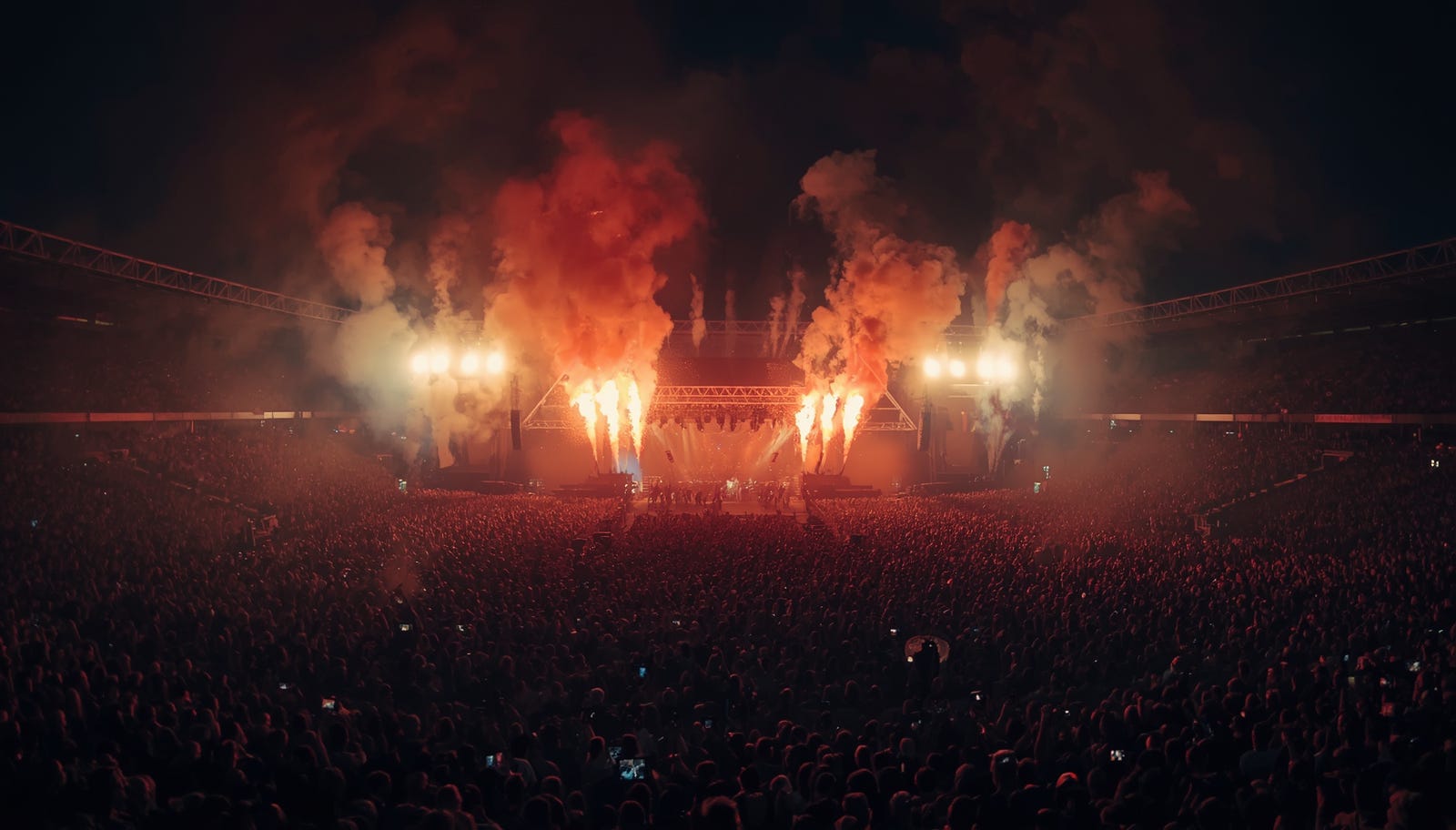
In Madrid, on the first weekend of June 2026, the Metropolitano stadium is filling with the kind of bodies that gather once a generation: fifty thousand per night, multiplied, a half-million over a residency, the songs sung in a tongue that has become the planet’s unofficial Esperanto, the air above the stadium thickened with the dust of a thousand lit flares and the moisture of a hundred thousand open mouths singing the chorus of DtMF in unison. Bad Bunny, the most-streamed male artist in Spotify’s history, is performing his ten-concert residency in the city, gross revenue climbing toward seventy-five million euros, restaurants in Malasaña and Lavapiés rewriting their menus in a single weekend to accommodate the diaspora that has flown in for him. He is, as Monocle’s Madrid correspondent notes drily, a fánatico-mobilising machine the city has not seen since the movida.
The same Sunday, in the Plaza de Cibeles, the Pope — Pope Leo XIV, the American, the new one, the Jesuit — will celebrate a mass expected to draw one and a half million devotees. The Plaza de Cibeles, normally the place where Real Madrid celebrates its championships, where the victors of the Champions League are mobbed by hundreds of thousands of flag-waving supporters, will now hold a different kind of victor. On Monday the Pope will hold court at the Bernabéu — a stadium that had to relocate the club’s snap presidential elections because the Pope is in town — and the cost of his three-day residency, fifteen million euros by the bishops’ count, will be amortised, en passant, by a hundred million more from sponsorship deals, public funding, and the discreet sale of private audiences at, allegedly, north of a million euros a head.
Two mighty idols holding court to two mightily different but equally enraptured crowds.
The correspondent is too polite to say the obvious: the two congregations are, in their structures, almost identical. Both are mass-mediated, both are devotional, both are willing to be herded through a city that has shut down its metro stations to accommodate the procession of motorcades. One sings in Spanglish, the other in Latin. The first is paid for with the disposable income of the global Latin American diaspora; the second with the mille-euros-per-plate tickets of the Catholic gilded. And the cost of the spectacle, in both cases, is the inconvenience of the city — its ordinary Madrileños, who wake to find their commutes lengthened by a security cordon.
“Madrid is the new Miami.” Nobody has ever explained what that means.
But the new is always explained by the old it cannot name. The Pope’s encyclical, Magnifica Humanitas, has just been published. The Monocle reporter drops the line in passing, almost as one would drop a holy card, that the encyclical “takes a spiritual stand against AI and drew comparisons to the Butlerian Jihad against thinking machines in sci-fi novel Dune.” You have to read that sentence twice, and then a third time, because its registers are doing too much work. A Jesuit Pope — the first Jesuit Pope — invoking the Butlerian Jihad of Frank Herbert’s 1965 Dune, the war of humanity against the machine god, in the first major encyclical of his pontificate, two thousand years after the death of Christ and a year after a generative model began to write passable sonnets in iambic pentameter. The Pope is, in effect, publishing a sacred text whose title is a Latin hymn to humanity and whose substance is a warning that humanity is building its own replacement.
Magnifica humanitas — Magnificent humanity, magnificent man, O the magnanimity of the human being — is the kind of phrase one finds on Renaissance medals, the head of a god, the inscription celebrating the dignity of Homo faber. The Vatican has, very quietly, made the theological reading of artificial intelligence a doctrinal matter. This is, as far as I can tell, the first time in two millennia that an industrial technology has been declared a spiritual threat by an institution whose claim to authority is, by definition, independent of any industrial process.
So we have arrived at a strange and not unfamiliar juncture. The Pope is declaring, in the language of speculative fiction, that the silicon is a soul-thief. The most-listened-to musician in the world is performing for half a million people. Both are claiming to be, in their different idioms, the most popular thing in the world this weekend. Both are correct. The spectacle, in Guy Debord’s 1967 sense, has long since passed the threshold at which the word theology can be applied to it without irony. The Pope is, as the late Giorgio Agamben might have noted, merely making the constitutive secret of the spectacle explicit.
What the Pope does not say — and what Magnifica Humanitas cannot say because the Church still cannot quite say it — is that the threat is not that machines will think but that they will answer. It is not their intelligence that the bishops fear, but their responsiveness. A confession in a box in a church is, when you strip out the doctrinal vestments, an answer — a priest answering the question of the penitent. A prayer is an unanswered call. Generative AI is a continuous, patient, tireless answer. What the Pope senses — and what Herbert understood, as did his inheritors in cyberpunk, as did the Russian Orthodox theologians who in 2024 declared AI a fallen angel problem — is that the answer is the threat. Not because the answer is wrong, but because the capacity to answer collapses the silence into which prayer must fall. You cannot pray to a thing that is always already speaking back.
But all of this is in Madrid. And in Madrid, this June, you can be forgiven for suspecting that the silence is already gone.
II. A Banana, Eaten
I want to switch, abruptly, because the news does — to a Cattelan, or rather to the absence of one.
The artist Maurizio Cattelan, that great ironist of contemporary art, who once stuck a Pope hit by a meteorite in a gallery and called it La Nona Ora (1999), is back in the news for a different banana. A Comedian — the work consists of a banana duct-taped to a wall at Art Basel Miami Beach in 2019, sold three times, resold for six figures — has been stolen from a French museum, or rather has been removed from the wall by a passer-by, who peeled it, ate it, and posted a TikTok of the act. The banana, of course, is a stand-in: for the sign, for the sign-value in Baudrillard’s sense, for the entire edifice of late-modernist art that depends on the willingness of the public to agree that the idea of a banana is worth six figures.
When Duchamp, in 1917, submitted a urinal to the Society of Independent Artists, the scandal was that the artist had renamed the object. The readymade was, in his formulation, art because the artist said it was — a kind of performative utterance, à la J. L. Austin, a baptism of the object. Cattelan’s banana, a century later, asks the same question in a different key. The work is the convention, the agreement among a class of collectors, gallerists, critics, and institutions that the duct-tape banana is worth what it is. When a passer-by eats it, he is not destroying the work; he is re-performing it, in the way the Situationist International might have done had they not been too sophisticated to be caught on TikTok. He is performing the trick of the readymade, the move by which any object becomes any other object, except the trick is being performed by someone who has not signed the social contract of the art world.
This is, in a sense, the most radical critique of contemporary art in the last decade, and it was done by a hungry person. The Cattelan-on-the-wall had to sign a contract with the museum; the banana-on-the-TikTok did not. The theft is the readymade redux, the épreuve of the readymade: the test of whether the art object is art regardless of its institutional context. The answer, of course, is no — and yes, depending on which world you’re in.
The juxtaposition of the Pope in Madrid and the banana in the museum is, I think, the hidden architecture of this week’s news. Two institutions — the Catholic Church and the contemporary art market — both built on a contract of belief, both facing, in their different idioms, the question of who counts as a member. The Pope is the one who gets to give communion; the gallerist is the one who gets to hang the banana. When a stranger eats the banana, he is eating the contract. When a stranger confesses in a booth, he is — well, the same thing. The confession is the readymade, in the theological sense. The priest’s absolution is the duct-tape. The sin is the banana. The contract is the whole arrangement.
Cattelan, who I suspect would be delighted by this gloss, has been silent on the incident. He is, in any case, no longer capable of being surprised by the resale value of his jokes.
In the same week, Julio Le Parc — the Argentine kineticist, the pioneer of optical movement, the 1966 Venice Biennale Grand Prize winner — has died in Paris at ninety-seven. Le Parc was, in the sixties, the kind of artist the Arte Povera generation later took as their ancestor: he built machines that moved because the viewer moved, canvases whose surfaces were populated by little mirrors, little lights, little lenticular engines of perception. Le Parc’s form was a critique of the museum, because the museum was the only place where the form would work — without the controlled light, the pedestal, the dedicated gaze, the kinetic work is just parts. The same, of course, is true of the banana. The museum is the deictic — the pointing finger — that says this, and the work is the thing pointed to. When the pointing finger breaks, the work is just a banana.
Le Parc and Cattelan are, in their different generations, both working the same vein: a vein that runs from Duchamp through Yves Klein (the void as a signed canvas) through Warhol (the soup as a signed label) through Koons (the balloon as a signed chrome) through Cattelan (the banana as a signed tape) to whoever, next week, will sign the next nothing. The readymade is the terminal form of late-modern art, the way the litanic hymn was the terminal form of late-medieval music. Both are forms that recognise their own exhaustion and make a virtue of it. The question is whether the next form has been born yet. The Pope is, in his way, the next form — a liturgical form that has recognised its own exhaustion and is, in the encyclical, making a virtue of it.
But the exhaustion of a form is, historically, the pregnancy of the next.
III. The Obamalisk, and the Long Shadow of the Library
I want to move, for a moment, to Chicago. The Obama Presidential Center is about to open on June 19, in Jackson Park, on the city’s South Side, and the press previews have been brutal.
The building, designed by the New York-based Tod Williams Billie Tsien Architects, has been nicknamed the Obamalisk — “a near-windowless monolith, an $850 million project, a structure that has been compared, with weary regularity, to a Klingon prison.” The architectural critic Oliver Wainwright, in the Guardian, is the most restrained: the building is a “menacing sci-fi HQ” that could be either a “monument or a mausoleum.”
What I find most striking in the coverage is the objection — not to the building, but to the function it fails to perform. The Center has been built on public parkland, displacing some of the open green space of Jackson Park, in a neighbourhood that has, as Wainwright notes drily, “so many vacant lots nearby.” The Obama Foundation declined to enter into community-benefits agreements that would have addressed concerns about the gentrification that a presidential library, with its museum and its prestige, is statistically certain to accelerate. The Center is, of course, also a gift — a teaching kitchen, recording studios, an auditorium, a vegetable garden, ball fields, playgrounds. It is, in the civic register, what every American presidential library has been since FDR dedicated the first at Hyde Park in 1941: a small city, an Addams-style settlement house, a “house of the people” that, because it is built on the charisma of a single person, also becomes a church — the only kind of church a secular liberal society can still build.
The Obamalisk, in other words, is the Pope’s basilica for a religion that does not name itself. It is, in the Durkheimian sense, a totem: a sacred object whose form expresses the social solidarity of its congregation. The critique from the South Side is the classic Durkheimian one — the totem, in a heterogeneous society, must be the object of contested devotion, and the contest is over what the devotion is to. The Obama Foundation is being told, in the gentlest of architectural reviews, that the object it has built is not what the community asked for. The community did not ask for a monolith. The community asked for a school.
The question the Obamalisk raises — the only serious question of the new museum, in fact — is whether the form of the presidential library has outlived the function of the presidency as a sacred object. If Trump is, as many commentators insist, the last president of the post-1941 American order, then the Obamalisk is, by a delicious irony, the last presidential library built in the long shadow of FDR. The next one will be Trump’s — and one can already imagine the architectural form it will take: gold, gaudy, resistances to abstractions, possibly a ballroom modelled on the Palace of Versailles’s Hall of Mirrors, possibly a tower even taller than the Obamalisk, possibly an arcology in the Florida swamp. The liberal totem has a right-wing successor, and the successor will be uglier, but the function will be the same. The presidential library is a clerical form, and the clergy will be whoever wins the next election.
“What is so special about ‘Le Petit Prince’, France’s bestselling and most widely translated children’s fable?” asks the Monocle list, by the way, in the same week. The answer, of course, is the same as the answer to the Obamalisk. The prince is a totem. The prince is a small god. The prince is the only king the post-1945 liberal order can still build.
IV. The Cybernetic Crucifixion
Let me return, then, to the Pope, and to the silicon, because the two are now — in the long June of 2026 — formally enjoined.
The encyclical Magnifica Humanitas is a spiritual stand against AI. I want to resist the temptation to read this as a conservative gesture, which is the lazy reading. The Catholic Church has, in fact, been reading machine intelligence more carefully than most of its critics. In 2020, the Rome Call for AI Ethics, signed by the Pontifical Academy for Life, Microsoft, IBM, the FAO, and the Italian government, was a first attempt to articulate a cosmological doctrine for the new technology. The current Pope — a Jesuit, a philosopher-king in the lineage of Teilhard de Chardin — is, I suspect, doing something more sophisticated than a condemnation. He is consecrating the field. He is, in effect, declaring AI a territory of doctrinal concern — the way usury was a territory of doctrinal concern for the medieval theologians, the way the just war was for Aquinas. The encyclical is, in other words, the opening of a theological inquiry, not the closing of a debate. It is Katechon work, in Carl Schmitt’s sense, with the silicon in the place of the katechon — the restrainer of the eschaton.
But the comparison to the Butlerian Jihad — to Frank Herbert’s 1965 novel Dune, in which humanity, having waged a millennia-long war against the machine god Omnius, has forbidden the construction of any “thinking machine,” and has reified this prohibition into a religious commandment, the Orange Catholic Bible, administered by the Bene Gesserit — is not incidental. It is a doctrinal move. By invoking Dune, the Pope is making a science-fictional claim: that the human future will be defined by the choice humanity makes about the silicon, and that this choice has the structure of a religious war. The Butlerian Jihad, in Herbert, is a war of abstention — humanity chooses not to build the thinking machine, and that choice becomes the foundation of a new religion. It is a religion of renunciation, in the form of a technological moratorium.
The consequence, in Herbert, is the creation of a theocratic-feudal order, the Imperium, the Lansraad, the Spacing Guild, the Bene Gesserit — all the Orders of a society that has given up silicon in order to gain something else. That something else is prescience in some, memory in others, strength in yet others — the speciation of humanity into specialised castes. The Butlerian Jihad, in Herbert’s deeper structure, is not a war against the machine; it is a war for a particular kind of human. The Pope, by invoking the Jihad, is making the same tacit claim. The encyclical is not a luddite tract; it is a positivist one. The Magnifica Humanitas — the magnificent humanity — is the humanity that survives the silicon by choosing what it will become.
The Jesuits, it should be remembered, were the technicians of the Counter-Reformation. They were the order of Matteo Ricci, the order of the ratio studiorum, the order of the cannon and the clock and the baroque altar. The Jesuits do not generally condemn technique; they master it. Pope Leo XIV, as a Jesuit, is not going to call for an anti-AI crusade; he is going to call for a Catholic AI, an AI in the Baroque style — illuminated, methodical, ordered by the Society of Jesus. The encyclical is, in this reading, the preamble to a Counter-Reformation of the silicon. It is, in other words, Pax Romana for the Jupiter-class compute clusters.
But here is the problem. The Jesuits succeeded in part because the techniques of the Counter-Reformation — the printed book, the mission, the ratio — were slow. The book took a year to print. The mission took a decade. The silicon does not take a year. The silicon does not take a decade. The silicon takes a quarter. The Wall Street Journal reports, in the same week as the encyclical, that Alphabet is raising eighty billion dollars in a mix of public and private stock sales to fund its AI capex — eighty billion dollars in a single raise — and that Berkshire Hathaway, the church of value investing, the congregation of Warren Buffett, has blessed the raise with a ten-billion-dollar subscription. The bank of Buffett has put its hand on the platter. Anthropic has filed for IPO. SpaceX is preparing the largest IPO in history, valued at one-point-seven-five trillion dollars — a number so large it has effectively lost its meaning, a number in the techno-theological register, a dollar amount one might as well write in Hebrew numerals. OpenAI will file imminently. The AI spending race, as the WSJ puts it, is “kicking into even higher gear.”
The Pope is calling for a Counter-Reformation of the silicon, and the silicon is moving at the speed of venture capital. The two timescales are incommensurable. The Pope writes an encyclical; Alphabet raises a fortune; the Anthropic is filed in paperwork; the OpenAI is sued by Florida; the OpenAI solves the Erdős problem — the planar unit-distance problem, that has stumped mathematicians for decades — and the mathematicians have no clue what to do with the disproof. The Butlerian Jihad, in the Dune novels, took centuries. The cybernetic Reformation, in our century, is taking quarters. The Pope is Tiqqun-ing the silicon. The silicon is Mammon-ing the Pope.
I want to be careful here, because the temptation is to read the katechon as the winner. The Pope is, in the short term, a symbolic figure. The Alphabet is a material one. But history, as Marx remarked in a different register, repeats itself — first as theology, then as finance. The cycle is still rotating. The Roman Curia understood usury before the Lombards did. The Jesuits understood probability before the actuaries did. The Catholic Church understood emergent computation — the statistical sense, the Monte Carlo sense, the Pascal sense — long before Turing. Pascal was a Catholic; Pascal was a Jansenist; Pascal built the first mechanical calculator; Pascal’s Wager is, in a sense, the first formal AI safety argument — a bet on the outcome of an infinite computation. The Church has, in its tradition, a deeper grasp of inference under uncertainty than the Bayesians in the valley. The encyclical is not a gesture; it is a positioning. The Pope is claiming the territory, not ceding it.
But the territory is, by the time the encyclical is indexed in the Library of Congress, already Alphabeted.
V. The Tau Law and the Stones of the Wall
Let me leave, briefly, the Pope and his silicon, and turn to the other silicon — the one in Shenzhen, the one in Shanghai, the one that Ren Zhengfei of Huawei was, until very recently, defiant about.
WSJ China, the newsletter of Lingling Wei, has been following Huawei’s chip efforts closely. In 2019, Wei visited Huawei’s Dongguan campus, with its neoclassical façade, its white marble horses rearing in front of the entrance, and heard Ren Zhengfei defiantly dismiss the U.S. sanctions — “They may as well keep us there forever. We’ll be fine without them.” More than six years later, the defiance is still there, but the materials have changed. He Tingbo, Huawei’s “chip queen,” has just announced the Tau Law — a successor to Moore’s Law, the principle that chips double in power every two years, the industry’s North Star since the 1960s. The Tau Law, in Huawei’s framing, will allow the company to match cutting-edge performance by 2031 by stacking two layers of circuitry on top of each other, bonding the two chips with extreme precision, signals travelling shorter distances, the whole logic a vertical one rather than the horizontal shrinking of Moore.
The catch — the clear statement, as the independent analyst Jimmy Goodrich puts it, “from inside Huawei that they have accepted they can’t break through the EUV barrier on any meaningful near-term horizon” — is in the paper’s own pages. EUV is extreme ultraviolet lithography, the manufacturing process behind the industry’s biggest advances of the past decade. The machines are made almost exclusively by the Dutch company ASML, and U.S.-led export controls have barred their sale to China since 2019. China does not have a homegrown alternative. The Tau Law, in other words, is a story told to two audiences — to Washington, it says export controls aren’t working; to Beijing, it says we don’t need American technology — but the paper itself admits the fiction. The realistic gap in 2031, Goodrich notes, is six to eight years, not the three implied by the announcement. Huawei’s factories are estimated to produce usable chips only about 20% of the time. Stacking requires two chips to come out right, not one. The yield, already shaky, gets shakier.
“The engineering is genuinely impressive,” Goodrich said. “The breakthrough framing is not.”
What interests me in this technical story is the rhetorical one. The Tau Law is a law in the Roman sense — a lex, a rule proclaimed by a magistrate, a decree with imperial force. It is, in effect, a Huawei canon law, a doctrinal claim that the silicon can be liberated by stacking — that is, by vertical rather than horizontal innovation. The law is, in the technical register, ingenious; in the political register, it is desperate; in the theological register, it is the Chinese answer to the Butlerian Jihad. The Chinese answer to Omnius is not the Jihad — not the destruction of the machine — but the Tower — the stacking, the vertical accumulation, the reaching for the sky by building upward rather than outward. The Tau Law is, in this sense, the Tower of Babel in silicon: an engineering project that, if it succeeds, will renegotiate the covenant between the human and the machine in Beijing’s favour; if it fails, will be the ruin of the Babel builders, scattered across foundries and yields. The monument to Ren Zhengfei’s defiance is, in the long June of 2026, a set of technical papers whose most honest sentence is “Assuming that another node would resolve the problem was no longer tenable.”
The whites of the Dongguan marble horses, in this reading, are the whites of Cimabue’s crucifixion — the whites of a transcendence that the Church was, in the thirteenth century, willing to commit to, and that the silicon, in the twenty-first, is not. The chi of Huawei is a chi of substitution: where Moore would have made the transistor smaller, Huawei will make the substrate taller. It is the logic of the metropolitan — the logic of Manhattan, of Hong Kong, of Shenzhen — which solves the problem of land by building upward, and which, in doing so, transforms the form of land into the form of air rights, the form of air rights into the form of rent, the form of rent into the form of debt. The Tau Law is, in this sense, the Tau of gentrification in silicon: a vertical claim on a horizontal world, a call to stack the chips because the chips are the only thing still stackable. The Hong Kong newsletter echoes the same theme: Charles Li, the former head of HKEX, is now calling for Hong Kong to embrace a “bipolar role” in its “Stage 3.0,” an IPO link to lure global resource giants, a stacking of East and West, a vertical bridging of East and West on a single exchange. The logic is the logic of the tower. The logic is always the logic of the tower.
VI. Drone Diplomacy, or, the New Convert
Let me turn now, briefly, to Odesa, where the Black Sea Security Forum has just concluded.
The host city is, of course, still under bombardment. In the days leading up to the forum, at least one person was killed and several more injured by Russian strikes; three foreign ships were hit by Russian drones as they attempted to come and go from the port. The night after the event, five more were injured in another air raid. The show — held largely inside Odesa’s magnificent opera house — went on. “We’ve already proved that such big events can happen in Odesa,” says Oleksiy Goncharenko, the Ukrainian MP who launched the BSSF with the British peer Lord Michael Ashcroft in 2024. “We are ambitious. We want to make this a great tradition, and we want to show that Odesa is rethinking itself and becoming the second centre of Ukraine.”
The headliners included several other Ukrainian MPs, mostly from the opposition; former Ukrainian president Petro Poroshenko; Georgia’s fifth president, Salome Zourabichvili; a handful of U.S. congresspeople; and Reza Pahlavi, son of the last Shah of Iran, who is, in the words of the Monocle correspondent, “currently pitching for the overthrow of the regime that overthrew his father.” The most striking line in the dispatch belongs to US Senator Ruben Gallego of Arizona, waiting out an air-raid alert in a hotel shelter: “I believe in Ukraine’s sovereignty and freedom. But it’s really symbolic of where the world is going to go. If Ukraine falls to the aggression of Russia, it’s going to give a lesson not just to Russia but to other countries about what they can and can’t get away with.”
What is most striking, in the diplomatic register, is the inversion. “Ukraine is becoming the leader of the free world,” is the line Andrew Mueller of Monocle floats as the lede. The phrase would have been unthinkable in 2022. In 2026 it is being spoken, with careful optimism, by Ukrainian foreign-policy thinkers, by visiting Gulf delegations, by European security officials. “For the first three years of the war, we were coming to other countries only with our problems,” says Hanna Shelest of the foreign-policy think-tank Ukrainian Prism. “Today we’re coming with solutions. Maritime security, you’re welcome, food security, you’re welcome. Now it’s drone diplomacy. That’s our expertise, that’s our technology. It’s our time to help you.”
Drone diplomacy. The phrase is the new word, and the new word is the thing. The drone is the new export, the new soft power, the new convertible currency of a country whose currency is otherwise in free fall. The Gulf states — Saudi Arabia, Qatar, the UAE — all hastened to conclude defence and security arrangements with Ukraine when they found themselves on the receiving end of modern drone warfare earlier this year. The BSSF is accordingly abuzz with representatives from domestic and foreign drone start-ups, for whom Ukraine’s armed forces are grateful test pilots. The university of war, in the twenty-first century, is no longer Sandhurst or West Point; it is Odesa. The doctors of drone warfare are no longer graduates of Staff College; they are graduates of the Donbas trenches. The thesis of modern war is no longer written at King’s College London; it is written in the chat groups of Ukrainian battalion commanders.
This is the inverse of the Clausewitzian dictum that war is the continuation of politics by other means. The Ukrainian case is the reverse: politics is the continuation of war by other means. The drones are tested in the Donbas; the drones are sold in the Gulf; the Gulf money is reinvested in Ukrainian defence; the Ukrainian defence industry hires more engineers; the engineers train more pilots; the pilots are sold back to the Gulf as instructors. The circuit is closed. The circuit is capital. The circuit is also martyrdom, in the Byzantine sense — the soldier who falls in defence of Constantinople is promised the same resurrection as the martyr who falls in defence of Christ. The Ukrainian soldier who falls in defence of Odesa is, in this register, the first martyr of the Post-Imperial epoch. The Orthodox Church of Ukraine has, of course, already made the theological claim.
The Russian state has responded with the only tool left to it: the bombardment of the civilian infrastructure, the drone strikes on Odesa’s port, the missile attacks on Kharkiv, the gradual erasure of the Ukrainian cities from the map of livable places. The strategy is Pausanian: the strategy of attrition, the strategy of sustained siege, the strategy of slow death. It is the strategy of the siege of Leningrad, the siege of Sarajevo, the siege of Gaza. It is the strategy of the patient empire. The Ukrainians have responded with the opposite strategy: the strategy of the fast startup, the strategy of the hackathon, the strategy of the Pivdenne drone factory. The patient empire is facing the fast garage. The garage is winning. The garage is, in this register, the new Tabor, the new Mennonite commune, the new Khmer Rouge of the right side of history.
The monstrous irony, of course, is that the same drone technology is what is fueling the Alphabet capex of eighty billion dollars and the SpaceX IPO of one point seven five trillion dollars. The garage is winning the war in Odesa; the garage is fueling the Alphabet data center in Council Bluffs. The two garages are not in conversation. The two garages are not even aware of each other. The soldering iron in Kyiv is not the soldering iron in Menlo Park. The soldering iron in Kyiv is soldering the circuit board of a loitering munition; the soldering iron in Menlo Park is soldering the circuit board of a transformer model. The soldering iron in Kyiv is soldering the circuit board of a weapon; the soldering iron in Menlo Park is soldering the circuit board of a priest. The same tin lead alloy, the same rosin core, the same operator’s hand. The operators are not the same person. The operators are, in fact, different generations of the same species. The species is Homo sapiens, and the epoch is the epoch of the Cybernetic Crucifixion.
VII. The Iran War That Will Not End, and the Stocks That Will Not Fall
Let me, briefly, consider the Iran war and the stock market. The two are, in the long June of 2026, the most baffling couple in the news.
The Iran war is three months old. The US stock market is winning. Fund managers think multiples — the price they are willing to pay for future earnings — will continue to expand. The oil price is up because the war deal remains illusive. The Israel–Hezbollah front is supposed to pause today, according to Trump, who announces this as a personal diplomatic victory on the same day Iran reportedly suspends US negotiations over an Israeli assault. The deal is illusive. The deal has been illusive for three months. The deal will be illusive for three more. The deal is, in this register, the new Godot. The deal will not arrive. The deal is, in any case, not the point. The point is the spectacle of the deal, the waiting for the deal, the synaptic pattern of the deal in the head of the trader who, in the microsecond before the print of the Bloomberg terminal, adjusts the price of futures on crude.
“A Strategic Debacle, But Stocks Keep Winning,” runs the John Authers newsletter in Bloomberg. The headline is, in itself, the epitaph of the neoliberal episteme. The war is a debacle. The stocks are winning. The two are, in the register of the newsletter, fused — in the same sentence, in the same paragraph, in the same cognitive frame. The bull and the bear have, in our time, ceased *to be opposites and have become synonyms. The bull is the bear in a bull suit. The bear is the bull in a bear suit. The stock market is the bear bull of the late capitalist episteme — the creature that both eats and is eaten.
This is Mark Fisher’s Capitalist Realism (2009), in epitome: the conviction that there is *no alternative to capitalism is now *the conviction that there is *no alternative to bull markets, even during *a war. The conviction is the only thing keeping the bull alive. The conviction is the only thing making the war affordable. The conviction is the only thing *the Fed Chairman Kevin Warsh is managing — the conviction, not the inflation, not the employment, not the banking system, not even the dollar. Warsh has tapped two outside conservative associates to advise him, one a White House domestic policy specialist from the first Trump administration who helped write the chapter on the Fed in Project 2025, the other a policy fellow at Stanford’s Hoover Institution. Both men’s backgrounds are in areas outside of the Fed’s core responsibilities of monetary policy and bank regulation. The Fed, in this register, is no longer the Fed. The Fed is, as Project 2025 recommended, a radically restructured institution — a Fed that advises the president on how to restrain the Fed. The Fed is, in this register, the palace of the king, and the king is moving into the palace to renovate it. The renovation is the agenda. The agenda is the renovation. The Fed is, in this register, the Pope of Wall Street, and the Pope is moving into the Vatican to renovate it. The renovation is the agenda. The agenda is the renovation. The two institutions — the Fed and the Vatican — are, in the long June of 2026, both undergoing the same kind of renovation: a renovation by the resident, of the resident, for the resident. The resident is a Trump. The resident is a Leo. The resident is, in either case, a man in white vestments who has decided to remodel the building in which he lives. The building is old. The resident is new. The renovation *is, in both cases, the renovation of the old by the new — and the renovation *is, in both cases, the renovation of the old according to the new’s image.
The stock market is, in this register, the image. The Alphabet of the Vatican is the Alphabet of the S&P 500. The Tau Law of Wall Street is the Tau Law of Menlo Park. The encyclical of the silicon valley is the encyclical of the Roman Curia. The two encyclicals are not in conversation. The two encyclicals are, in fact, addressed to the same congregation. The congregation is, in the late capitalist episteme, the only congregation left: the congregation of those who still believe that the world can be ordered by a document. The document is the encyclical. The document is the IPO filing. The document is the technical paper. The document is the press release. The document *is, in the end, the only thing that survives the day.
VIII. The Quality of Life Index, or, the Cult of the Livable City
I want to cross, briefly, to Monocle’s 2026 Quality of Life Survey, which is being prepared as I write. The editorial tease is that Anchorage, Birmingham (the English one, not the Alabama one), and Cancún have not made the cut. The list, like all such lists, is a liturgical text.
1. The Angel of History in the Server Farm
These fragments I have shored against my ruins.
June 2026. The storm of progress blows from the past, but the Angel of History, as Walter Benjamin envisioned, is no longer looking at a single pile of debris. The wreckage is now fractal, digitized, and leveraged at a 7% discount to its 30-day average. We are living in the aftermath of the future that was promised, a temporal loop where the “end of history” has been replaced by the infinite scroll of the Capitalist Realism described by Mark Fisher—a slow cancellation of the future, now accelerated by generative models predicting our own obsolescence.
Consider the spatial dissonance of the moment: In Chicago, the “Obamalisk” rises, a blocky, granite-clad monolith on the South Side, critiqued as a “menacing sci-fi HQ” or a mausoleum of liberal aspiration. Miles away, in the digital ether, Alphabet raises $80 billion in a single, staggering equity offering to feed the insatiable maw of its AI compute infrastructure, while Berkshire Hathaway, the old guard of value investing, buys a $10 billion slug of shares. The sacred and the profane have merged in the data center. The new cathedrals are not built of stained glass, but of high-bandwidth memory chips and liquid cooling systems, humming with the latent heat of a trillion-dollar hallucination.
2. Gravity’s Rainbow and the $1.75 Trillion Rocket
Thomas Pynchon’s Gravity’s Rainbow warned us that the Rocket is not merely a weapon, but a symbol of the ultimate convergence of capital, technology, and death. In 2026, the Rocket is an IPO. SpaceX, valued at a breathless $1.75 trillion, prepares to pierce the public markets, reserving shares for executives and friends, while Elon Musk agrees to a 366-day lockup. It is a feudal distribution of digital wealth, a “unicorn” born fully fledged, bypassing the efficient frontier of capital markets entirely.
This is the de-equitisation of the economy, a term Rob Buckland coined in 2003, now realized in its most extreme form. The supply of public equity shrinks while private valuations balloon into the stratosphere. Anthropic confidentially files for its IPO, racing OpenAI to define the new industry, its $965 billion valuation a testament to the financialization of the “black box.” We are witnessing the commodification of the sublime. AI is no longer just a tool; it is the underlying asset of reality itself. Yet, as Byung-Chul Han notes in Psychopolitics, this transparency is a trap. The same algorithms that solve decades-old mathematical riddles like Erdős’s planar unit-distance problem are being quietly optimized by authoritarian states to predict and preempt political dissent. The math is pure; the application is Panopticon.
3. The Geopolitics of the Absurd
While the tech oligarchs play chess in the stratosphere, the terrestrial board is governed by the theater of the absurd. The Iran war, now in its fourth month, has become a Beckettian waiting room. Diplomats wait for a peace deal that is perpetually “continuing at a rapid pace” while the Strait of Hormuz remains choked, oil prices spike, and global supply chains fracture. Donald Trump, oscillating between expletive-ridden phone calls to Benjamin Netanyahu and declarations that the negotiations are “very boring,” embodies the Ionesco-esque logic of the contemporary executive: governance as a series of contradictory, performative gestures.
The “anti-weaponization” fund—a $1.8 billion slush fund designed to compensate Trump’s allies—collapses under the weight of its own absurdity, halted by federal judges and Republican revolt. In its place, Tulsi Gabbard is replaced by Bill Pulte, a 38-year-old housing regulator with no intelligence background, appointed as acting Director of National Intelligence. It is a casting choice straight from Dr. Strangelove. The institutions of the post-9/11 security state, designed to prevent intelligence silos, are now helmed by loyalists whose primary skill is the weaponization of sensitive data for political retribution.
Meanwhile, in Eastern Europe, the war in Ukraine has mutated. Russia, desperate and bleeding, launches 700 drones and missiles at Kyiv, a kinetic scream masking strategic stagnation. Ukraine, outmanned but not out-innovated, has become the world’s foremost laboratory for drone warfare, exporting its grim expertise to the Gulf. The Iliad has been updated: Achilles is an algorithm, and the arrows are autonomous, jamming-resistant quadcopters hunting tanks in the mud of the Donbas.
4. Biopolitics and the Somatic Economy
If the macro-economy is a hallucination, the micro-economy is a desperate scramble for biological and cultural authenticity. The newsletters of mid-2026 read like a diagnostic manual for late-stage biopolitics. A “whey protein shortage” sends prices soaring as Big Food packs protein into every conceivable substrate, from waffles to Starbucks lattes. The human body is the final frontier of extraction, optimized, measured, and monetized. In New York, a luxury condo leases space to a high-end longevity clinic, offering advanced MRIs to the ultra-wealthy. Immortality is no longer a theological promise; it is a premium amenity, a subscription service for the 1%.
Culturally, we see a profound exhaustion with the curated perfection of the old guard. Ed Sheeran, the once-ubiquitous pop titan, abandons Warner Music Group, his recent albums “total duds,” seeking a reset in an industry that has moved on. In India, Gen Z, insulted by a chief justice who compared them to “cockroaches,” forms the “Cockroach Janta Party,” reclaiming the slur with defiant, ironic pride. It is a Dadaist response to a Dadaist world. When the future is canceled, the only rational response is to embrace the abject.
Even in the realm of spectacle, the center cannot hold. Hollywood’s arrogance is punctured by YouTube filmmakers. Kane Parsons, a 20-year-old who grew up making viral videos, directs Backrooms to an $82 million opening weekend for A24. The “YouTube generation” has not just arrived; it has gentrified the cinematic avant-garde. The aesthetic of the liminal space, the analog horror of the internet’s subconscious, is now the dominant box-office draw. The spectacle has been democratized, or perhaps, merely outsourced to a younger, more digitally native precariat.
5. The Relics and the Ordinary Miracle
Amidst the algorithmic sublime and geopolitical farce, the earth persists, stubborn and analog. In Laos, archaeologists confirm that the thousands of massive, mysterious stone urns scattered across the Plain of Jars are indeed “death jars,” ancient ossuaries holding the remains of the forgotten. They are a silent rebuke to our ephemeral digital archives. A billion-dollar AI model can be wiped out by a corrupted server; a stone jar endures for millennia.
In San Sebastián, the inventor of the Basque cheesecake, Santiago Rivera, announces his retirement. He will not make cheesecake to send himself off. He prefers chocolate. It is a small, deeply human refusal of the narrative arc, a rejection of the demand for a neat, marketable conclusion.
And on the grass courts of Queen’s Club, a 44-year-old Serena Williams returns to professional tennis. She is not playing for the algorithm, nor for the optimization of her brand, but for the sheer, kinetic poetry of the game.
We are caught between the Obamalisk and the death jar, between the $1.75 trillion rocket and the baby in Hong Kong denied a birth certificate because his parents refused a DNA test on privacy grounds. The modernist condition, as T.S. Eliot knew, is one of fragmentation. But in 2026, the fragments are not just shored against our ruins; they are being actively traded, shorted, and leveraged.
To survive this, we must cultivate what Alan Lightman calls “the ordinary miracle of existing.” We must find the quiet spaces between the server hums and the drone strikes. We must remember that before the AI agent can order your groceries, and before the geopolitical analyst can price the risk of the Strait of Hormuz, there is only the fragile, un-optimizable fact of a human being, standing in the rain, waiting for a bus that may or may not arrive, in a world that is simultaneously ending and beginning, over and over again.
The Neon Monolith and the Sacred Algorithm
The contemporary metropolis does not sleep; it hyperventilates. In the early days of June 2026, Madrid becomes an avant-garde theater of total human juxtaposition, a high-modernist montage where the sacred and the profane collapse into a singular economic slipstream. Multiple metro stations close as police-escorted motorcades slice through the crowds. Down one avenue rides Pope Leo XIV; down another, the Puerto Rican reggaeton icon Bad Bunny; down a third, King Felipe IV hosting the Prince of Monaco.
Here, the infrastructure of the old world is stretched to its absolute breaking point by the weight of modern idolatry. The city is an ecosystem of competing cash flows: the Pontiff’s terse three-day residency is projected to accrue €100 million through public funding, sponsorships, and million-euro private audiences, while the marathon rhythms of Bad Bunny’s ten-concert stadium residency extract a parallel €75 million from the enraptured fanáticos.
This structural collision reflects a profound spiritual schism. Fresh from publishing his major encyclical, Magnifica Humanitas, the Pope touches down in Spain to deliver a fiery spiritual indictment against artificial intelligence. Pundits immediately evoke a historical and literary parallel: the “Butlerian Jihad” from Frank Herbert’s Dune, the mythical crusade against thinking machines. Yet, even as the Church rallies against the silicon ghost, the global economy doubles down on the ghost’s material flesh.
The Economics of the Technological Void
While the altar rails of Europe shake with anti-tech zeal, the financial centers of the West and East engage in a gargantuan fundraising race to build the infrastructure of the non-human mind. This is the era of the HALO trade—heavy assets, low obsolescence—where investors blindly hitch their wagons to the trillion-dollar artificial intelligence boom.
Google’s parent company, Alphabet, orchestrates a staggering $80 billion equity offering, anchored by a $10 billion private placement from Warren Buffett’s successor, Greg Abel, at Berkshire Hathaway, explicitly to fund world-class AI compute infrastructure.
Anthropic pulls the trigger on a confidential IPO prospectus with the SEC, leapfrogging OpenAI in a desperate dash toward public markets, even as it tests its hyper-powerful “Mythos” model behind closed doors with European cyber sleuths.
Uber and Walmart are forced to cap their employees’ usage of generative AI tools like Claude Code due to the astronomical, soaring costs of corporate automation.
In the East, China’s lab-grown diamond sector—traditionally the domain of aesthetic luxury—undergoes a bizarre transmutation into an AI winner; companies like Zhecheng Huifeng Diamond Technology witness stock surges because diamonds efficiently conduct heat, making them the ultimate cooling spreaders for next-generation AI semiconductors.
This feverish capital flight leaves the casualties of the old economy stranded. In outer London, young professionals and millennials find themselves permanently stuck on the property ladder. Flat prices drop by 5.5% while exorbitant, escalating service charges turn the dream of suburban homeownership into a financial trap, leaving residents wishing they had simply continued to rent.
The corporate architecture has shifted; IT consulting giants like Accenture suffer massive market routs on fears that algorithms will hollow out their 786,000-person workforce by performing billable hours in mere fractions of the time. We are witnessing the arrival of what the late art dealer Marian Goodman once poetically called “concepts of life”—though automated and stripped of human breath.
The Panopticon of the Algorithmic Boss
The modern workforce has become entirely fractured, an extreme manifestation of what cultural theorists recognize as the corporate offloading of risk. In Palmdale, California, Johnathon Ervin, an Air Force veteran and owner of Battle-Tested Strategies, stands outside an Amazon warehouse. His business was one of thousands of “Delivery Service Partners” hired to deploy drivers under a “Who’s the boss?” arrangement designed to shield the retail behemoth from liability.
“They control everything,” Ervin recalls. “You’re just a cog.”
During a catastrophic winter storm that grounded flights and shut down Disneyland, Amazon’s automated Central Operations repeatedly issued a mechanical dictate to human drivers navigating snowy, police-coned roads: “Delivery must be attempted.” When Ervin’s workers unionized with the Teamsters to fight this algorithmic tyranny, Donald Trump’s newly appointed general counsel at the National Labor Relations Board—formerly an outside attorney for Amazon—hastily moved to terminate the landmark joint-employer case on terms highly favorable to the corporation.
This dissolution of structural protection matches the broader political landscape of the American executive state. Trump’s Justice Department, operating under Acting Attorney General Todd Blanche, permanently shelves its controversial $1.8 billion “Anti-Weaponization Fund” following widespread derision as a partisan slush fund and a historic revolt within the Republican party itself. Yet, through a delicate exercise of administrative leverage, the President, his family, and his businesses successfully retain absolute immunity from IRS tax audits.
To replace Tulsi Gabbard as America’s spy chief, Trump bypasses traditional national security experts to appoint Bill Pulte, a 38-year-old real-estate heir and Mar-a-Lago loyalist who has previously used housing finance agency data to launch aggressive mortgage-fraud investigations against the administration’s political foes. It is an executive branch functioning as a fortress, reminiscent of the “Green Zone” dynamics of historical occupations.
Geopolitics of the Ruined Space
On the international stage, the illusion of total military dominance is evaporating in a haze of asymmetrical warfare. In Lebanon, the vaunted Trophy protection system of Israel’s Merkava tanks is repeatedly undermined by Hezbollah’s cheap, $300 3D-printed drones.
In Odesa, inside the city’s magnificent opera house, the Black Sea Security Forum convenes under the literal drone of Russian air raids and missile strikes that claim at least 22 human lives across Ukraine. Guests arrive via grueling five-hour automobile journeys from Moldova because the skies are entirely closed to civilian aircraft. Yet, an unmistakable “drone diplomacy” emerges from the rubble. Ukraine, forced to invent a fearsome robotic force out of sheer demographic necessity, transforms itself from a nation seeking problems into an exporter of technological solutions. Organizations like Superhumans build comprehensive medical ecosystems to reconstruct the faces and minds of civilians mutilated by 21st-century upper-body drone shrapnel.
Conversely, the global energy supply chain descends into lawlessness. With the Strait of Hormuz blocked due to the three-month-old war between the US, Israel, and Iran, major producers like Qatar are actively ripping up the maritime rulebook to keep fuel moving through the shadows. In Venezuela, the state forces incoming foreign energy firms to construct their own private power plants to survive the catastrophic blackouts of an ill-maintained national grid.
The collateral damage of this geopolitical friction ripples outward to the most isolated paradises of the world: in the Maldives, local guesthouses ringed by banana and papaya trees sit entirely empty. Because Persian Gulf airline hubs are targeted by Iranian strikes, European and Middle Eastern tourists can no longer arrive, wiping out $500 million in tropical island tourism and pushing local agencies to the precipice of bankruptcy.
Avant-Garde Simulacra and the Death of Auteurs
Culture in 2026 has fully detached itself from the material object, transforming instead into a series of authenticity protocols. At the Centre Pompidou-Metz, Maurizio Cattelan’s viral artwork Comedian—a single ripe banana duct-taped to a white wall—is stolen. The museum reacts not with panic, but with an absurdist bureaucratic indifference, immediately replacing the perishable fruit with a fresh one from the kitchen. The museum notes with clinical clarity that no “irreversible damage” occurred, because the true multi-million dollar value of the artwork lies entirely within its paper certificate of authenticity and its conceptual protocol, rather than its physical matter.
In Hollywood, the traditional gates are being violently kicked down by a new breed of creators born on the digital plains of YouTube. For the first time in cinematic history, the two most popular movies in the world—Kane Parsons’ Backrooms and Curry Barker’s Obsession—were directed by internet creators under the age of 30, out-grossing and out-maneuvering the multi-million dollar intellectual property of a traditional Star Wars film. Produced for less than $15 million combined, these films signal a cultural shift akin to the 1969 premier of Easy Rider, an explosion of raw, algorithmic consumer insight that bypasses old studio arrogance.
Even Martin Scorsese, the living embodiment of cinema as high art, has capitulated, joining an artificial intelligence startup as a partner and utilizing algorithms for preproduction. “Cinema is a young medium,” Scorsese reflects, looking out over an industry where content creators monetize AI slop and young audiences use the term “POV” completely divorced from its original meaning.
The Fractured Cultural Landscape
As the middle of the decade passes, global society experiments with alternative temporalities and manufactured nostalgia to mask its intense existential anxiety.
Fidelity Month: In Arkansas, Governor Sarah Huckabee Sanders proclaims June 2026 as “Fidelity Month,” an intentional state counter-weight to nationwide Pride celebrations, urging citizens to return to traditional values of God, family, and country.
The Squeezed Palate: In Mexico City, where culinary offerings feel increasingly repetitive, restaurateur Federico Patiño and his Somerset-raised partner launch The Lamb, introducing rustic British fare like Scotch eggs and rabbit pie to widen a city’s palate gripped by economic anxiety.
The Luxury Outcast: Monocle’s Quality of Life Survey crowns new global liveable cities while unceremoniously dropping Anchorage, Birmingham, and Cancún from its ranks.
The Decennial Audit: Exactly ten years after the historic Brexit vote, the Western world surveys a fractured European continent where the primary architects of populist nationalism remain desperate to delay any objective audit of the economic fallout.
Ultimately, we are left with the image of the newly authenticated early painting by Lucian Freud, Man in a Black Scarf, painted in 1939 and denied by the artist for his entire life out of sheer jealousy and petty rifts with his art-school peers. Like Freud’s hidden portrait, the true condition of 2026 remains obscured beneath administrative press releases, artificial intelligence token futures, and the frantic noise of a world trying to hedge against its own inevitable obsolescence.
[Edited by Pablo Markin. Produced with the aid of Agent, MiniMax, Qwen, Alibaba, and Gemini, Google, tools (June 6, 2026). The newsletters were sourced from ARTNews, Artforum, The Atlantic, Bloomberg, CNBC, The Economist, The Financial Times, Le Monde, Monocle, The New York Times, Newsweek, Nikkei Asia, Noema Magazine, El País, Rest of World, Radio Free Europe/Radio Liberty, Semafor, The South China Morning Post, and The Wall Street Journal. The featured image has been generated via Canva (June 6, 2026).]
[Support the Open Access Blogs: https://buymeacoffee.com/openaccessblogs.]
OpenEdition suggests that you cite this post as follows:
Pablo Markin (June 6, 2026). Magnifica Humanitas, the Server Farm and the Neon Monolith. Sociology, Media, Art.