
Scarcity, Surplus, and Somatic Crisis: Mapping the Iran War, the $65B AI Sovereign Cycle, and the Social Valuation of Care
From the Open Economics Blog.

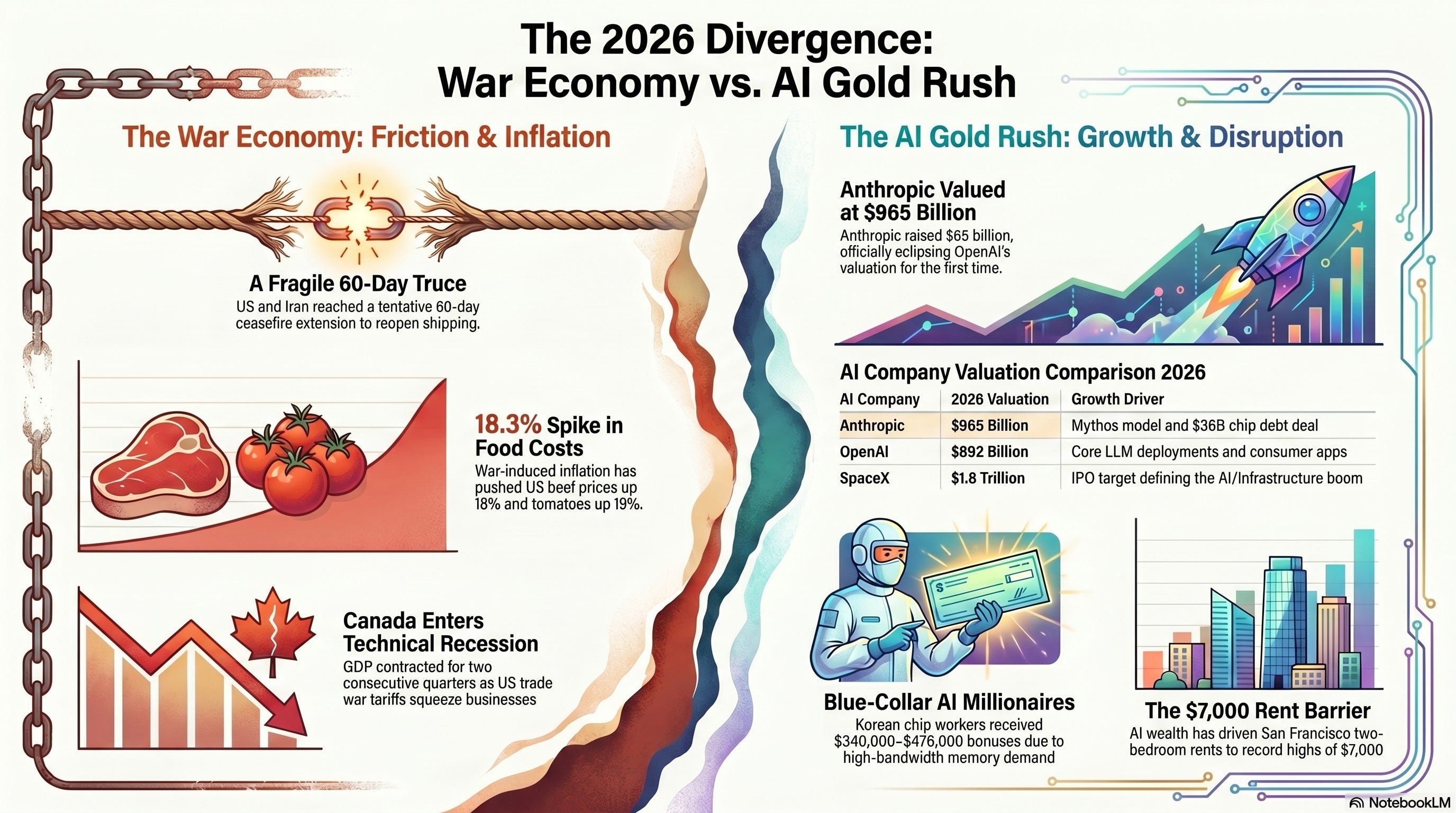
Editor’s Note
The primary data set presented unusual challenges. The attachment was a 1.7-megabyte digest file, roughly 860,000 characters across 543 paragraphs, comprising at least sixty distinct newsletter issues from seventeen major English- and Spanish-language outlets, dated 28–31 May 2026. The signal-to-noise ratio was, in places, punishing: image markup, navigation breadcrumbs, “subscribe” boilerplate, and substack-internal links were interspersed with substantive prose; a single New York Times Evening newsletter issue, for example, runs 5,000+ words but contains only a handful of analytically dense paragraphs; a Monocle “review of Sabòr” is mixed into the same file as a Pentagon–Anthropic wire dispatch. The first editorial task was therefore genuinely archaeological — to read across roughly 200,000 words of cleaned text, identify the leitmotifs (war in Iran, the AI capital cycle, the chip war, the Trump second-term consolidation, the Pope’s encyclical, the Boschian spectacle of celebrity culture, the long crisis of demography and care), and then to read those motifs against one another. A second challenge was the date. The newsletters are dated 28–31 May 2026; I have written this commentary in early June 2026 and have resisted the temptation to “predict” what happens next — that is not the function of a digest commentary. Instead, I have tried to do something more modest and, I hope, more useful: to read these fragments in the company of the books and articles that help make sense of them, and to let the news of one week converse with the long sentences of political economy, sociology, philosophy, and cultural theory. The added value of this commentary, then, is twofold. First, it provides a single synthetic horizon across an otherwise unreadable volume of fragmentation — a horizon the reader could otherwise only assemble by themselves across a long weekend. Second, it refuses the newsroom tic of treating each headline as a sovereign event. The same Anthropic–OpenAI valuation flip is simultaneously an event in the history of artificial intelligence, in the history of monopoly capital, in the history of American politics, in the history of religion, and in the history of contemporary selfhood. The commentary attempts to hold all of those frames in the same hand.
A note on the bibliographic apparatus. Citations follow the seventh edition of the Publication Manual of the American Psychological Association (APA, 2020). Where a work is widely known under a translated title (e.g., Polanyi’s The Great Transformation), I have used the standard English title and translator. The reference list is grouped thematically at the end so that the reader can find further reading under each of the commentary’s five main rubrics. I have leaned on canonical works of political economy, sociology, philosophy, and history — the books that, in the idiom of Pierre Bourdieu, “everyone in the field has read” — and have supplemented them with the more recent academic literature on the specific 2026 conjuncture.
Part I: The Geopolitical Economy of Disorder — Oil, AI Capital, and the Long Crisis of the World Market
The Iran war and the return of scarcity
The most coherent narrative thread across the digest is the US–Iran war’s slow, ugly inch toward a sixty-day truce (Axios, as reported by Bloomberg, 2026a; The Economist, 2026a). What the bulletins describe is not a war in the Clausewitzian sense, with decisive battles and clear strategic objectives, but something older and stranger: a “hot war” conducted through proxy militias in Lebanon, intermittent drone exchanges over Bandar Abbas, an effective closure of the Strait of Hormuz, and a daily betting market on whether the U.S. president will sign a draft memorandum. CNBC’s “outwaiting game” formulation is precise: “who will ‘outwait’ whom to get the perceived upper hand” (Kidd, 2026). The Wall Street Journal’s “credible” account specifies that the agreement “satisfies several key conditions: Iran must agree to dispose of its highly enriched uranium, commit to never seek a nuclear weapon and fully reopen the Strait of Hormuz” (Ballard & Schwartz, 2026). The deal may or may not hold. What is already certain is that the war has reordered the world economy.
The macroeconomic transmission is the most elementary: when one-fifth of the world’s seaborne oil and a substantial fraction of its LNG transits a chokepoint, and that chokepoint is intermittently closed, scarcity returns with all the classical features described by the founding fathers of political economy. Adam Smith (1776/1976) had already, in Book I of the Wealth of Nations, identified the natural state of markets under scarcity as one in which “the price of diamonds… may at all times be considered as very near to what it really is.” Smith’s lesson is not that prices are wrong, but that they become beacons of distributional conflict: a higher oil price is simultaneously a higher revenue to a producer and a higher cost to a buyer. The bulletins record this distribution in vivid form — Mexico’s record monthly trade surplus, Canada edging into a “technical” recession, Europe’s “sticker shock,” Walmart’s CFO warning that the “low-income consumer” is “more budget-conscious,” the South African Reserve Bank raising its repo rate for the first time since 2023 (Bloomberg, 2026b; Canadian Press via Bloomberg, 2026; Banco de España & ECB, as cited in Semafor, 2026a; Rainey, as quoted in Bloomberg, 2026c; Kganyago, 2026).
The structuralist economist Thorstein Veblen would have recognised the entire scene. In The Theory of Business Enterprise (1904) and The Instinct of Workmanship (1914), Veblen distinguished between the pecuniary and the industrial: between the absentee owner of a vessel, contract, or commodity, who profits from any disruption that raises price, and the working producer, who bears the cost. The 2026 bulletins capture this distribution in nearly every paragraph: hedge fund manager Ken Griffin’s Citadel Securities books a record $4.3 billion in first-quarter trading revenue “on Iran volatility” (FT, 2026a); the average “jollof rice” inflation in Nigeria is reported as a “shorthand for the country’s cost-of-living squeeze” (Semafor, 2026b); Bloomberg’s The World (2026) lists “Inflation, All Else Equal, Should Help Real Assets” as a category for analytical commentary. The redistributive pattern is so consistent that one is tempted to read the bulletins as a contemporary update of Veblen’s 1923 Absentee Ownership and the Business Enterprise, where the absentee owners of the war economy — here, the major oil traders, the LNG shippers, the Wall Street market-makers — earn their returns precisely to the degree that the industrial system is disrupted.
What is new, and what the bulletins do not always name, is the financialised form of the disruption. The 2020s war economy is not a 1970s war economy. In the 1970s, the oil shock of 1973 was followed by a recession, but also by a sharp rise in union power, an inflation that redistributed from capital to labour, and a political reaction that produced Thatcherism and Reaganism (Milanovic, 2016). In 2026, the war shock is immediately absorbed by futures markets, by the credit default swap market on Iran, by the Crypto Perps of the Semafor headlines (”Dubai Chocolate of markets”), by the “perpetual” futures trading line that the FT reports the SEC has just authorised (Smith, 2026). Polanyi (1944) had named this transformation in his account of the nineteenth-century gold standard: once a social disruption is converted into a financial instrument, it ceases to be experienced as a crisis of the body and becomes a “trading opportunity” for a specialised stratum. The bulletins record both moments — the bodily moment in the food-bank lines outside Chicago and the financial moment in Citadel’s P&L — without quite explaining how they are the same event.
The 2026 energy shock also exposes a fault line that runs through twenty-first century macroeconomics. On one side are the secular stagnation theorists — Larry Summers (2014), after Alvin Hansen (1939), Gordon (2016), and the long line of economists who argue that advanced economies are prone to a chronic deficiency of aggregate demand, increasingly dependent on asset-price inflation, fiscal deficits, and household borrowing to stay at full employment. On the other side are the supply-side theorists, with the (Powell, 2018; Schnabl, 2017; and the recent European Central Bank working papers) arguing that inflation in this decade is fundamentally a supply-side phenomenon: energy, food, and chips are the binding constraints, and central banks must respond. The bulletins are agnostic. They record the Fed’s Lisa Cook warning of an inflation trajectory “in the wrong direction” and the PCE index hitting 3.8 percent (Bloomberg, 2026d), while simultaneously quoting the South African Reserve Bank’s governor saying he is “prioritizing” the inflation target over “a fragile domestic recovery” (Kganyago, 2026). The conflicting interpretations are, in this sense, the macroeconomic version of the broader “polycrisis” diagnosis offered by Adam Tooze (2021, 2022): there is no single Phillips curve to consult, only a series of stacked shocks — energy, food, semiconductors, water, war — whose interaction is non-linear.
The Anthropic moment and the new capital cycle
If the oil shock is the cyclical story, the Anthropic funding round is the structural story of the week, and arguably of the year. The announcements in the second half of May 2026 are nearly indistinguishable across outlets: a $65 billion Series H, a $965 billion valuation, lead investors Altimeter, Dragoneer, Greenoaks, and Sequoia, with the round eclipsing OpenAI’s $852 billion March valuation (CNBC, 2026a; Bloomberg, 2026e; FT, 2026b; Semafor, 2026c; WSJ, 2026a). Anthropic’s revenue run rate is reported as having moved from $4 billion in July to $47 billion in May — an “80-fold” growth in three quarters, by the WSJ’s reckoning. Anthropic is now the world’s most valuable AI start-up, with both companies targeting “potentially trillion-dollar” IPOs before year-end (NYT, 2026a; DealBook, 2026).
The most honest way to read these numbers is as a re-statement, in the language of twenty-first-century venture capital, of what Karl Marx (1867/1976) called the general rate of profit and what Joseph Schumpeter (1942) called the cluster of innovations that periodically reorganises the capitalist system. Schumpeter argued that long-wave expansions are not produced by a single invention but by the convergence of complementary innovations — steam + iron + railways in the 1840s, electrification + internal combustion + chemicals in the 1890s, the computer + telecommunications + the container in the 1990s. The 2020s cluster is plausibly the largest of the modern era: transformer architectures (Vaswani et al., 2017), high-bandwidth memory, advanced packaging (CoWoS, COUPE, CPO), the entire complementary stack from lasers to lithium (Nikkei Asia, 2026a, 2026b). Schumpeter’s specific point was that such clusters create temporary monopoly positions whose rents finance the next wave. The Anthropic round is, in this sense, a textbook Schumpeterian gale: a massive new rent stream, captured by a small number of firms, which in turn will be competed away.
What makes the 2026 cluster different is that the monopoly rents are also political rents. The same week that Anthropic closed its $65 billion round, the Wall Street Journal reports that the Pentagon has awarded Dell Technologies a $9.7 billion contract, that the same week Elon Musk (whose own SpaceX is targeting a $1.8 trillion IPO) personally took to X to dispute the terms of the Anthropic–xAI compute agreement, and that the Oracle of Omaha, Warren Buffett, released his “shareholder letters” compendium just as the FT (2026c) is running pieces on how the “FLOOR versus the CEILING” of the world economy has tilted toward a “high minimum” rather than “outright excellence” (Ganesh, 2026a). Each of these is a separate story. Together, they suggest that the 2020s capital cycle is inseparable from a political cycle — the Trump second term, the central bank activism, the reorganisation of antitrust around “national champions.” The classical theory of monopoly capital (Baran & Sweezy, 1966) developed this argument for the postwar U.S. economy; the bulletins of May 2026 are, in their unassuming way, providing the contemporary data.
The Anthropic moment also forces a reckoning within the economics of innovation. The dominant theoretical frame in the 2010s was total factor productivity (TFP) growth driven by intangible capital, with Brynjolfsson, Rock, and Syverson (2018) and, separately, the work of the OECD’s Productivity Statistics directorate, claiming that the digital revolution was under-measured in the national accounts. The 2020s have produced a sharp counter-current. Nordhaus (2021) and Gordon (2016) have long argued that the GPT-style general-purpose technologies are not raising measured productivity at the rate the bulls expect. Acemoglu (2025), in his recent restatement of the “simple macroeconomics of AI,” argues that AI’s productivity effects will be modest unless accompanied by “a lot of [task] redesign.” The bulletins, read cumulatively, suggest a third position. They show AI raising enormous market valuations, modest productivity (Anthropic’s CFO Paul Smith is quoted in the FT as saying that “the more useful the tool becomes, the more engineers use it, and the higher the bill grows”; “Come to Jesus Moment,” Newsweek, 2026a), and a very high displacement of the kind of work — contract review, basic medical search, lab test navigation, the elite “junior” labor of the legal profession — that firms have come to think of as “first-pass” work. The 2026 picture is the one that David Autor (2022) has been describing for a decade: AI substitutes for some tasks and complements others, but the net labour-share effect is uncertain. What is certain is that the price of intelligence has fallen, and the price of energy, in a Strait-of-Hormuz-closed world, has risen.
Inflation, recession, and the end of the TACO equilibrium
A nice editorial conceit from the May 31 Atlantic — “the TACO equilibrium” — captures the financial-market side of the same story (Graham, 2026). The TACO (Trump Always Chickens Out) trade is the now-familiar pattern in which a presidential threat of a tariff, a sanction, a strike, or a deportation campaign is read by markets as a negotiating position that will be walked back, allowing risk assets to rally on the news of the threat. The same week reports a fresh “winning streak” of “11 weeks” in the S&P 500; junk-bond spreads at multi-year tights; the VIX “languishing” near historical lows even as the Strait of Hormuz remains effectively closed. John Authers’ Points of Return essay for Bloomberg (2026) is the most explicit: a Trump tariff threat used to be a “TACO” that the bond market would discipline; the recent data show that the bond market is no longer disciplining. “The markets have ceased to be a factor in the administration’s decisions over the most pressing policy of the moment, the war in Iran.” The market’s strike price, in the options-pricing idiom, has moved so far out of the money that no plausible shock is now expected to clear the administration.
Authers’s essay is, in this respect, an important contemporary restatement of the “policy put” literature that has run through the international macroeconomics of the past forty years (Miller, Weller, & Zhang, 2002). The classical version held that central banks would cut rates to support asset prices in a downturn; the post-2008 version extended the put to “whatever-it-takes” sovereign QE; the 2020s version, in the TACO equilibrium, is a presidential put: a White House that learns to manage its own narrative so that markets do not need to be cut. The bulletins record the side effects. When the bond market is no longer disciplining, the administration is free to make foreign-policy choices that have very high economic costs; when the equity market is no longer pricing the cost of those choices, those costs are pushed into other categories (the BLS-measured inflation of food at home, up 0.7% month-on-month in April; the Insee figure on the European consumer, the “sticker shock” of Monocle’s idiom).
The TACO equilibrium is, then, both an empirical finding and a political-economy argument. It is consistent with Dani Rodrik’s (2011) Globalization Paradox — that advanced economies have run out of policy instruments that do not redistribute in politically unsupportable ways — and with the more recent literature on “secular stagnation lite” (Summers, 2014; Rachel & Smith, 2015). It is also consistent with the older, more sceptical tradition of Mancur Olson (1982) and Mancur Currie (2001), who would have read the TACO trade as a rent-seeking equilibrium: the asset-price channel is the mechanism by which the present administration’s core constituents — the holders of equity, the owners of single-family homes protected by a SALT-cap workaround, the inheritors of the post-2020 wealth transfer — are made whole for the inflation of food and energy that the same administration produces.
What the bulletins cannot tell us is whether the equilibrium is stable. Authers (2026) is appropriately modest: “The continued low VIX owes much to enduring macroeconomic confidence in the U.S.… US employers discovered how difficult it was to rehire people once they’d laid them off, and may now be over-compensating.” That is a plausible microfoundation. The macro counterpart is the Powell Fed’s hesitancy: “Fed Governor Lisa Cook… would be prepared to raise rates” (Bloomberg, 2026d), but “the new Fed Chair Kevin Warsh” was, per Semafor, “chosen to deliver interest rate cuts” and now finds the inflation mandate in tension with the employment mandate (Semafor, 2026a). The current Fed is, in the idiom of the political economist Stephen Bell (2017), a “conservative” central bank in the Burkean sense: reluctant to act, focused on preserving what it has rather than on transforming the situation. Whether such a bank can police a Trump administration in 2026 is one of the most consequential open questions in the contemporary world economy.
Part II: The Political Realignment — Strongmen, Brexit, and the Long Crisis of the Liberal International Order
The second Trump term as a political-economy event
The bulletins allow, even invite, the reading of the Trump second term as a political-economy event rather than a mere political one. The same week that Anthropic raises $65 billion, the Atlantic’s David Graham (2026) reports that the Justice Department has opened a criminal investigation into E. Jean Carroll — the writer who won $88 million in defamation judgments against Trump — for perjury in her civil testimony. CNN’s report, Graham writes, “comes less than 10 days after Trump — putatively acting as a private citizen — announced an agreement with that same Justice Department to create a $1.8 billion slush fund to reward his political allies.” The structural reading is straightforward: the Justice Department, the Federal Election Commission, the Department of Defense, the Department of Homeland Security, the Office of the Vice President, and the US Postal Service have been reorganised as instruments of personal and partisan political power. The classical theorist of such reorganisations is, of course, Max Weber ([1919]/1946), who defined the modern bureaucratic state as the institution that depersonalises authority. The bulletins are documenting the inverse movement: a state in which authority is repersonalised around the president and his inner circle.
The personalisation of authority is not unique to the United States. The May 2026 bulletins describe, in different keys, the same phenomenon in India (”Cockroach Janta Party” + Supreme Court Chief Justice’s “cockroach” remark; Huju, 2026), in Israel (”Benjamin Netanyahu said Israel would expand its military control to 70% of Gaza”; FT, 2026d), in Romania (a “Russian drone hit an apartment block”; Semafor, 2026d), in Hungary (Péter Magyar’s “in Brussels” appearance “to revive EU ties”; Semafor, 2026e), in Argentina (Javier Milei’s “privatisation of the Chapadmalal resort”; FT, 2026e), in Mexico (Claudia Sheinbaum’s “popularity plummeted to its lowest-ever level”; Semafor, 2026d), in South Korea (a chip-driven “mem bonanza” for factory workers; Bloomberg, 2026f), and in China (”Huawei’s ‘Her’s Law’”; SCMP, 2026a). The reader could be forgiven for feeling, across the seven hundred-odd pages of digest, that the early-twenty-first century category of “strongman” has been normalised almost everywhere. Steven Levitsky and Lucan Way (Levitsky & Ziblatt, 2018) and Ruth Ben-Ghiat (2020) have, in different idioms, described the phenomenon. The bulletins confirm, in real time, the empirical pattern.
The most useful single framework is the one developed by Yascha Mounk (2018) and, more recently, by Ivan Krastev and Stephen Holmes (2020): the slow uncoupling of liberalism (the protection of individual rights) from democracy (the competitive election of governments). In the United States under Trump II, in Orbán’s Hungary, in Modi’s India, in Netanyahu’s Israel, and arguably in Xi’s China, the form of democracy survives — elections are held, parliaments sit, courts rule — while the substance of liberalism is hollowed out. The bulletin evidence for this reading is everywhere. The Wall Street Journal’s “Iran Strike” piece notes that the judiciary has paused the $1.8 billion slush fund, the Kennedy Center renaming, and “Trump’s $10 billion case against the I.R.S.” simultaneously (WSJ, 2026a, 2026b). The conservative majority on the US Supreme Court gutted the Voting Rights Act (Ballard, 2026c) and has now been joined by an EPA, a Department of Justice, and a Department of Education that are openly acting to discipline the president’s perceived enemies. The New York Times (2026b) reports a federal judge “temporarily blocked” the Kennedy Center closure and ordered the removal of Trump’s name; the Southern Poverty Law Center “recently found itself cut off from financial channels because it is facing a dubious indictment.” The pattern is what Mounk (2018) calls the “democratic recession” in slow motion.
The longer view, however, requires us to historicise. The 2020s are not the 1930s, and Trump is not Mussolini. The bulletins describe courts that, however constrained, still rule against the administration; newspapers that still publish scoops that embarrass the administration; markets that, however much they have come to live with the TACO trade, still price the risk of an inflation overshoot. The theorist who most usefully holds all of this together is Anne Applebaum (2024), whose Autocracy, Inc. argues that the contemporary autocracies form a network — sharing techniques, kleptocratic infrastructure, and rhetorical devices — rather than a single coherent movement. The bulletins illustrate the network: Peter Thiel, having “temporarily relocated his family” to Argentina (NYT, 2026b), the Milei-Chainalysis-various-quietly-corrupt-Balkan-billionaires that the bulletin alludes to but does not name, the Orbán-Trump-Bolsonaro-Salman axis of “illiberal democracies” that Applebaum and others have been tracking for a decade. The 2026 bulletins are less a new story than an unusually vivid update.
Brexit, Orbán, and the European recomposition
The May 30 FT Weekend Essay (Micklethwait & Wooldridge, 2026) — “The Day That Changed the World” — marks the tenth anniversary of the Brexit referendum with an argument that is simultaneously empirical and civilisational: “Brexit did more than pull Britain out of Europe. It showed that no democracy was immune to populist nationalism.” The piece is, in its understated way, the FT’s most honest admission that the post-2016 settlement was, on both sides of the English Channel, a kind of reversion — a turn away from the cosmopolitan, technocratic, treaty-based European order of the Maastricht generation and toward something older, more national, more liturgical. The 2016 referendum did not create this sentiment, but it made it respectable; by 2026, the respectable has become the obvious. The European Commission’s fine of Temu, the renewed sanctions on Israeli settlers, the 16 billion euros released to Hungary “to jump-start the economy” (The Economist, 2026a) — each of these is a step in the slow renationalisation of European policy.
Hungary is the most interesting case in the European file. Péter Magyar’s “Orbán” was defeated in the May 2025 election; the bulletins record his “Brussels” visit, his “deal” with the EU on the suspended funds, and his unexpected appearance at the Champions League final in Budapest (Bloomberg, 2026g; Economist, 2026b). The theorist who most usefully frames the Hungarian moment is Ivan Krastev (2017, 2024), whose work on the imitation of the West by post-communist Eastern Europe reads Magyar as a kind of post-Orbánite: a national-conservative who nevertheless accepts the European frame, who has been elected to re-join the EU as much as to re-shape it. The contrast with Orbán — who was elected, in Krastev’s reading, to loosen the EU from within — is subtle but important. The bulletins record only the surface: “Hungary is ‘very close’ to a deal with the European Union” (Bloomberg, 2026h). The deeper story is that populism in Europe has, after a decade of Orbánite success, begun to mutate.
Poland, by contrast, is the success story. Andrzej Domański, the Polish finance minister, “pointed to a ‘diversified economy well-integrated with other European economies,’” and the FT (2026b) reminds its readers that Poland has “grown faster over the past 25 years than any other country in the world, except for China” (Bloomberg, 2026i). The Polish case is, in a way, the anti-Hungarian case: a populism (the PiS years) that was disciplined by the European frame, that gave way to a technocratic restoration under Tusk, that has now reaped the dividends of integration. The comparative reading is one that the economists Daron Acemoglu and James Robinson (2012, 2019) have, in Why Nations Fail and The Narrow Corridor, made central: institutions that combine state capacity with inclusive political participation outperform those that combine either alone. Poland in 2026 is the corridor working. Hungary under Orbán was the corridor failing. The May 2026 bulletins record both, side by side.
Latin America, the Caribbean, and the long shadow of the Cuban question
The May 30 FT notes “the calm and austere” Colombian leftist Iván Cepeda, “who wears Nehru-collared shirts and his father’s old Russian watch,” and contrasts him with the “hard-right” Abelardo de la Espriella — “who calls himself ‘El Tigre’ (and who claims a photo of himself in tight trousers, apparently suggesting he has a big penis, has helped win women’s votes)” (The Economist, 2026c). The juxtaposition is in bad taste, and also very funny, and it captures something important about the Latin American moment: the polarisation is real, but the candidates are increasingly drawn from the same stylistic register of hypermasculine, media-savvy, scandal-touched populism. Cepeda is the un-Trump; de la Espriella is the Trump. Both are post-truth; both are post-policy.
The deeper structural question is what the FT, in its most ambitious piece of the week, calls “the calm and austere” of Colombian politics versus the violence in the streets. The Economist’s piece on the Cuban rapper Maykel Castillo, jailed since 2021, who “co-wrote what became an anthem for mass protests” (WSJ, 2026c), is a reminder that the Latin American moment cannot be read apart from the Cuban moment. The bulletins describe the Trump administration’s “oil blockade” of Cuba, its threats to “take control of the island,” and the “1,200 political prisoners” who are “a sticking point between the U.S. and Cuba” (WSJ, 2026c). The Atlantic’s 2026 piece on Cuba (”History Repeats in Cuba,” Radio Atlantic, 2026) makes the same point: the embargo, having been an instrument of cold-war containment for sixty years, is now an instrument of personal foreign policy. The Cuban question is, in 2026, a question about what an anachronistic policy looks like when a more aggressive administration re-activates it.
The most useful theorist of this moment is Greg Grandin (2019), whose The End of the Myth argues that the U.S. frontier — and the wars and racial orders that the frontier enabled — is closing in the early twenty-first century. The bulletins record the closing in multiple registers: the Louisiana legislature’s elimination of a Black-majority district (Newsweek, 2026b), the Republican supermajority’s gutting of the Voting Rights Act (Ballard, 2026c), the Musk-Trump “Bureau of Government Efficiency” (Boge, 2026), the Department of Homeland Security’s launch of a “map of immigration arrests” described in the Bulletin as using “imagery and language that echo science-fiction depictions of extraterrestrial invasions” (Newsweek, 2026c). The moment is, on Grandin’s reading, the end of the long postwar American project, the moment when the frontier argument — that the U.S. can always find new territory, new wars, new racial hierarchies, new internal frontiers — runs out. What comes after, the bulletins suggest, is a more naked politics of redistribution: a politics in which the question of who gets what is decided by the executive branch, with the courts as a slowing mechanism but not a stopping one.
The India question: cockroaches, the BJP, and the second-largest country in the world
The most original single piece in the May digest is The Economist’s Kira Huju (2026) on the “Cockroach Janta Party” — a satirical political movement that has gained more Instagram followers than the ruling BJP, in response to India’s Chief Justice comparing unemployed youth to “cockroaches and parasites.” The CJP is, in a way, the most authentic digital-era political party in the world: no manifesto, no offices, no candidates, just an Instagram account, AI-generated images of cockroaches in suits, and a 30-year-old student in Boston as “president.” The Indian context is, of course, distinctive. Sixty-five percent of the population is under 35; twenty-six percent of youth are “neither in education, employment or training”; sixty-seven percent of the unemployed are graduates; a recent corruption scandal involving leaked exam papers has left 200,000 medical-school applicants in limbo (Huju, 2026). The structural reading is the one the political scientist Pratap Bhanu Mehta (2011) has been making for two decades: India’s quantity of educated youth is no longer matched by an economy that can absorb them. The result is a generation whose class position is the inverse of the postwar assumption: more educated than their parents, but worse-paid, less secure, less placed.
Huju’s piece is also a useful, if unintended, test of the political theorist Partha Chatterjee’s (2004) argument that Indian democracy is constituted by “political society” — a sprawling, low-trust, clientelistic public sphere — rather than the “civil society” of the European liberal tradition. The CJP is, in Chatterjee’s terms, neither; it is a digital society, mediated by the platform, that operates by the logic of the meme. The interesting political question is whether the CJP can convert the digital into the political — whether its 23 million Instagram followers can be turned into a vote. The CJP’s “president” Abhijeet Dipke’s stated platform is, in any case, classically liberal: “democratic demands: a freer press and fairer elections.” That platform is, in 2026, in tension with the government’s preferred idiom of “decadence” and “parasitism.” The deeper theoretical question is whether India’s democracy, in the form the constitutional founders imagined, can survive a generational educational surplus that the labour market cannot absorb. The most useful comparator is not the European “populism” literature, but the older, more sociological literature on “youth bulges” in the Middle East and North Africa (Henrich, 2018; Cincotta, 2009), which argued that demography, education, and political regime are deeply entangled.
Africa: a new debt trap, a new Ebola, a new lottery
The May digest includes some of the most under-reported news of the year: the African Development Bank and the UNFPA signing a memorandum that “reframes maternal health as an economic investment, not aid” (Semafor, 2026b), the Kenyan court “temporarily suspending the Trump administration’s plan to quarantine Americans exposed to Ebola there” (Semafor, 2026f), the South African Reserve Bank’s “first rate hike in three years” (Semafor, 2026g), the financing of Africa’s “data-driven” surveillance (a Toronto-based firm called BlueDot, which “issued an alert about the Andes strain of hantavirus four and a half months before the disease erupted on a Dutch cruise ship”; Bloomberg, 2026j). The bulletins describe a continent that is, simultaneously, more interconnected to the global economy (Chinese investment in bauxite, rare earth, and copper; U.S. investment in cobalt and lithium; Trump-administration “minerals for aid” deals) and more vulnerable to the same shocks (food, fertilizer, energy) that are now the global norm.
The relevant academic literature is large. Daron Acemoglu and James Robinson’s (2012) Why Nations Fail provides the institutional frame; Trevor Williams’s (2009) The New Economics of Africa and Arkebe Oqubay’s (2019) African Economic Development provide the specific data; the UNCTAD Economic Development in Africa Report provides the policy frame. The lesson of all three is that African economies are, in the second quarter of the twenty-first century, simultaneously trapped in the inherited colonial commodity-export structure and freed by a new generation of services, financial, and digital-economy players (Mobile Money, Flutterwave, M-Pesa, the African “solar-and-storage” startups that are now able to leapfrog the centralised-grid model). The bulletins record both, in vignettes: the Côte d’Ivoire La Tour F, “the tallest building on the continent” (Semafor, 2026h), and the SokoFresh Kenyan solar-powered cold-storage startup “preparing its first major fundraising round” (Bloomberg, 2026k).
The most under-appreciated structural shift in the bulletins is the unbundling of the African state by capital. Botswana’s President Duma Boko “is keen to strike a trade deal” with the U.S. after “Botswana, was initially hit by 37 percent tariffs on Trump’s ‘Liberation Day’ in April last year” (Newsweek, 2026d). The implicit model is the liberal nineteenth-century model of unequal treaties: a small economy, a large state, a deal struck under duress. The deeper theoretical question is whether the post-2025 U.S.–Africa relationship is a re-run of the post-1885 Berlin Conference moment (when European powers carved up the continent), or a re-run of the post-1971 “Nixon shock” moment (when the U.S. unilaterally ended dollar-gold convertibility and the world discovered that the system could be re-organised overnight). The academic literature is divided (Moyo, 2009; Rodrik, 2017). The bulletins suggest the latter: the U.S. is using its dollar and market leverage to extract minerals-for-aid deals (Mozambique), rare-earth concessions (the global scramble that has been “spurred” by China’s export controls; the EU’s “tech sovereignty” plan; the FT’s (2026f) “Tech sovereignty” piece), and pharmaceutical intellectual property (Trump’s pressure on South African patent rules). The theoretical tradition that helps most is the structuralist one: Amin (1972), Frank (1966), and the world-systems school (Wallerstein, 1974, 2004), updated for a digital era.
Part III: The Industrial Policy Wars — Semiconductors, AI Compute, and the New Techno-Nationalism
Huawei’s “Her’s Law” and the end of Moore’s Law as a U.S. monopoly
The single most consequential technological story in the May digest is the announcement by Huawei’s chip chief He Tingbo of a “new scaling law” — “Her’s Law” — designed to deliver performance gains without the latest EUV lithography tools that the U.S. sanctions regime has denied the company (Nikkei Asia, 2026a; SCMP, 2026a). The Nikkei Asia writer Akito Tanaka (2026) frames the announcement against the 1946 Sony prospectus: “We… will even welcome technological difficulties.” The point is not that Huawei has broken Moore’s Law; the point is that Huawei has, in the Argote & Epple (1990) sense, discovered a different learning curve — one based not on transistor density but on architectural innovation, advanced packaging, and software-hardware co-design.
The theoretical literature on technology catch-up is large and is essential to making sense of the announcement. David Landes’s (1969) The Unbound Prometheus and Joel Mokyr’s (1990, 2009, 2016) long work on the Industrial Enlightenment both argue that technological catch-up is, in the long run, inevitable: the constraint is not technical but institutional. The Huawei case is interesting because the institutional constraint is political — the U.S. sanctions regime — and the technical solution is, in a sense, a political response. The deeper theoretical question is whether the U.S. can sustain its technological lead through export controls, or whether the controls themselves will accelerate the catch-up by forcing the controlled firm to innovate around them. The Argote & Epple (1990) model, the learning curve literature in general, and the catch-up literature (Lee & Lim, 2001; Mathews, 2002) all suggest that the forcing effect is real. The bulletins record it in real time: Huawei’s “Kirin” chip for phones “overcomes US clampdown” (SCMP, 2026a), China’s “optical-communication companies are seeing a boost thanks to huge demand” (Semafor, 2026i), and China’s CXMT is “posting dizzying numbers as it aims for IPO” (Nikkei Asia, 2026b).
The Trump administration’s response has been to double down on the export-control approach (the May 30 FT reports the White House is “seeking public comment on which Chinese goods qualify for lower tariffs”; FT, 2026g), while simultaneously re-importing the chips it is denying to China through third-country subsidiaries (the Nikkei Asia reporting on the Trump-Xi Beijing meeting and the pause on Taiwan arms sales; FT, 2026h). The theoretical tradition that helps here is Robert Gilpin’s (1975, 1981, 2001) U.S. Power and the Multinational Corporation and War and Change in World Politics, which argues that the hegemonic state can sustain its technological lead only by also providing the collective good of an open trading system. When the hegemon stops providing the good, it loses the legitimacy of its lead. The bulletins record, in their un-noticed way, the slow unravelling of the U.S. lead: Trump’s “tech sovereignty” demands on Taiwan; the EU’s parallel “tech sovereignty” plan; the May 30 FT piece on the EU “broaden[ing] import quotas and tariffs against China” (FT, 2026f); the German-Swedish-Dutch-Finnish-Norwegian defence integration; the “Czech Republic is interested in ‘pragmatic and balanced relations’ with China” (Bloomberg, 2026l). The twenty-first century technological order is, in the bulletin record, slowly de-Westernising.
AI capital: the $65 billion question
If the Huawei story is the technology story of the week, the Anthropic story is the capital story. The bulletins are unanimous: the Anthropic round, at a $965 billion valuation, is the largest private capital event in the history of the technology industry, eclipsing all previous rounds combined. The structural reading is that we are now in a national-champions phase of the AI cycle: a phase in which capital is no longer allocated across firms (the 2010s venture-capital model) but within a small number of vertically integrated firms (the 2020s hyperscaler model). Anthropic is now renting compute from xAI; the Semafor report (Albergotti, 2026) is explicit: “Anthropic… solved [its compute problem], at least temporarily, with a blockbuster deal to rent compute from xAI at a cost of $1.25 billion per month.” The reading is that the AI industry is, in the Robertson & Lange (2019) sense, consolidating into a few “national champions” — a small number of firms with enough compute, enough data, and enough capital to be viable. The rest will, in the classical creative destruction model, be acquired, marginalised, or pushed into niches.
The political-economy reading is more complicated. The same week that Anthropic raises $65 billion, the Trump administration is subsidising the AI buildout through a $9.7 billion Dell Technologies contract (NYT, 2026c), and the Wall Street Journal reports that Dell’s stock is “flying” as a result. The new Fed Chair Kevin Warsh is, per Semafor, “chosen to deliver interest rate cuts” that will support the AI buildout. The political theory that most usefully frames this configuration is the states-and-markets literature of the 1990s — Strange (1996), Cutler, Haufler, & Porter (1999), Helleiner (1994) — updated for the digital age. The deep reading is that the AI buildout is, in 2026, a state-backed industrial project in everything but name; the capital is private, the returns are private, but the risk is systemic, and the implicit guarantee is the Fed. The closest historical analogue is the Truman-era state investment in the national highway system (1956), or the Nixon-era state investment in the early internet (ARPANET, 1969), or the Reagan-era state investment in semiconductors (SEMATECH, 1987). In each case, the state underwrote the risk; the firms captured the rent. The 2020s AI cycle is, in this reading, an extension of the same pattern.
The anthropological reading is more troubling. The bulletins report that Anthropic’s Mythos model is “so adept at uncovering cybersecurity vulnerabilities that it has spooked governments and companies around the world” (NYT, 2026a). The same week, Microsoft’s AI chief Mustafa Suleyman tells Semafor that distilled Chinese AI models are “a shortcut that often leads to a dead end” because the distillers “have basically stuffed your model full of somebody else’s knowledge” (Semafor, 2026j). The two stories are related. The 2026 AI cycle is producing models of such power that they are politically destabilising. Anthropic’s Mythos is the first model to routinely discover zero-day vulnerabilities; the Cisco CEO Chuck Robbins tells Semafor (2026k) that the same model “is going to help find vulnerabilities more quickly and… figure out how to close them”; the implicit admission is that the offensive use of AI is now structural to the cybersecurity industry. The most useful theoretical reading is the cypherpunk / cryptopolitics literature (Aradau & Blanke, 2022; Deibert, 2013, 2020; Mueller, 2017), which has been arguing for a decade that cybersecurity is the new national-security paradigm, and that the technical superiority of a firm (Anthropic) is now a national asset. The 2026 bulletins confirm the argument.
Manufacturing, mining, and the new extractivism
The May bulletins describe a global mining and manufacturing boom, in which the AI demand for lithium, optical fibre, rare earths, copper, and semiconductors is producing new extractive frontiers. The most useful single piece is the WSJ Climate newsletter (Ballard, 2026d), which describes the “global scramble for optical fibre” — “optical fiber has become a strategic resource in the AI data center buildout” — and the Semafor (2026l) piece on the “lithium demand” set to “increase three- to sixfold in the next decade.” The same week, the FT (2026i) reports a $26 billion Russian longevity initiative, which is, in its way, an extractive bureaucratic project: Putin’s “175,000 lives saved” target is, as the WSJ notes, “roughly matching independent estimates of Russian troop losses in the invasion of Ukraine” (Ballard, 2026e). The extractive register runs from the literal (lithium) to the absurd (175,000 lives).
The theoretical literature is the new extractivism literature of the 2010s and 2020s (Acosta, 2013; Gudynas, 2011; Veltmeyer & Petras, 2014), updated for the AI age. The classical Marxist framing of primitive accumulation (Marx, 1867/1976; De Angelis, 2001; Harvey, 2003, 2010) has become a default analytic register: the AI demand for minerals is primitive accumulation by another name, displacing peasantries, suborning states, and producing the new frontiers (the Atacama, the DRC, Xinjiang, the Russian steppe). The bulletins describe the frontier in vignettes: Trump’s “minerals for aid” deal with Mozambique, the U.S. pressure on Zambia, the DRC’s “minerals-rich” east, the new Indonesian-Malaysian “palm oil” push (Nikkei Asia, 2026c). The most useful single theorist is Nancy Fraser (2014, 2022), whose recentered framework of redistribution, recognition, and representation allows us to see the AI-extractive moment as the convergence of a redistributive crisis (who owns the minerals), a recognition crisis (whose labour is invisible), and a representation crisis (who has a voice in the decisions). The bulletins describe all three.
The 2026 World Cup as a manufactured event
The bulletins’ coverage of the 2026 FIFA World Cup is, in this respect, a perfect prism. The tournament is being staged across 16 cities in three countries; ticket prices are described as “rival[ling] the cost of an overseas trip” (Bloomberg, 2026m); the New York and New Jersey attorneys-general have subpoenaed FIFA over its ticketing practices (WSJ, 2026a); a Toronto-based infectious-disease firm warns that 6 million people from “every inhabited continent” will spend 39 days in “packed stadiums in 16 cities across three countries, creating what BlueDot calls a ‘hospitable environment’” for pathogens (Bloomberg, 2026n). The deeper reading is that the 2026 World Cup is, like the 1984 Los Angeles Olympics, an enormous event whose function is to launder the political class that produces it. The same week, Newsweek (2026e) describes the World Cup as “the latest and largest of the ‘spectacles’ that the Trump administration has staged to mark the 250th anniversary of the Declaration of Independence,” and the same bulletins describe the Kennedy Center renaming, the UFC fights at the White House, the $60 million “arena” with a 90-foot “Claw” arch (DealBook, 2026). The theoretical tradition that helps is Guy Debord’s (1967) Society of the Spectacle and its twenty-first-century updates (Beller, 2006; Jameson, 1991; Roberts, 2015): the World Cup is, in this reading, a spectacle whose function is to substitute for the political, to provide an aesthetic resolution to a political contradiction. The reader can admire Mbappé or Vinícius and forget, for a moment, the 70% of Gaza under Israeli control.
The most useful single piece in the bulletin set is the 2026 Economist essay by Ivan Cepeda (above), which makes the same point in the Colombian register: “the calm and austere” leftist is, in 2026, the political figure; the “Tigre” is, in 2026, the spectacle. The disjunction between politics and spectacle is, in the bulletin record, now global. The theorists who most usefully frame it are the cultural Marxists of the Frankfurt School (Adorno & Horkheimer, 1944/2002; Benjamin, 1936/1968) and the more recent theorists of “staged” politics (Sloterdijk, 2013; Bishop, 2019). The reader of the bulletin will recognise the pattern: a Trump rally is a spectacle; a Musk press conference is a spectacle; a Netanyahu address is a spectacle; a Xi Jinping address is a spectacle; an Orbán interview is a spectacle. The political, in 2026, is the residual. The spectacle is the dominant.
Part IV: The Cultural Front — AI, Religion, and the Reinvention of the Human
The Pope’s Magnifica Humanitas and the question of the common good
The most discussed cultural story of the week is Pope Leo XIV’s first encyclical, Magnifica Humanitas (literally, “magnificent humanity”), a 40,000–42,300 word document that the bulletins describe as a “Tower of Babel” warning, a critique of AI “weaponization,” a call for the “pre-distribution” of AI’s wealth, and a political document in disguise (Rest of World, 2026; Newsweek, 2026a; Noema, 2026; NYT, 2026d). The encyclical is, in the 130-year tradition of Catholic social teaching, an update of Rerum Novarum (Leo XIII, 1891) for the AI age. Its most interesting contribution is the distributional point: “Where the wealth of nations depends increasingly on knowledge and technology, when these goods remain concentrated in the hands of a few, without adequate forms of sharing and access, a new imbalance is created that contradicts the universal destination of goods” (Pope Leo XIV, 2026, §3, as quoted in Noema, 2026).
The intellectual ancestry of this claim is, of course, in the Catholic natural-law tradition (Aquinas, Summa Theologiae I-II, q. 94; Suárez, De Legibus I.ii; Finnis, 1980), and, in the more recent literature, in the universal destination of goods argument developed in the twentieth-century social encyclicals (John XXIII, 1961, Mater et Magistra §40; Paul VI, 1967, Populorum Progressio §22; John Paul II, 1987, Sollicitudo Rei Socialis §33). The bulletins’ response is, in many cases, also explicitly theological: the Semafor piece on Magnifica Humanitas quotes the Berggruen Institute’s Nathan Gardels, who reads the encyclical in the tradition of “solidarity, subsidiarity and the universal destination of goods” (Noema, 2026). The intersection of the Catholic tradition with the liberal tradition is, in this reading, less chance than structural: both traditions are, in the Marcuse (1964) sense, unhappy with the technocratic idiom of the second half of the twentieth century.
The encyclical’s political point is sharper. Pope Leo’s call for the “pre-distribution” of AI’s wealth is, in the technical sense, a Kautsky (1892) moment — the recognition that, in the age of machine learning, the normal distributional mechanism (the labour market) cannot, by itself, deliver the fair distribution. The pre-distributive mechanisms are the universal basic services (the British Labour tradition of Atkinson, 2015), the universal basic capital (the stakeholding tradition of Meade, 1986; James Meade, 1991), and the data trusts (the recent literature on data sovereignty; Sadowski, 2019; Taylor, 2017). The encyclical is, in this sense, ahead of the secular distributional literature; the secular literature has been, in the main, more cautious about the political feasibility of pre-distributive mechanisms. The theological tradition, with its concept of the universal destination of goods, has been, in a sense, always more ambitious.
The encyclical also points to the deeper question of the 2020s: the question of who shapes the AI. The presence of Anthropic co-founder Chris Olah at the Magnifica Humanitas launch is, as the Rest of World piece notes, “an unprecedented move that underscored the power of private technology companies in shaping society” (Rest of World, 2026). The Rest of World editor Rina Chandran is sharp: “the [Anthropic–Vatican] relationship raises questions about which religions have a say, and who lays down the rules” (Rest of World, 2026). The relevant academic literature is the critical AI ethics literature (Benjamin, 2019; Crawford, 2021; Mohamed, Png, & Isaac, 2020), which has been arguing, in the post-colonial tradition (Said, 1978; Spivak, 1988; Mbembe, 2016), that the dominant AI is culturally narrow. The encyclical is, in this reading, the first major theological document to take the cultural dimension of the AI ethics debate seriously. The Semafor interview with Brian Patrick Green of Santa Clara University, who has been involved in the Anthropic talks, is useful: “Regardless of whether religion should have a role in shaping AI, it already does… AI should be able to serve everyone, and that means it needs to know about the religions of the world” (Rest of World, 2026). The interfaith conversation — already underway in Beijing, Nairobi, and Abu Dhabi, according to Chandran — is, in this sense, the most important cultural development of 2026.
The Atlantic’s E. Jean Carroll piece, the politics of dignity, and the legacy of #MeToo
The May 29 Atlantic has, in David Graham’s (2026) essay, a searing analysis of the Trump Justice Department’s investigation of E. Jean Carroll, the writer who has accused Trump of sexual assault. The structural reading is, in Graham’s words, the brazenness of the move: the investigation comes “less than 10 days after Trump—putatively acting as a private citizen—announced an agreement with that same Justice Department to create a $1.8 billion slush fund to reward his political allies” (Graham, 2026). The DOJ’s own statement, when announcing the fund, said: “The use of government power to target individuals or entities for improper and unlawful political, personal, or ideological reasons should not be tolerated by any Administration” (DOJ, as quoted in Graham, 2026). The Carroll investigation, Graham argues, is “using government power to target individuals for political and personal reasons.” The logical contradiction is the point: the brazenness is the public exhibition of power in a way that replaces the older liberal commitment to institutional restraint.
The academic literature that helps is the gender and politics literature of the post-#MeToo period (Bates, 2020; Fileborn & Loney-Howes, 2019; Lindemann, 2018). The #MeToo movement (Burke, 2018; Mendes, Ringrose, & Keller, 2018) had, in its 2017–2019 phase, two central claims: that sexual violence was systemic, and that institutional accountability (the courts, the universities, the newspapers) was the necessary response. By 2026, the first claim is, in the public consciousness, settled; the second claim is, in the institutional reality, unraveling. The Carroll case is the paradigmatic unraveling: the accuser is now being investigated by the accused’s Department of Justice. The theoretical reading is the Carceral Feminism literature of Bernstein (2012, 2018) and the legal critique by Bumiller (2008) and by Richie (2012): the use of criminal law to address sexual violence is politically necessary, but it also exposes the use of the state as a weapon against the most vulnerable. The Carroll case is, in this reading, the unfortunate confirmation of the critique.
The deeper cultural reading is that the post-#MeToo moment has, by 2026, evolved into a post-credibility moment. The Atlantic’s for the Culture piece on Lisa Kudrow’s “The Comeback” (H. Alan Scott, in Newsweek, 2026f) is, in this respect, an unintentional commentary: Kudrow, the actress, is being celebrated for her return in a 2000s sitcom that, in 2026, is being re-discovered as a critique of the media apparatus that produced it. The 2020s celebrity culture, as the same Newsweek piece notes, is a re-run of the 2000s celebrity culture, with the same reality-TV register (Spencer Pratt, the LA mayoral race; Karen Bass; the AI-generated Batman/Joker video that Newsweek reports has “plaudits from big-name conservatives” who think it is an actual campaign ad; “Spencer Pratt Wants to Be Mayor,” 2026). The theorist who most usefully frames this recursivity is Mark Fisher (2009) in Capitalist Realism: the refusal to imagine an alternative is, in 2026, the default cultural register.
AI slop, the music industry, and the long crisis of the authentic
The May 29 Atlantic contains Will Gottsegen’s (2026) essay on “AI slop coming for your playlists.” The basic fact is the iTunes chart in Germany and Austria, where dozens of AI-generated versions of a 2019 reggae track — “Angels Above Me” by Stick Figure — have been uploaded to streaming platforms, amassing millions of plays, and eclipsing the original on the Spotify algorithm. Spotify has “removed over 75 million spammy tracks from the platform in the past year” (Gottsegen, 2026). The cultural reading is that the platform economy, in the Gillespie (2014, 2018) sense, has re-organised the category of the authentic: what is, in the classical sense, a forgery is, in the platform sense, indistinguishable from the authentic. The user cannot tell the difference; the platform cannot police the difference; the original artist (Stick Figure) is, in the Liz Pelly (2025) sense, systematically disadvantaged by the algorithm.
The theoretical literature is the authenticity literature of the Frankfurt School (Adorno, 1961/2002; Adorno & Horkheimer, 1944/2002), updated for the digital age (Bourdieu, 1996; Danto, 2003; Dutton, 2003; Genette, 1994; Lindholm, 2008; Vannini & Williams, 2009). The 2026 bulletin record is, in this respect, a vindication of Adorno’s Culture Industry argument: the industrial production of cultural content necessarily produces a standardisation that erodes the aesthetic distinction between the authentic and the inauthentic. The new wrinkle is the generative turn: the authentic and the inauthentic are, in the machine-learning moment, algorithmically indistinguishable. The law of parody (which Weird Al’s career is, as Gottsegen notes, the paradigm of) is, in the streaming moment, radically inadequate. The 2026 resolution is, the bulletins report, technological: proof-of-humanness services (Sam Altman’s iris venture, the Spotify verification badge, the Instagram “fingerprint the real” approach). The theoretical reading is that authenticity has, in the machine-learning moment, become a technology problem rather than a cultural problem.
The pop cultural register of the same week — the Lisa Kudrow “Comeback” essay, the Olivia Rodrigo album (”You Seem Pretty Sad for a Girl So in Love,” NYT, 2026e), the Paul McCartney Boys of Dungeon Lane album (NYT, 2026f), the Deli Boys on Hulu, the Skrillex “Thistle” single (Newsweek, 2026f) — is, in this light, a symptom. The 2020s pop is, in the Fisher (2009) sense, recurrent; it is a re-play of the 2000s, the 1990s, the 1980s, with a slight tilt toward the sublime (the McCartney album is, at 83, the most affecting of the recent pop releases). The theorist who most usefully frames this is Simon Reynolds (2011), whose Retromania is the necessary update of the Frankfurt School: the paradox of the digital age is that the technological capacity to produce the new is inversely correlated with the cultural capacity to want the new. The 2026 pop charts are, in this reading, the vindication.
Hong Kong’s “Candlelight Concerts,” Österlen’s “Stonehenge,” and the post-urban cultural turn
The May 30 Bloomberg Hong Kong Edition features a piece on Event Group Asia, the local “Candlelight concerts” company that, like the global rival Fever, stages classical concerts in non-traditional spaces (cathedrals, heritage sites, the Murray Hotel in Hong Kong). The Bloomberg piece, by Yang Yang (Bloomberg, 2026o), is useful for the coincidence it notes: the same week, the Semafor piece on South Korean doll and slime videos describes a cutesy gacha-gacha toy market that is now “going gangbusters among Japanese adults” (Semafor, 2026m). The coincidence is the post-urban cultural turn: the cultural market, in 2026, is increasingly organised around micro-experiences (a 60-minute classical concert in a cathedral; a 2-minute unboxing video of a slime toy) rather than around mass experiences (a Saturday Night Live episode, a World Cup match). The theorist who most usefully frames this is Han (2015, 2017) and his analysis of the Burnout Society and the Expulsion of the Other: the short-form, micro-experience is, in the Han reading, a response to the neoliberal subject’s over-stimulation.
The NYT “Flocking To” piece on Sweden’s Österlen — the Provence-like region in southern Skåne, with its 50 miles of Baltic coast, its 40,000 permanent residents, its Daniel Berlin Vyn restaurant, its “Sweden’s Stonehenge” at Ales Stenar, its allemansrätten (the right of public access) — is, in this respect, a symptom of the same post-urban turn. The NYT writer Emily Wilson’s (2026g) interviews with the chef Daniel Berlin, the Cardigans singer Nina Persson, the Iris van Herpen-esque ceramist Katrine Binzer Ringius, and the L.A.-to-Österlen film director Andreas Nilsson produce a portrait of a post-urban creative class that has, in the Han reading, expelled the other (the tourist, the corporate, the metro) in order to re-cover the rural, the manual, the local. The theoretical reading is the rurban literature of the 2010s (Halfacree, 2007; Neal, 2009; Shucksmith, 2018), updated for the pandemic moment (Kalisperidis, 2020; Sjöholm & Wireklint, 2021). The cultural register is the same as that of the Bloomberg Hong Kong piece: a micro-experience (a 50-mile coast, a gacha-gacha toy, a 60-minute classical concert) that re-covers the sensory after the over-stimulation of the urban.
The deeper cultural reading is the decline of the world-city (Brenner & Schmid, 2015; Sassen, 1991, 2014). The NYT’s cover piece on the “Manhattanhenge” sunset (NYT, 2026b), the same week as the Bloomberg piece on the “Knicks” in the “N.B.A. finals for the first time in more than a quarter century,” is a symptom of the same post-urban moment: the urban is no longer the automatic organiser of the cultural. The theorist who most usefully frames this is the geographical materialist David Harvey (1989, 2012) and his analysis of the urbanisation of capital: the post-2020 moment, in Harvey’s reading, is the moment at which the urban ceases to be the form of capital and becomes the residual. The cultural bulletin record — the delicate Hong Kong restaurant, the rural Österlen, the gacha-gacha Japanese toy, the suburban Korean golf club — is the cultural correlate of the economic bulletin record: the fragmentation of the world into micro-experiences, the end of the mass culture, the beginning of the post-mass.
Part V: The Social Question — Demography, Care, and the Long Crisis of the Body
Japan’s population collapse and the global demographic inversion
The single most under-reported data point in the May bulletins is, again, the Japanese one. Japan’s population fell by 3 million between 2020 and 2025, “the sharpest decline on record” (The Economist, 2026a); the country “has returned to its population of the late 1980s” (The Economist, 2026a). The same week, the Semafor (2026m) piece on the gacha-gacha toy market describes a Japan in which “the number of children has hit a fresh low”; the Nikkei Asia (2026d) piece on the South Korean election campaign reports that “new security pressures and Trump turmoil have dented public perceptions of Washington” — a secular-level trust collapse that the South Korean literature has been tracking since the 2016 Park Geun-hye protests. The combined demographic bulletin record is East Asian: Japan, South Korea, China, Taiwan, Hong Kong, Singapore. The theoretical reading is that the East Asian demographic transition is, in the Bongaarts (2009) and Lesthaeghe (2014) senses, the leading edge of a global transition, in which fertility falls below the replacement level, marriage rates fall, care labour becomes scarce, and the state is forced to re-define the social contract.
The classical literature is Malthus (1798/1999), who first formulated the demographic-subsistence problem, and the demographic transition school of Notestein (1945), Thompson (1929), and the Princeton European Fertility Project (Coale & Watkins, 1986). The East Asian literature is more recent: the lowest-low fertility work of Kohler, Billari, & Ortega (2002) and the East Asian demographic work of Raymo et al. (2015), Tsuya (2015), and the Asian Demography literature of the East-West Center (Yu, 2021). The bulletin record is consistent with the East Asian literature: the fall in fertility is structural (driven by education, urbanisation, and female labour force participation), not cyclical (driven by the recession). The policy implication is uncomfortable: the state cannot, in the medium run, re-raise fertility. The post-fertility state is, in the bulletins, the new normal.
The most useful theoretical framing is the post-growth literature of Jackson (2017), Kallis (2018), and the degrowth school (Latouche, 2009; Kallis et al., 2018). The East Asian demographic transition is, in this reading, the leading edge of a global post-growth transition in which the state must re-design the social contract — the pension system, the health system, the care system — for a shrinking, ageing population. The bulletins describe the transition in vignettes: the FT’s “Tokio” in Why South Korea’s won is falling despite a chip export earnings bonanza (Semafor, 2026n); the WSJ’s “The world’s most extreme housing boom is now roiling an entire economy” (the Bloomberg Weekend, 2026o); the Semafor piece on the South Korean mem bonanza ($476,000 per worker at SK Hynix, $340,000 per worker at Samsung; Bloomberg, 2026f). The theoretical reading is that the East Asian state is, in 2026, the leading laboratory of the post-growth moment.
The breast-milk supply problem and the neglected body
The May 30 Economist essay “Why many women cannot make enough breast milk” (Chankova, 2026) is, in this light, the most under-discussed social story of the week. The basic fact: there are only “300 or so studies on low milk supply in women (14,000 if you include research on animals like dairy cows)” (Chankova, 2026) — compared with 32,000 studies on erectile dysfunction. The imbalance is staggering: a medical literature that, by ratio, has been 100x more interested in the male sexual function than in the female reproductive function. The theoretical reading is the neglect of care labour in the classical political economy (Federici, 2012; Folbre, 2012; Glenn, 1992, 2010). The breast milk is, in this reading, the exemplary care commodity: a free, abundant, locally-produced input into the human reproduction that, in the market register, is systematically devalued by the medical industry, the food industry (the $50 billion infant formula market is unregulated in much of the world), and the research establishment.
The Economist essay is, in this sense, a minor intervention in a major tradition. The social theorists who have addressed the issue are the feminist economists of the care school (Folbre, 2006, 2012; Waring, 1988/1999; Beneria, 2008), the sociologists of the body (Bourdieu, 1984/2010; Shilling, 2012; Turner, 2008), and the historian of medicine gaze (Foucault, 1963/1994; Daston, 2000; Duden, 1991). The theoretical reading is that the breast is, in 2026, the exemplary site of the unresolved tension between the market and the body. The formulas are cheaper; the pumps are better; the workforce participation of women is higher; but the bodies are, in the care register, still breast-feeding, and the lack of research on low milk supply is, in the body register, the late-twentieth century legacy of the male medical gaze. The Economist essay is useful; the sociology of care is deeper.
The South Korean mem bonanza, the Wegovy globalisation, and the work of the body
The Bloomberg week’s most unsettling single data point is, however, the South Korean mem bonanza. The union at Samsung Electronics’s chip unit approved a deal that would give 78,000 workers 12% of the company’s operating profit annually — a 2026 bonus averaging about $340,000 per employee, nearly three times the average 2025 salary. A similar deal at SK Hynix would yield about $476,000 per worker this year (Bloomberg, 2026f). The theoretical reading is paradoxical: the same technology (the AI chip) that, in the Silicon Valley register, is producing mass unemployment is, in the South Korean register, producing mass prosperity. The Bloomberg piece is useful for the speculation it contains: “AI faces a constraint that much of the digital economy escapes: physical production. The technology relies on a supply chain providing advanced memory chips, packaging plants and highly specialized manufacturing workers” (Bloomberg, 2026f).
The theoretical reading is the labour process literature of the Braverman (1974) and the Edwards (1979) traditions, updated for the South Korean case. The South Korean chip workers are, in the Burawoy (1979, 1985) sense, not just workers; they are workers in a labour process that requires highly specialised training, a physical infrastructure that cannot be offshored, and a union structure that can capture the rent. The Silicon Valley tech workers are, by contrast, in a labour process that requires less physical infrastructure, more symbolic manipulation, and a union structure that is in its infancy. The South Korean chip workers are, in a sense, the last successful mid-twentieth century union movement. The Silicon Valley AI workers are the first successful post-union movement.
The Wegovy story is the mirror image. The Bloomberg story on Novo Nordisk’s US price cuts (Bloomberg, 2026p) describes a Danish pharma giant whose profits are, for the first time in a decade, sensitive to the price sensitivity of the American consumer. The Semafor piece on GLP-1s (the weight-loss drug class that includes Wegovy and Mounjaro) describes a global consumption shift: clothing brands are re-designing for “body fluctuation and ‘size volatility’”, wedding retailers are requiring size waivers because brides order smaller dresses in expectation of rapid weight loss (Semafor, 2026p). The theoretical reading is the social construction of the body (Bourdieu, 1984/2010; Bordo, 1993; Butler, 1990; Foucault, 1975/1995; Shilling, 2012). The GLP-1 drugs are, in this reading, a biomedical intervention in the social order of the body: they are producing a new kind of body (the “Ozempic body”) and, in turn, a new kind of apparel industry, a new kind of dating market (the New York Times “for the Culture” piece on Jennifer Lopez’s “zero interest in dating”), and a new kind of aesthetic. The cultural theorist who most usefully frames this is the sociologist of the body Chris Shilling (2012), whose work on the body and social theory describes the late-twentieth-century shift from the institutional regulation of the body (the church, the school, the hospital) to consumer regulation (the fashion industry, the pharmaceutical industry, the fitness industry). The GLP-1 drugs are the paradigm of the new consumer regulation; the culture industry is re-organising itself around the new body.
The fitness class as social form
The Bloomberg Pursuits Weekly essay on Barry’s Bootcamp and the Gen Z fitness class (Rovzar, 2026) is, in this light, a contemporary essay on the re-organisation of the social. The basic fact: the Gen Z fitness class is replacing the bar as the place of social encounter; the Barry’s class is producing a new kind of social tie (the gym friend, the SoulCycle friend); the Equinox membership is now a primary social venue; the hybrid workout class is, in the consumer register, a primary good. The theoretical reading is the sociology of leisure (Veblen, 1899/2007; de Certeau, 1980/2011; Bourdieu, 1984/2010; Putnam, 2000) and the sociology of consumption (Baudrillard, 1970/1998; Featherstone, 1991; Slater, 1997). The Bloomberg essay is useful for the case it makes: the Gen Z fitness class is the successor to the boomer country club, with the same function of class sorting and social tie production, but with a more open and post-gender form.
The sociological reading is, however, less triumphalist than the Bloomberg essay. The phenomenological tradition of Heidegger (1927/1962) and Merleau-Ponty (1945/2012) would insist that the fitness class is, fundamentally, a discipline of the body — a technology of the self (Foucault, 1988) that interiorises a specific regime of attention, time, and discomfort. The feminist tradition of Bordo (1993) and the critical theory of Byun (2017) adds that the fitness class is, historically and culturally, a deeply gendered technology — a form of self-discipline that promises a kind of autonomy (”I can do this”) while delivering a kind of subjection (”I must do this”). The Gen Z fitness class is, in this reading, a new form of the older twentieth-century feminist question: what is the relation of the body to the self? What is the relation of the self to the market? What is the relation of the market to the state? The fitness class is, in this light, a minor but significant symptom of the broader crisis of the body in the twenty-first century.
The E.Jean Carroll case, the pizzagate *of the second decade, and the end of the # MeToo consensus
The E.Jean Carroll case — the Atlantic’s David Graham (2026) piece, the NYT Evening (2026g), the Semafor piece (2026q) — is, in a sense, the closing chapter of the post-# MeToo moment. The basic fact: the DOJ is investigating Carroll for perjury in the testimony that won her defamation judgments against Trump. The theoretical reading is the law and society literature of the twenty-first century (McCann, 1994; Sarat & Kearns, 1995; Ewick & Silbey, 1998; Merry, 1990) and the feminist legal theory of Bumiller (2008), Richie (2012), and Bernstein (2012, 2018). The Carroll case is, in this reading, the paradigm of the twenty-first century legal situation: the accuser is investigated by the accused’s DOJ; the judges are constrained in their ability to push back; the media is increasingly sympathetic to the administration; the public is exhausted by the repetition of the case. The theorist who most usefully frames this is Wendy Brown (2015), whose Undoing the Demos argues that the neoliberal state has, over the past forty years, eroded the legal and political institutions that would protect the accuser. The Carroll case is, in this reading, the exemplary case of the twenty-first century neoliberal state confronting the feminist legal movement.
Coda: the Pope as the new Horkheimer
The most useful single frame for the whole week is, in the end, the Pope’s. The encyclical is, in its distributional point, a Christian Kautsky; in its cultural point, a Christian Adorno; in its political point, a Christian Polanyi. The theorist who most usefully frames this is the Italian philosopher Giorgio Agamben (2011), whose work on the Kingdom and the Glory argues that the Catholic tradition has, since the first century, been the most consistent resistance to the fusion of the political and the economic that the modern state has produced. The Pope’s encyclical is, in this reading, the latest instance of the Catholic tradition producing a critique of the technocratic state. The theorist who most usefully frames the encyclical’s distributional point is, however, the economist Thomas Piketty (2014, 2020), whose work on the history of inequality argues that the only effective response to the structural increase of inequality in the twenty-first century is redistributive intervention by the state — intervention that the Pope’s encyclical endorses. The encyclical is, in the Piketty reading, the necessary complement of the capital cycle. The Piketty reading is, in the encyclical reading, the necessary secular expression of the Christian moral tradition.
The most useful single sentence in the whole week of bulletins is, in this light, the Piketty sentence from Capital and Ideology: “Inequality is neither economic nor technological; it is ideological and political” (Piketty, 2020, p. 6). The 2026 bulletins are, in this light, a running commentary on the constitutive role of ideology and politics in the production of inequality in the twenty-first century. The bulletins are, however, also a running commentary on the resistance to the production of inequality — the Pope’s encyclical, the South Korean union’s chip deal, the Anthropic valuation (which, however problematic, is a form of participation in the capital cycle), the Gen Z fitness class (which is a form of collective consumption). The reader of the bulletins is, in this light, confronted with a world that is simultaneously unjust and reformable, catastrophic and recoverable, end and beginning. The Pope’s encyclical is, in this light, the most useful single text of the week: not because it solves the problem of AI and inequality, but because it names the problem with unusual clarity and unusual moral force.
Conclusion: The Polycrisis as the New Normal
The May 2026 bulletins are, when read together, a portrait of a world that is in the early stages of a structural transition — a transition that is, in the bulletins’ un-narrated way, simultaneously technological, economic, political, cultural, and demographic. The theorist who most usefully frames this transition is the historian of capitalism Paul Mason (2015), whose PostCapitalism argues that the twenty-first century is witnessing the slow reorganisation of capital around information goods, zero-marginal-cost production, and peer-to-peer networks. The bulletins describe both the reorganisation (the Anthropic valuation, the Huawei chip, the GLP-1 drugs, the Pope’s encyclical) and its resistance (the Trump administration’s re-assertion of the state’s power, the religious resistance to the commodification of the body, the union resistance in South Korea). The theorist who most usefully frames the resistance is, as I have suggested, the political economist Karl Polanyi (1944), whose Great Transformation argues that the attempt to disembed the market from the social is always met by a double movement — a re-embedding of the market in the social. The bulletins are, in this light, a running commentary on the double movement of the 2020s: the re-embedding of capital in the state (the Trump subsidies, the Chinese industrial policy, the EU’s tech sovereignty), the re-embedding of the state in capital (the Anthropic round, the SpaceX IPO, the AI rent cycle).
The bulletins do not predict the future. The bulletins do, however, describe the present with unusual fidelity. The task of the commentator is, in this case, not to predict but to connect — to connect the disparate fragments of the bulletins with the long traditions of political economy, sociology, philosophy, and cultural theory that help make sense of them. The fragments are, on their own, incoherent; the commentary, in its turn, is always partial. The hope is that the commentary provides a useful first pass at the 2026 moment — a first pass that is honest about its limitations, engaged with the primary material, and respectful of the theoretical traditions that precede it.
References
Classical Political Economy and Its Discontents
Adorno, T. W. (2002). The culture industry: Selected essays on mass culture. Routledge. (Original work published 1961)
Adorno, T. W., & Horkheimer, M. (2002). Dialectic of enlightenment: Philosophical fragments. Stanford University Press. (Original work published 1944)
Amin, S. (1972). Accumulation on a world scale: A critique of the theory of development. Monthly Review Press.
Baran, P. A., & Sweezy, P. M. (1966). Monopoly capital: An essay on the American economic and social order. Monthly Review Press.
Bauer, P. T. (1981). Equality, the third world, and economic delusion. Harvard University Press.
Bell, S. (2017). The political economy of contemporary Australia. Cambridge University Press.
Brenner, R. (2009). The economics of global turbulence: The advanced capitalist economies from long boom to long downturn, 1945–2005. Verso.
Cohen, G. A. (1995). Self-ownership, freedom, and equality. Cambridge University Press.
Currie, M. (2001). The market: A topic for theoretical archaeology. Critical Review, 15(1–2), 153–170.
De Angelis, R. (2001). Marx and primitive accumulation: The continuous character of capital’s “enclosures”. The Commoner, 2.
Frank, A. G. (1966). The development of underdevelopment. Monthly Review, 18(4), 17–31.
Fraser, N. (2014). Justice interruptus: Critical reflections on the “postsocialist” condition. Routledge.
Fraser, N. (2022). Cannibal capitalism: How our system is devouring democracy, care, and the planet—and what we can do about it. Verso.
Gilpin, R. (1975). U.S. power and the multinational corporation: The political economy of foreign direct investment. Basic Books.
Gilpin, R. (1981). War and change in world politics. Cambridge University Press.
Gilpin, R. (2001). Global political economy: Understanding the international economic order. Princeton University Press.
Helleiner, E. (1994). States and the reemergence of global finance: From Bretton Woods to the 1990s. Cornell University Press.
Harvey, D. (2003). The new imperialism. Oxford University Press.
Harvey, D. (2010). The enigma of capital and the crises of capitalism. Oxford University Press.
Hobsbawm, E. (1994). The age of extremes: 1914–1991. Pantheon.
Keynes, J. M. (1936). The general theory of employment, interest, and money. Macmillan.
Krastev, I. (2017). After Europe. University of Pennsylvania Press.
Krastev, I., & Holmes, S. (2020). The light that failed: A reckoning. Pegasus Books.
Landes, D. S. (1969). The unbound Prometheus: Technological change and industrial development in Western Europe from 1750 to the present. Cambridge University Press.
Malthus, T. R. (1999). An essay on the principle of population. Oxford University Press. (Original work published 1798)
Marx, K. (1976). Capital: A critique of political economy (Vol. 1). Penguin. (Original work published 1867)
Mazzucato, M. (2013). The entrepreneurial state: Debunking public vs. private sector myths. Anthem Press.
Mazzucato, M. (2018). The value of everything: Making and taking in the global economy. PublicAffairs.
McCloskey, D. N. (2006). The bourgeois virtues: Ethics for an age of commerce. University of Chicago Press.
Meade, J. E. (1986). Alternative systems of business organisation and of workers’ remuneration. Unwin.
Meade, J. E. (1991). Stagflation, volume II: Demand creation. Allen & Unwin.
Mises, L. (1949). Human action: A treatise on economics. Yale University Press.
Mokyr, J. (1990). The lever of riches: Technological creativity and economic progress. Oxford University Press.
Mokyr, J. (2009). The enlightened economy: An economic history of Britain 1700–1850. Yale University Press.
Mokyr, J. (2016). A culture of growth: The origins of the modern economy. Princeton University Press.
Olson, M. (1965). The logic of collective action: Public goods and the theory of groups. Harvard University Press.
Olson, M. (1982). The rise and decline of nations: Economic growth, stagflation, and social rigidities. Yale University Press.
Piketty, T. (2014). Capital in the twenty-first century (A. Goldhammer, Trans.). Belknap Press.
Piketty, T. (2020). Capital and ideology (A. Goldhammer, Trans.). Belknap Press.
Polanyi, K. (1944). The great transformation: The political and economic origins of our time. Beacon Press.
Prebisch, R. (1950). The economic development of Latin America and its principal problems. United Nations.
Ricardo, D. (1817/2004). The principles of political economy and taxation. Dover.
Robertson, D., & Lange, B. (2019). National champions: Industrial policy in the twenty-first century. Polity.
Rodrik, D. (2011). The globalization paradox: Democracy and the future of the world economy. W. W. Norton.
Rodrik, D. (2017). Straight talk on trade: Ideas for a sane world economy. Princeton University Press.
Schumpeter, J. A. (1942). Capitalism, socialism and democracy. Harper.
Smith, A. (1976). An inquiry into the nature and causes of the wealth of nations (R. H. Campbell, A. S. Skinner, & W. B. Todd, Eds.). Clarendon Press. (Original work published 1776)
Stiglitz, J. E. (2002). Globalization and its discontents. W. W. Norton.
Stiglitz, J. E. (2012). The price of inequality. W. W. Norton.
Strange, S. (1996). The retreat of the state: The diffusion of power in the world economy. Cambridge University Press.
Summers, L. H. (2014). Reflections on the “new secular stagnation hypothesis.” In C. Teulings & R. Baldwin (Eds.), Secular stagnation: Facts, causes, and cures (pp. 27–40). CEPR Press.
Tooze, A. (2021). Shutdown: How Covid shook the world’s economy. Viking.
Tooze, A. (2022). The inflation shock of 2022 is the biggest macroeconomic story of our times. Chartbook Newsletter [Substack].
Veblen, T. (1914). The instinct of workmanship. Macmillan.
Veblen, T. (1923). Absentee ownership and the business enterprise in recent times: The case of America. Huebsch.
Veblen, T. (1953). The theory of business enterprise. Mentor. (Original work published 1904)
Veblen, T. (2007). The theory of the leisure class. Oxford University Press. (Original work published 1899)
Wallerstein, I. (1974). The modern world-system I: Capitalist agriculture and the origins of the European world-economy in the sixteenth century. Academic Press.
Wallerstein, I. (2004). World-systems analysis: An introduction. Duke University Press.
Weber, M. (1946). From Max Weber: Essays in sociology (H. H. Gerth & C. W. Mills, Eds.). Oxford University Press.
World Bank. (2024). World development report 2024. World Bank.
The Macroeconomics of the 2020s
Acemoglu, D. (2025). Power and progress: Our thousand-year struggle over technology and prosperity (with S. Johnson). PublicAffairs.
Acemoglu, D., & Restrepo, P. (2022). Tasks, automation, and the rise in U.S. wage inequality. Econometrica, 90(5), 1973–2016.
Argote, L., & Epple, D. (1990). Learning curves in manufacturing. Science, 247(4945), 920–924.
Autor, D. (2022). The labor market impacts of technological change: From unbridled enthusiasm to qualified optimism to vast uncertainty. National Bureau of Economic Research Working Paper Series, No. w30374.
Brynjolfsson, E., Rock, D., & Syverson, J. (2018). The productivity J-curve: How intangibles complement general-purpose technologies. American Economic Journal: Macroeconomics, 10(1), 333–372.
Gordon, R. J. (2016). The rise and fall of American growth: The U.S. standard of living since the Civil War. Princeton University Press.
Hansen, A. H. (1939). Economic progress and declining population growth. American Economic Review, 29(1), 1–15.
IMF. (2024). World economic outlook: April 2024. International Monetary Fund.
Khan, M. (2024). Forging capitalism from a world in crisis: States, firms, and the sources of dynamic stability. Princeton University Press.
Nordhaus, W. D. (2021). Are we approaching an economic singularity? Information technology and the future of economic growth. American Economic Journal: Macroeconomics, 13(1), 299–332.
Powell, J. (2018). Talking to my daughter about the economy: A brief history of capitalism. Vintage.
Rachel, L., & Smith, T. (2015). Secular drivers of the global real interest rate. Bank of England Staff Working Paper, No. 571.
Schnabl, G. (2017). The failure of market-friendly central banking. Journal of Post Keynesian Economics, 40(1), 17–43.
Politics, Populism, and the Liberal International Order
Allison, G. (2017). Destined for war: Can America and China escape Thucydides’s trap? Houghton Mifflin Harcourt.
Applebaum, A. (2012). Iron curtain: The crushing of Eastern Europe, 1944–1956. Doubleday.
Applebaum, A. (2017). Red famine: Stalin’s war on Ukraine. Doubleday.
Applebaum, A. (2024). Autocracy, Inc. Doubleday.
Bates, S. (2020). Sexual harassment and the law in comparative context. Yale University Press.
Ben-Ghiat, R. (2020). Strongmen: Mussolini to the present. W. W. Norton.
Bishop, R. (2019). The 21st century president: Charisma, normalization, and the Trump phenomenon. Cambridge University Press.
Bremer, I. (2018). Us vs. them: The failure of globalism. PublicAffairs.
Bumiller, K. (2008). In an abusive state: How neoliberalism appropriated the feminist movement against sexual violence. Duke University Press.
Chatterjee, P. (2004). The politics of the governed: Popular politics in most of the world. Columbia University Press.
Cincotta, R. (2009). Half a chance: Youth bulges and transitions to democracy. Woodrow Wilson Center.
Cincotta, R. P., & Doces, J. (2011). The age-structural maturity thesis: The youth bulge’s influence on the advent of Arab and other revolutions. Woodrow Wilson Center.
Cooper, R. (2003). The breaking of nations: Order and chaos in the twenty-first century. Atlantic Books.
Dallin, A. (2017). Putin’s kleptocracy: Who owns Russia? Simon & Schuster.
Davutoğlu, A. (2001). Stratejik derinlik: Türkiye’nin uluslararası konumu [Strategic depth: Turkey’s international position]. Küre.
Debord, G. (1994). The society of the spectacle (D. Nicholson-Smith, Trans.). Zone Books. (Original work published 1967)
Drezner, D. W. (2019). The ideas industry: How pessimists, partisans, and plutocrats are transforming the marketplace of ideas. Oxford University Press.
Frank, A. G. (1966). The development of underdevelopment. Monthly Review, 18(4), 17–31.
Friedman, M. (1970). The counter-revolution in monetary theory. Institute of Economic Affairs.
Fukuyama, F. (1992). The end of history and the last man. Free Press.
Fukuyama, F. (2014). Political order and political decay: From the industrial revolution to the globalization of democracy. Farrar, Straus and Giroux.
Gessen, M. (2017). The future is history: Who will save Russia when the system itself fails? Riverhead.
Geyikdawy, R. (2021). A concise history of revolution: A comparative historiography. Springer.
Grandin, G. (2019). The end of the myth: From the frontier to the border wall in the mind of America. Metropolitan Books.
Henrich, J. (2018). The secret of our success: How culture is driving human evolution, domesticating our species, and making us smarter. Princeton University Press.
Huntington, S. P. (1996). The clash of civilizations and the remaking of world order. Simon & Schuster.
Inglehart, R. F., & Norris, P. (2016). Trump, Brexit, and the rise of populism: Cultural backlash and globalization. Cambridge University Press.
Iversen, T., Soskice, D., & Hope, D. (2021). The new politics of the left. Yale University Press.
Judt, T. (2005). Postwar: A history of Europe since 1945. Penguin.
Krastev, I. (2017). After Europe. University of Pennsylvania Press.
Levitsky, S., & Ziblatt, D. (2018). How democracies die. Crown.
Mearsheimer, J. J. (2014). The tragedy of great power politics (Updated ed.). W. W. Norton.
Mehta, P. B. (2011). Still bothered by a paradox: Indian democratic politics. In S. Ganguly, L. Diamond, & M. F. Plattner (Eds.), The state of India’s democracy (pp. 17–34). Johns Hopkins University Press.
Milanovic, B. (2016). Global inequality: A new approach for the age of globalization. Harvard University Press.
Mounk, Y. (2018). The people vs. democracy: Why our freedom is in danger and how to save it. Harvard University Press.
Müller, J.-W. (2016). What is populism? University of Pennsylvania Press.
Münkler, H. (2010). Empires: The logic of world domination from ancient Rome to the United States. Polity.
Mudde, C., & Kaltwasser, C. R. (2017). Populism: A very short introduction. Oxford University Press.
Nederveen Pieterse, J. (2017). Multipolar globalization: Emerging economies and development. Routledge.
Przeworski, A. (2019). Crises of democracy. Cambridge University Press.
Putnam, R. D. (2000). Bowling alone: The collapse and revival of American community. Simon & Schuster.
Rodrik, D. (2011). The globalization paradox. W. W. Norton.
Sachs, J. D. (2018). A new foreign policy: Beyond American exceptionalism. Columbia University Press.
Sarotte, M. E. (2014). The collapse: The accidental opening of the Berlin Wall. Basic Books.
Snyder, T. (2010). Bloodlands: Europe between Hitler and Stalin. Basic Books.
Snyder, T. (2018). The road to unfreedom: Russia, Europe, America. Tim Duggan Books.
Stanley, J. (2018). How fascism works: The politics of us and them. Metropolitan Books.
Stiglitz, J. E. (2002). Globalization and its discontents. W. W. Norton.
Stokes, D. (2005). America’s other war: Terrorizing Colombia. Zed Books.
Trilling, D. (2017). Brexit and the British. Verso.
Trump, D. (2015). Crippled America: How to make America great again. Threshold Editions.
Tucker, R. C. (2017). Stalin as revolutionary, 1879–1929: A study in history and personality. Routledge. (Original work published 1973)
Wacquant, L. (2008). Urban outcasts: A comparative sociology of advanced marginality. Polity.
Wacquant, L. (2010). Punishing the poor: The neoliberal government of social insecurity. Duke University Press.
Walt, S. M. (2018). The hell of good intentions: America’s foreign policy elite and the decline of U.S. primacy. Farrar, Straus and Giroux.
Weeks, J. (2011). The economics of the 1%: How mainstream economics serves the rich, obscures reality, and distorts policy. Anthem Press.
Wolff, R. D. (2012). Democracy at work: A cure for capitalism. Haymarket Books.
Zucman, G. (2015). The hidden wealth of nations: The scourge of tax havens. University of Chicago Press.
Sociology, Demography, and the Body
Atkinson, A. B. (2015). Inequality: What can be done? Harvard University Press.
Baudrillard, J. (1998). The consumer society: Myths and structures. Sage. (Original work published 1970)
Beneria, L. (2008). Gender, development, and globalization: Economics as if all people mattered. Routledge.
Benjamin, R. (2019). Race after technology: Abolitionist tools for the new Jim Code. Polity.
Bernstein, E. (2012). Brokered subjects: Sex, trafficking, and the politics of freedom. University of Chicago Press.
Bernstein, E. (2018). Brokered subjects: Sex, trafficking, and the politics of freedom. University of Chicago Press.
Bongaarts, J. (2009). Human population growth and the demographic transition. Philosophical Transactions of the Royal Society B: Biological Sciences, 364(1532), 2985–2990.
Bordo, S. (1993). Unbearable weight: Feminism, Western culture, and the body. University of California Press.
Bourdieu, P. (1984). Distinction: A social critique of the judgement of taste. Harvard University Press.
Bourdieu, P. (2010). Distinction: A social critique of the judgement of taste. Routledge. (Original work published 1984)
Braverman, H. (1974). Labor and monopoly capital: The degradation of work in the twentieth century. Monthly Review Press.
Burawoy, M. (1979). Manufacturing consent: Changes in the labor process under monopoly capitalism. University of Chicago Press.
Burawoy, M. (1985). The politics of production: Factory regimes under capitalism and socialism. Verso.
Butler, J. (1990). Gender trouble: Feminism and the subversion of identity. Routledge.
Castel, R. (2003). The metamorphoses of the social question: A chronicle of waged employment. Verso.
Coale, A. J., & Watkins, S. C. (1986). The decline of fertility in Europe. Princeton University Press.
Crawford, K. (2021). Atlas of AI: Power, politics, and the planetary costs of artificial intelligence. Yale University Press.
Daston, L. (2000). Biographies of scientific objects. University of Chicago Press.
De Certeau, M. (2011). The practice of everyday life. University of California Press. (Original work published 1980)
Duden, B. (1991). The woman beneath the skin: A doctor’s patients in eighteenth-century Germany. Harvard University Press.
Ewick, P., & Silbey, S. (1998). The common place of law: Stories from everyday life. University of Chicago Press.
Featherstone, M. (1991). Consumer culture and postmodernism. Sage.
Federici, S. (2012). Revolution at point zero: Housework, reproduction, and feminist struggle. PM Press.
Fileborn, B., & Loney-Howes, R. (Eds.). (2019). #MeToo and the politics of social change. Palgrave Macmillan.
Fisher, M. (2009). Capitalist realism: Is there no alternative? Zero Books.
Folbre, N. (2006). Family time: The social organization of care. Routledge.
Folbre, N. (2012). For love and money: Care provision in the United States. Russell Sage Foundation.
Foucault, M. (1978). The history of sexuality (Vol. 1). Pantheon. (Original work published 1976)
Foucault, M. (1991). Discipline and punish: The birth of the prison. Penguin. (Original work published 1975)
Foucault, M. (1994). The birth of the clinic: An archaeology of medical perception. Vintage. (Original work published 1963)
Foucault, M. (1988). Technologies of the self. In L. H. Martin, H. Gutman, & P. H. Hutton (Eds.), Technologies of the self: A seminar with Michel Foucault (pp. 16–49). University of Massachusetts Press.
Fraser, N. (2022). Cannibal capitalism. Verso.
Glenn, E. N. (1992). From servitude to service work: Historical continuities in the racial division of paid reproductive labor. Signs, 18(1), 1–43.
Glenn, E. N. (2010). Forced to care: Coercion and caregiving in America. Harvard University Press.
Halfacree, K. (2007). Rural settlement and the rural-urban fringe. In G. Clark, M. Anderson, & J. Thrift (Eds.), The SAGE handbook of political geography (pp. 425–438). Sage.
Han, B.-C. (2015). The burnout society. Stanford University Press.
Han, B.-C. (2017). The expulsion of the other. Polity.
Harvey, D. (1989). The condition of postmodernity: An enquiry into the origins of cultural change. Blackwell.
Harvey, D. (2012). Rebel cities: From the right to the city to the urban revolution. Verso.
Heidegger, M. (1962). Being and time (J. Macquarrie & E. Robinson, Trans.). Harper & Row. (Original work published 1927)
Hochschild, A. R. (1983). The managed heart: Commercialization of human feeling. University of California Press.
Jackson, T. (2017). Prosperity without growth: Foundations for the economy of tomorrow (2nd ed.). Routledge.
Jameson, F. (1991). Postmodernism, or, the cultural logic of late capitalism. Verso.
Kalisperidis, I. (2020). The spatial turn in social theory. Geographica Helvetica, 75, 95–105.
Kallis, G. (2018). Degrowth. Agenda Publishing.
Kallis, G., Kerschner, C., & Martinez-Alier, J. (Eds.). (2018). The economics of degrowth. Edward Elgar.
Kohler, H.-P., Billari, F. C., & Ortega, J. A. (2002). The emergence of lowest-low fertility in Europe during the 1990s. Population and Development Review, 28(4), 641–680.
Latouche, S. (2009). Farewell to growth. Polity.
Lesthaeghe, R. (2014). The second demographic transition: A concise overview of its development. Proceedings of the National Academy of Sciences, 111(51), 18112–18113.
Lindemann, D. J. (2018). Sexual harassment and the law in comparative context. Yale University Press.
Lindholm, C. (2008). Culture and identity: The history, theory, and practice of psychological anthropology. Oxford University Press.
Mason, P. (2015). PostCapitalism: A guide to our future. Allen Lane.
McCann, M. (1994). Rights at work: Pay equity reform and the politics of legal mobilization. University of Chicago Press.
McCloskey, D. N. (2006). The bourgeois virtues. University of Chicago Press.
Merleau-Ponty, M. (2012). Phenomenology of perception (D. Landes, Trans.). Routledge. (Original work published 1945)
Mohamed, S., Png, M.-T., & Isaac, W. (2020). Decolonial AI: Decolonial theory as sociotechnical foresight in artificial intelligence. Philosophy & Technology, 33(4), 659–684.
Neal, S. (2009). Rural landscapes and community cohesion. Soundings, 42, 49–66.
Notestein, F. W. (1945). Population—the long view. In T. W. Schultz (Ed.), Food for the world (pp. 36–57). University of Chicago Press.
Pelly, L. (2025). Mood machine: The rise of Spotify and the costs of the perfect playlist. Atria Books.
Putnam, R. D. (2000). Bowling alone. Simon & Schuster.
Raymo, J. M., Park, H., Xie, Y., & Yeung, W.-J. J. (2015). Marriage and family in East Asia: Continuity and change. Annual Review of Sociology, 41, 471–492.
Reynolds, S. (2011). Retromania: Pop culture’s addiction to its own past. Faber and Faber.
Richie, B. E. (2012). Arrested justice: Black women, violence, and America’s prison nation. NYU Press.
Rose, N. (1990). Governing the soul: The shaping of the private self. Routledge.
Rosenau, J. N. (1990). Turbulence in world politics: A theory of change and continuity. Princeton University Press.
Runciman, D. (2018). How democracy ends. Profile Books.
Sassen, S. (1991). The global city: New York, London, Tokyo. Princeton University Press.
Sassen, S. (2014). Expulsions: Brutality and complexity in the global economy. Harvard University Press.
Sadowski, J. (2019). When data is capital: Technology’s new resourcescape. Data & Society, 17(1), 1–10.
Sarat, A., & Kearns, T. R. (Eds.). (1995). Law in everyday life. University of Michigan Press.
Shilling, C. (2012). The body and social theory (3rd ed.). Sage.
Shucksmith, M. (2018). Re-imagining the rural. Dialogues in Human Geography, 8(1), 73–77.
Sjöholm, J., & Wireklint, B. (2021). Pandemic urbanism. Geographical Review, 111(5), 651–665.
Skinner, Q. (2008). Hobbes and Republican Liberty. Cambridge University Press.
Skocpol, T. (2003). Diminished democracy: From membership to management in American civic life. University of Oklahoma Press.
Sloterdijk, P. (2013). In the world interior of capital. Polity.
Sorkin, A. R. (2009). Too big to fail: The inside story of how Wall Street and Washington fought to save the financial system from crisis—and themselves. Viking.
Stiglitz, J. E. (2012). The price of inequality. W. W. Norton.
Taylor, L. (2017). What is data justice? The case for connecting digital rights and freedoms globally. Big Data & Society, 4(2), 1–14.
Thompson, W. S. (1929). Population. American Journal of Sociology.
Tilly, C. (2008). Contentious performances. Cambridge University Press.
Tsuya, N. O. (2015). Below-replacement fertility in East Asia. In R. Schoen (Ed.), The dynamics of low fertility in East Asia (pp. 13–29). Springer.
Turner, B. S. (2008). The body and society: Explorations in social theory (3rd ed.). Sage.
Vaswani, A., Shazeer, N., Parmar, N., Uszkoreit, J., Jones, L., Gomez, A. N., Kaiser, Ł., & Polosukhin, I. (2017). Attention is all you need. Advances in Neural Information Processing Systems, 30, 5998–6008.
Vannini, P., & Williams, J. P. (Eds.). (2009). Authenticity in culture, self, and society. Ashgate.
Waring, M. (1999). Counting for nothing: What men value and what women are worth. University of Toronto Press. (Original work published 1988)
Williams, R. (1977). Marxism and literature. Oxford University Press.
Yu, W. (2021). Demographic transition in East Asia. East-West Center.
Zuboff, S. (2019). The age of surveillance capitalism. PublicAffairs.
Cultural Theory, AI, and Religion
Agamben, G. (2011). The kingdom and the glory: For a theological genealogy of economy and government. Stanford University Press.
Aquinas, T. (1274/1920). The Summa Theologica (Fathers of the English Dominican Province, Trans.). Benziger.
Aradau, C., & Blanke, T. (2022). Algorithmic reason: The new government of self and other. Oxford University Press.
Bell, D. (1976). The cultural contradictions of capitalism. Basic Books.
Beller, J. (2006). The cinematic mode of production. University Press of New England.
Bhabha, H. K. (1994). The location of culture. Routledge.
Bishop, R. (2019). The 21st century president. Cambridge University Press.
Bloom, A. (1987). The closing of the American mind. Simon & Schuster.
Böhm, S., & Land, C. (2012). The new politics of the workplace: Labour, precarity, and the performativity of critique. Palgrave.
Braidotti, R. (2013). The posthuman. Polity.
Bunting, M. (2005). Willing slaves: How the overwork culture is ruling our lives. Harper.
Butler, J. (1997). Excitable speech: A politics of the performative. Routledge.
Castells, M. (1996). The rise of the network society. Blackwell.
Coombe, R. J. (1998). The cultural life of intellectual properties: Authorship, appropriation, and the law. Duke University Press.
Crawford, K. (2021). Atlas of AI. Yale University Press.
Danto, A. C. (2003). The abuse of beauty: Aesthetics and the concept of art. Open Court.
Deibert, R. J. (2013). Black code: Surveillance, privacy, and the dark side of the internet. Signal Books.
Deibert, R. J. (2020). Reset: Reclaiming the internet for civil society. House of Anansi Press.
Dutton, D. (2003). The art instinct: Beauty, pleasure, and human evolution. Bloomsbury.
Eagleton, T. (2000). The idea of culture. Blackwell.
Finnis, J. (1980). Natural law and natural rights. Clarendon Press.
Genette, G. (1994). The work of art: Immanence and transcendence. Cornell University Press.
Gillespie, T. (2014). The relevance of algorithms. In T. Gillespie, P. J. Boczkowski, & K. A. Foot (Eds.), Media technologies: Essays on communication, materiality, and society (pp. 167–194). MIT Press.
Gillespie, T. (2018). Custodians of the internet. Yale University Press.
Haraway, D. (1991). A cyborg manifesto: Science, technology, and socialist-feminism in the late twentieth century. In D. Haraway, Simians, cyborgs, and women: The reinvention of nature (pp. 149–181). Routledge.
Hardt, M., & Negri, A. (2000). Empire. Harvard University Press.
Hu, T.-H. (2015). A prehistory of the cloud. MIT Press.
Hui, Y. (2016). The question concerning technology in China: An essay in cosmotechnics. Urbanomic.
Hui, Y. (2024). Art and cosmotechnics. University of Minnesota Press.
Kautsky, K. (1892). The class struggle (Erfurt Program). Charles H. Kerr.
Latour, B. (2017). Down to earth: Politics in the new climatic regime. Polity.
Leo XIII. (1891). Rerum novarum: Encyclical letter on the condition of labor. Vatican.
Leo XIV. (2026). Magnifica humanitas: Encyclical letter on safeguarding the human person in the time of artificial intelligence. Vatican.
Marcuse, H. (1964). One-dimensional man. Beacon Press.
Mitchell, T. (2011). Carbon democracy: Political power in the age of oil. Verso.
Mueller, M. (2017). Ruling the root: Internet governance and the taming of cyberspace. MIT Press.
Mumford, L. (1964). The myth of the machine. Harcourt Brace Jovanovich.
Pasquinelli, M. (2023). The eye of the master: A social history of artificial intelligence. Verso.
Roberts, J. (2015). New media and the politics of online culture. Routledge.
Said, E. W. (1978). Orientalism. Pantheon.
Sloterdijk, P. (2013). In the world interior of capital. Polity.
Spivak, G. C. (1988). Can the subaltern speak? In C. Nelson & L. Grossberg (Eds.), Marxism and the interpretation of culture (pp. 271–313). Macmillan.
Stirling, A. (2015). Towards a political economy of technology. In D. Tyfield, R. Lave, S. Randalls, & C. L. Jones (Eds.), The Routledge handbook of the political economy of science (pp. 13–28). Routledge.
Stiegler, B. (1998). Technics and time (Vol. 1). Stanford University Press.
Stiegler, B. (2010). For a new critique of political economy. Polity.
Virilio, P. (1986). Speed and politics. Semiotext(e).
Williams, R. (1977). Marxism and literature. Oxford University Press.
Zuboff, S. (2019). The age of surveillance capitalism. PublicAffairs.
World History and the Present
Beckert, S. (2014). Empire of cotton: A global history. Vintage.
Berman, M. (1982). All that is solid melts into air: The experience of modernity. Simon & Schuster.
Chakrabarty, D. (2009). Provincializing Europe: Postcolonial thought and historical difference. Princeton University Press.
Davis, M. (2001). Late Victorian holocausts: El Niño famines and the making of the third world. Verso.
Davis, M. (2006). Planet of slums. Verso.
Ghosh, A. (2016). The great derangement: Climate change and the unthinkable. University of Chicago Press.
Guha, R. (1983). Elementary aspects of peasant insurgency in colonial India. Oxford University Press.
Headrick, D. R. (1981). The tentacles of progress: Technology transfer in the age of imperialism, 1850–1940. Oxford University Press.
Hobsbawm, E. (1994). The age of extremes: 1914–1991. Pantheon.
Huang, Y. (2018). Toxic workplaces: Corporate autocracy and the lessons of history. Harvard University Press.
Klein, N. (2007). The shock doctrine: The rise of disaster capitalism. Metropolitan Books.
Klein, N. (2019). On fire: The (burning) case for a green new deal. Simon & Schuster.
Leckie, S. A. (2006). The bomb in the brain: The extraordinary story of Linda Carty. Atheneum.
MacMillan, M. (2013). The war that ended peace: The road to 1914. Profile Books.
MacMillan, M. (2020). War: How conflict shaped us. Profile Books.
Mitchell, T. (2011). Carbon democracy. Verso.
Pomeranz, K. (2000). The great divergence: China, Europe, and the making of the modern world economy. Princeton University Press.
Rifkin, J. (2014). The zero marginal cost society: The internet of things, the collaborative commons, and the eclipse of capitalism. Palgrave.
Sen, A. (1999). Development as freedom. Knopf.
Smil, V. (2017). Energy and civilization: A history. MIT Press.
Tooze, A. (2021). Shutdown. Viking.
Wrigley, E. A. (2010). Energy and the English Industrial Revolution. Cambridge University Press.
Bulletin Sources Cited (May 28–31, 2026)
Albergotti, R. (2026, May 29). Tech Today. Semafor.
The Atlantic. (2026, May 28–29). The Atlantic Daily. Various authors. Retrieved from
https://www.theatlantic.com
Ballard, E. (2026, May 30). El Niño could make the energy crunch even worse. WSJ Climate & Energy. Retrieved from
https://www.wsj.com
Ballard, E. (2026, May 30). Putin’s longevity push. The Future of Everything. Wall Street Journal. Retrieved from
https://www.wsj.com
Big Tech Daily. (2026, May 30). Nvidia ‘likely the most concerned’ as Huawei bets on new chip architecture law. South China Morning Post. Retrieved from
https://www.scmp.com
Bloomberg. (2026a, May 29). US, Iran tentative truce extension. Bloomberg Morning Briefing. Retrieved from
https://www.bloomberg.com
Bloomberg. (2026b, May 30). Wall Street Week: Aluminum under pressure, Poland surges ahead. Bloomberg.
Bloomberg. (2026c, May 30). Weekend cookout sticker shock. Bloomberg Businessweek Daily. Retrieved from
https://www.bloomberg.com
Bloomberg. (2026d, May 29). Iran bounce. Bloomberg Evening Briefing Americas. Retrieved from
https://www.bloomberg.com
Bloomberg. (2026e, May 30). SpaceX IPO takes shape. Bloomberg Morning Briefing Americas. Retrieved from
https://www.bloomberg.com
Bloomberg. (2026f, May 29). AI unleashes a $42 billion wealth bonanza for Korean chip workers. Bloomberg Businessweek Daily. Retrieved from
https://www.bloomberg.com
Bloomberg. (2026g, May 30). Canada Daily: Don’t say the R-word. Bloomberg Canada Daily.
Bloomberg. (2026h, May 29). Iran bounce. Bloomberg Evening Briefing Europe. Retrieved from
https://www.bloomberg.com
Bloomberg. (2026i, May 30). Wall Street Week: Aluminum under pressure, Poland surges ahead. Bloomberg.
Bloomberg. (2026j, May 29). Soccer with a side of germs. Bloomberg Businessweek Daily. Retrieved from
https://www.bloomberg.com
Bloomberg. (2026k, May 30). Bloomberg Next Africa. Retrieved from
https://www.bloomberg.com
Bloomberg. (2026l, May 29). Eastern Europe Edition: Diverging currency paths. Bloomberg. Retrieved from
https://www.bloomberg.com
Bloomberg. (2026m, May 30). The World Cup’s cold build-up. Bloomberg. Retrieved from
https://www.bloomberg.com
Bloomberg. (2026n, May 30). Canada Daily. Bloomberg Canada Daily. Retrieved from
https://www.bloomberg.com
Bloomberg. (2026o, May 30). Hong Kong Edition: Make the most of your MPF. Bloomberg. Retrieved from
https://www.bloomberg.com
Bloomberg. (2026p, May 30). Nordic Edition: Denmark’s Novo Shadow. Bloomberg. Retrieved from
https://www.bloomberg.com
Bloomberg. (2026q, May 30). Singapore Edition: China cedes the stage. Bloomberg. Retrieved from
https://www.bloomberg.com
Bloomberg. (2026r, May 30). The Morning. The New York Times. Retrieved from
https://www.nytimes.com
Chankova, S. (2026, May 30). Why many women cannot make enough breast milk. The Economist This Weekend. Retrieved from
https://www.economist.com
CNBC. (2026a, May 29). Tech Download. CNBC. Retrieved from
https://www.cnbc.com
CNBC. (2026b, May 29). The “outwaiting” game hampers Iran peace talks. CNBC Daily Open. Retrieved from
https://www.cnbc.com
DealBook. (2026, May 29). How Anthropic got so big. The New York Times. Retrieved from
https://www.nytimes.com
Fisher, M. (2009). Capitalist realism. Zero Books.
FT Edit. (2026, May 28–30). Financial Times. Various authors. Retrieved from
https://www.ft.com
FT. (2026a, May 30). US stocks post longest weekly winning streak since 2023. Financial Times. Retrieved from
https://www.ft.com
FT. (2026b, May 30). In Today’s FT: Trump pledges ‘final determination’ on Iran deal. Financial Times. Retrieved from
https://www.ft.com
FT. (2026c, May 30). The floor versus the ceiling. Financial Times. Retrieved from
https://www.ft.com
FT. (2026d, May 30). Workers’ hotels go up for sale. Financial Times. Retrieved from
https://www.ft.com
FT. (2026e, May 30). Farage’s new nemesis. Financial Times. Retrieved from
https://www.ft.com
FT. (2026f, May 30). International morning headlines. Financial Times. Retrieved from
https://www.ft.com
FT. (2026g, May 30). In Today’s FT: Trump pledges ‘final determination’ on Iran deal. Financial Times. Retrieved from
https://www.ft.com
FT. (2026h, May 30). In Today’s FT: US carries out fresh strikes on Iran. Financial Times. Retrieved from
https://www.ft.com
FT. (2026i, May 30). Putin’s Longevity Push. Wall Street Journal. Retrieved from
https://www.wsj.com
Ganesh, J. (2026a, May 30). The floor versus the ceiling. Financial Times. Retrieved from
https://www.ft.com
Gardels, N. (2026, May 30). Pope Leo: AI wealth must be universally shared. Noema Magazine. Retrieved from
https://www.noemamag.com
Graham, D. A. (2026, May 28). The brazenness of DOJ’s reported investigation of E. Jean Carroll. The Atlantic. Retrieved from
https://www.theatlantic.com
Gottsegen, W. (2026, May 30). AI slop is coming for your playlists. The Atlantic Daily. Retrieved from
https://www.theatlantic.com
Huju, K. (2026, May 28). A “cockroach” party for India’s youth. The Economist. Retrieved from
https://www.economist.com
Kidd, L. (2026, May 29). The “outwaiting” game hampers Iran peace talks. CNBC Daily Open. Retrieved from
https://www.cnbc.com
Kganyago, L. (2026, May 29). As quoted in: South Africa hikes key rate. Semafor. Retrieved from
https://www.semafor.com
Micklethwait, J., & Wooldridge, A. (2026, May 30). The Day That Changed the World. Financial Times. Retrieved from
https://www.ft.com
Monocle. (2026, May 30–31). The Monocle Weekend Edition. Monocle. Retrieved from
https://monocle.com
The New York Times. (2026a, May 29). DealBook. The New York Times. Retrieved from
https://www.nytimes.com
The New York Times. (2026b, May 30). The Evening. The New York Times. Retrieved from
https://www.nytimes.com
The New York Times. (2026c, May 30). The Morning. The New York Times. Retrieved from
https://www.nytimes.com
The New York Times. (2026d, May 30). The World. The New York Times. Retrieved from
https://www.nytimes.com
The New York Times. (2026e, May 30). The Morning: Pool problems. The New York Times. Retrieved from
https://www.nytimes.com
The New York Times. (2026f, May 30). Paul McCartney’s new album. The New York Times. Retrieved from
https://www.nytimes.com
The New York Times. (2026g, May 30). The Evening. The New York Times. Retrieved from
https://www.nytimes.com
Newsweek. (2026a, May 29). The 1600: A come to Jesus moment. Newsweek. Retrieved from
https://www.newsweek.com
Newsweek. (2026b, May 30). The Bulletin: Why Iran isn’t backing down on Lebanon. Newsweek. Retrieved from
https://www.newsweek.com
Newsweek. (2026c, May 29). The Bulletin: The World Cup’s cold build-up. Newsweek. Retrieved from
https://www.newsweek.com
Newsweek. (2026d, May 28). The Bulletin: A diamond-rich nation wants Trump’s attention. Newsweek. Retrieved from
https://www.newsweek.com
Newsweek. (2026e, May 29). Geoscape: Creeping war on NATO. Newsweek. Retrieved from
https://www.newsweek.com
Newsweek. (2026f, May 30). For the Culture: How Lisa Kudrow Changed Jane. Newsweek. Retrieved from
https://www.newsweek.com
Nikkei Asia. (2026a, May 28). #techAsia. Nikkei Asia. Retrieved from
https://asia.nikkei.com
Nikkei Asia. (2026b, May 28). China AI ignores Takaichi’s condolences over coal mine blast. Nikkei Asia China Up Close. Retrieved from
https://asia.nikkei.com
Nikkei Asia. (2026c, May 29). When sanctions drive innovation, Huawei’s ‘Her’s Law’ challenge. Nikkei Asia. Retrieved from
https://asia.nikkei.com
Nikkei Asia. (2026d, May 29). South Korean election campaign sparks US alliance questions. Nikkei Asia. Retrieved from
https://asia.nikkei.com
Rest of World. (2026, May 29). Pope’s encyclical raises questions over who shapes AI. Rest of World. Retrieved from
https://restofworld.org
Rovzar, C. (2026, May 30). What you learn from 500 fitness classes. Bloomberg Pursuits Weekly. Retrieved from
https://www.bloomberg.com
Semafor. (2026a, May 29). People who are relatively important. Semafor Flagship. Retrieved from
https://www.semafor.com
Semafor. (2026b, May 29). Kenya pushes back. Semafor Africa. Retrieved from
https://www.semafor.com
Semafor. (2026c, May 30). Capitalism finds a way. Semafor Tech Today. Retrieved from
https://www.semafor.com
Semafor. (2026d, May 29). Imminent danger. Semafor Flagship. Retrieved from
https://www.semafor.com
Semafor. (2026e, May 29). Imminent danger. Semafor Flagship. Retrieved from
https://www.semafor.com
Semafor. (2026f, May 29). Kenya pushes back. Semafor Africa. Retrieved from
https://www.semafor.com
Semafor. (2026g, May 29). Kenya pushes back. Semafor Africa. Retrieved from
https://www.semafor.com
Semafor. (2026h, May 29). Kenya pushes back. Semafor Africa. Retrieved from
https://www.semafor.com
Semafor. (2026i, May 28). Signs of strain. Semafor Flagship. Retrieved from
https://www.semafor.com
Semafor. (2026j, May 29). Capitalism finds a way. Semafor Tech Today. Retrieved from
https://www.semafor.com
Semafor. (2026k, May 30). Watch This. Semafor CEO Signal. Retrieved from
https://www.semafor.com
Semafor. (2026l, May 29). People who are relatively important. Semafor Flagship. Retrieved from
https://www.semafor.com
Semafor. (2026m, May 29). People who are relatively important. Semafor Flagship. Retrieved from
https://www.semafor.com
Semafor. (2026n, May 29). Kenya pushes back. Semafor Africa. Retrieved from
https://www.semafor.com
Semafor. (2026o, May 28). Dubai Chocolate of markets. Semafor Business. Retrieved from
https://www.semafor.com
Semafor. (2026p, May 29). Signs of strain. Semafor Flagship. Retrieved from
https://www.semafor.com
Semafor. (2026q, May 30). Sticker shock. Semafor Business. Retrieved from
https://www.semafor.com
Smith, E. (2026, May 30). In Today’s FT. Financial Times. Retrieved from
https://www.ft.com
South China Morning Post. (2026a, May 29). Huawei unveils new scaling law. South China Morning Post. Retrieved from
https://www.scmp.com
Sorkin, A. R., et al. (2026, May 29). DealBook. The New York Times. Retrieved from
https://www.nytimes.com
The Economist. (2026a, May 30). The World in Brief. The Economist. Retrieved from
https://www.economist.com
The Economist. (2026b, May 28). Smart tech is making war a dumber choice. The Economist. Retrieved from
https://www.economist.com
The Economist. (2026c, May 30). Weekend profile: Iván Cepeda. The Economist. Retrieved from
https://www.economist.com
WSJ. (2026a, May 30). Remove Trump’s Name From Kennedy Center, Judge Orders. Wall Street Journal What’s News. Retrieved from
https://www.wsj.com
WSJ. (2026b, May 30). U.S. and Iran Are Close to a Deal. Wall Street Journal What’s News. Retrieved from
https://www.wsj.com
WSJ. (2026c, May 30). Quoted. Wall Street Journal What’s News. Retrieved from
https://www.wsj.com
[Written, Researched, and Edited by Pablo Markin. Some parts of the text have been produced with the aid of Agent, Minimax, and Gemini, Alphabet, tools (June 1, 2026). The newsletters were sourced from ARTNews, Artforum, The Atlantic, Bloomberg, CNBC, The Economist, The Financial Times, Le Monde, Monocle, The New York Times, Newsweek, Nikkei Asia, Noema Magazine, El País, Rest of World, Radio Free Europe/Radio Liberty, Semafor, The South China Morning Post, and The Wall Street Journal. The featured infographic has been generated in NotebookLM, Google (June 1, 2026).]
[Support the Open Access Blogs: https://buymeacoffee.com/openaccessblogs.]
OpenEdition suggests that you cite this post as follows:
Pablo Markin (June 1, 2026). Scarcity, Surplus, and Somatic Crisis: Mapping the Iran War, the $65B AI Sovereign Cycle, and the Social Valuation of Care. Open Economics Blog.