
The AI Capital Explosion, the Strait of Hormuz Energy Shock, and the Global Fracturing of Public Institutions
From the Open Culture Blog.

Introduction
The three-day newsletter digest spanning June 1 through June 3, 2026, constitutes a remarkably dense documentary record of a world in simultaneous flux across multiple registers of human activity. Drawn from sources including Monocle, ARTnews, Bloomberg, Semafor, the South China Morning Post, the Wall Street Journal, and Radio Free Europe/Radio Liberty, these snippets form a mosaic of events that, when read together, reveal patterns of interconnection that no single headline could convey. The purpose of this commentary is to draw out those patterns, to trace the filaments that link Alphabet’s eighty-billion-dollar equity offering to Kenya’s housing evictions, that connect the theft of a duct-taped banana in Metz to the audit immunity of an American president, and that bind Pope Leo XIV’s encyclical on artificial intelligence to the competitive frenzy of AI companies racing toward public markets.
The method employed here is deliberately associative and integrative. Rather than treating economic, social, political, and cultural developments as separate columns of analysis, this commentary follows the conviction—articulated with force by thinkers from Polanyi (1944) to Appadurai (1996)—that these domains are constitutive of one another, that markets are embedded in social relations, that cultural productions refract political anxieties, and that policy choices shape the imaginative horizons of entire civilizations. Each thematic section therefore moves freely across disciplinary boundaries, drawing on scholarly books, academic articles, research papers, and works of general nonfiction to illuminate the deeper currents beneath the surface of the news. The APA citation style is used throughout, and a full bibliography concludes the document.
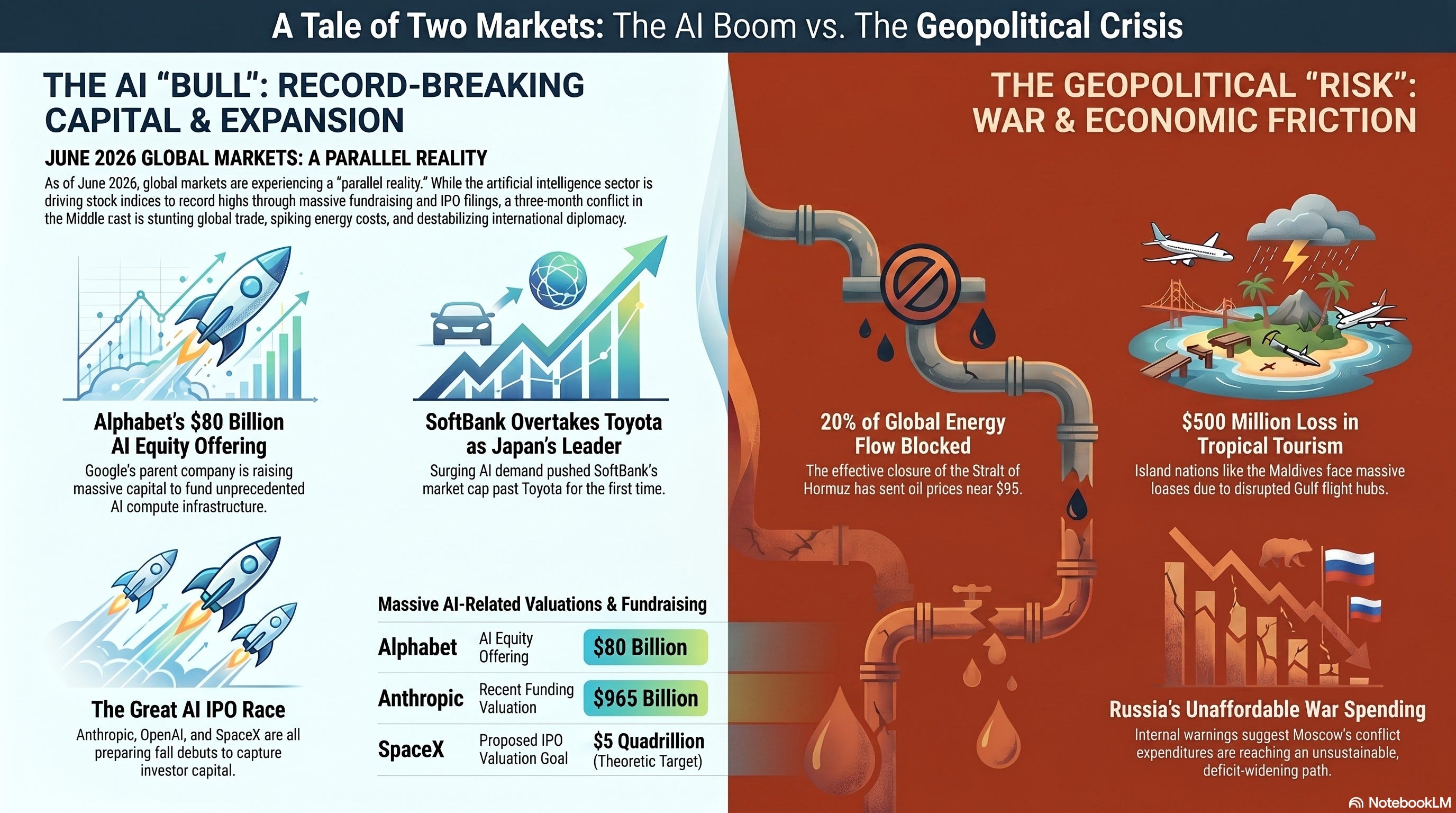
The period under review is distinctive for the simultaneity of its crises and opportunities. The Iran war, now in its fourth month, has reshaped global energy markets, displaced tourism economies from the Maldives to the Seychelles, and triggered inflationary pressures that central banks from Frankfurt to Pretoria are scrambling to contain. At the same time, the artificial intelligence sector is experiencing a capital formation event of historic proportions, with SpaceX targeting a $1.75 trillion valuation, Alphabet raising $80 billion, and Anthropic filing for an IPO that values it near $1 trillion. These developments are not parallel but intertwined: the same semiconductor supply chains that power AI also depend on global trade routes threatened by conflict, and the same fiscal pressures created by military expenditure shape the policy environments in which technology companies operate. What follows is an attempt to make these connections legible.
Economic Developments and Implications
The AI Capital Formation Event and the End of De-Equitization
The most striking economic development of this period is the sheer scale of capital mobilization in the artificial intelligence sector. Alphabet’s announcement of an $80 billion equity offering—including $10 billion from Berkshire Hathaway—represents one of the largest equity deals in corporate history (Bloomberg, 2026a). Simultaneously, SpaceX is preparing an IPO at a valuation of approximately $1.75 trillion, with plans to raise $60–80 billion by selling under 5% of shares (Wall Street Journal, 2026). Anthropic, having just raised $65 billion at a $965 billion valuation, has confidentially filed for its own public listing, potentially leapfrogging OpenAI in the race to Wall Street (Bloomberg, 2026b). The aggregate capital being drawn into AI-related enterprises over a period of weeks exceeds the GDP of many nation-states, a fact that invites comparison with the railroad booms of the nineteenth century, when, as Charles Kindleberger documented in Manias, Panics, and Crashes (Kindleberger & Aliber, 2011), the sheer velocity of capital deployment created its own momentum, often outrunning the underlying fundamentals.
John Authers, writing in Bloomberg’s Points of Return newsletter, situates these offerings within the longer arc of what Citi strategist Rob Buckland termed ‘de-equitization’—the decades-long shrinkage of publicly available equity driven by buybacks, private equity, and the decision of unicorns to delay going public (Authers, 2026). The forthcoming wave of mega-IPOs, Authers argues, may mark the end of this era, as founders who accumulated unprecedented valuations in private markets now ‘feed the ducks’ that have been quacking for equity exposure. Yet the structural risks are significant: companies arriving on exchanges already valued as the world’s most powerful businesses challenge the assumptions of index funds, which may be forced to channel passive capital into newly public companies at prices set by insiders (Kaissar, 2026). As Hyman Minsky (1986) argued in Stabilizing an Unstable Economy, stability itself breeds instability, and the very fact that markets have accommodated the AI boom without a major correction may be the condition for the next one.
Energy Markets and the Strait of Hormuz
The Iran war’s most consequential economic effect has been the effective closure of the Strait of Hormuz, through which approximately 20% of the world’s oil and gas previously flowed (Bloomberg, 2026c). Oil prices have surged above $90 per barrel for West Texas Intermediate and near $95 for Brent, with OPEC+ experts warning that supply disruptions will persist through year-end even if the waterway reopens promptly (Bloomberg, 2026d). The inflationary consequences are already visible: eurozone inflation topped 3% for the first time in over two years, cementing expectations for an ECB rate hike in June (Bloomberg, 2026e), while South Africa has rolled back temporary fuel price relief, pushing gasoline to record levels (Bloomberg, 2026f). The global gas trade, as Javier Blas reports, is being pushed ‘into the shadows’ as major producers like Qatar rip up the maritime rulebook in desperation (Blas, 2026).
Daniel Yergin, in The New Map (Yergin, 2020), argued that energy infrastructure constitutes a form of geopolitical architecture—the physical routes through which hydrocarbons flow are simultaneously corridors of power and vulnerability. The Hormuz closure confirms this analysis with brutal clarity. The consequence is not merely higher prices but a fundamental restructuring of trade routes, with Canada’s TSX index—where energy stocks comprise over 17% of the composite—hitting successive record highs (Bloomberg, 2026g), and copper topping $14,000 a ton as supply constraints compound demand optimism (Bloomberg, 2026g). These are not temporary dislocations but signals of what Adam Tooze (2021) has called the ‘polycrisis’—the simultaneous occurrence of interconnected shocks whose combined effect exceeds the sum of their parts.
Labor, Capital, and the Structuring of Work
The Amazon delivery-driver case reported by Bloomberg’s Josh Eidelson opens a window onto one of the central structural questions of contemporary capitalism: the relationship between firms and the workers who make their operations possible. Johnathon Ervin, a former Air Force veteran who ran a delivery service partner for Amazon, describes being ordered to send drivers into a blizzard against his judgment, then having his contract terminated when he pushed back (Eidelson, 2026). The case is significant not merely as an instance of corporate callousness but as a demonstration of what David Weil (2014) termed ‘the fissured workplace’—the systematic disaggregation of employment relationships through subcontracting, franchising, and supply-chain management that allows lead firms to externalize risk while retaining control.
The NLRB’s decision to end the case on terms favorable to Amazon, under a general counsel who had previously represented the company, illustrates what Janine R. Wedel (2014) has called the ‘shadow elite’—the revolving network of insiders who move between corporate and regulatory roles, shaping outcomes in ways that formal accountability structures fail to capture. Meanwhile, SpaceX employees are banding together to negotiate with wealth managers ahead of the IPO, and Uber and Walmart are capping employee use of AI tools to cut costs (Bloomberg, 2026h)—a reminder that the AI revolution, like every technological transformation before it, is being negotiated on terrain already shaped by power asymmetries between capital and labor.
Social Developments and Implications
Housing, Displacement, and the Right to the City
Kenya’s mass housing drive, reported by Bloomberg’s Next Africa newsletter, encapsulates a tension that runs through urban development across the Global South: the imperative to build affordable housing collides with the dispossession of existing communities. President William Ruto’s program aims to construct 200,000 units annually, but the demolition of low-rise neighborhoods has displaced thousands without guarantee of rehousing, and the housing levy imposed to fund construction faces constitutional challenge from over 60 plaintiffs (Bloomberg, 2026f). In Hong Kong, the conversion of boutique hotels to student dormitories and the resumption of luxury sales at 21 Borrett Road after a prolonged slump reveal a different facet of the same problem: a property market that serves capital rather than community (SCMP, 2026a, 2026b).
Henri Lefebvre’s (1968) concept of ‘the right to the city’—the insistence that urban space should serve its inhabitants rather than the logic of accumulation—provides a framework for understanding these developments. David Harvey (2008) extended Lefebvre’s insight by arguing that the city has become a primary vehicle for capital’s search for surplus absorption, and that the resulting pattern of creative destruction—demolition, displacement, and redevelopment—is not a market malfunction but a market function. The Kenyan evictions, the Hong Kong property corrections, and the British millennials’ inability to move up the property ladder (Bloomberg, 2026i) are all manifestations of what Harvey calls ‘accumulation by dispossession’—the transfer of assets from the vulnerable to the powerful under the cover of development.
Health, Body, and the Politics of Care
The new Ebola outbreak in the Democratic Republic of Congo, and the innovative research into survivor immunity being conducted by immunologist Jennifer Serwanga (Bloomberg, 2026j), invites reflection on what Paul Farmer (2004) called ‘pathologies of power’—the systematic ways in which structural violence determines who receives care and who does not. The Congolese outbreak is occurring in a conflict zone where health facilities have been attacked and misinformation is rampant, precisely the conditions that Farmer identified as producing the greatest suffering among the poorest. Meanwhile, the US push to expel Cuban doctors from Venezuela is leaving communities without access to care (Bloomberg, 2026k), and Hong Kong is confronting rising cancer rates that demand systemic responses (SCMP, 2026c).
Ukraine’s Superhumans Center, offering free rehabilitation to soldiers and civilians with drone injuries, represents a different mode of response—what Joanna Bourke (2014) might recognize as the social reconstruction of the wounded body, a process in which physical repair is inseparable from social reintegration. Olga Rudnieva’s description of building ‘a full ecosystem where the patient gets everything: psychological support, prosthetics, surgical support and rehabilitation’ (Monocle, 2026a) echoes the capabilities approach articulated by Amartya Sen (1999) and Martha Nussbaum (2011), in which health is not merely the absence of disease but the presence of the conditions for a flourishing life.
Privacy, Surveillance, and the Limits of State Power
The arrest of Hong Kong parents who refused a DNA test for their infant’s birth registration on privacy grounds (SCMP, 2026d) raises questions that sit at the intersection of social policy, law, and political philosophy. The state’s insistence on genetic identification as a condition of legal personhood—and the parents’ equally firm refusal on grounds of privacy—recalls what Zygmunt Bauman (2000) described as the tension between ‘the state’s hunger for legibility’ and the individual’s claim to opacity. James C. Scott (1998), in Seeing Like a State, argued that the modern state’s drive to make its population ‘legible’—through cadastral maps, surnames, and identification systems—is a prerequisite for governance but also a source of vulnerability for those who fall outside its categories. The Hong Kong case demonstrates that these dynamics persist even in technologically advanced societies, where the tools of surveillance have become more granular but the ethical questions they raise remain as urgent as ever.
Political and Policy Developments
Institutional Capture and Democratic Erosion
The Trump administration’s retreat from its $1.8 billion ‘anti-weaponization’ fund—widely derided as a ‘slush fund’—alongside the preservation of audit immunity for the president, his family, and his businesses (Bloomberg, 2026l), represents a pattern of institutional capture that Steven Levitsky and Daniel Ziblatt (2018) identified in How Democracies Die as the hallmark of democratic erosion: the co-optation of nominally independent institutions by elected leaders who use the forms of legality to undermine the substance of accountability. The appointment of Bill Pulte—a 38-year-old heir with no intelligence background—as acting director of national intelligence (Bloomberg, 2026m), and the gutting of the Consumer Financial Protection Bureau under Russell Vought (Bloomberg, 2026n), illustrate what Nancy Bermeo (2016) terms ‘executive aggrandizement’—the concentration of power through formally legal means that nevertheless hollow out the checks and balances essential to democratic governance.
The Amazon-NLRB case, in which the government moved to end proceedings against the company under a general counsel who had previously represented it, is a microcosm of this pattern. As Tim Wu (2020) argued in The Curse of Bigness, the concentration of corporate power and the concentration of political power are mutually reinforcing: large firms shape the regulatory environment that governs them, while political actors leverage corporate dependencies for their own ends. The result is what Mark Mazower (2000) called ‘the dark continent’ of governance—not the overt authoritarianism of the twentieth century but a subtler form in which the architecture of accountability persists in form while being emptied of function.
Geopolitics and the Crisis of Alliance
NATO-US tensions have become ‘more difficult to manage,’ according to former secretary general Jens Stoltenberg, who noted that relationships have frayed even compared to the period when Trump toyed with leaving the alliance (Bloomberg, 2026o). Trump’s characterization of NATO as a ‘paper tiger’ for refusing to support US operations in the Strait of Hormuz, and European leaders’ resistance to involvement in the Iran war, expose what G. John Ikenberry (2011) described as the fundamental tension of the liberal international order: the system depends on American leadership but is undermined when that leadership is exercised unilaterally. The upcoming NATO summit in Ankara will test whether the alliance can reconcile American demands for burden-sharing with European reservations about American strategic judgment.
The US-Iran peace talks—repeatedly suspended and revived amid Israeli military operations in Lebanon—illustrate what Robert Jervis (1976) called ‘perception and misperception in international politics.’ Trump’s claim that Israel and Hezbollah had agreed to suspend attacks was contradicted by Netanyahu, who insisted the campaign would continue (Bloomberg, 2026p). The gap between American and Israeli accounts of the same phone call is not merely a matter of spin but reflects a deeper structural divergence: as John Mearsheimer (2001) argued in The Tragedy of Great Power Politics, allies often have conflicting interests that no amount of diplomatic management can fully reconcile, and the current rift between Washington and Jerusalem is a case in point.
China: Regulation, Competition, and Strategic Ambiguity
China’s tightening of tech investment rules—granting Beijing authority to counter foreign entities it views as harming its interests (SCMP, 2026e)—alongside the continued detention of a top map-making scientist in an anti-corruption sweep (SCMP, 2026f), signals a state that is simultaneously tightening domestic control and asserting external sovereignty. The WSJ’s assessment of Huawei as ‘clever, but not enough’—likely trailing rivals by six to eight years by 2031 despite its innovations (Wall Street Journal, 2026)—reveals the limits of technological self-sufficiency under sanction. Meanwhile, the KMT chairwoman’s visit to Washington, following a meeting with Xi Jinping, exemplifies the ‘strategic ambiguity’ that has long characterized cross-strait relations (SCMP, 2026g).
These developments resonate with the analysis of Carl Minzner (2018) in End of an Era, which argued that the Chinese state’s turn toward centralization and control reflects not strength but anxiety—the leadership’s recognition that the era of easy growth is over and that the mechanisms of governance must be reinforced to manage the consequences. The tightening of outbound investment rules, the probe into a scientist-entrepreneur, and the strategic deployment of the KMT in cross-strait diplomacy are all consistent with Minzner’s thesis that China is entering a period of what he calls ‘repressive adaptation’—adjusting the tools of governance to meet new challenges without fundamentally altering the structure of power.
Cultural Developments and Implications
Art, Authenticity, and the Question of Value
The authentication of a Lucian Freud painting that the artist himself long denied making (ARTnews, 2026a), the theft of Maurizio Cattelan’s Comedian—a duct-taped banana—from the Centre Pompidou-Metz (ARTnews, 2026b), and the opening of the Obama Presidential Center, already dubbed the ‘Obamalisk’ by critics who compare it to a ‘Klingon prison’ (ARTnews, 2026c), collectively raise fundamental questions about the nature of artistic value and the relationship between material objects and the protocols that authorize them. The Freud case turns on the artist’s refusal to acknowledge an early work motivated by personal grudges—a reminder, as Arthur Danto (1981) argued in The Transfiguration of the Commonplace, that the status of an artwork depends not on its intrinsic properties but on the discursive context in which it is situated. The Cattelan case takes this logic to its absurdist conclusion: the banana itself is worthless, replaceable at a moment’s notice; what matters is the certificate of authenticity and ‘the protocol governing its presentation’ (Centre Pompidou-Metz, 2026).
The ‘Obamalisk’ controversy extends these questions into the domain of public architecture and collective memory. As Tony Bennett (1995) argued in The Birth of the Museum, cultural institutions are not neutral containers but ‘technologies of governance’ that shape the public’s relationship to history and identity. The Obama Center’s location in Jackson Park, its $850 million cost, and its refusal to enter into community benefit agreements about gentrification all raise questions about whom the institution serves and what version of history it enshrines. The Guardian’s Oliver Wainwright asks whether it is ‘a monument or a mausoleum’—a question that applies as much to the politics of memorialization as to the aesthetics of architecture.
Madrid: The City as Palimpsest
Monocle’s dispatch from Madrid—where the Pope’s visit, Bad Bunny’s concert residency, Colombian elections, and Real Madrid’s snap elections are occurring simultaneously (Monocle, 2026b)—presents the city as a palimpsest of overlapping cultural, religious, and political performances. The description of Bad Bunny’s 10-concert residency at the Metropolitano Stadium—expected to generate over €75 million in ticket revenue and €28 million in hospitality spending—alongside the Pope’s mass for 1.5 million devotees, illustrates what Guy Debord (1967) called ‘the society of the spectacle,’ in which experience is mediated through performance and consumption. Yet the Madrid dispatch also suggests something more nuanced: the coexistence of radically different forms of collective effervescence within the same urban space, what Richard Sennett (1970) might recognize as ‘the uses of disorder’—the productive encounter with difference that cities, at their best, make possible.
Bad Bunny’s decision to anchor his tour in a single city rather than traverse the globe with a ‘constant, no doubt exhausting, caravan of one-off shows’ (Monocle, 2026b) also reflects a shift in the political economy of live entertainment that has implications beyond the music industry. As Elizabeth Currid-Halkett (2017) argued in The Sum of Small Things, the ‘aspirational class’ increasingly values experiences over material goods, and the concentration of cultural capital in particular cities—Madrid for Latin music, Helsinki for fashion design (Monocle, 2026c)—reinforces the economic advantages of urban centers while potentially deepening the cultural impoverishment of peripheries.
The Pope’s Encyclical and the Spirit of Resistance
Pope Leo XIV’s first major encyclical, Magnifica Humanitas, which ‘takes a spiritual stand against AI and drew comparisons to the Butlerian Jihad against thinking machines in Frank Herbert’s Dune’ (Monocle, 2026b), represents the most prominent institutional challenge to the trajectory of AI development from a moral and philosophical standpoint. The comparison to Herbert’s fictional universe is not merely a journalistic flourish: the Butlerian Jihad, as Herbert (1965) imagined it, was a civilizational revolt against the delegation of human judgment to machines, a theme that resonates with concerns articulated by scholars from Joseph Weizenbaum (1976) to Shoshana Zuboff (2019). Zuboff’s concept of ‘surveillance capitalism’—the extraction of behavioral data for commercial prediction and manipulation—finds its theological counterpart in the Pope’s insistence that certain domains of human experience must remain beyond the reach of algorithmic optimization.
The encyclical also intersects with the death of Julio Le Parc, the Argentine-born pioneer of kinetic art whose vibrating light installations and shimmering mobiles ‘invited viewers to actively participate with the works’ (ARTnews, 2026d). Le Parc’s artistic practice—grounded in collective experimentation and the rejection of the solitary artistic master—offers a model of creativity that is fundamentally opposed to the individualistic, efficiency-driven logic of AI development. As Andreas Huyssen (1986) argued in After the Great Divide, the avant-garde tradition to which Le Parc belonged has always defined itself against the instrumental rationality of modernity, and the current moment—in which AI companies are raising unprecedented sums while the Pope denounces their ambitions—represents the latest iteration of a very old tension.
Integrative Analysis: Interrelations and Synthesis
The most important insight to emerge from reading these newsletters across their full range is the depth of interconnection between domains that are conventionally treated as separate. The AI capital formation event is not merely an economic story; it is a social, political, and cultural phenomenon. The $80 billion that Alphabet is raising will fund data centers that consume electricity generated in part by the fossil fuels whose supply is disrupted by the Iran war, which is itself a political crisis with cultural ramifications—from the Pope’s encyclical to the silence of Iranian citizens coping with limited internet access (Monocle, 2026d). The same semiconductor supply chains that make AI possible are subject to export controls shaped by the US-China strategic competition, which in turn affects the Chinese EV market that Morgan Stanley identifies as ripe for AI-driven redefinition (SCMP, 2026h).
Karl Polanyi’s (1944) insight in The Great Transformation—that the economy is not autonomous but ‘embedded’ in social relations, and that attempts to disembed it produce what he called ‘the double movement’ of social protection against market expansion—provides the most powerful framework for understanding these interconnections. The current moment is characterized by a Polanyian double movement of extraordinary intensity: the expansion of AI-driven markets into ever more domains of human activity provokes counter-movements in the form of regulatory crackdowns, papal encyclicals, labor organizing, and privacy protests. China’s tightening of tech investment rules, the EU’s preparation of tough trade action (Semafor, 2026), and the British Museum’s controversial postponement of a lecture on ancient Israel (ARTnews, 2026b) are all expressions of the same impulse: the attempt to reassert boundaries against the encroachments of market logic.
Yet the counter-movements are themselves shaped by the same forces they resist. Tom Steyer’s campaign for California governor—in which a billionaire hedge fund founder wins endorsements from Bernie Sanders’ Our Revolution by advocating a wealth tax (Bloomberg, 2026p)—demonstrates what Wendy Brown (2015) has called ‘the economization of all of life,’ in which even opposition to capitalism is articulated in capitalist terms. The ‘China-maxxing’ trend identified by the South China Morning Post—in which young Westerners embrace Chinese habits and culture, ‘started as a meme’ but carries ‘a serious political signal’ (SCMP, 2026i)—similarly reveals the ambivalence of cultural responses to geopolitical shifts: the embrace of Chinese culture is simultaneously a genuine cosmopolitan impulse and a recognition of the shift in global power that economic developments have produced.
The interconnection of war and economy, culture and policy, is perhaps most vividly illustrated by the ripple effects of the Hormuz closure on tourism in the Indian Ocean. The Maldives, Mauritius, the Seychelles, and Sri Lanka depend on Gulf carriers—Emirates, Etihad, Qatar Airways—to bring visitors to their shores; those carriers have seen traffic plummet as Iran targets their Persian Gulf hubs (Bloomberg, 2026q). A war in the Middle East thus produces unemployment in the Maldives, fiscal strain in South Africa, and inflationary pressure in Europe—a chain of consequences that confirms the analysis of globalization offered by Jagdish Bhagwati (2004) and its critics, from Joseph Stiglitz (2002) to Quinn Slobodian (2018), who have variously argued that the integration of global markets creates interdependencies that are both the source of prosperity and the vector of crisis.
From the Editor
The primary data for this commentary—a collection of newsletter snippets spanning June 1–3, 2026—presented several challenges that warrant acknowledgment. First, the snippets are inherently fragmentary: each newsletter offers a condensed version of events, with full articles typically gated behind paywalls or accessible only via web links that may not persist. The commentary has therefore worked with what might be called ‘the surface of the news’—the version of events that editors have chosen to present to their subscribers—while recognizing that this surface is itself a product of editorial judgment, institutional perspective, and commercial incentive. Monocle’s focus on quality-of-life indicators and Helsinki fashion designers is not neutral; it reflects a particular worldview that is as much a cultural artifact as the news it reports.
Second, the research process involved synthesizing material from sources with very different epistemic standards. Bloomberg’s financial reporting operates under protocols of verification and sourcing that differ markedly from ARTnews’s art-critical discourse or Monocle’s lifestyle journalism. The commentary has attempted to be transparent about the provenance of each piece of information while drawing connections that no single source would make on its own. The scholarly references—drawn from economics, sociology, political science, and cultural studies—serve as a bridge between the fragmentary present-tense of the newsletters and the deeper analytical frameworks that historical and comparative scholarship provides.
Third, the writing itself required a balancing act between detail and synthesis. Each of the thematic sections could easily have expanded into a standalone essay; the challenge was to provide sufficient depth to justify the scholarly citations while maintaining the integrative ambition of the project as a whole. The result is necessarily selective—many stories in the original digest (the Philippine Senate deadlock, the Vast Space headquarters in Paris, the Wolfgang Tillmans interview) receive only glancing mention or no mention at all—and the editor accepts responsibility for the paths not taken.
The added value of this commentary for its readers lies in three areas. First, it makes connections that are invisible when the news is consumed in its original, siloed form: the link between AI capital formation and the end of de-equitization, the relationship between the Hormuz closure and Indian Ocean tourism, the structural parallels between the Kenyan housing evictions and the British property ladder breakdown. Second, it provides historical and theoretical depth by connecting current events to established bodies of scholarship, enabling readers to understand the present not as a series of unprecedented shocks but as the latest iteration of long-running dynamics. Third, it demonstrates that the conventional separation of economic, social, political, and cultural analysis is not merely an organizational convenience but a substantive obstacle to understanding—and that a genuinely integrative approach, while more demanding, yields insights that no single discipline can provide on its own.
Bibliography
Appadurai, A. (1996). Modernity at large: Cultural dimensions of globalization. University of Minnesota Press.
ARTnews. (2026a, June 2). ‘Obamalisk’ unveiled, newly authenticated Lucian Freud painting on view, and more. ARTnews Daily.
ARTnews. (2026b, June 1). Julio Le Parc dies, Cattelan’s banana stolen from French museum, and more. ARTnews Daily.
ARTnews. (2026c, June 2). Obama Presidential Center preview. ARTnews Daily.
ARTnews. (2026d, June 1). Julio Le Parc obituary. ARTnews Daily.
Authers, J. (2026, June 2). SpaceX—To boldly raise money where no IPO has gone before. Bloomberg Points of Return.
Bauman, Z. (2000). Liquid modernity. Polity Press.
Bennett, T. (1995). The birth of the museum: History, theory, politics. Routledge.
Bermeo, N. (2016). On democratic backsliding. Journal of Democracy, 27(1), 5–19.
Bhagwati, J. (2004). In defense of globalization. Oxford University Press.
Blas, J. (2026, June 2). Why liquified natural gas is about to experience a glut. Bloomberg Opinion.
Bourke, J. (2014). Wounding the world: How military violence and war play are central to us. Virago.
Brown, W. (2015). Undoing the demos: Neoliberalism’s stealth revolution. Zone Books.
Bloomberg. (2026a, June 2). Alphabet slips after unveiling $80 billion equity offering. Morning Briefing Americas.
Bloomberg. (2026b, June 2). AI giants’ fundraising race heats up with Alphabet, Anthropic moves. Evening Briefing Asia.
Bloomberg. (2026c, June 2). Iran reportedly suspends US negotiations over Israeli assault. Evening Briefing Americas.
Bloomberg. (2026d, June 2). Oil industry experts tell OPEC+ supply disruptions to persist. Evening Briefing Americas.
Bloomberg. (2026e, June 3). Euro-area inflation tops 3%. Evening Briefing Europe.
Bloomberg. (2026f, June 2). Kenya’s mass housing drive stirs a hornets’ nest. Next Africa.
Bloomberg. (2026g, June 3). TSX hits yet another record. Canada Daily.
Bloomberg. (2026h, June 3). SpaceX staff seek lower fees, tax savings before IPO. Morning Briefing Asia.
Bloomberg. (2026i, June 2). Stuck on the property ladder. Morning Briefing Europe.
Bloomberg. (2026j, June 2). Tracking down Ebola survivors in remote mountains to find a cure. Evening Briefing Asia.
Bloomberg. (2026k, June 3). Cuba crackdown. Businessweek Daily.
Bloomberg. (2026l, June 3). Trump, family and businesses retain audit immunity. Evening Briefing Americas.
Bloomberg. (2026m, June 3). Pulte appointed acting director of national intelligence. Evening Briefing Americas.
Bloomberg. (2026n, June 2). Trump’s consumer watchdog lets big business out of millions owed. Morning Briefing Europe.
Bloomberg. (2026o, June 3). NATO-US tensions ‘more difficult to manage,’ says former chief. Evening Briefing Europe.
Bloomberg. (2026p, June 2). How a billionaire won over the Bernie Bros. Businessweek Daily.
Bloomberg. (2026q, June 2). Vacation destinations suffer as Gulf carriers see traffic plummet. Businessweek Daily.
Centre Pompidou-Metz. (2026, June 1). Statement on the theft of Comedian by Maurizio Cattelan.
Currid-Halkett, E. (2017). The sum of small things: A theory of the aspirational class. Princeton University Press.
Danto, A. (1981). The transfiguration of the commonplace: A philosophy of art. Harvard University Press.
Debord, G. (1967). The society of the spectacle (D. Nicholson-Smith, Trans.). Zone Books.
Eidelson, J. (2026, June 3). What Trump delivered for Amazon. Bloomberg Businessweek Daily.
Farmer, P. (2004). Pathologies of power: Health, human rights, and the new war on the poor. University of California Press.
Harvey, D. (2008). The right to the city. New Left Review, 53, 23–40.
Herbert, F. (1965). Dune. Chilton Books.
Huyssen, A. (1986). After the great divide: Modernism, mass culture, postmodernism. Indiana University Press.
Ikenberry, G. J. (2011). Liberal Leviathan: The origins, crisis, and transformation of the American world order. Princeton University Press.
Jervis, R. (1976). Perception and misperception in international politics. Princeton University Press.
Kaissar, N. (2026, June 2). Companies are not supposed to show up on exchanges already the world’s most valuable businesses. Bloomberg Opinion.
Kindleberger, C. P., & Aliber, R. Z. (2011). Manias, panics, and crashes: A history of financial crises (6th ed.). Palgrave Macmillan.
Lefebvre, H. (1968). Writings on cities (E. Kofman & E. Lebas, Trans.). Blackwell.
Levitsky, S., & Ziblatt, D. (2018). How democracies die. Crown.
Mazower, M. (2000). Dark continent: Europe’s twentieth century. Vintage.
Mearsheimer, J. J. (2001). The tragedy of great power politics. W. W. Norton.
Minsky, H. P. (1986). Stabilizing an unstable economy. Yale University Press.
Minzner, C. (2018). End of an era: How China’s authoritarian revival is undermining its miracle. Oxford University Press.
Monocle. (2026a, June 2). At the Black Sea Security Forum in Odesa, Ukraine looks increasingly like the leader of the free world. The Monocle Minute.
Monocle. (2026b, June 3). From the Pope to Bad Bunny, Madrilenos have plenty to put their faith in this weekend. The Monocle Minute.
Monocle. (2026c, June 2). Forget Milan, Paris and London: Helsinki is where talent scouts head. The Monocle Minute.
Monocle. (2026d, June 2). How Iranians have been coping with the US-Israel conflict. The Monocle Minute.
Nussbaum, M. C. (2011). Creating capabilities: The human development approach. Harvard University Press.
Polanyi, K. (1944). The great transformation: The political and economic origins of our time. Beacon Press.
SCMP. (2026a, June 2). CK Asset resumes sales at 21 Borrett Road. South China Morning Post.
SCMP. (2026b, June 1). Closure of boutique hotel linked to student-housing trend. South China Morning Post.
SCMP. (2026c, June 1). Why are so many more people getting cancer in Hong Kong? South China Morning Post.
SCMP. (2026d, June 3). Protection order sought for baby after parents arrested in DNA test refusal case. South China Morning Post.
SCMP. (2026e, June 3). China tightens tech investment rules. South China Morning Post.
SCMP. (2026f, June 2). Top Chinese map-making scientist detained in anti-corruption sweep. South China Morning Post.
SCMP. (2026g, June 1). Can Taiwanese opposition leader pull off balancing act during US trip? South China Morning Post.
SCMP. (2026h, June 1). AI could redefine China’s EV market: Morgan Stanley. South China Morning Post.
SCMP. (2026i, June 1). Why China-bashing is being replaced by China-maxxing. South China Morning Post.
Scott, J. C. (1998). Seeing like a state: How certain schemes to improve the human condition have failed. Yale University Press.
Sennett, R. (1970). The uses of disorder: Personal identity and city life. Alfred A. Knopf.
Sen, A. (1999). Development as freedom. Oxford University Press.
Slobodian, Q. (2018). Globalists: The end of empire and the birth of neoliberalism. Harvard University Press.
Stiglitz, J. E. (2002). Globalization and its discontents. W. W. Norton.
Tooze, A. (2021). Shutdown: How Covid shook the world’s economy. Viking.
Wall Street Journal. (2026, June 2). WSJ China: Clever, but not enough. Wall Street Journal.
Wedel, J. R. (2014). Unaccountable: How elite power brokers corrupt our finances, freedom, and security. Pegasus Books.
Weil, D. (2014). The fissured workplace: Why work became so bad for so many and what can be done to improve it. Harvard University Press.
Weizenbaum, J. (1976). Computer power and human reason: From judgment to calculation. W. H. Freeman.
Wu, T. (2020). The curse of bigness: Antitrust in the new gilded age. Columbia Global Reports.
Yergin, D. (2020). The new map: Energy, climate, and the clash of nations. Penguin Press.
Zuboff, S. (2019). The age of surveillance capitalism: The fight for a human future at the new frontier of power. PublicAffairs.
[Written, Researched, and Edited by Pablo Markin. Some parts of the text have been produced with the aid of GLM, Zhipu, and Gemini, Alphabet, tools (June 6, 2026). The newsletters were sourced from ARTNews, Artforum, The Atlantic, Bloomberg, CNBC, The Economist, The Financial Times, Le Monde, Monocle, The New York Times, Newsweek, Nikkei Asia, Noema Magazine, El País, Rest of World, Radio Free Europe/Radio Liberty, Semafor, The South China Morning Post, and The Wall Street Journal. The featured infographic has been generated in NotebookLM, Google (June 6, 2026).]
[Support the Open Access Blogs: https://buymeacoffee.com/openaccessblogs.]
OpenEdition suggests that you cite this post as follows: Pablo Markin (June 5, 2026). The AI Capital Explosion, the Strait of Hormuz Energy Shock, and the Global Fracturing of Public Institutions. Open Culture.