
The Echoes in the Reflecting Pool: Spectacle, Silicon, and the Thermodynamics of an Aging Empire
How a Week of News Exposes the Fraying Infrastructure of Democratic Life: July 2–5, 2026.

Introduction
Picture a man in a pressed shirt, jacket slung over his arm, wandering through the Paris Metro on a sweltering July afternoon. Andrew Tuck, editor in chief of Monocle, is trying to reach a television studio for an interview about his magazine’s Quality of Life Survey — an annual ranking that placed Paris eighth in the world. The irony is not lost on him. After two metro stops, the wayfinding system transforms from “gentle guiding hand” to what he describes as “spin this fool around and see if he can ever get to his destination.” His map app surrenders, replaced by a laughing emoji. He arrives perspiring, his shirt “clinging to him as though he was entering the seniors round of a wet T-shirt competition.” The eighth-best city in the world, it turns out, is excruciatingly difficult to actually find.
Tuck’s disorientation is more than a travel anecdote. It is a parable for a broader condition that pervades the news of early July 2026: the collapse of the infrastructures — physical, social, and symbolic — that orient citizens in democratic space. From Parisian metro signs to American national parks, from French village bars to Singaporean cinemas, from the architecture of Washington to the algorithms of artificial intelligence, the week’s stories collectively describe a world in which the structures that once grounded public life are either failing, being contested, or being repurposed for ends quite different from those they originally served.
I. The Algae and the Algorithm
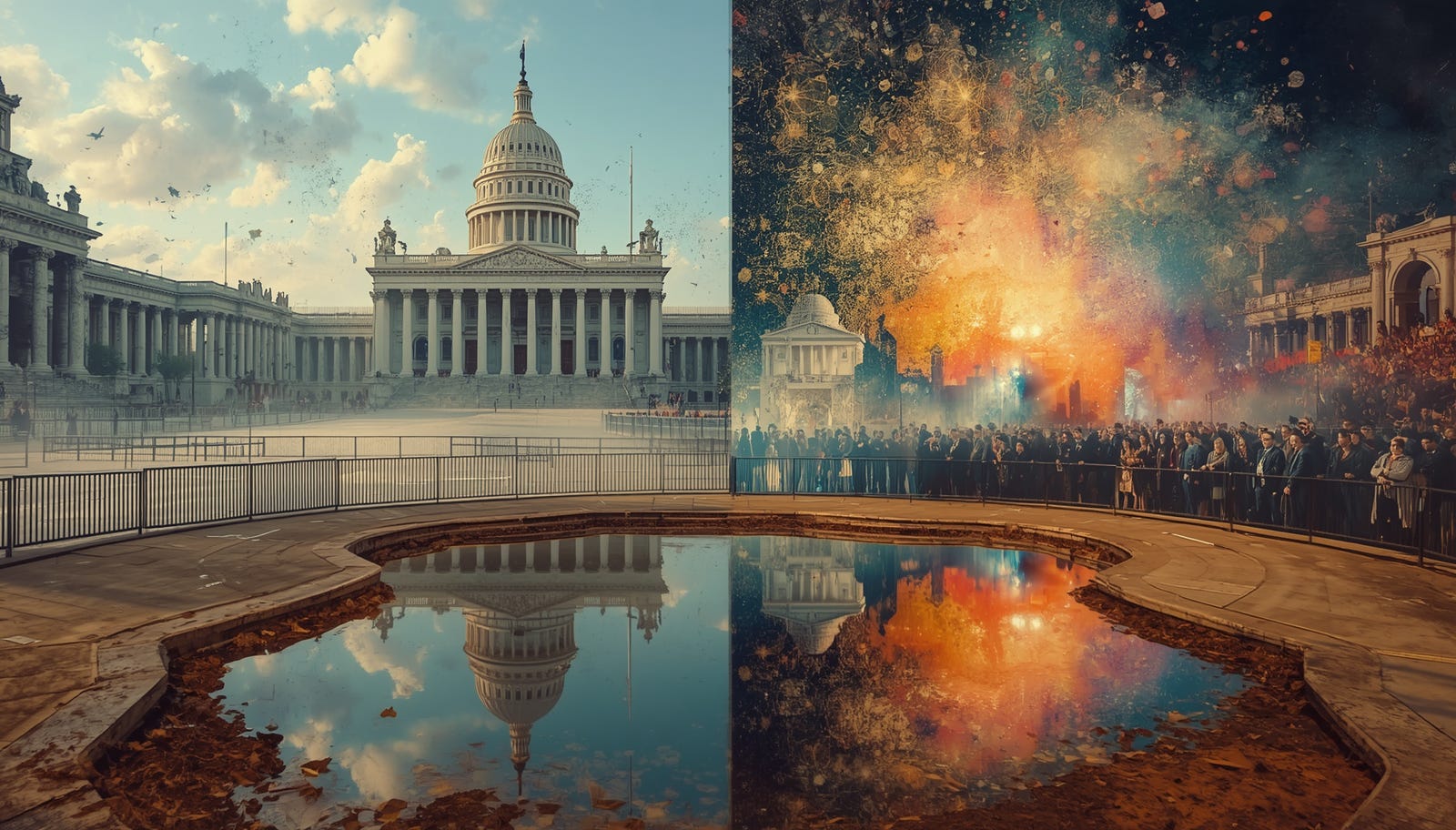
The Lincoln Memorial Reflecting Pool, recently renovated at great expense to serve as a pristine mirror for the nation’s semiquincentennial, is clouded with algae and peeling paint. The deterioration of the monument’s surface became the backdrop for a peculiar civic drama when a former Olympic canoeist was indicted for felony destruction of property after allegedly touching the failing sealant. A few hundred yards away, the National Mall is barricaded by fencing and heavily patrolled by the National Guard to host the “Great American State Fair,” a sparsely attended, militarized jubilee featuring an artificial intelligence-generated George Washington dispensing providential wisdom from the back of a “Freedom Truck.” Meanwhile, a few miles north in New York, Madison Square Garden is hermetically sealed by private security and local police to host the wedding of Taylor Swift and Travis Kelce, an event guarded with the tactical rigor of a head-of-state summit.
These contrasting scenes—the decaying civic monument, the algorithmic simulacrum of the founding father, and the hyper-secured privatization of pop culture—form a triptych of America at 250. They reveal a profound tension between the original republican ideals of the nation and its current iteration as a society organized around spectacle and security. When the poet James Russell Lowell struggled to write an ode for the nation’s centennial in 1876, he warned against the complacency of a citizenry that believed the Founders had merely built a “machine that would go of itself” (Lowell, 1876, “An Ode for the Fourth of July, 1876”). Lowell feared that treating the republic as an automated mechanism would render the public “neglectful” of its political responsibilities.
Today, that machine has not merely been neglected; it has been replaced by a curated simulation. The sociologist Guy Debord famously posited that in modern capitalist societies, “all that once was directly lived has become mere representation” (Debord, 1967, The Society of the Spectacle). The fenced-off National Mall and the AI-generated Washington demonstrate how the state now relies on the aesthetics of patriotism rather than the substance of civic participation. The republic is no longer a shared public square but a heavily policed venue, while the actual cultural energy of the populace is siphoned into the private, hyper-commodified spectacle of the Swift-Kelce nuptials. The political and the cultural have diverged into two separate, heavily guarded realities, leaving the literal and metaphorical reflecting pools to stagnate.
II. The Thermodynamics of the Cloud
Inside the control rooms of the PJM Interconnection, which manages the electrical grid for 13 states and Washington, D.C., operators are issuing emergency “hot-weather” and load-management alerts. A brutal heat dome has settled over the Eastern Seaboard, pushing temperatures past 100 degrees and forcing millions to crank their air conditioners to maximum capacity. Simultaneously, the executives of hyperscalers like Amazon and Meta are conceding that their corporate carbon emissions are rising for consecutive years. The cause is the insatiable, localized energy demand of artificial intelligence data centers, which require vast amounts of electricity and water for cooling, forcing the energy sector to rely on backup diesel generators and delaying the retirement of fossil-fuel plants.
This juxtaposition exposes the central contradiction of the contemporary digital economy: the “cloud” is not an ethereal abstraction, but a heavy, thermodynamic reality built on silicon, copper, and concrete. The collision between the AI boom and planetary boundaries highlights a structural vulnerability in the global economic model. As Vaclav Smil observes in his comprehensive analysis of human energy use, “there are no prime movers without fuels, and no fuels without prime movers,” reminding us that every leap in informational complexity requires a corresponding, and often brutal, expansion of physical energy extraction (Smil, 2017, Energy and Civilization: A History).
The economic implications of this thermodynamic friction are immense. The AI revolution, currently driving a massive portion of global equity valuations, is fundamentally tethered to the very legacy energy infrastructures that the world is desperately trying to decarbonize. Furthermore, the geopolitical fragility of this energy supply chain was laid bare by the recent US-Iran conflict and the choking of the Strait of Hormuz. Even as shipping lanes cautiously reopen and oil prices retreat, the structural shock has prompted nations from India to Japan to scramble for strategic petroleum stockpiles. The novelist Amitav Ghosh argues that modern institutions suffer from a profound failure of imagination, treating climate change as a distant, marginal issue rather than a central force reshaping human civilization (Ghosh, 2016, The Great Derangement). As grid operators weigh the risk of blackouts against the demands of AI server farms, the “immaterial” economy is forcing a harsh reckoning with the physical limits of the Earth, transforming climate change from an environmental externality into an immediate macroeconomic constraint.
III. The Financialization of Reality and the Automation of Agency
On digital streaming platforms, the mechanics of cultural consumption are being quietly rewritten by financial speculation. Spotify was recently forced to delete 500,000 streams of a chart-topping song after discovering that the surge in listens was artificially engineered by users seeking to cash out on wagers placed on prediction markets like Kalshi. Concurrently, in the realm of civil justice, a flood of employment tribunal claims is overwhelming the legal system, driven by “vibe lawyering”—a phenomenon where workers use large language models to draft grievances, estimate compensation, and navigate complex legal procedures without human attorneys. In the background of these shifts, OpenAI has begun preliminary discussions to hand the US government a 5 percent equity stake in the company, effectively blurring the line between sovereign regulator and algorithmic oligarch.
These seemingly disparate events share a common structural DNA: the financialization of human behavior and the automation of civic agency. When prediction markets incentivize the manipulation of cultural artifacts, art is reduced to a derivative asset class. When citizens rely on chatbots to assert their legal rights, the deeply human friction of justice is streamlined into a probabilistic output. The sociologist Shoshana Zuboff warns that this dynamic represents a new frontier of capital accumulation, where human experience is unilaterally claimed as free raw material for translation into behavioral data and market prediction (Zuboff, 2019, The Age of Surveillance Capitalism).
The proposition that OpenAI might cede a stake to the federal government further complicates this landscape, echoing Karl Marx’s prescient “Fragment on Machines,” which theorized that as automation subsumes the “general intellect” of society, the state and capital will inevitably merge to manage the resulting disruptions to labor and value (Marx, 1939, Grundrisse). If the state becomes a shareholder in the very AI models that mediate public discourse, legal claims, and economic forecasting, the traditional boundaries of democratic oversight dissolve. As Nathan Gardels and Nicolas Berggruen argue in their assessment of America’s institutional evolution, the digital age requires a “third turn” of democracy—one that fosters “participation without populism” by integrating deliberative citizen assemblies to counterbalance the cacophony of algorithmic manipulation and organized capital (Gardels & Berggruen, 2026, “America At 250 & Beyond”). Without such structural counterweights, the automation of agency risks reducing the citizen to a mere node in a financialized network.
IV. The Architecture of Retreat
In the quiet corridors of the US Trade Representative’s office, the administration has allowed the USMCA—the North American free-trade pact once heralded as a cornerstone of regional integration—to lapse into a “zombie agreement.” Instead of a long-term renewal, the pact is now subject to annual reviews, injecting chronic uncertainty into continental supply chains. Across the Atlantic, European leaders are gathering in Ankara for a high-stakes NATO summit, bracing for transactional demands from Washington while grappling with their own stalled defense industrial base, epitomized by the collapse of the KNDS tank-maker’s IPO and the cancellation of next-generation fighter programs. Meanwhile, in Beijing, the government swiftly scrubs the internet of images and discussions after a small plane deliberately crashes into the CITIC Tower, managing domestic fragility through absolute digital censorship.
These geopolitical maneuvers signal the definitive end of the post-1945 liberal international order and the retreat of the American hegemon into neo-mercantilism. The refusal to renew long-term trade pacts and the treatment of military alliances as protection rackets reflect a profound shift in the global balance of power. The historian Paul Kennedy famously documented how great powers inevitably succumb to “imperial overstretch,” where the economic costs of maintaining global security commitments eventually erode the domestic prosperity that made the hegemony possible in the first place (Kennedy, 1987, The Rise and Fall of the Great Powers). America’s pivot toward transactionalism—demanding allies pay their own way while utilizing tariffs as a primary diplomatic weapon—is a classic symptom of a superpower managing its relative decline by attempting to liquidate its geopolitical assets for short-term economic gain.
This retrenchment creates a vacuum that rival powers are eager to fill, albeit while managing severe internal contradictions. China’s aggressive expansion of its EV manufacturing into markets like Brazil, coupled with its draconian censorship of the Beijing plane crash, illustrates a regime projecting outward economic power while remaining deeply anxious about domestic stability. The ancient historian Thucydides noted that alliances and empires are sustained not merely by force, but by a shared belief in the legitimacy and predictability of the hegemon’s order (Thucydides, c. 411 BCE, History of the Peloponnesian War). As the US replaces long-term institutional commitments with annual reviews and unpredictable tariffs, it forces the rest of the world to adapt to a fragmented, multipolar reality.
V. The Pursuit and the Point
As the fireworks are prepared to light up the sweltering, fenced-off skies over the Potomac, the nation finds itself caught between the immense, awe-inspiring prosperity of its suburbs and the venality of its current political theater. The American project has always been defined by a tension between its soaring founding ideals and its messy, often contradictory realities. The pursuit of happiness, as enshrined in the Declaration of Independence, was never guaranteed as an outcome, but rather codified as an ongoing, collective striving.
Today, that striving is mediated by algorithmic feeds, strained power grids, and shifting geopolitical fault lines. The algae in the Reflecting Pool is a reminder that institutions, like physical monuments, require constant, deliberate tending. The machine will not go of itself. Whether the republic can navigate the thermodynamic limits of its digital ambitions and the transactional retreat of its foreign policy will depend on its ability to look past the spectacle, step outside the hermetically sealed arenas, and do the quiet, unglamorous work of maintaining the core.
Empire of Echoes: Power, Exile, and Paradox at America’s 250th Birthday
“The great danger facing democratic societies was not tyranny but mediocrity—the tendency of equal conditions to produce a culture of small ambitions.”
— Alexis de Tocqueville, Democracy in America (1835)
The Arch and the Abyss
A model sits on a conference table in Washington: a scaled replica of a seventy-six-metre triumphal arch, spanning the Potomac River. Beside it, renderings show a new White House ballroom, a Mar-a-Lago-inspired remodelling of the Lincoln Memorial Reflecting Pool, and the renamed Kennedy Center. The images circulated this week as the United States approached its 250th birthday, and they carried, for some observers, an uncanny echo. A few months after the 1936 Berlin Olympics, Adolf Hitler and his architect Albert Speer unveiled a masterplan to reconceive Berlin as “Germania,” its cornerstone a hundred-metre triumphal arch and a domed gathering hall large enough to hold a quarter million people. The plan was political and spatial at once: architecture as the staging of imperial destiny (Speer, Inside the Third Reich, 1970).
That the comparison has been made publicly is itself significant. It signals how far the semiotics of Washington’s built environment have shifted under Donald Trump’s second presidency. A $1 billion plan to remake the capital is described by its proponents as a “gift to the nation”; by critics, it is an effort to race past checks and balances and stamp a personal brand onto the federal city. The political uses of monumental architecture have a long and well-documented history, from Augustus to Haussmann to Mussolini. What is distinctive about the current moment is the simultaneity: the building programme unfolds alongside a Mount Rushmore speech in which the president warned of a “communist menace” within the United States, kicking off the 250th anniversary celebrations under a storm warning as temperatures neared 40°C.
Half a world away, another kind of monumental spectacle was playing out. In Tehran, dignitaries from more than a hundred nations gathered under tight security to mourn Ayatollah Ali Khamenei, the slain supreme leader whose funeral became a display of state authority as carefully choreographed as any military parade. The succession question hangs over the entire region. The parallel is instructive. In Washington and Tehran alike, power stages itself through stone, ceremony, and the management of visibility. One regime builds arches; the other manages the absence of an heir. Both are exercises in what the anthropologist Clifford Geertz called the “theatre state”—politics conducted not through policy alone but through the manipulation of symbols, spaces, and collective memory (Geertz, Negara: The Theatre State in Nineteenth-Century Bali, 1980).
The economic underpinning of this performative turn is equally revealing. America at 250 is, by The Economist’s accounting, “anxious and awesomely powerful”—growing mightier in absolute terms but slightly diminished in relative ones. The June jobs report showed only 57,000 positions added, a sharp undershoot after three months of overperformance. The Federal Reserve’s balance sheet, at $7 trillion, remains a puzzle that Kevin Warsh, the incoming chair, must somehow tame. The result is a nation that can project power through architecture and fireworks while the material foundations of that power show signs of strain. The Economist’s new BBQ index, measuring the cost of a July 4th cookout, found prices driven sharply upward by tariffs and the ongoing conflict with Iran. It is a minor indicator, but a resonant one: when the hot dog becomes a luxury, the empire’s celebrations take on a different tone.
The Heat and the Hearth
In the suburbs of eastern America, 150,000 households sat without power as a heat dome pressed temperatures toward 40°C. Electricity prices soared. Utility grids groaned. In the western Atlantic, Russian shadow tankers, sanctioned vessels that had long used the English Channel as a shortcut, began taking a circuitous route around the British Isles after naval interceptions by European states. The physical world, in other words, was pushing back.
Climate has become an economic variable of the first order, and this week’s events illustrated the mechanism from several angles. In the United Kingdom, farmers shaken by recent heatwaves have begun embracing regenerative agriculture, cutting out chemical inputs and intensive ploughing to improve soil’s water-retaining capacity. The shift is pragmatic rather than ideological, driven by the brute fact that conventional methods are failing under new conditions. In Germany, the far-right Alternative für Deutschland has proposed reviving coal and nuclear power while curbing non-EU immigration, a platform that businesses in eastern Germany warn could damage the economy. The tension is a familiar one: climate policy as a site of political contestation, where the costs of transition are immediate and visible while the benefits are diffuse and deferred. As Naomi Klein argued in This Changes Everything: Capitalism vs. the Climate (2014), the climate crisis is not an environmental problem that happens to intersect with economics; it is a structural crisis of an economic model that externalises ecological costs.
The data-centre backlash offered another variation on the theme. Blackstone’s QTS unit cancelled a Virginia data-centre campus after community protests, making it the latest casualty of growing resistance to the massive energy and water demands of artificial-intelligence infrastructure. The irony is acute: the same AI boom that is driving a semiconductor surge on Wall Street, powering what Bloomberg dubbed “the bank of Nvidia,” is also generating a grassroots revolt against the physical infrastructure it requires. Meta’s decision to sell excess compute capacity to outside customers, a pivot that sent its stock up 9 percent, only deepens the paradox. For years, Big Tech insisted it faced a shortage of compute; now it appears to have accumulated so much that it can become a cloud vendor. The shift suggests either a strategic stockpiling play or, more troublingly, an AI investment programme that has outpaced the company’s ability to deploy the chips productively.
In Caracas, the physical world pushed back in a far more devastating way. A double earthquake struck La Guaira, killing thousands and reducing apartment blocks to rubble. Among the dead were 147 deportees whose flight, arranged by U.S. Immigration and Customs Enforcement, met the same catastrophic end as the buildings they had been sent back to. The correspondent for El País described the scene: the smell of death clinging to clothing and car vents, families sleeping on mattresses in front of collapsed buildings, refusing to leave because they could not bear to miss the moment a rescuer’s pickaxe broke through. Venezuela’s crisis was, before the earthquake, already among the worst humanitarian disasters in the Western Hemisphere. The tremor rendered it, momentarily, invisible to a world distracted by fireworks and arches.
The Alliance That Cracks at the Seams
In Ankara, NATO Secretary-General Mark Rutte and his staff spent the days before a summit working to shorten the agenda. The goal was not efficiency but damage control: fewer speeches meant fewer opportunities for confrontation, fewer chances for Donald Trump, who, it was reported, was attending only out of personal regard for Recep Tayyip Erdogan, to air his grievances about European allies’ insufficient loyalty. The staging was elaborate. A state dinner. Carefully choreographed gestures of imperial hospitality. Everything, as El País put it, “with that imperial touch he likes.” The subtext was anything but ceremonial. NATO is undergoing its greatest internal stress since the Cold War, and the Ankara summit was a thermometer for a fever that shows no sign of breaking.
The symptoms are multiplying. The United States has announced a review of its military presence in Europe. European nations face what has been called their largest rearmament effort since the fall of the Berlin Wall, driven by Trump’s pressure on burden-sharing and the continuing war in Ukraine. Germany’s Renk, a tank supplier, has acquired the British firm David Brown Defence in a $200 million deal, a small transaction that nonetheless illustrates how the European defence industry is scrambling to consolidate and scale up. The Financial Times reported that Britain’s defence capabilities have been “cruelly exposed” by years of cost-cutting. In the Black Sea, Turkey’s strategic position has made it an indispensable gatekeeper for shipping routes, giving Erdogan outsize leverage in an alliance where trust is thin.
The fracturing extends beyond the military sphere. Canada’s Prime Minister Mark Carney announced plans for a new oil pipeline to the Pacific coast, a multibillion-dollar project designed to supply Asia with a million barrels per day and, crucially, to reduce Canada’s economic dependence on the United States amid trade hostilities. The project includes LNG terminal expansions and port developments, and it represents a geopolitical recalibration that would have been unthinkable a decade ago. Iceland, rattled by Trump’s expansionist rhetoric toward Greenland, has begun a new push to join the European Union after a decade-long hiatus, seeking institutional shelter from a neighbour whose intentions are no longer predictable.
In East Asia, a different but related realignment was underway. Japan’s Prime Minister Sanae Takaichi met with India’s Narendra Modi in the shadow of Chinese pressure, drawing two of Asia’s largest democracies closer together after Beijing’s restrictions on rare-earth exports. China, for its part, was projecting power in every direction: spending heavily to rival India’s Buddhist influence across Asia, investing at least $6 billion in Brazil in 2025 alone, and watching its banks dominate Hong Kong dealmaking while Wall Street rivals fell behind. The week’s most striking Chinese story, however, was one it tried to suppress: a light aircraft crashing into CITIC Tower, Beijing’s tallest building, on the 105th anniversary of the founding of the Chinese Communist Party. The pilot, police later said, suffered from insomnia and anxiety and had made repeated references to suicide in his diary. The government imposed a news blackout. In both Washington and Beijing, architecture and aviation became accidental metaphors: structures of power tested by forces, internal and external, that no amount of stagecraft could fully control.
The Compute Paradox
On the front lines in Ukraine, German-made AI drones supplied by the defence company Helsing carried out combat missions while DW’s correspondent looked on. In London’s employment tribunals, a flood of AI-assisted legal claims from workers suing their employers left the system struggling to cope. In American courtrooms, a phenomenon dubbed “vibe lawyering” saw individuals emboldened by AI tools representing themselves, with, The Economist noted, mixed results. And in Silicon Valley, OpenAI proposed handing the Trump administration a 5 percent stake in the company, an extraordinary move that blurred the line between public governance and private technology in ways that would have been inconceivable a decade ago.
These developments, disparate as they are, share a structural logic. Artificial intelligence is no longer a sector; it is an infrastructure, like electricity or the internet, that reshapes every domain it touches. The economic implications are vast. The chip rally has tightened technology’s grip on Wall Street to a degree that some analysts find concerning. Private equity continues to cash out of the AI ecosystem: Blue Owl Capital’s private credit funds reported a “slow bleed,” while investors piled into Nvidia and its suppliers. The Italian software firm Bending Spoons achieved a $26 billion market capitalisation on its first trading day, a valuation built almost entirely on the private-equity playbook of acquiring and optimising apps, a strategy that AI has made both more profitable and more precarious.
The political implications are equally profound. Trump’s outgoing tech adviser, Sriram Krishnan, told the Financial Times that the president is against a centralised AI regulator, a position that aligns neatly with the interests of OpenAI, Meta, and other major players. The proposal to give the government a stake in OpenAI can be read as a form of state capture in reverse, not the state controlling the company, but the company seeking to make the state a shareholder in its success. It recalls the argument of Shoshana Zuboff in The Age of Surveillance Capitalism (2019): that the business models of technology companies are not merely commercial but political, seeking to reshape the rules of governance itself. When an AI company offers the government an equity stake, it is not a regulatory submission; it is a bid for structural entanglement.
The cultural dimension completes the picture. Prediction markets, once a niche corner of financial speculation, have begun to warp cultural production itself. Spotify was forced to delete more than 500,000 fake streams of a song called “Earrings” by Malcolm Todd after users of Kalshi and Polymarket manipulated song rankings tied to prediction-market bets. More than half a million streams were manufactured to move a track up the charts, a trivial event in itself, but a revealing one. It showed how the logic of financialised speculation, turbocharged by AI tools, now extends into the domain of popular culture, turning the consumption of music into a derivatives market. The sociologist Donald MacKenzie, in An Engine, Not a Camera: How Financial Models Shape Markets (2006), demonstrated that economic models do not merely describe markets; they actively constitute them. The Spotify episode is a miniature version of the same phenomenon: the map becomes the territory, and the chart becomes the song.
The Migration of Wealth
A nine-year-old boy was pulled from the rubble of a collapsed building in La Guaira by Mexican rescuers. In Monaco, a man in black left a backpack at the entrance to a residential building; moments later it exploded, injuring Vadim Ermolaev, a Ukrainian oligarch pursued by Kyiv’s authorities. In the opulent principality, a place whose brand depends on being one of the safest and most discreet countries on earth, the bombing prompted shock that went well beyond the immediate victims. As El País’s Paris correspondent observed, the blast threatened not only because of its possible political connections to the war in Ukraine but because it struck at Monaco’s core proposition: that it is a sealed compartment where fortunes can reside without noise.
The two scenes, the rescued child and the targeted oligarch, frame the extremes of a world in which movement, both voluntary and coerced, has become a defining feature of the era. The Economist reported this week that the world’s wealthy are migrating like never before, facilitated by a booming industry of advisers who smooth their passage. Dubai has become a magnet for Chinese capital, as money scrutinised at home and viewed with suspicion in the West flows into the Gulf. The phenomenon is not new, but its scale is. A generation ago, capital flight was primarily a problem of developing nations; today it is a structural feature of the global system, facilitated by digital banking, golden-visa programmes, and a network of jurisdictions that compete to offer the rich the greatest combination of low taxes and high discretion.
The social dimensions of this mobility are equally striking. Census data from the United States shows that the phenomenon of the “trophy wife,” whereby men in the top 1 percent of the income distribution married women decades younger, is fading. In 1980, such men were about 50 percent more likely than others to marry someone ten years their junior; today they marry much like everyone else. The shift reflects deeper changes in the culture of wealth: as capital has become more mobile, the social performances that once accompanied it have become less necessary and, perhaps, less desirable. American luxury brands like Ralph Lauren and The Row are booming, not because the wealthy are becoming more conspicuous but because the markers of status have shifted from the relational, a young spouse, to the consumptive, a handbag, a label. Europe’s luxury houses, The Economist’s Charlemagne column observed this week, function as a “global tax on vanity,” a clever formulation that captures how an industry rooted in European cultural heritage has become, in effect, a rent extraction mechanism operating at planetary scale.
The political consequences are starting to become visible. Spain’s immigration amnesty drew 1.2 million applicants, more than twice the expected number, mostly from Latin America. In Britain, the Entry/Exit System at European borders has collapsed into dysfunction, with automated smart-border technology first proposed in 2008 now delaying travellers rather than expediting them. And in Peru, the conservative Keiko Fujimori, daughter of the autocrat Alberto Fujimori, won a knife-edge election on a platform promising to boost private investment in mining while taking a tough line on crime. The pattern is consistent: mobility, whether of people or capital, generates political reactions that range from the pragmatic, Spain’s regularisation, to the nativist, Germany’s AfD, to the dynastic, Peru’s Fujimori. The political scientist Saskia Sassen, in Expulsions: Brutality and Complexity in the Global Economy (2014), argued that the global economic system operates through a series of expulsions, of people, of capital, of ecological capacity, that are structurally necessary but politically destabilising. This week’s news offered a case study in the mechanism.
Even the cultural sector reflected the tension. New York City’s Mayor Zohran Mamdani approved a record-breaking $323 million arts budget, a statement of cultural ambition. In Chile, by contrast, a far-right government cancelled a retrospective of the artist Leon Ferrari at the Museo Nacional de Bellas Artes, an act of cultural suppression dressed up as fiscal prudence. The two gestures, one expansive, one reductive, illustrated the degree to which culture itself has become a front in a broader contest over the terms of public life. As Pierre Bourdieu demonstrated in Distinction: A Social Critique of the Judgement of Taste (1979), cultural preferences are never merely aesthetic; they are expressions of class position and instruments of social reproduction. When a government cancels an art exhibition, it is not making a budget cut; it is drawing a boundary around the acceptable.
The Rubble and the Reflection Pool
In La Guaira, a woman sat on a mattress outside a collapsed building, waiting. She had been there for days, sleeping in the open, refusing to leave because she believed her family might still be found beneath the concrete. Around her, Mexican rescuers worked through the night, pausing occasionally at the request of survivors who asked for silence so they could listen for sounds from below. The correspondent described the smell of death as inescapable, clinging to clothes, seeping through car air-conditioning vents, coating every surface. “There is a serenity, a continuing desire to look forward and a resilience that is incredible,” the correspondent wrote. “They keep going and going and going, day and night.”
In Washington, the Lincoln Memorial Reflecting Pool was being redesigned, its classical symmetry to be softened by what critics have called the “Mar-a-Lagoification” of the National Mall. In Mount Rushmore, the president stood before the carved faces of Washington, Jefferson, Roosevelt, and Lincoln to warn of a communist menace. In Tehran, more than a hundred national delegations filed past the body of a supreme leader whose reign had defined an era of theocratic governance and regional confrontation. In Kyiv, Russia unleashed seventy-four missiles and nearly five hundred drones in a single bombardment. In Sudan, the United Nations warned of an impending catastrophe as paramilitaries closed in on a major city.
These scenes are not equivalent, and it would be obscene to suggest they were. But they are connected, by the same global system that produces the wealth funding Dubai’s towers and the poverty that sends migrants onto Spanish beaches; the same political dynamics that drive NATO’s rearmament and Venezuela’s collapse; the same technological currents that put AI drones over Ukrainian battlefields and AI-generated streams onto Spotify charts. What connects them is a world in which power is simultaneously more concentrated and more contested than at any point since the end of the Cold War, and in which the gap between the performance of power and the experience of those who live under it has become a chasm.
The political theorist Hannah Arendt, in The Origins of Totalitarianism (1951), distinguished between power and violence, arguing that power arises from human action in concert, while violence is the instrument of those who have lost power. The distinction is useful for reading this week. The architectural ambitions in Washington, the funeral choreography in Tehran, the diplomatic theatre in Ankara, these are performances of power by actors who, in different ways, are grappling with its erosion. Trump’s America grows mightier in absolute terms but less dominant in relative ones; Iran mourns a leader while his succession remains uncertain; NATO members rearm because they no longer trust the guarantee of American protection. The fireworks over the Potomac on July 4th were, by all accounts, spectacular. But they illuminated a landscape in which the certainties that once undergirded the American-led international order are dissolving, and in which the cost of that dissolution, measured in heatwaves, earthquake rubble, displaced populations, and cancelled art exhibitions, is being borne by those who had no hand in creating it.
Alexis de Tocqueville, whose footsteps The Economist’s John Prideaux retraced this week for a podcast on the American experiment, observed in Democracy in America (1835) that the great danger facing democratic societies was not tyranny but mediocrity, the tendency of equal conditions to produce a culture of small ambitions and constrained imaginations. Two hundred years later, the problem looks rather different. The ambitions on display this week were anything but small. What is uncertain is whether they remain tethered to the democratic project that Tocqueville admired, or whether they have become, as the architecture and the stagecraft suggest, performances of power that have lost their anchoring in the popular will. The answer will not be found in the arches, the memorials, or the reflecting pools. It will be found, if it is found at all, in the rubble.
The Wayfinding Crisis
I. The Body Politic’s Disorientation
Tuck’s Parisian odyssey opens onto a problem that political theorists have long recognized: the connection between physical space and democratic confidence. When John Parkinson examines “how space is public” in his 2013 study for Environment and Planning C: Government and Policy, he finds that “democratic values are almost entirely absent from key decisions around public space.” The result is what political geographer B. Gleeson calls the “desocializing of space” — the withdrawal of public infrastructure that once facilitated encounter and orientation (Social & Cultural Geography, 2006). The consequences extend beyond inconvenience. As sociologists Eric Stewart and Doug Hartmann argue in their 2020 article “The New Structural Transformation of the Public Sphere” (Sociological Theory), the decline of “social infrastructure that undergirds democratic practice” has profoundly affected “participation in the public sphere.” When people cannot find their way through public space — literally, as in Tuck’s case, or metaphorically, as in the broader experience of civic disorientation — they retreat from it. The Paris Metro’s wayfinding failure becomes a microcosm of democratic estrangement: the citizen, already uncertain of their place in the political order, is physically unable to locate themselves in the urban one.
The American response to this disorientation has taken a peculiar form. As Bloomberg’s CityLab reports, cities across the United States are celebrating the nation’s 250th anniversary with elaborate festivals — flotilla parades of old-timey ships, traveling “Freedom Planes” carrying historic documents, cycling events and craft fairs. But these celebrations, deliberately decentralized away from Washington where President Trump’s “Freedom 250” programming has “tended toward the last-minute, loud and privatized,” reveal a telling ambivalence. Philadelphia’s organizers insist that “nobody owns this patriotism” — a statement that acknowledges precisely the contested nature of national memory. The most interesting celebrations are happening where local planners have spent years “brainstorming meaningful events” — not in the capital, where the official narrative is being written, but in the provinces, where alternative Americas are being staged.
This spatial politics of commemoration finds its most acute expression in the “Democracy Matters” exhibition at the New York Historical, curated by Wendy Nalani E. Ikemoto. The show opens with fragments of an equestrian statue of King George III — toppled in 1776, melted into musket balls — and proceeds through a series of “dissonances and conflicts that the nation has wrestled with since its inception.” Thomas Cole’s Course of Empire series, depicting “the rise and spectacular fall of an Anglo- and Euro-centric civilization,” is presented as an allegorical warning about imperial expansion. The exhibition’s central insight — that “asking what it means to be American — and arguing over who gets to claim that identity — may be the most consistent throughline across the centuries” — captures the fundamental tension of this anniversary moment. The 250th birthday is not a celebration of settled meaning but a battle over what, if anything, remains of the democratic experiment.
II. Monuments to Uncertainty
If democratic space is losing its wayfinding systems, authoritarian space is acquiring new monuments with alarming speed. As Monocle reports, President Trump has proposed erecting a 76-meter triumphal arch across Washington’s Potomac River, alongside a new White House ballroom, the “Mar-a-Lagoifying” of the Lincoln Memorial Reflecting Pool, and the renaming of the Kennedy Center. Michael Murphy, writing for Monocle, draws the explicit parallel to Adolf Hitler and Albert Speer’s 1936 masterplan for “Germania,” which featured — among other imperial trappings — a 100-meter triumphal arch, the largest ever proposed, connected by a grand boulevard to an enormous gathering hall, the Volkshalle.
The parallel is historically grounded and analytically precise. As architectural historian Aristotle Kallis argues in his 2024 study “Architecture and Dictatorship: The Dialectics of Destruction and Creation” (Journal of Urban History), authoritarian regimes have consistently used the built environment as “an expression of fascist power” — not merely as backdrop but as active participant in the project of political domination. Sociologist Virag Molnar, in her 2016 study for Qualitative Sociology on “The Power of Things,” demonstrates how “material culture serves as political resource” through “explicit and monumental displays of authoritarian state power.” The triumphal arch, in this tradition, is not mere decoration; it is a disciplinary statement, a claim upon space that precedes and prefigures claims upon persons.
What makes the Trumpian architectural playbook particularly significant is its timing — coinciding with America’s 250th anniversary, a moment when the nation’s self-understanding is already under extraordinary strain. The Democracy Matters exhibition, with its fragments of King George’s statue and its transparent 19th-century ballot box displayed alongside a map of Seneca Village detailing property requirements for Black voting, stages the contrast between democratic and imperial architectures of space. Where democratic space is transparent, contested, and deliberative — what Jurgen Habermas, in his 2022 reflections on the “structural transformation of the political public sphere” (Theory, Culture & Society), describes as the “public sphere” as a domain where “deliberation is still open within the public sphere itself” — imperial space is monumental, unilateral, and declarative.
The tension between these two spatial logics pervades the week’s news. In Lagos, Mbari Kola — a new cultural hub designed by architect Kelechi Odu — opens as a deliberate counter-project: a space for “joy, community and the warmth that emerges when people gather around a shared fire,” in the words of founder Ugoma Chinelo Ebilah. Its central feature is a stained-glass eye designed by Victor Ehikhamenor, symbolizing watchful creativity rather than authoritarian surveillance. In Skopje, by contrast, B. Staletovic documents in a 2024 study for Nationalities Papers how “Project Skopje 2014” transformed the Macedonian capital through “monumental new headquarters” for the ruling party, capturing the city as “an expression of authoritarian political power.” The difference between these two architectures — one inviting participation, the other imposing hierarchy — maps neatly onto the broader political geography of the moment.
III. The Commerce of Memory
If authoritarian space seeks permanence, democratic capitalism traffics in nostalgia — a more volatile but no less consequential form of memory-work. The week’s most striking example comes from Chanel’s acquisition of Charvet, the world’s first dedicated shirt shop, founded in 1838 with a client list that includes Jean Cocteau, Marcel Proust, and Charles de Gaulle. As Natalie Theodosi reports for Monocle, the acquisition continues Chanel’s efforts to “preserve some of the country’s historic craft workshops” — a mission that sounds benign enough until one considers what is actually being preserved. Charvet is not merely a maker of shirts; it is a custodian of a particular French identity, one whose cultural capital derives from its associations with literary modernism (Proust), artistic avant-gardism (Cocteau), and Gaullist nationalism.
Gary Cross, in his 2015 study Consumed Nostalgia: Memory in the Age of Fast Capitalism, argues that nostalgia has become “part of consumer culture, a phenomenon that makes things easy and pleasurable — albeit at a price.” The “commercialization of nostalgia,” Cross demonstrates, responds to a deep structural need in late capitalism: as traditional sources of identity and continuity erode, the market steps in to provide simulated versions. Chanel’s purchase of Charvet is not merely a business transaction; it is an act of cultural conservation that simultaneously produces exclusivity. The shirts, at $750 apiece, are accessible only to the affluent — which is precisely the point. Heritage, in this economy, is a positional good.
The China House proposal, floated by tile entrepreneur Caroline Cheng and enthusiastically endorsed by Monocle’s James Chambers, operates within the same logic but at a national scale. Cheng’s proposal for a “China House” in London — modeled on Japan House on Kensington High Street — would showcase “the best of the country’s culture and commerce” as “a shop window rather than a show of strength.” The five brands Chambers selects for inclusion (Midea air conditioners, a tea brand “ready to take over Western capitals,” and others) are all private companies, the financing entirely private. What is being sold is not merely products but a narrative of Chinese modernity that bypasses the political controversies surrounding Beijing’s new embassy at the former Royal Mint Court. As Chambers archly notes: “yes, it will be home to Chinese spies, just like the existing embassy in Marylebone and pretty much every UK and US embassy in China.” The China House proposal aestheticizes national identity, rendering geopolitical rivalry as consumer choice.
This commodification of cultural memory finds its most poignant expression in the Singaporean reception of Dear You, a low-budget Chinese family drama about migration from China to Southeast Asia. As Karoline Kan reports for Bloomberg, the film — shot almost entirely in Teochew, the southern Chinese language of Singapore’s second-largest dialect group — has become a “massive cultural phenomenon,” triggering “a wave of nostalgia over family roots and cultural identity.” The government’s response was initially to mandate a Mandarin-dubbed version for general release, in accordance with the 1979 Speak Mandarin campaign launched by Lee Kuan Yew. When all eight “special screenings” in the original Teochew sold out within two hours, and an additional 40 screenings sold out in three hours, the government grudgingly approved 100 more.
The incident crystallizes a half-century tension in Singaporean language policy. As Xiao Jin Lee documents in his 2015 study Wars of Words: Mandarin and Chineseness in Taiwan and Singapore, “government language policy promotes Mandarin as the official Chinese variety” while systematically marginalizing dialects. The 2020 census revealed the devastating effectiveness of this policy: while almost 32% of Singaporean Chinese aged above 60 used a dialect as a most or second-most frequently spoken language, only 1.4% of those aged 5 to 34 did so. As linguistics professor Luke Lu observed, “We are long overdue a review of how these policies are implemented” — particularly since “English is more likely to interfere with their learning of Mandarin, not dialects.” The Teochew film phenomenon suggests that official memory policies are meeting popular resistance; the government’s partial retreat indicates the limits of cultural engineering in an age of transnational media.
IV. The Last Smokers and the Vanishing Commons
The week’s most unexpected political metaphor arrives in the form of airport smoking lounges. As Morgan Meaker reports for Bloomberg, these “glass-walled relics” persist even as smoking has disappeared from offices, bars, and restaurants worldwide. A Belgian musician once called the airport smoking lounge “the worst room on Earth,” yet travelers continue to crowd into them, and tobacco companies continue to sponsor them. These spaces are “strange holdouts in a world hostile to cigarettes” — but they are also, more profoundly, survivors of a broader extinction event in the infrastructure of public sociability.
The French bars-tabacs — bars that sell tobacco, scratch cards, and companionship — tell a politically consequential version of this story. As Anna Richards reports for Monocle, some 18,000 bars-tabacs closed across France between 2002 and 2022, according to a study by the Centre for Economic Research and its Applications (Cepremap). Where these institutions have closed, votes for Jordan Bardella’s Rassemblement National (RN) have risen sharply. The correlation is not merely incidental: the bar-tabac, as Richards documents, is “often the only place to socialise in rural areas.” Without it, “there’s probably no library, no cultural centre and no restaurant.” The friend in Lozere reported a collapse from 15 bars to one between the 1960s and the present day.
This is not merely a story about alcohol and tobacco; it is a story about what sociologist Ray Oldenburg called “third places” — spaces that are neither home nor work but sites of informal public life. Robert Putnam, in his landmark 2000 study Bowling Alone: The Collapse and Revival of American Community, documented the decline of such spaces in the United States and connected it to the erosion of “social capital” — the networks of trust and reciprocity that sustain democratic participation. The Cepremap study confirms that this process is reversible: where bars-tabacs opened, the RN vote decreased. The implication is radical but simple: the best defence against far-right populism may not be better messaging or stronger institutions but more places to have a drink and argue with your neighbors.
The American “fun shortage” reported by Ben Steverman for Bloomberg Businessweek extends this analysis across the Atlantic. Over the past two decades, the United States has lost 2,000 golf courses, 7,000 bars and nightclubs, and 1.3 million boats. It has become “prohibitively expensive to open a new summer camp and practically impossible to build a beachfront resort or marina.” The consequences are broadly political: as Steverman notes, “the pursuit of happiness” — that foundational American aspiration — “has become more difficult.” The article’s appearance on the eve of the 250th anniversary is symbolically freighted: a nation founded on the right to pursue happiness is systematically dismantling the infrastructure through which happiness might actually be pursued.
Political scientists Pippa Norris and Ronald Inglehart, in their 2019 study Cultural Backlash: Trump, Brexit, and Authoritarian Populism, demonstrate that the rise of far-right parties correlates strongly with “an erosion in how far social structure and” traditional community institutions continue to function. The bars-tabacs study and the American fun shortage suggest a mechanism: when third places disappear, citizens lose the everyday practices of sociability — disagreement, deliberation, mutual recognition — that make democratic politics possible. The far right does not merely exploit economic anxiety; it fills a vacuum left by the collapse of social infrastructure.
V. AI and the New Sovereignty
If physical infrastructure is crumbling, digital infrastructure is being constructed at extraordinary speed — and with profoundly political implications. The week’s most striking development is OpenAI’s proposal to give the United States government a 5% stake in the company. As reported by the Financial Times and picked up by Bloomberg, CEO Sam Altman has been floating the idea since 2025, arguing that “giving the public a slice of the company is the best way to share upside from the AI boom.” The proposal reframes a private corporation’s governance structure as a matter of public interest — an unprecedented claim that blurs the boundary between state and market in the digital economy.
Mariana Mazzucato and colleagues, in their 2022 report Governing Artificial Intelligence in the Public Interest published by UCL’s Institute for Innovation and Public Purpose, argue that “the US lacks a proactive vision for AI and a robust set of policies on AI for the public good.” The OpenAI proposal can be read as a response to this critique — but also as a preemptive strike against more robust forms of public governance. A 5% stake buys influence without accountability, a presence at the table without a vote on the menu. As Helen Simmonds argues in a 2026 paper on “Digital Public Infrastructure and the Political Economy of Artificial Intelligence” (SSRN), genuine public capability requires not merely “a government portal” but “contestable governance” — structures that enable democratic oversight rather than private co-optation.
The Chinese response to this challenge takes a different form. As Bloomberg reports, AI-powered quant funds are drawing billions from investors in China, and Hong Kong has become “a vital conduit for high-tech products moving in and out of China,” accounting for more than half of China’s $239 billion chip imports in the first five months of 2026. The state is not taking stakes in private AI companies; it is shaping the infrastructural conditions under which they operate. As Francesco Ferrari argues in a 2024 study for Competition & Change on “State Roles in Platform Governance,” the “’foundational logic’ of AI’s global political economy” is increasingly determined by state-capital collaboration in which public and private interests become indistinguishable.
The Bending Spoons IPO offers a third model. The Milan-based software conglomerate, which owns AOL, Evernote, Vimeo, and dozens of other “misshapen and forgotten software” companies, went public at an $18.4 billion valuation — a “very strange business” that CEO Luca Ferrari describes as “like private equity had a baby with Google.” The company’s S-1 reveals that 76% of overall sales come from businesses acquired since the start of 2025; revenue and monthly users fell for older apps even as the company expanded. Bending Spoons uses AI to “accomplish more with fewer people” — including buying companies more efficiently. As one critic quoted by Mark Bergen observes, the company “takes advantage of Silicon Valley’s valuation ADHD.” This is AI not as public good but as asset-stripping technology, a tool for extracting value from declining enterprises rather than creating it anew.
The dollar’s evolving role in global finance illustrates the geopolitical stakes. As Walter Frick reports for Bloomberg, a new wave of books is challenging the “Mercury” theory — which attributes the dollar’s dominance to American commerce and trade — with a “Mars” theory that emphasizes military power, alliances, and geopolitics. The debate, Frick notes, “has become a debate over the future of America itself.” If the dollar’s dominance rests on geopolitical power rather than economic fundamentals, then AI infrastructure — the new battlefield for great-power competition — becomes not merely a commercial matter but a sovereign one. ByteDance’s $39 billion data center in Brazil, opening “a new front in the US-China battle for AI dominance,” is only the most dramatic example of how digital infrastructure is becoming the new terrain of imperial rivalry.
The Wayfinding Problem
What connects these disparate threads — the lost Parisian commuter, the triumphal arch in Washington, the Teochew filmgoers in Singapore, the closing bars of rural France, the quant funds of Shanghai? They are all symptoms of a fundamental wayfinding crisis: the collapse of the structures — physical, social, linguistic, economic — that enable people to orient themselves in a complex world and to recognize themselves as participants in a shared public life.
The political theorist Jurgen Habermas, in his 2022 reflections on the “structural transformation of the political public sphere” (Theory, Culture & Society), warned that the public sphere can only function when it is supported by “social infrastructure” that enables “rational deliberation.” Without such infrastructure — without bars and metro signs and shared languages and democratic monuments — the public sphere becomes not a space of deliberation but a site of manipulation, vulnerable to the appeals of authoritarianism, commercialism, and technological solutionism.
The week’s news offers no simple remedy. But it does suggest that the way back from democratic disorientation may be surprisingly concrete: better metro signage in Paris, more bars in rural France, Teochew-language screenings in Singapore, a public that actually owns its AI infrastructure. The wayfinding crisis is not merely cognitive or cultural; it is material. And so, perhaps, is its solution.
Triumph and the Empty Café
Three scenes from a republic at 250
I. Triumphal Arches
The Potomac, a planned bridge of stone. The White House, a ballroom rising in the East Wing. The Lincoln Memorial Reflecting Pool, drained and tinted the green of Mar-a-Lago. The Kennedy Center, renamed. A 76-metre triumphal arch straddling a river that has never known one.
If a stranger from 1900 were set down in Washington on the morning of July 4th, 2026, they would recognize the country instantly — and they would not. They would recognize the festival: brass bands, parades, fireworks, the rhetoric of union. They would not recognize the imperial sublime. Monocle‘s Michael Murphy, writing this week, draws the comparison almost inevitably: the new Washington is “eerily familiar” to those who recall what Adolf Hitler and his architect Albert Speer unveiled a few months after the 1936 Berlin Olympics, when their masterplan reconceived Berlin — even renamed it “Germania” — and crowned it with a triumphal arch larger than any ever proposed (Murphy, 2026, “Trump weaponises architecture ahead of the US’s 250th birthday”). The cornerstone was a Volkshalle, a grand boulevard, an empire to be inscribed in stone.
In the same week, the president celebrated 250 years of independence at Mount Rushmore with the warning that his domestic opponents constitute a “communist menace” (Financial Times, 2026, “Trump uses Mount Rushmore speech to warn of ‘communist menace’ in US”). Bloomberg CityLab observes that the Great American State Fair on the National Mall has been deliberately stripped of crowds — “beauty and security over accessibility” — a setting more parade ground than public space. To look at the new Washington is to witness the substitution of public monument for public monumentality.
But the week also held an opposite image, in three time zones. New York’s new mayor, Zohran Mamdani, signed a record-breaking $323.8 million arts budget — a seven-percent rise and more than $100 million above what the City Council had proposed — alongside a $10 million “Cultural Stability Fund” for struggling cultural institutions (ARTnews, 2026, “NYC Mayor Mamdani Approves Record $323 M. Arts Budget”). In Santiago, by contrast, a major retrospective of the late Argentine artist León Ferrari — whose work has long indicted state violence and authoritarianism — was cancelled by the newly installed government of José Antonio Kast, whose culture ministry has had its budget slashed by nearly ten percent. The curators’ own phrasing is precise: Ferrari’s work is “in conflict with Kast’s ultra-conservative politics,” routinely compared with the legacy of Augusto Pinochet (ARTnews, 2026, citing The Art Newspaper, “KAST ASIDE”). Almost in counterpoint, the New York Historical Society opened the inaugural exhibition of its Tang Wing for American Democracy, “Democracy Matters” — anchored by Thomas Cole’s Course of Empire (1836), a five-canvas cycle depicting the rise and fall of an imperial civilization; the opening fragment is a piece of the equestrian statue of King George III, which colonists pulled down in 1776 and melted into musket balls (Dawson, 2026, “A Standout 250th Show Confronts Centuries of American Contradictions,” in Art in America).
The architectural is, of course, always the political. The political theorist Murray Edelman long ago argued that buildings are statements and statements are buildings; their durability is the durability of the power they house (Edelman, 1964, The Symbolic Uses of Politics). Cole’s warning, painted before Tocqueville’s prose, is that America “does not, indeed cannot, mean just one thing if it is to survive.” The Economist‘s cover essay this week makes the same case in another idiom: at 250, America is “anxious, and awesomely powerful”; its restlessness — which Tocqueville regarded as the new republic’s preservative — is, in 2026, also its vulnerability (Economist, 2026, “America is anxious, and awesomely powerful”). Hannah Arendt, in On Revolution, identified the “lost treasure” of the founding as the formation of spaces where citizens could appear to one another outside of state and market — the councils, sections, and clubs through which the early American republic defined itself against mere constitutionalism (Arendt, 1963, On Revolution). The architectural turn in Washington, the simultaneous shedding in Santiago, and the budgetary preservation in New York are three emphases of the same argument over what the inherited symbols now mean.
II. Chips, Tokens, Algorithms
The morning of July 2nd brought a different kind of monument into view. A leveraged exchange-traded product in Hong Kong tied to the South Korean chipmaker SK Hynix had grown so large — more than $16.8 billion in assets — that the ETF was moving the equity it was supposed to track (Bloomberg, 2026, “One Leveraged ETF Is Reshaping Trading in World’s Top AI Memory Stock”). In two days, the late-spring AI trade unwound: Samsung off 21 percent from its June high, SK Hynix off 25 percent, Micron down more than 10 percent in a session. South Korea’s Kospi, which had doubled in six months, gave back a fifth of its gain in three days. The “Magnificent Seven” — the defining trade of the past two years — has, Bloomberg notes, shed about two percent on a total-return basis in the first half; a quiet deflation in the rally that defined the era (Bloomberg, 2026, “The AI Trade Is Losing One of Its Key Signals: Taking Stock”).
It is tempting to read this as a discrete market wobble awaiting sober hands. Charles Kindleberger, who chronicled such episodes across four centuries, argued the temptation should be resisted. A speculation becomes, for a time, “an integral part of the productive system”; it resolves only when credit and confidence together turn (Kindleberger and Aliber, 2011, Manias, Panics, and Crashes). Carlota Perez, in Technological Revolutions and Financial Capital, describes each great installation boom as a four-stage cycle — the smashing of the previous infrastructure, a manic surge, a recession and restructuring, a “turning point” in which capital and society align with a new paradigm. The AI summer sits visibly between her second and third stages (Perez, 2002, Technological Revolutions and Financial Capital).
What is unprecedented this time is the explicit movement of finance into statecraft. The Financial Times reports that OpenAI has begun preliminary discussions with the Trump administration about giving the U.S. government a five-percent stake in the leading AI developer, with similar arrangements floated at Anthropic, Google and Meta (Bloomberg, 2026, “OpenAI Suggests Giving US a 5% Stake as Part of Broader AI Plan”). SoftBank announced that it would rent AI computing power to U.S. firms next year, exposing “fault lines in the growing pile of AI debt”; SAP, the German business-software giant, paused non-essential hiring and travel to redirect capital toward AI (Bloomberg, 2026, “Tesla’s Sales Beat Wasn’t Enough to Best BYD”). Anthropic’s Claude Fable 5 and Mythos 5 models, barred from export for cybersecurity reasons three weeks earlier, were released this week after Washington–Anthropic negotiations; the company’s CEO, Dario Amodei, was received at the Élysée Palace a few days later (CNBC, 2026, “U.S. lifts Anthropic export controls”). Six thousand Microsoft engineers were reassigned as “forward deployed” implementation specialists embedded in client organizations — a phrase Palantir coined that almost every major American AI lab has now adopted (CNBC, 2026, “Amazon’s AI devices”). Bending Spoons, a Milanese software conglomerate that acquired AOL last year for $2.8 billion, listed on Nasdaq at an $18.4 billion market capitalisation on opening day, with its CEO Luca Ferrari pointing out that only nine million of half a billion users of its apps pay monthly (Bloomberg, 2026, “Bending Spoons IPO Tests Wall Street’s Appetite for Bygone Software”). Trump himself disclosed that he made more than $580 million from crypto-related income last year, including roughly $515 million from sales of the Trump-linked World Liberty Financial token (CNBC, 2026, “Trump on ‘nothing illegal,’ family matters and foregoing the Presidential salary”).
When companies begin to negotiate directly with the executive for percentages of themselves, the older analogies wear thin. The 19th-century joint-stock monopolies — the East India Company, the Atlantic shipping combines — may be closer analogues than contemporary antitrust law. Karl Polanyi’s counter-text is more useful still: a market that is “disembedded” from society always calls forth a counter-movement of state and citizen, even when the disembedding is conducted by algorithms rather than commodities (Polanyi, 1944, The Great Transformation). Joseph Schumpeter, who called creative destruction “the essential fact about capitalism,” saw the same arc — only he doubted whether the state could ever catch up with the creative instrument it subsidized (Schumpeter, 1942, Capitalism, Socialism and Democracy). John Authers, writing in Bloomberg Opinion this week on a U.S. “bear-flattening” yield curve, warns that “if Warsh chooses to fight, delaying necessary rate adjustments will likely force the Fed to hike a lot more down the line” — risking a “major bond dislocation” the easy policy has been storing (Authers, 2026, “Warsh must beware of curves flattening to deceive”). The Economist this week prints a rare and striking admission: “we woz wrong about oil” — a mea culpa for forecasting that the Iran war’s energy shock would persist (Economist, 2026, “We woz wrong about oil”). It is a moment, in short, when the cycle’s third stage is throwing shadows.
III. Closing Cafés, Open Chokepoints
The marble is hollow.
On Tuesday, in Monocle‘s pages, Anna Richards published a small article with large implications: 18,000 bars-tabacs across France have closed between 2002 and 2022; where they have closed, votes for Marine Le Pen and Jordan Bardella’s Rassemblement National have risen sharply; where they have opened, those votes have fallen. The findings come from a Cepremap study cited by Richards; a friend in Lozère describes a town that has gone from fifteen bars in the 1960s to one today: “If there’s no bar, there’s probably no library, no cultural centre, no restaurant” (Richards, 2026, “For democracy’s sake, France’s centre-left should reopen ‘bars-tabacs’,” in Monocle).
Robert Putnam, in Bowling Alone, made the same diagnosis with American data: civic disengagement is not a consequence of political extremism but its leading indicator (Putnam, 2000, Bowling Alone). Alexis de Tocqueville, in the 1830s, called such third places “voluntary associations” — the non-governmental school of democratic habit (de Tocqueville, 1840, Democracy in America). Arendt, again in On Revolution, identified the “lost treasure” of the founding as the formation of spaces where citizens could appear to one another outside the state and the market (Arendt, 1963, On Revolution). The bar-tabac is, in its small way, a contemporary of those councils: a place where an elector watches the channel of his choice and the next table may disagree. What we call polarization is, more often than we admit, the loss of such rooms.
The American numbers point to the same drift. Bloomberg Businessweek reports that the United States has lost 2,000 golf courses, 7,000 bars and nightclubs, and 1.3 million boats in two decades; the cost of opening a new summer camp is “prohibitively expensive”; the network of children’s sports leagues, amateur performance venues and evening meeting places has thinned (Steverman, 2026, “The Fun Shortage Is Real, and It’s Making America Miserable,” in Bloomberg Businessweek). Jewish museums across Europe have seen attendance dips comparable to those of the early pandemic, according to the New York Times; audiences, the Danish Jewish Museum’s director reports, conflate Jewish culture with Israeli policy in a way that is “unwarranted” (ARTnews, 2026, “DWINDLING ATTENDANCE,” citing The New York Times). In India, where Amazon and Walmart’s Flipkart now promise under-fifteen-minute delivery in three hundred cities with cashback up to twenty-five percent for first orders, the daily trip to the corner shop — once a small civic errand — has begun to dissolve, replaced by dark stores and quiet algorithms (CNBC, 2026, “Amazon, Walmart’s Flipkart fight for relevance”).
This is the third image of the week, and it makes the first legible. The triumphal arch over the Potomac and the closing of the last French bar-tabac are not separable phenomena. The first builds the visible symbols of state; the second removes the invisible infrastructure of society. They are joined at the hip by an ideology of permanent campaign and post-political governance, in which spectacle replaces deliberation and consumption replaces association. The polarization diagnosed by Pew and the social-capital decline documented by Putnam are two names for the same drift.
The Strait of Hormuz, finally, offers a parable. Some 8,000 seafarers — mostly Indian, one Ukrainian — have been stranded behind the chokepoint since late February; Captain Abhijit Chopra and his 22-strong crew celebrated Holi at sea by anointing one another’s foreheads with kitchen turmeric and bonding in karaoke to old Hindi songs (Bloomberg, 2026, “Sailors Stuck in the Gulf”). The waterway is reopening — but, as Oman has told European officials, “there’s no way of going back to the pre-war status quo” — ships will pay fees for navigation and de-pollution (Bloomberg, 2026, “Europe’s Newest Nuclear Unit Took 39 Years for Slovaks to Build,” reporting on the post-war regime). The stranded sailors’ liberation is also a new regime: a commodified, fee-bearing strait, a world of tariffs rather than flags.
Three worlds were simultaneously visible in this single week of July 2026: a republic’s marble spectacle, an algorithm’s speculative froth, and a town’s emptying public house. The first expands; the second inflates; the third contracts. Tocqueville’s question at fifty years, observing America, was whether the new republic could keep its democratic habits without the muscle of small associations (de Tocqueville, 1840, Democracy in America). The question at 250, viewed from an empty café on a road that has stopped leading anywhere, is whether the same answer now applies to the international order — and whether the rest of us have any stake in answering it.
[Written, Researched, and Edited by Pablo Markin. Some parts of the text have been produced with the aid of Qwen, Alibaba, Agent, Minimax, Kimi, Moonshot, and GLM, Zhipu, tools (July 7, 2026). The newsletters were sourced from ARTNews, Artforum, The Atlantic, Bloomberg, CNBC, Deutsche Welle, The Economist, The Financial Times, Le Monde, Monocle, The New York Times, Newsweek, Nikkei Asia, Noema Magazine, El País, Rest of World, Radio Free Europe/Radio Liberty, Semafor, The South China Morning Post, The Sydney Morning Herald, and The Wall Street Journal. The featured image has been generated in Canva (July 7, 2026).]
This is the synthesis dispatch — the place where the recent days are read as coherent arguments. These dispatches go out every week; subscribe to get them in your inbox.
If a dispatch earns its keep, you can support the work directly — one-off [https://buy.stripe.com/28E8wOfvo6jIalv6MM3Ru01] or, if you’d rather, monthly [https://buy.stripe.com/14AbJ02IC37w0KV0oo3Ru02].
OpenEdition suggests that you cite this post as follows:
Pablo Markin (July 7, 2026). The Echoes in the Reflecting Pool: Spectacle, Silicon, and the Thermodynamics of an Aging Empire. Open Access Blog.