
The Strait, the Kill Switch, and the Aging Muscle
A week that reopened one chokepoint and revealed another — and the matter that refused to disappear.

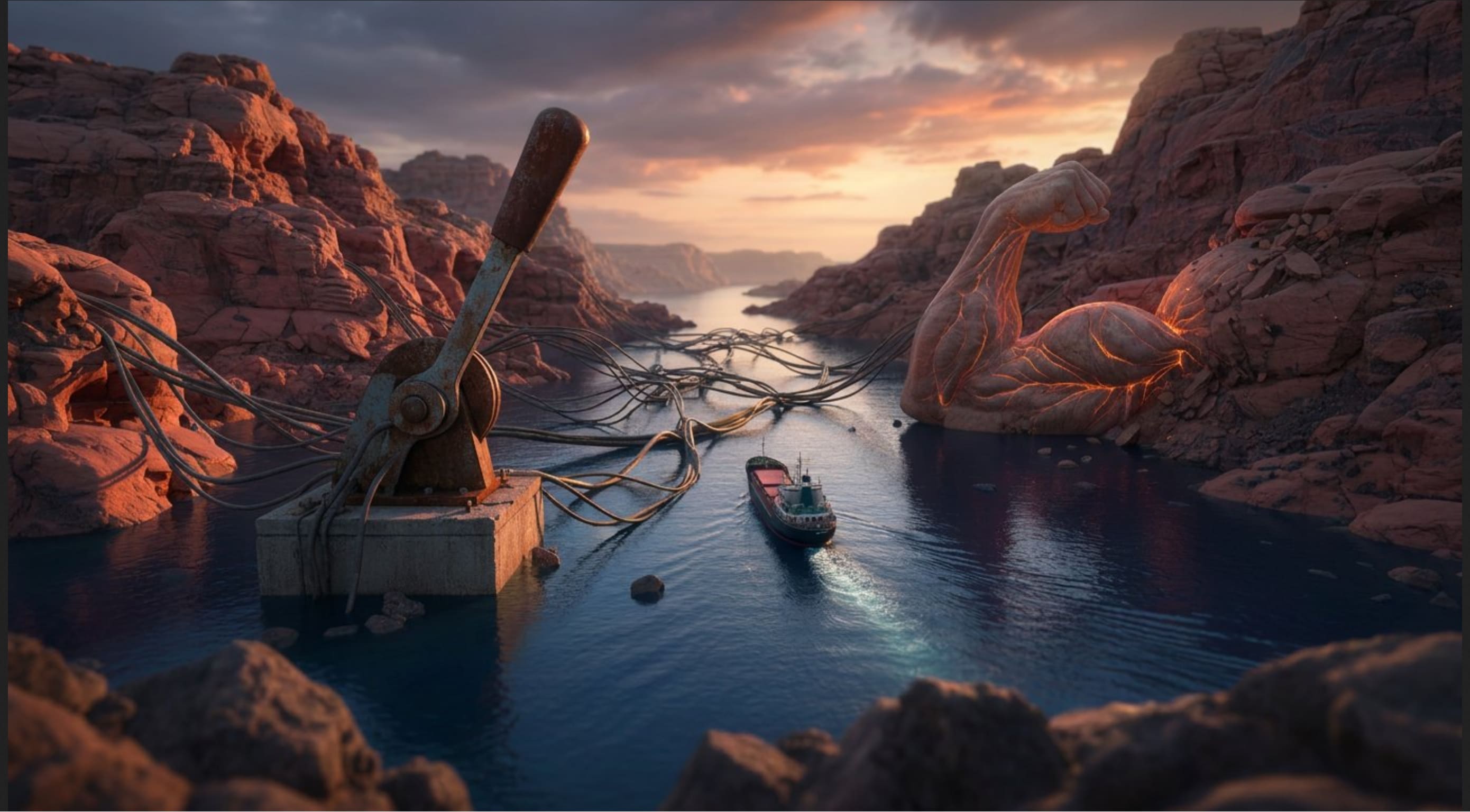
“SpaceX’s ambition … is ‘to extend the light of consciousness to the stars.’ To get to that ethereal end-state, however, will require colossal quantities of hard physical stuff.” — David Fickling, The Wall Street Journal, June 2026
Begin with the ships. Not the rocket, not the trillion-dollar ticker, not the cage fight on the White House lawn — the ships. According to the data firm Kpler, nearly six hundred vessels sat in the Persian Gulf this week awaiting departure, with hundreds more waiting on the other side of a twenty-one-mile-wide piece of water, while engineers prepared to clear the mines that Iran had sown across it. The Strait of Hormuz, President Trump announced, would reopen on Friday — “toll-free,” “permanently,” in the language he prefers for things that are neither. But senior officials conceded it could take more than two weeks to resume normal shipping, and months to bring infrastructure back to capacity. The oil cannot be wished through the narrows. It has to be sailed through, slowly, past the mines, by insurers who are not yet sure they want to underwrite the passage.
I want to hold that image — six hundred ships, idling, hostage to a strait — against the other image the week produced, which was its exact opposite. On the same Monday the ships sat still, SpaceX, three trading days after the largest IPO in the history of capital markets, climbed past Amazon to become the world’s fifth-largest public company, on the strength of a deal to buy a coding startup with stock that did not exist a week earlier. Its price-to-sales ratio is roughly a hundred and fifty. It lost $4.9 billion last year. “Feels like one of those meme stocks,” an analyst told Reuters; “you have to be very, very careful.” This is value at its most weightless — capital that has shed cash flow the way the smuggler in last week’s column had shed everything but his diamonds and his headphones, value as pure velocity, value that wants nothing so much as to leave the ground.
And there, in the gap between the still ships and the soaring stock, is the whole argument of the week. We live inside a long dream of frictionless flow — of oil, of capital, of intelligence, of images, all of it weightless, borderless, instantaneous. And the news, this week, was the dream waking up, again and again, at a chokepoint.
I. The Strait
The chokepoint is the oldest geopolitical fact there is, and we keep forgetting it. Alfred Thayer Mahan built an entire theory of history on it in The Influence of Sea Power upon History (1890): whoever holds the narrows — Gibraltar, Malacca, Suez, Hormuz — holds the artery, and the empire is the body that the artery feeds. The twenty-first century told itself it had dissolved all that, that the network had replaced the route, that we had floated free of geography into something called the cloud. Hormuz is geography’s reply. A waterway you can close with mines and small boats is not a metaphor. It is a place where matter sets the terms.
What makes this week genuinely novel is not that Iran closed the strait — empires have been strangling each other through narrows since Themistocles — but the precise jurisprudential shape of the fight over reopening it. Trump wants it “toll-free.” Iran’s Fars agency reports that Tehran and Oman intend to levy “service fees” after sixty days. This is not a quarrel about money. It is the four-hundred-year-old argument between Hugo Grotius and John Selden, revived in the Gulf. In Mare Liberum (1609), Grotius argued that the sea cannot be owned, that it is by nature free, common to all, beyond the reach of any sovereign’s enclosure — a doctrine the Dutch found congenial because it justified sailing wherever they pleased. Selden answered in Mare Clausum (1635): the sea can be closed, possessed, taxed, made the property of a crown. Every era reruns this dispute, and the side you take depends entirely on whether you own the strait or merely need to pass through it. Trump speaks Grotius because America buys the passage. Iran speaks Selden because Iran owns the shore. “Washington is no longer the guarantor of global energy security,” Semafor’s energy editor wrote, and the strait “will never really be ‘open’ in the same way again.” That sentence is the death certificate of Mare Liberum as an American birthright. The sea is closed now. Someone collects at the gate.
Paul Virilio, who spent his life arguing that every technology manufactures its own catastrophe, had the relevant aphorism: invent the ship and you invent the shipwreck; invent the strait and you invent the blockade. The global economy spent thirty years optimizing for flow — just-in-time, single chokepoint dependencies, lean everything — and in doing so manufactured, with great efficiency, the perfect hostage. Six hundred ships. The accident was always built into the architecture.
II. The Kill Switch
Now watch the same form appear where you would least expect it — in the one domain that was supposed to be pure mind, pure flow, pure escape from matter.
On Friday, the Trump administration ordered Anthropic to bar all foreign nationals — including its own foreign-born employees — from using its most powerful models, Mythos and Fable. The company, unable to comply selectively, shut access for everyone. DealBook called it crossing a Rubicon, and the metaphor is right but the river is wrong. What Washington demonstrated is that the cloud has a coastline, that artificial intelligence — the most apparently weightless thing humanity has built, a being made entirely of probability and electricity — passes through a strait, and that the strait has a gate, and that someone in Washington has a hand on it. Mikko Hyppönen, the Finnish security researcher, said the quiet part: if Washington can switch off access to American models, “that makes U.S. AI models problematic for the rest of the world.”
Carl Schmitt defined the sovereign as “he who decides on the exception” — the one who can suspend the normal order and reveal, in the suspension, where power actually lives. For a generation we were told that no one was sovereign over the internet, that it routed around control as around damage. The Anthropic order is the exception that names the sovereign. And the rest of the world understood it instantly in the grammar of the strait: France’s intelligence service tore up its Palantir contract for a domestic rival; Germany has snubbed Palantir for defense; the European Parliament, ratifying a trade deal, no longer trusts Washington enough to sign without exit clauses. Everyone is suddenly building pipelines around the chokepoint, exactly as the Gulf states are laying pipe around Hormuz. Mare clausum, once declared, makes every nation a shipbuilder.
And here is the cruelest detail. DeepSeek, China’s most valuable AI startup, raised $7.4 billion this week — a figure that “wouldn’t crack the top 10 in the US.” Why so small? Because, an analyst told Reuters, geopolitical constraints confine its fundraising to China and cut off its access to American hardware, making it “pointless to match the multi-billion-dollar computing budgets” of its rivals. The most disembodied industry on earth turns out to be governed, in the last instance, by the supply of physical chips — by sand, etched in particular ways, shipped through particular ports. The light of consciousness, here too, requires colossal quantities of hard physical stuff. There is no intelligence without a strait somewhere upstream, and someone deciding who sails.
III. The Image That Lost Its Referent
If oil and intelligence both kept running aground on matter this week, one thing did finally achieve escape velocity — and the man who watched it go is terrified.
Eli Saslow’s profile of Hany Farid is the most quietly devastating thing in any of these inboxes. Farid, sixty, is the world’s leading expert in detecting manipulated images. Governments and courts and newsrooms call him to tell them what is real. And he has stopped being able to tell. “I miss the days when it was a grainy video of a shark swimming up the street,” he says, pouring a whiskey on his back deck. “I don’t trust anything. Every image I see, I’m drawing lines for shadows and doing geometry in my head… Within a year or two, our whole visual system will be utterly useless.”
This is the chokepoint relocated to the inside of the skull. Jean Baudrillard, in Simulacra and Simulation (1981), described the “precession of simulacra” — the stage at which the image no longer bears any relation to a reality, no longer even pretends to, and finally “is its own pure simulacrum.” For decades that read like a French provocation, the kind of thing a graduate student quotes and a sensible person ignores. Farid is the sensible person, and he is telling us Baudrillard was an optimist. The image has severed itself from its referent. The strait between what we see and what is — the narrows through which all human knowledge of the distant world must pass — has been mined, and there is no minesweeper. We spent the week unable to verify the text of the Iran deal (no one has released it), unable to agree on whether Epstein’s death was a plot (the Times spent three million pages establishing only that no plot was provable), unable, soon, to believe our own eyes. The reopening of one strait coincided with the permanent mining of another.
IV. The Aging Muscle
And then, folded into a wellness newsletter between a recipe and a real-estate listing, the week offered its strangest dispatch from the frontier of matter.
One in five Australians over sixty, the Sydney Morning Herald reported, live with sarcopenia — age-related muscle loss — a condition more common than diabetes and largely invisible until it puts you in a wheelchair. The remedy is almost insultingly physical. No app, no model, no token. “In regard to muscle loss,” Dr. Ben Kirk said, “the term ‘use it or lose it’ holds true.” You must lift the weight. You must, repeatedly and in your own body, do the work, or the capacity disappears. Muscle is the one form of capital that cannot be compounded by proxy, cannot be financialized, cannot be offloaded to an agent. It does not have a learning loop. It has only loading.
Set that beside the other body the week refused to automate: the court reporter. The Wall Street Journal found that stenography has become a textbook case of AI’s limits, because the courtroom is irreducibly material — the cough, the slammed door, the gesture, the witness who must be gently asked to repeat traumatic testimony. Satya Nadella spent the week arguing, to sixty-four million views, that the future of the firm is “the ability to compound that learning across people and AI.” Hannah Arendt would have recognized the dream and named its blind spot. In The Human Condition (1958), she distinguished labor — the endless, bodily, cyclical work of keeping the organism alive, which leaves no monument — from work, which builds the durable world of things. Our age wants to abolish labor, to rise out of the body into pure compounding mind. But the muscle, the courtroom, the cleared mine, the laid pipe: these are labor, and labor is the chokepoint that consciousness cannot route around. You cannot offload your aging. You cannot offload your learning, Nadella admits — but he means it as triumph, and it lands as confession. The self is the last mare clausum. No one sails it for you.
Coda: The Cathedral
The image I cannot put down from this week is the Dormition Cathedral in Kyiv, one of the oldest and holiest sites in Eastern Orthodox Christianity, its roof engulfed in flame after a Russian strike, fire rising beside the onion cupolas. Zelensky called it “one of the largest Russian crimes against Christian culture.” It is the counter-image to every weightless thing the week produced. A cathedral is matter organized into memory — stone made to outlast the people who quarried it, the durable world in Arendt’s exact sense, the artifice that lets a civilization recognize itself across centuries. It burns in an afternoon. The trillion-dollar valuation can be re-minted by Tuesday; the cathedral cannot.
So the week put two ceremonies on offer. On the White House lawn, on the president’s eightieth birthday, a cage fight — crypto advertisements ringing the octagon, billionaires and cabinet members in the seats, a foiled plot to fly explosive drones into the crowd, pure spectacle, weightless, the society Debord diagnosed when he wrote that the spectacle is “capital accumulated to the point where it becomes image.” And six thousand miles away, six hundred ships sat motionless in the Gulf, and a cathedral’s roof fell in, and somewhere a sixty-year-old woman lifted a kettlebell so that she could still walk at eighty.
The age dreams of frictionless flow. It keeps waking up at the strait.
The Simulacrum of Stability: Fragments from the June Solstice, 2026
“History is a nightmare from which I am trying to awake,” Stephen Dedalus famously lamented in James Joyce’s Ulysses. Yet, scanning the telexes, digests, and newsletters of mid-June 2026, one wonders if the nightmare has not simply been reformatted for a pay-per-view audience. In the sprawling tapestry of dispatches from Bloomberg, Monocle, The Atlantic, and Semafor, we find a world oscillating violently between the tactile seductions of an analog past and the dematerialized brutalism of an algorithmic future. It is a moment defined by a paradoxical quest for autarky, where borders are simultaneously militarized and dissolved by technology, and where the specter of collapse is commodified, packaged, and sold as a “relief rally.”
To read the news of June 15 through 17, 2026, is to wander through a Guy Debord-esque Society of the Spectacle. On the South Lawn of the White House, to mark the nation’s 250th anniversary and the President’s 80th birthday, blood is spilled in a makeshift UFC octagon dubbed “The Claw.” It is an orgy of pumped-up patriotism and testosterone, a literalized “manosphere” manifest on the hallowed ground of diplomatic history. Meanwhile, across the Atlantic, Emmanuel Macron hosts the G7 at Évian-les-Bains, attempting to soothe the same American president with dinners at Versailles. As Newsweek observes, “You cannot stare down one who does not believe in the table. So, you add more chairs.” Here, geopolitics is stripped of its Metternichian subtlety, reduced to a primal theater of dominance.
Yet, beneath this performative masculinity, a profound geopolitical tectonic shift has occurred. The interim peace deal with Iran, set to be signed at Bürgenstock, is heralded by markets as a triumph. But as Bloomberg’s John Authers notes, quoting Jean Ergas, “Iran! — Peace to end all peace! Iran regime wins!” The United States, having initiated a war to dismantle the Islamic Republic’s nuclear capabilities, has essentially capitulated to the reality of geography. By demonstrating its capacity to close the Strait of Hormuz—a maritime chokepoint through which a fifth of the world’s energy flows—Iran has weaponized the very architecture of globalization.
In doing so, the war has accelerated the fragmentation of the global economy. As Semafor and the New York Times report, the Strait “will never really be ‘open’ in the same way again.” We are entering an era of autarkic policies, a regression to the mercantilist fortresses of the 1930s. This is the “Polanyian double movement” in action: as Karl Polanyi outlined in The Great Transformation, the utopian expansion of the market inevitably provokes a societal counter-movement aimed at self-protection. The race to electrification, the hoarding of rare earths, and the sustained central bank buying of gold are not mere economic data points; they are the nervous tics of a system preparing for a prolonged severance.
Simultaneously, the economic divergence of China provides a stark mirror to Western anxieties. As CNBC and Bloomberg report, Chinese retail sales have contracted for the first time since the pandemic, private capital expenditure has slumped, and the property crisis deepens. Yet, industrial output, driven by AI-related hardware demand, surges ahead. It is a “two-track economy” where the state betrays a profound Malthusian anxiety about its own consumer class. Beijing’s recent curbs on executive pay at state-owned financial institutions—a cap of roughly $148,000—reflects Xi Jinping’s “common prosperity” doctrine, an ideological pivot that echoes the egalitarian rhetoric of Mao, yet operates within a hyper-capitalist machine. As Semafor cleverly notes, Adidas is “Chinamaxxing,” participating in Chinese culture as a distinctly foreign brand, illustrating the paradox of a nationalist consumer base eagerly absorbing globalized goods.
If the macro-economy is fracturing, the micro-economy of artificial intelligence is consolidating power at a velocity that alarms even its creators. The Trump administration’s directive to Anthropic, barring foreign nationals from accessing its Fable and Mythos models, represents a Rubicon moment. As The Atlantic and FT report, Washington is treating frontier AI models as munitions. This digital embargo has sent shockwaves from Ottawa to Paris. Cohere’s Aidan Gomez calls it a “massive wake-up call,” while France’s spy agency drops Palantir for domestic alternatives.
In this AI arms race, we witness what Michel Foucault termed “governmentality”—the subjugation of knowledge to the apparatus of the state. Yet, the state is reacting to a technology that operates beyond its ontological comprehension. When Microsoft’s Satya Nadella argues that the future of the firm lies in the ability to compound learning between “human capital” and “token capital,” he is describing a post-human economic paradigm. As Parmy Olson warns in Bloomberg, AI may not necessarily destroy jobs, but it will “hollow out work,” turning humans into mere reviewers of algorithmic output. It is the ultimate realization of Hannah Arendt’s fear in The Human Condition: the subordination of homo faber (the human creator) to the automated processes of the animal laborans. The FT’s Sarah O’Connor rightly pushes back against the mechanistic view of the brain, reminding us that “we are not machines,” yet the market begs to differ.
Amidst this digital leviathan, culture offers a frantic, almost desperate, search for materiality. Monocle’s rapturous review of Hermès’s new London mega-flagship on New Bond Street is instructive. The luxury house, we are told, is “diverting modern-day luxury away from scale, logos and it-products, and instead towards craft, privacy and a healthy dose of fun.” It is a direct rebellion against the ephemeral, digital-queueing systems of the modern age. Here, the deep-burgundy leather railings and bright-yellow rooms of fine jewelry are bulwarks against a dematerialized world. It brings to mind Walter Benjamin’s assertion in The Work of Art in the Age of Mechanical Reproduction that the aura of an object is tied to its presence in time and space. In 2026, as AI-generated “slop” floods streaming services and deepfakes shatter our epistemological foundations—so much so that the NYT’s leading deepfake expert, Hany Farid, laments, “I don’t trust anything”—the physical craft of a hand-stitched leather bag becomes a form of high-end existential resistance.
This resistance is mirrored in the art world. At Art Basel, cautiously optimistic dealers bet on “quality over volume.” Meanwhile, in Münsterplatz, Ghanaian artist Ibrahim Mahama unveils The God of Small Things, a vast textile installation patchworked from batakari robes and post-independence-era rubber tires. Mahama’s work, emerging from his recovery from a brutal assault allegedly by Ghanaian police, is a profound materialization of post-colonial trauma. It stands in stark contrast to the sterile, data-driven abstractions of the financial markets. And in Houston, when a painting of a Black man draped in an American flag by Clarence Heyward is vandalized, the museum’s decision to hang it “as is”—punctured and scraped—turns the vandalism into a living testament to the enduring physical friction of racial politics. The canvas becomes a battleground, echoing Frantz Fanon’s observation in The Wretched of the Earth that decolonization is always a violent phenomenon, leaving scars that cannot be photoshopped away.
Even in our social policies, the tension between protection and connection plays out in paradoxical ways. The UK’s Keir Starmer announces a blanket ban on social media for under-16s. As Monocle argues, it is a policy that “treats children like the problem,” punishing the victims of algorithmic harm while failing to dismantle the Big Tech monopolies that monetize social division. It is a neo-Puritanical gesture, echoing Philippe Ariès’ Centuries of Childhood in its attempt to gatekeep the innocence of youth, yet it simultaneously denies the reality that for today’s youth, the digital realm is the agora. How can a government grant 16-year-olds the vote, as the FT points out, while banning them from the information ecosystem where modern political discourse is forged?
And then, there are the fleeting, luminous moments of collective transcendence that pierce through the doom. The New York Knicks win their first NBA championship in 53 years, prompting a cathartic, city-wide release of communal joy. Newsweek captures this beautifully: “What we saw across the Big Apple... was an express rejection of not just Trumpism but the modern political-media-tech industrial complex designed to split us into factions.” It is a reminder, as Albert Camus might say, that in the midst of an absurd world, the sheer, unadulterated celebration of a shared physical space is an act of rebellion.
Similarly, at the World Cup, Cape Verde—a tiny island nation making its tournament debut—holds Spain to a shocking 0-0 draw. A 40-year-old goalkeeper makes seven saves, and a single Polymarket trader loses $1 million on the certainty of a Spanish victory. It is a beautiful, statistical anomaly. The ancient Greeks believed that the gods intervened in sports to humble the hubris of mortals. In Cape Verde’s resilience, and in the Iranian national team’s defiant presence on American soil despite geopolitical war, we see the unscripted drama of the human spirit refusing to be algorithmically predicted.
As we close the newsletters of June 2026, the image that lingers is not the UFC cage on the White House lawn, nor the dry diplomatic communiqués of the G7. It is the New York Times report from the Park Avenue Armory, where the French sound artist Céleste Boursier-Mougenot has floated 250 glazed ceramic bowls in circular pools. Driven by physics and jets of water, the bowls collide, creating a symphony of dings, clinks, and bongs. The reviewer calls it “a powerful simulation of inevitability.”
This is the perfect metaphor for our present condition: a delicate, fragile ecosystem of discrete objects, pushed together by invisible currents, colliding and making music—or noise—in the dark. We are those floating bowls, bumping against one another in the turbulent waters of 2026, trying to find harmony in the inevitable, shattering collisions of our age.
THE STRAIT AND THE SPECTACLE
“History is a nightmare from which I am trying to awake.”
— James Joyce, Ulysses“The image is not a certain meaning, expressed by the director, and received by the passive audience. The image is a series of operations on a shared sensible fabric.”
— Jacques Rancière, The Emancipated Spectator
I. THE OVERWHELM OF THE SIMULTANEOUS
To read a digest of global news across three June days in 2026 is to experience what the cultural theorist Paul Virilio called dromology — the politics of speed — in its most vertiginous form. Here, in the brief interval of seventy-two hours, the world insists on its interconnectedness with an almost aggressive legibility: a narrow waterway between Oman and Iran reshapes energy markets; a luxury maison opens its doors on Bond Street; an 11th-century Ukrainian cathedral goes up in flames; an art market assembles its nervous optimism in Basel; a president turns eighty in the company of cage-fighters; an AI company finds itself conscripted into a geopolitical argument it did not ask to join. Marshall McLuhan, who imagined the “global village” as a space of simultaneous tribal drumbeats, would recognize this week’s news cycle instantly — and probably find it somewhat more lurid than even he had prophesied in Understanding Media (1964).
The difficulty of commentary, then, is not to find connections — connections are everywhere, almost embarrassingly available — but to resist the seduction of false coherence. A good week’s reading produces the illusion that the world is a single text, unfolding according to some authorial intention. It is not. It is, rather, what Roland Barthes called le bruissement de la langue — the rustle of language — a vast, polyphonic emanation that sounds like meaning without quite resolving into it. The literary critic’s task, and here we attempt something like it, is to sit with the rustle long enough to hear its actual rhythms.
What the newsletters of June 15–17, 2026 reveal, taken together, is a world in which the great structural tensions of the early twenty-first century — American hegemony versus multipolarity, digital capitalism versus the nation-state, the spectacle versus the real, globalization versus autarky — are not merely persisting but accelerating toward some as-yet-unnamed resolution. They reveal, above all, a world in which the concept of the chokepoint — physical, digital, political, cultural — has become the operative metaphor for power.
Let us begin with the most literal one.
II. THE STRAIT: CHOKEPOINTS AND THE GRAMMAR OF POWER
The Strait of Hormuz is twenty-one miles wide at its narrowest. Through it passes, in ordinary times, roughly twenty percent of the world’s traded oil and liquified natural gas — what Bloomberg calls “one fifth of the world’s oil and liquefied natural gas supplies.” For the three months preceding these newsletters, it had not been ordinary times. An American-Israeli war against Iran, begun on February 28th of this year, had seen Iran’s forces mine and effectively blockade this slender passage, stranding nearly six hundred vessels in the Persian Gulf and triggering a global energy crisis of the first magnitude.
The newsletters mark the moment of apparent resolution: a memorandum of understanding, negotiated under the auspices of Pakistan and scheduled to be signed in Switzerland on June 19th, promises Iran’s cooperation in reopening the Strait in exchange for immediate oil sales, access to a $300 billion development fund, and the eventual release of frozen assets. Oil drops. Markets rally. The world’s wealthiest five hundred people add $336 billion to their collective fortunes in a single trading session — the largest single-day wealth creation in the history of Bloomberg’s Billionaires Index.
This sequence — chokepoint, crisis, deal, market rally — is worth examining with some historical care, because it describes a recurring grammar of great-power politics whose deep logic has not changed since Thucydides set it down in the History of the Peloponnesian War. Athens, Thucydides observed, built its empire on control of the sea lanes, and it was the threat to those lanes — at Pylos, at Syracuse, at the Hellespont — that structured the war’s turning points. The city that commanded the straits commanded the trade; the city that commanded the trade commanded the politics. What Thucydides’ account demonstrates, with terrible lucidity, is that the logic of the chokepoint is not ultimately about geography but about will: whether the controlling power has the stomach to enforce its control under pressure.
The bloom of Donald Trump’s Iran adventure, as read through these dispatches, belongs to a tradition the historian Paul Kennedy anatomized in The Rise and Fall of the Great Powers (1987): the phenomenon of “imperial overstretch,” whereby a hegemonic power exhausts itself attempting to police commitments that outrun its material capacity and political will. Kennedy’s thesis — provocative when published, largely vindicated since — was that the correlation between productive economic base and military reach tends, over historical time, to reassert itself against ideological ambition. The United States, having entered the war with demands for “unconditional surrender,” exits it with an arrangement that the Bloomberg analyst Jean Ergas summarizes with barely suppressed glee: “Iran regime wins!”
Bloomberg’s John Authers, channeling the war’s market logic through the metaphor of Moby-Dick — specifically the “Nantucket sleighride” in which a harpooned whale drags the boat behind it — captures something the straight news coverage tends to miss: that this is a story about the limits of force as an instrument of political will, a lesson Clausewitz spent an entire career trying to teach and that political leaders in every generation must learn anew. “War is the continuation of politics by other means,” Clausewitz wrote in On War — but the corollary, which he also understood, is that when military force fails to deliver political results, politics must reassert itself, often on terms unfavorable to the initiating power.
The Newsweek columnist Carlo Versano, in a remarkably candid jeremiad, formulates this with the directness that only genuine anger can produce: “The world knows the limits of American power projection, and how little stomach the American people have for literally any economic pain resulting from a protracted conflict anywhere in the world. That is information you better believe the Chinese are gonna keep in their back pocket.” This is Thucydides updated for the attention economy — the Melian Dialogue restated in the vocabulary of geopolitical leverage — and it is no less disturbing for being expressed in the register of a political newsletter rather than a work of classical historiography.
The deeper irony, which both Bloomberg’s analysis and Newsweek’s commentary identify, is that Iran has demonstrated something new and teachable: that a determined regional power, equipped with inexpensive drone technology and control of a geographic bottleneck, can force a superpower to the negotiating table. Bloomberg’s Points of Return newsletter draws out the structural implications: “Countries that enjoy some form of chokepoint in the global economic system have the green light to exploit it. China’s control of rare earths and Iran’s power over Hormuz have both now forced a US climbdown within the space of 12 months.” The political economist Susan Strange, in her late work The Retreat of the State (1996), argued that structural power — the capacity to shape the framework within which others must operate — was increasingly more important than relational power. Iran, armed with five-hundred-dollar drones and a geological accident, has demonstrated Strange’s thesis in real time.
Against this backdrop of deglobalization anxiety, the newsletter dispatches note that “autarkic policies make sense” but “will come with a cost” — an observation that retrieves the spirit of Karl Polanyi’s The Great Transformation (1944), which argued that the liberal international economic order is not a natural condition but a political construction, and that its disruption always produces dislocation that falls hardest on those least able to absorb it. The roughly six hundred vessels stranded in the Persian Gulf, the spike in shipping insurance, the inflation transmitted into the food prices of Nigerian households — these are the human substance of what market dispatches record as basis-point movements.
III. THE ALGORITHM AS FRONTIER: AI AND THE NEW ENCLOSURES
If the Strait of Hormuz represents the physical chokepoint around which this week’s geopolitical drama revolves, the restriction of Anthropic’s Fable 5 and Mythos 5 models represents the digital one. On what Bloomberg describes as “yet another Friday night bombshell from Washington,” the Trump administration imposed export controls on the company’s two most advanced AI models, effectively barring any foreign national anywhere in the world from accessing them — including, in a detail of almost Kafkaesque precision, many of the company’s own staff.
The reaction is instructive. Canadian Prime Minister Mark Carney immediately identifies the episode as a demonstration of “something that can happen with over-reliance on certain models.” Cohere’s co-founder Aidan Gomez calls it a “massive wake-up call” that “exposes the pitfalls of outsourcing machine intelligence.” Across the world, AI companies sense opportunity in Anthropic’s distress, while governments that had outsourced their digital infrastructure to American platforms find themselves reconsidering the terms of that dependence.
This is, in miniature, a replay of the dynamic that the political theorist Langdon Winner examined in his prescient 1980 essay “Do Artifacts Have Politics?” — the argument that technology is never merely instrumental but is always already saturated with the power relations of the society that produces it. The export control on AI models is not a departure from the logic of American technological hegemony; it is its most candid expression. For decades, the global diffusion of American digital platforms — from Google to Meta to now Anthropic — has been understood, even celebrated, as a form of soft power whose beneficence appeared obvious to its practitioners. The Friday-night executive order makes visible what was always structurally true: that the platform and the nation-state that hosts it are not separate things.
The philosopher Norbert Wiener, who founded the field of cybernetics in The Human Use of Human Beings (1950), spent his final years trying to warn the world that the automation of decision-making carried within it the seeds of a new kind of totalitarianism — not the dramatic kind, with its uniforms and rallies, but the quiet, administrative kind, in which the capacity for meaningful human choice was progressively colonized by systems whose designers had ceased to understand their own creations. Wiener’s anxiety was, characteristically, ahead of its time. The Anthropic episode — a company that cannot fully explain why its model might be able to bypass its own safety guardrails on cybersecurity tasks — is exactly the kind of situation he feared: a technology at the frontier of human comprehension, deployed at civilizational scale, suddenly conscripted into the logic of national security with consequences nobody can fully calculate.
Michel Foucault’s concept of gouvernementalité — the ways in which power operates not through direct coercion but through the shaping of the conditions within which people make choices — finds its most contemporary expression here. The AI lab that trained its model on the collective written output of human civilization is now a vector of national security policy. The researcher in Seoul or Nairobi who needs access to the model for her work finds that access suspended by an executive order issued from the other side of the world. The RBC CEO Dave McKay, who tells Bloomberg that an AI system “produces a report for me” each morning, is a figure both of the age’s promise and its pathos: the executive whose cognitive scaffolding now runs on infrastructure he did not build and cannot control.
The Bloomberg newsletter’s observation that the G7 summit itself put AI “notably in the financial sector” at the top of its agenda, with the CEOs of OpenAI and Anthropic attending a working lunch on “safe, rapid and effective deployment,” captures the peculiar governance theatre of the moment: the same week that one arm of the American state imposes emergency export controls on an AI company, another arm of the same state is hosting that company’s CEO for a diplomatic lunch in the French Alps. The left hand, as it were, does not know what the right hand is doing — or perhaps knows all too well, and has decided that this productive ambiguity serves its purposes.
IV. THE SPECTACLE OF THE IPO: ELON MUSK AND THE NEW GILDED AGE
SpaceX’s $86.2 billion initial public offering, which took place the week before these newsletters and reverberates through all of them, is many things simultaneously: a genuine technological achievement, a financial event of historic scale, a cultural moment of peculiar significance, and — perhaps most revealingly — a window into the political economy of the contemporary United States.
The Economist Thorstein Veblen, in The Theory of the Leisure Class (1899), coined the term “conspicuous consumption” to describe the way in which the wealthy signal their status through ostentation rather than utility. But Veblen also had a complementary theory — less often cited — of “pecuniary emulation,” the mechanism by which entire societies reorient themselves around the worship of wealth and the wealthy. SpaceX’s IPO, designed explicitly (as the Bloomberg dispatches note) to give ordinary retail investors a symbolic stake in the company — each eligible customer at Robinhood, Schwab, Fidelity receiving at least one share — is a masterwork of pecuniary emulation in the Veblenian sense: it democratizes the appearance of participation while concentrating the actual gains in the hands of those who were already wealthy.
The novelist F. Scott Fitzgerald understood something about this dynamic that no economist has quite matched. In The Great Gatsby (1925), he wrote of “the service of a vast, vulgar, and meretricious beauty” — and the phrase is unavoidably available to anyone watching SpaceX’s stock price rise more than fifty percent in three trading sessions, or tracking the moment at which the company briefly displaced Amazon as the world’s fourth-largest publicly traded company. The billionaire Antonio Gracias’s net worth crosses $24 billion. SpaceX acquires the AI coding startup Cursor for $60 billion, “minting four more multibillionaires” in the process.
Thomas Piketty’s central argument in Capital in the Twenty-First Century (2013) — that when the rate of return on capital exceeds the rate of economic growth, inequality will increase without bound — has never seemed more grimly accurate than in a week when the 500 wealthiest people on earth add $336 billion to their fortunes in a single day, a fact reported without apparent irony in the same newsletters that also note an Ebola outbreak overwhelming treatment centers in eastern Congo. The contrast is not incidental; it is structural. The Bloomberg Billionaires Index and the Ebola mortality figures are produced by the same global economic system, and both are consequences of its operating logic.
The Bloomberg opinion piece by Gautam Mukunda — which the newsletters cite as arguing that “trillionaires and republics will be a toxic mix” — retrieves the concerns of the political philosopher Aristotle, who in the Politics argued that extreme inequality was incompatible with democratic self-governance, and of Montesquieu, who made a similar argument in The Spirit of the Laws. These are not marginal views; they represent the mainstream of political philosophy from antiquity through the Enlightenment. That they must now be restated as opinion pieces in financial newsletters — alongside advertisements for luxury goods and tips on frozen yogurt pricing — is itself a measure of how thoroughly the economic has colonized the political.
V. CHINA’S DIVIDED SELF: THE PARADOX OF THE GREAT DIVERGENCE
The economic data from China reported in these newsletters presents a portrait of a society bifurcated in ways that recall a different moment in economic history. Retail sales falling for the first time since the end of Covid lockdowns. Car purchases down sixteen percent. Home prices declining. Fixed-asset investment shrinking. Private capital expenditure at its worst pace since 2020. And yet: industrial production climbing, driven by AI-related hardware exports. The MSCI China Index down ten percent for the year, while semiconductor manufacturers in Korea post gains of five percent in a single session.
This is not, as some Western commentary reflexively suggests, simply the failure of the Chinese economic model. It is something more interesting and more troubling: the visible divergence between the sectors of the global economy that are flourishing under the AI boom and those — housing, retail, traditional manufacturing — that are being hollowed out by precisely the forces that are enriching the technology sector. The CNBC correspondent in Beijing offers a vivid ground-level detail: the streets are full of people again this summer, “not necessarily spending much, but enjoying the best air quality in recent years.” There is something haunting about this image — a population that has emerged from pandemic restriction and war-induced economic stress into a peculiar form of post-growth leisure: present, mobile, not buying.
John Maynard Keynes, in his famous 1930 essay “Economic Possibilities for Our Grandchildren,” imagined that by the early twenty-first century, the solving of the “economic problem” would leave humanity with “our greatest challenge”: how to use the freedom that technological abundance would provide. The Chinese urban professional wandering the streets of Beijing at four in the morning, the high schooler who has just completed the gaokao, the film industry worker — these figures might be read as early inhabitants of the post-growth world that Keynes imagined, except that the abundance is distributed grotesquely unevenly, and the freedom is shadowed by structural precarity.
The economist’s dilemma, as the KKR mid-year outlook cited in the CNBC newsletter formulates it, is that “property remains the single biggest reason we are not more bullish” on China — a single sector dragging down an entire economy by the force of its accumulated debt and unsold inventory. This is the Minskyian moment that the economist Hyman Minsky spent his career analyzing: the point at which a prolonged period of stability produces the very instability it has suppressed, as debt structures that seemed sustainable during the boom become unsustainable once asset prices turn. The Chinese property market’s slow-motion deflation is not a Chinese phenomenon; it is a global phenomenon that happens to be most visible in China.
VI. ART UNDER FIRE, ART IN THE MARKETPLACE
“Culture under fire” — the headline that ARTnews applies to the Russian drone strike on Kyiv’s eleventh-century Dormition Cathedral — is a phrase with a long, melancholy history. Zelensky calls the attack “one of Russia’s most serious crimes against Christian culture to date.” France’s foreign minister invokes Notre-Dame. The language of cultural patrimony, of the wound to civilization itself, is deployed with familiar urgency.
Walter Benjamin, in his 1936 essay “The Work of Art in the Age of Mechanical Reproduction,” observed that every document of civilization is simultaneously a document of barbarism. The Dormition Cathedral — built in the eleventh century, rebuilt after destruction by the Mongols, damaged during the Second World War, now damaged again — embodies this insight with terrible literalism. It is a building that has survived as a palimpsest of every catastrophe that has washed across Eastern Europe, and now bears the mark of another. The drones found at the site, Shaheds of Iranian manufacture, connect this act of cultural destruction to the same military-industrial complex that has been blockading the Strait of Hormuz: a thread of iron and fuel connecting a Ukrainian monastery to a Persian Gulf shipping lane to an American stock market.
In Houston, meanwhile, two white men dress in black and slip into the Museum of African American Culture to scrape and puncture Clarence Heyward’s painting Man in the Garden — a portrait of a Black man draped in the American flag. The museum’s decision not to repair the painting but to display it as-is converts an act of destruction into an act of testimony. “Art has long been a space where social tensions become visible,” the artist says. Susan Sontag, in Regarding the Pain of Others (2003), reflected on the way that images of suffering and violation can function either as evidence or as aesthetic object — and the Houston museum’s decision is precisely the kind of intervention she analyzed: a refusal of the neutralizing power of restoration, a choice to let the wound remain legible.
Across the Atlantic, Basel is assembling its annual festival of the art market. ARTnews describes “cautiously optimistic” dealers after “three years of market correction,” with galleries “betting on quality over volume” and relying on “prudent pricing.” The art market, as the sociologist Pierre Bourdieu analyzed it in The Field of Cultural Production (1993), is the paradigmatic case of what he called “symbolic capital” — the transformation of economic value into cultural legitimacy and back again, through a process that simultaneously mystifies and reproduces inequality. Art Basel is the annual apotheosis of this process: a fair where the ultra-wealthy gather to acquire objects whose value derives precisely from their inaccessibility to everyone else, while simultaneously asserting their possession of refined taste.
Ibrahim Mahama’s installation on the Münsterplatz — a vast textile work patchworked from batakari robes, post-independence rubber tires, and truck canvases that ended their European journeys in Ghana — is titled The God of Small Things. The title, borrowed from Arundhati Roy’s 1997 Booker Prize novel, is not accidental. Roy’s book is about the violence of caste and the “Love Laws” that determine “who should be loved, and how. And how much” — an analysis of how social systems encode hierarchy into the texture of everyday life. Mahama, himself recovering from a brutal physical attack allegedly at the hands of Ghanaian police, has assembled materials that trace the flow of Western surplus into African spaces, converting the debris of European logistics into a meditation on the afterlives of things. The installation does not merely critique the art market in which it appears; it metabolizes it.
VII. THE BODY POLITIC: UFC, SOCIAL MEDIA, AND THE THEATRE OF FORCE
On Sunday, June 15th, as markets digest the Iran peace deal, Donald Trump turns eighty on the White House South Lawn with an Ultimate Fighting Championship bout staged in a specially constructed arena called “The Claw.” The Monocle newsletter, with its characteristic mixture of aesthetic judgement and political analysis, describes “an orgy of pumped-up patriotism and testosterone, the manosphere that helped to sweep Trump to power manifest on his back lawn.”
The spectacle is worth examining at length, because it is the kind of political performance that conventional political science is poorly equipped to analyze, and that cultural theory handles rather better. Norbert Elias, in The Civilizing Process (1939), traced the long historical arc by which European societies gradually internalized controls on the public expression of violence, substituting regulated spectacle — tournaments, sports, theatrical warfare — for actual brutality. The UFC bout on the White House lawn is, in Elias’s terms, a deliberate inversion of this civilizing process: a calculated assertion that the managed violence of the combat sport is an appropriate setting for presidential celebration. The inverted reading is also possible, of course — that this is precisely the sublimation of violence that Elias described, and that the spectacle of controlled brutality is safer than its alternatives.
Don DeLillo, in White Noise (1985) and throughout his subsequent career, has been the novelist most attuned to the way that American public culture uses spectacle to manage anxiety. The UFC event at the White House — with its fighter-draped flags, its colossal red-white-and-blue structure dwarfing the executive mansion, its audience of tech billionaires and political allies — is precisely the kind of overcoded tableau that DeLillo’s fiction has always inhabited. The “pumped-up patriotism” that Monocle identifies is not irrational; it is the performance of a particular claim about what America is, offered at a moment when American power in the Persian Gulf has just been revealed as more limited than previously advertised.
Simultaneously, Keir Starmer’s government announces a ban on social media for under-16s — following Australia’s 2025 model and joining a growing international movement toward state regulation of children’s digital lives. Monocle’s Yo Zushi offers the most cogent critique: the ban addresses the wrong problem. If “the algorithms are at fault, why not target the technology, rather than its victims?” This is, in miniature, the same question that John Stuart Mill posed in On Liberty (1859) — where is the appropriate boundary between individual freedom and state protection? — recontextualized for the digital age. Mill’s answer, roughly, was that the state’s legitimate interest in restricting liberty was confined to preventing harm to others; the harm from social media algorithms flows, on Zushi’s analysis, from the algorithms themselves, not from the children who use them.
Neil Postman, in Amusing Ourselves to Death (1985), argued that television had converted American public discourse into entertainment, with consequences for political rationality that we are still living with. His analysis was prescient, but it could not fully anticipate the recursive quality of the social media era, in which the platform is not merely an entertainment medium but a social infrastructure whose removal from a child’s life is, as the NSPCC acknowledges, potentially harmful for “the disabled and LGBT+ communities” who rely on it for support. The social media ban is a regulatory response to a problem that regulation alone cannot solve — a political gesture toward a set of anxieties whose actual remediation would require structural changes to the business models of the companies involved.
That those companies — TikTok, Instagram, Facebook, X, YouTube — will, under the UK ban, be required to verify ages and collect more data from users, thereby increasing the private information held by the very corporations whose conduct prompted the ban, is the kind of irony that Kafka might have recognized, and that Zushi identifies crisply: “the ban will hand more private data to tech giants.”
VIII. THE GLOBAL SOUTH: AID, ARMS, AND THE LONG SHADOW OF EXTRACTION
The Bloomberg dispatches from Africa and the Middle East trace, in parallel, two stories that are in fact one story told from different ends.
In Sudan, the newsletter reports, “more than a hundred thousand people” have died in a civil war between the Sudanese Armed Forces and the Rapid Support Forces, while weapons flow in from the UAE, Turkey, China, and Iran. The Bloomberg “Next Africa” newsletter notes that “Iranian drones used by Sudan’s army” are now a liability as the military seeks American support in peace talks — the same Iranian drones whose variants have struck Kyiv’s cathedral, mined the Strait of Hormuz, and been found at sites across the Middle East. The drone is the week’s connective tissue: manufactured in Iran, deployed in Sudan, used against Ukrainian civilians, discovered at a UNESCO-listed monastery. Arms flow; culture burns; people die; markets briefly register and move on.
In South Africa, meanwhile, the newsletter traces a tale of two cities whose divergence encodes the legacies of apartheid with a clarity that no amount of macroeconomic data could quite capture. Cape Town — politically stable, infrastructure-maintaining, business-friendly — is pulling ahead of Johannesburg in nearly every economic metric. The analysis is presented in largely managerial terms, as a story about good governance and political stability. But Achille Mbembe, the Cameroonian philosopher who has spent decades analyzing what he calls “necropolitics” — the ways in which power decides who gets to live and who is left to die — would read this divergence differently: as the ongoing spatial expression of a racialized geography that apartheid inscribed and the new South Africa has not yet managed to undo. “The poor [remain] far from work opportunities,” the newsletter acknowledges, in the same sentence that describes Cape Town’s “scenic coastline and steep mountain slopes.”
China’s $3.5 million HIV grant to South Africa — replacing, provisionally and inadequately, more than $400 million in annual American Pepfar funding — is reported as a story about geopolitical competition, and it is that. But it is also a story about what happens when the hegemon withdraws from the responsibilities that accompany hegemony. The political scientist Joseph Nye coined the concept of “soft power” — the ability to attract and co-opt rather than coerce — as a description of American influence through aid, cultural exchange, and institutional leadership. The Bloomberg dispatches track, in real time, the speed with which that soft power is being converted into hard resentment, and the speed with which China — operating “at a fraction of the price,” as Bloomberg notes — is filling the void with smaller but symbolically meaningful interventions.
Frantz Fanon, in The Wretched of the Earth (1961), wrote that decolonization is always a violent phenomenon because colonialism itself is always violent — not merely in its overt brutality but in the structural violence of its economic arrangements. The Ebola outbreak in eastern Congo, overwhelming treatment centers as “surveillance, testing and contact tracing are struggling to keep pace,” represents this structural violence in one of its most unmediated forms: a disease that spreads in conditions of poverty and conflict, treated with resources depleted by the withdrawal of American foreign aid, in a country whose mineral wealth has been extracted for over a century by forces that share no part of the consequent liability.
Paul Collier, in The Bottom Billion (2007), identified the “conflict trap” — the way in which civil conflict and resource extraction reinforce each other in a feedback loop that traps the poorest societies in perpetual instability — as one of the central obstacles to development in sub-Saharan Africa. Sudan and Congo, in these dispatches, are studies in that trap’s continued operation.
IX. THE LUXURY OF THE PRESENT: HERMÈS, ART BASEL, AND THE AESTHETICS OF CAPITAL
The Hermès London flagship — six buildings, four staircases, fifty-five rooms, a Foster + Partners spiral staircase, a five-hundred-piece art collection selected by artistic director Pierre Alexis-Dumas — opens on New Bond Street the same week that Kyiv’s cathedral burns. This is not a comparison to be made cheaply; both are significant facts about the world, and their simultaneity is not meaningless.
Walter Benjamin’s Arcades Project — his vast, unfinished meditation on the Paris shopping arcades of the nineteenth century — argued that the commodity form was not merely an economic phenomenon but a dreamworld, a collective hallucination that converted the products of labor into objects of quasi-magical significance. The luxury fashion house, in its twenty-first-century mega-flagship incarnation, is the Arcades Project updated for an era of global capital mobility and Instagram documentation. The Monocle newsletter, ever alert to the distinction between good design and mere expense, praises Hermès for “helping to divert modern-day luxury away from scale, logos and it-products, and instead towards craft, privacy and a healthy dose of fun” — a formulation that inadvertently reveals the ideology of taste itself: the aspiration is not to escape the logic of luxury but to refine it into a form that seems to transcend mere wealth.
Thorstein Veblen would have recognized the maneuver instantly. In The Theory of the Leisure Class, he described how the highest form of conspicuous consumption is precisely the consumption that does not appear conspicuous — the deep-burgundy leather railing, the privately repaired handbag, the “one-on-one service” in the upstairs rooms, the artworks that are not for sale. The Hermès flagship is, among many other things, a monument to the discovery that the ultra-wealthy are willing to pay enormous premiums to feel that they are not merely rich but cultivated — that their wealth has been transmuted into something less vulgarly material than money.
Art Basel performs a related operation at larger scale. The “cautious optimism” of the dealers, the “tightly edited stands and prudent pricing,” the “quality over volume” ethos that ARTnews describes — all of this is the art market performing its self-understanding as a domain of aesthetic judgment rather than speculation, even as the same fair hosts Leonardo Drew’s new gallery representation with Hauser & Wirth and Leonora Carrington’s estate signing with Almine Rech. The art market and the luxury fashion market are, in Bourdieu’s framework, variants of the same machine: the conversion of economic capital into symbolic capital and back, a laundering of wealth into value that the society at large is then invited to revere.
Grace Wales Bonner’s appointment as Hermès’s menswear artistic director — announced for January 2027 — is the most interesting gesture in the Monocle fashion dispatch: a British-Jamaican designer, “lauded for her mastery of tailoring as much as her cultural credibility,” being granted stewardship of one of the oldest French luxury houses. This is either the luxury industry’s recognition that “cultural credibility” is its most precious current resource, or something more genuinely hopeful: the slow diversification of what counts as taste. Probably both.
X. THE WORLD CUP AS WORLD: PLAY, POLITICS, AND THE PEDAGOGY OF THE UPSET
The 2026 FIFA World Cup — played across eleven American cities, the first since prediction markets “exploded onto the scene as a new way to bet on sports” — runs through these newsletters as a kind of comic counterpoint to the week’s geopolitical grimness. Spain, “the most recent European champion” and Goldman Sachs’s twenty-six-percent probability favorite, is held to a draw by Cabo Verde, a nation that “has never played in the tournament before and has no high-profile professional players on its roster.” A single trader on Polymarket loses nearly a million dollars. The forty-year-old Cabo Verde goalkeeper leaves the pitch in tears.
Johan Huizinga, in Homo Ludens (1938), argued that play was not a subsidiary activity of human culture but its very foundation — that the spirit of genuine play, the Spielraum in which rules are freely accepted and freely observed, was the precondition for all genuine cultural production. The World Cup is, at its best, a manifestation of this Huizingan spirit: the moment when Cabo Verde’s forty-year-old goalkeeper stops a Spanish shot that the probability models said would not be stopped is genuinely a moment outside the order of money and power, a moment in which the smaller thing asserts itself against the larger.
The Iran national team’s experience in Los Angeles complicates this idealism with characteristic force. The players — several of them veterans of the 2022 Qatar tournament, where they silently declined to sing the national anthem in protest of the Mahsa Amini crackdown — now find themselves subjected to five-hour security checks for a short journey from Tijuana, with key staff denied visas and FIFA reportedly indifferent to their plight. The Newsweek reporter’s observation that “these players were on the field in Qatar in 2022, when they stood silently during the national anthem” and “faced sanctions back home for it, and they did it anyway” is one of the most quietly powerful passages in the entire digest: a reminder that even within the most thoroughly commercialized spectacle, there are human beings capable of principled action at personal cost.
The prediction market that lost a million dollars on the Cabo Verde draw is the financial market’s colonial claim on the territory of play: the conversion of uncertainty into risk, the pricing of outcomes that are, at their best, genuinely unpredictable. Friedrich Hayek, who argued in “The Use of Knowledge in Society” (1945) that prices were the most efficient mechanism for aggregating dispersed information, would have been interested in prediction markets as a real-time test of his thesis. The Cabo Verde goalkeeper is its refutation.
XI. THE FORM OF THE DISPATCH: ON NEWSLETTERS AND THE CONSTRUCTION OF THE PRESENT
It would be incomplete to reflect on this digest without reflecting on its form. These are newsletters — a genre that has experienced, in the decade of their composition, a curious renaissance. The newsletter is neither book nor broadcast, neither argument nor reportage; it is something closer to what Virginia Woolf, in A Writer’s Diary, called “the present moment” — the attempt to capture experience in its own motion, before retrospection has organized it into meaning.
The epistolary form has a long history in literature — from Montaigne’s essays (which he conceived as letters to an imagined reader) through Richardson’s Pamela and Laclos’ Les Liaisons Dangereuses to the actual newspapers of the Enlightenment and the personal letters of Keats and Flaubert. What the newsletter adds is immediacy without conversation: the voice of an interlocutor who is always present but never responds, who shapes your morning with the authority of an editor and the intimacy of a friend.
The Bloomberg “Points of Return” newsletter’s extended mountaineering metaphor — tracking inflation as the ascent and descent of a “Rates Mountain” — is itself a literary act: the imposition of narrative coherence on data that resists it, the conversion of monetary policy into adventure story. That the same dispatch ends with a list of songs about mountains — from Marvin Gaye’s “Ain’t No Mountain High Enough” to Midnight Oil’s “King of the Mountain” — is a disclosure of the sensibility behind the analysis: a sensibility that finds aesthetic pleasure even in the mechanics of central banking, and that is not ashamed to say so.
Marcel Proust, in In Search of Lost Time, argued that involuntary memory — the sudden recollection triggered by a taste, a smell, a texture — was the only form of true remembrance, because it recovered the past in its original emotional weight rather than its retrospective organization. The newsletter functions as something like involuntary memory’s opposite: a willed reconstruction of the present, assembled from the most visible data points of the day, designed to provide orientation in real time. Its limitation is exactly what it purchases: the orientation comes at the cost of depth, the immediate at the cost of the considered.
XII. CODA: THE STRAIT REOPENS, THE WORLD GOES ON
On Friday, June 19th — the date on which these newsletters are compiled, the date on which the US-Iran memorandum of understanding is scheduled to be signed in Switzerland — the approximately six hundred vessels stranded in the Persian Gulf will begin, tentatively, to move. The mines will be cleared, or some of them will, over weeks that will feel to the shipping executives and oil traders as much longer. The global energy crisis will ease, or ease somewhat, or ease unevenly, depending on which part of the world one inhabits. Markets will calibrate. Central banks will decide. The 500 richest people will, in aggregate, be somewhat richer or somewhat poorer than they were the week before. The Hermès flagship will open its gilded doors every morning at nine. Art Basel will close. The World Cup will continue.
And somewhere in eastern Congo, an Ebola treatment center will be overwhelmed, and the patients in it will wait for resources that the withdrawal of American foreign aid has made more scarce, in a geopolitical moment when China has offered $3.5 million to fill a gap that previously received $400 million per year, and when the fifty richest people on earth added to their fortunes, in a single trading session, more than the total annual humanitarian aid budget of the United States.
T.S. Eliot, in The Waste Land (1922), assembled the shards of a broken civilization into a poem that derived its force precisely from their juxtaposition — from the refusal to smooth the contradictions into a single, consoling narrative. The newsletter digest of June 15–17, 2026, is not art; it is information. But read with Eliot’s attention to juxtaposition, it offers something similar to what he offered: the sense of a civilization that is not failing so much as failing to notice the degree to which its various activities are connected, and the degree to which the same logic that produces a $336 billion single-day wealth creation also produces a cholera ward in Khartoum and an overwhelmed Ebola clinic in Goma.
Samuel Beckett — whose drama Waiting for Godot gave the twentieth century its most enduring image of human beings caught in recursive uncertainty, performing activity in the absence of arrival — offered as his deepest insight not despair but the obligation to continue: “I can’t go on, I’ll go on.” The Cabo Verde goalkeeper who stops the Spanish shot, the Houston museum that displays the damaged painting rather than repair it, the Ghanaian artist who takes his installation to Basel three months after a brutal attack — these are figures of continuance rather than triumph, of the insistence on meaning in conditions that do not obviously support it.
The strait will reopen. The world will go on. Whether it goes on wisely is the question that the newsletters, in their dispatch-by-dispatch urgency, both pose and defer, as every newspaper in every era has done, consigning the answer to a future that is always, by definition, the next day’s edition.
The Strait, the Octagon, the Algorithm
“Time is not a line but a series of punctual nows.”
— after Gilles Deleuze
I. The Hydraulic Empire and the Hexagonal Cage
Picture, if you will, the early summer of 2026. The Strait of Hormuz — that twenty-one-mile-wide squiggle of seawater through which, in peacetime, one-fifth of the planet’s hydrocarbons pass like blood through a clenched fist — has just been prised open again. The news comes not in the form of a treaty but as a truthful social-media post: Donald J. Trump, age eighty, declaring on his own platform that “The Deal with the Islamic Republic of Iran is now complete. Congratulations to all! … Ships of the World, start your engines. Let the oil flow!” A hundred and fifty Iranian missiles and nearly five thousand drones later, a memorandum of understanding is signed in Switzerland on the nineteenth of June. Sixty days of further negotiations; a $300 billion development fund; the unfreezing of some $25 billion in Iranian assets; a waiver of oil sanctions. Iran, the bulletins whisper, has retained the right to charge transit tolls, jointly with Oman, once the sixty-day window has elapsed.
What is this, if not the apotheosis of the hydraulic empire — to borrow a phrase from the historian Peter Frankopan, whose The Silk Roads (2015) and The New Silk Roads (2018) made us reconsider that the world’s pivots have never quite sat where nineteenth-century mapmakers pinned them? For two centuries we had grown accustomed to a maritime order policed by the Anglo-American fleet — a Pax Britannica extended, mutatis mutandis, into a Pax Americana. The British did it with coaling stations and cable landings; the Americans with carrier groups and dollar clearing. Both operated under the implicit understanding that the sea-lane was a public good, free at the point of use, guaranteed by the slow violence of an offshore balancer.
That compact, like all compacts, has been eroding for at least a decade. By 2026, what remains is less a system than a condition — what the late Tony Judt, in Postwar (2005), might have called a “settled disorder.” For the first time since the Suez Crisis of 1956 — when Eisenhower and Khrushchev together administered a corrective to the British, French, and Israelis — a regional power has managed to weaponise a chokepoint and, against a fully mobilised American war machine, extracted terms. The Strait was mined; the US Navy blockaded Iranian ports; Tehran, in turn, threatened Gulf shipping with $500 drones and the closure of a waterway through which, the Economist notes with that particular blend of alarm and relish it reserves for the truly ominous, “five-star hotels and airports” can be touched by accident. The Gulf’s “carefully cultivated images as havens of stability,” in Newsweek‘s splendid phrase, “have been badly set back.”
In Capital in the Twenty-First Century (2013), Thomas Piketty observed that capital seeks the lowest r in the formula r > g, and is unhappiest when confronted with the inverse. The Strait of Hormuz moment is the inverse made geographical. A single piece of coastline, held by a “rump regime of theocrats” (Carlo Versano’s mordant formulation), has, for the second time in twelve months, “forced a US climbdown” — John Authers in Bloomberg underlines this with the cold joy of a man who has been vindicated by events. Earlier, China’s chokehold on rare earths had obliged Washington to climb down over magnet and metal. Now the strait has done the same with crude. “Countries that enjoy some form of chokepoint in the global economic system have the green light to exploit it,” Authers writes, citing his colleague Tina Fordham. The cost of trade will rise; the architecture of autarky, that most discredited of twentieth-century fetishes, is suddenly fashionable again.
What the Financial Times calls a “truce of convenience” is therefore something rather more interesting than a piece of diplomacy: it is the visible emergence of a multipolarity that is not the neat G-Zero of Robert Kaplan’s imagining, nor the cooperative “Chimerica” of Niall Ferguson and Moritz Schularick, but something messier — a lattice of friction points in which each pivot is contested by every other. The Straussians among us will be tempted to say that Thucydides, who understood the Athenian plague and the Sicilian expedition with equal exactness, has been proved right once again: “Ho polemos hōn me amphoterōn etoimos ōn“ — the war between two that neither is ready for. But that is too tidy. The war in Iran was meant to be short and victorious. It was not. What we have instead is what Machiavelli, in The Prince (1532), §III, called a case where fortune is “a woman,” and “it is necessary, if you wish to master her, to take her by force”; Trump took her by force in late February, and by mid-June fortune had taken him by the throat. As Machiavelli wrote in the same chapter: “E tuttavia, perché la è donna, bisogna, volendola tenere sotto, batterla e urtarla.”
II. The Claw and the Cathedral: On the Dramaturgy of Late Empire
While the diplomats hovered in Evian-les-Bains, and the economists hedged their forecasts, another ceremony was being staged on the South Lawn of the White House. An octagon — “The Claw” — was erected. Inside it, on the evening of Flag Day, 14 June 2026, an Ultimate Fighting Championship card took place. Donald Trump, in his eightieth year, watched as a fighter in “skin-hugging shorts emblazoned with the Stars and Stripes” pounded another into a “bloody pulp” before a crowd that “brayed ‘USA! USA! USA!’” It was, the Monocle correspondent Charlotte McDonald-Gibson wrote without quite meaning to be Borges, an “orgy of pumped-up patriotism and testosterone, the manosphere that helped to sweep Trump to power manifest on his back lawn.”
A few days earlier, on the other side of the Black Sea, an 11th-century Orthodox cathedral — the Dormition Cathedral of the Kyiv Pechersk Lavra — was set ablaze by Russian Shahed drones. Zelensky called it “one of Russia’s most serious crimes against Christian culture to date”; France’s foreign minister compared the damage to Notre-Dame. ARTnews quotes the French foreign minister’s invocation of the cathedral as a parallel. A cathedral burned; an octagon blazed; two icons, one thousand years apart, both claiming to be the future.
A reader of the Iliad will recognise the choreography. The mēnis — the wrath, the Achillean resentment of being made small — is not, Homer reminds us, the property of any single party to a quarrel. It is what circulates. The fighters on the Claw were promised, in the language of the UFC CEO Dana White, the redemption of physical spectacle; the priests of the Lavra were promised, in the language of the Russian Orthodox Patriarchate, the redemption of an older imperial liturgy. Both performances, observes the cultural theorist Byung-Chul Han in The Burnout Society (2010), belong to the same era: the era in which the violence of symbol has been displaced by the symbol of violence.
And meanwhile, in Houston, two white men in black vandalised a painting called Man in the Garden — a portrait of a Black man draped in the American flag, by the artist Clarence Heyward — at the Houston Museum of African American Culture. They punctured the canvas; they scraped it. The museum’s director, John Guess Jr., chose to hang the painting as it was, refusing restoration. The artist noted that “art has long been a space where social tensions become visible.” A century and a half after Émile Zola wrote “J’accuse,” the museum wall is still the only newspaper that prints in colour.
We are, the Frankfurt School argued in the Dialectic of Enlightenment (1944), inhabitants of a culture industry that integrates dissent as décor. The vandalised flag, the burning cathedral, the cage on the lawn — these are not contradictions of the present; they are its actual texture. If Theodor Adorno were writing Negative Dialectics today, he might be tempted to rename the chapter on the culture industry after The Claw.
III. Hermès, Labubus, and the Cathedral of the Hand-Stitch
Let us now turn, briefly, from the macro to the micro. On 16 June, Hermès opened a six-building, fifty-five-room, four-staircase emporium at 166 New Bond Street, London. The roof terrace looks, presumably, over a city that no longer recognises itself. Inside, the architect Norman Foster’s studio has installed an atrium — “originally an outdoor area” — with a glass roof and an imposing spiral staircase. The deep-burgundy leather railing is, we are told, in the spirit of the maison; the bright-yellow rooms take the customer from sunrise to sunset; the bathrooms are “a fiery red.” Upstairs, smaller rooms allow one-on-one service. Five hundred artworks have been chosen by Pierre Alexis-Dumas; Jessica Wetherly has sculpted a horse. And, in January 2027, Grace Wales Bonner will debut as artistic director of menswear.
What is interesting about this building is not its cost — although it is expensive — but its epistemology. In an age in which flags burn, currencies fluctuate, and algorithms can disable entire economies, the Hermès maison performs the conservative miracle of fixity. The maison declares, by its very existence, that there is such a thing as a stitch; that such a thing as a Kelly bag made by a single artisan over eighteen hours has a meaning beyond its resale price on the secondary market. In this sense, the maison is a cathedral — to invert the metaphor — a building made for the rite of the hand.
Walter Benjamin, in his 1935 essay “The Work of Art in the Age of Mechanical Reproduction,” worried that aura would evaporate under the pressure of reproducibility. The Hermès maison is an answer to Benjamin, written in burgundy leather and yellow lacquer: the aura is still here, and it costs. As the Monocle fashion director Natalie Theodosi notes, the new mega-flagship eschews the “high-end digital queueing systems and copy-paste interiors” that have made so many of its competitors feel “detached from their brand’s founding values — let alone a sense of fun.” Hermès, in other words, is playing the fashion game by its own rules — and is, accordingly, performing the only politics available to the luxury house in a polycrisis: the politics of resistance by patience.
What, then, of the Belgium-based Le Rub, with its aluminium tubes of SPF serums, named, half-ironically, after the Fountain of Youth? “Depending on who you ask,” Monocle deadpans, the Fountain of Youth “is a mythical spring with restorative powers, or a 2025 film directed by Guy Ritchie.” The line is a small master class in late-modernist irony: the writer knows that the reader knows that we all know. Guy Ritchie as a footnote to Ponce de León.
In the same week, in Omaruru, a small town in central Namibia, a brother-and-sister team — Sakeus Nkolo and Petrus Mufenge — finished a hand-built steel bicycle called the Bliksem (Afrikaans for “lightning”). The labour is meticulous; each model is custom-finished for its rider; the frame can be sprayed in any number of colourways. This, too, is Hermès-knowledge, transposed to the veld: that slowness is a kind of freedom.
IV. The Algorithm Eats Its Children
Across the ocean, in California, the algorithms are eating something else. Anthropic, the AI laboratory recently valued at more than $900 billion and now considering an IPO, has been ordered by the Trump administration to disable access to its Fable 5 and Mythos 5 models for “any foreign national, whether inside or outside the United States, including foreign national Anthropic employees.” The ostensible reason is a security vulnerability: the model could be tricked into bypassing cyber-defence guardrails. The cybersecurity researcher Katie Moussouris, having seen the relevant White House report, calls this “the model working as intended”; other American models, including OpenAI’s GPT-5.5, perform the same functions. The Chinese Kimi 2.7 does too. Only Anthropic has been singled out.
The FT‘s editorial page calls the move “a gift to China”; Cohere’s co-founder Aidan Gomez, a Toronto native, calls it “a massive wake-up call” for any nation that has built critical infrastructure on top of foreign AI APIs. The European Commissioner Kaja Kallas — the same Kallas who once led Estonia, the same country whose researchers, the FT reports, have found Mistral vulnerable to Russian disinformation — is, with characteristic Baltic directness, beginning to talk about “sovereign AI.”
The political theorist Wendy Brown, in In the Ruins of Neoliberalism (2019), warned that the state had been hollowed out by market logic just in time for technology to fill the void. What the Anthropic moment reveals is the reverse: the state, having been humiliated for four decades by the doctrine that government is the problem, has remembered, with the awkward alacrity of a man finding his old sword in the attic, that it has the monopoly on violence — including the violence of export controls.
Meanwhile, SpaceX — which completed an $86 billion IPO last week and has since added a $60 billion deal for the AI coding tool Cursor — is, by some reckonings, “the most expensive stock on the planet.” Elon Musk’s space-and-AI firm has leapfrogged Amazon in market capitalisation. The satellite entrepreneur Gina Rinehart — Australia’s iron-ore queen — has become a SpaceX shareholder. The Motley Fool reader is now a minor shareholder in a vehicle whose mission, in the language of the prospectus, is “to make humanity multiplanetary.”
In a 1970 lecture titled “The Idea of a World University,” the philosopher of technology Lewis Mumford distinguished between the megamachine — the vast bureaucratic-military-industrial complex that runs on disciplined subordination — and the neotechnic world of decentralised, life-affirming invention. SpaceX, in 2026, is neither. It is something else: a megamachine that has internalised the neotechnic style. The result is a programmable empire, whose tokens are Starship launches and whose public-relations department writes in the second person. The Bank of Japan, the same week, has raised interest rates to 1 percent — the highest since 1995. Two events that, at first glance, seem to belong to different planets are, in fact, the same announcement.
V. The G7 and the Geometry of Insult
The Group of Seven met in Évian-les-Bains. The French president, Emmanuel Macron, played host at the gilded Hall of Mirrors in Versailles for a working dinner, and invited the leaders of Qatar, the UAE, and Egypt to keep an eye on the Gulf; tried, unsuccessfully, to lure Xi Jinping to attend; and watched, with the long-suffering patience of a maître d’ whose restaurant has been booked by a man who has declared bankruptcy three times, as the American president arrived.
The geometry of the table, as so often in this decade, was the message. Newsweek reminds us of the famous 2018 photograph from Charlevoix — Angela Merkel leaning over the table, hands planted; Macron with his knuckles pressed into the wood; Shinzo Abe with folded arms; John Bolton looming; Trump, seated, “apparently immune to the combined exasperation of the democratic world.” Eight years later, in Évian, the G7 has drawn a more brutal conclusion. “You cannot stare down a president who does not believe in the table,” the magazine writes. “So you add more chairs.”
The image is, in its way, a précis of Jean-Paul Sartre’s Critique of Dialectical Reason (1960): the group-in-fusion of the democratic sovereigns cannot coerce the lone practico-inert object that the American president has, with some art, made himself. The only recourse is praxis without terror — the multiplication of invitations, the enlargement of the circle, until the dissenter is, as it were, dissolved into the gesture of inclusion.
The German chancellor Friedrich Merz, who told schoolchildren the United States was being “humiliated in Iran,” tried to do a little face-saving. The Italian prime minister Giorgia Meloni, once the “Trump Whisperer,” has fallen out of favour after defending the Pope. The British prime minister Keir Starmer, having announced an Australian-style social-media ban for under-16s, finds himself caught between his domestic progressive base and his American interlocutor. Mark Carney of Canada, more cannily, has declared — on a visit to Dublin — that the “new world order will be built from Europe.” It is the kind of sentence that, if uttered in 1939, would have been read as either prophecy or madness; in 2026, it is read as a Reuters headline.
What makes the Évian meeting notable, however, is not the theatre but the substance. The G7 agreed to increase sanctions on Russian energy; to coordinate, in principle, on demining the Strait of Hormuz; to fete the CEOs of OpenAI and Anthropic at a working lunch on AI safety. There is a peculiar fin-de-règne atmosphere to all this. As the historian Tony Judt wrote of the European integration project in Postwar, the institutions “were not the product of foresight but of despair”; the G7 in 2026 has the same feel — not the optimistic despair of 1950, but the exhausted despair of 2025, in which everyone is too tired to dismantle.
VI. The Beijing Patient
The Chinese economy, in the meantime, has announced something rather worrying. Retail sales fell 0.6 percent year-on-year in May — the first decline since the country reopened from Covid lockdowns in late 2022. Car purchases plunged 16 percent; the decline in home prices deepened; fixed-asset investment shrank 4.1 percent in the first five months of the year. The MSCI China Index has tumbled about 10 percent this year, against a 23 percent gain for the broader Asia-Pacific index. The KKR mid-year outlook notes that “property remains the single biggest reason we are not more bullish” on China.
The South China Morning Post reports that the Pentagon has expanded its list of Chinese military-linked firms to include Alibaba and Baidu. The Chinese chipmaker Huawei’s “chip queen” has emerged from the shadows to declare that her company has, at last, achieved a scaling law — meaning that its chips can be made at yields that scale with manufacturing volume, in the manner of TSMC’s best processes. Meanwhile, Dreame, a Chinese robot-vacuum startup, has been caught in a financial imbroglio that the CNBC dispatch describes as “exposing cracks in Beijing’s tech funding machine.” Dreame’s predicament is, in miniature, the predicament of the entire Chinese state-capital nexus: state money pours in, market discipline does not follow, and the resulting misallocation is becoming harder to disguise.
Michael Pettis, the Peking University–based economist, has argued for more than a decade in The Great Rebalancing (2013) and in his indispensable blog China Financial Markets that China’s growth model — predicated on suppressed household consumption, over-investment in real estate, and an undervalued currency — is not a plan but a trap. In 2026, the trap is, slowly, snapping shut. The contrast with India is instructive: Narendra Modi, in the same news cycle, is heading to his first face-to-face meeting with Trump in over a year, and is laying claim to be the G7’s most consequential interlocutor.
It is fashionable, in Western commentary, to interpret the Chinese slowdown as the consequence of autocracy: the party, the argument goes, cannot pivot to consumption because it cannot tolerate the political consequences of allowing households to become richer than the state. There is something to this. But there is also something to the opposite reading, advanced by the political scientist Yuen Yuen Ang in How China Works (2024): that the Chinese system is, in fact, the world’s most successful adaptive regime of the twenty-first century, capable of course-correction in ways that Western democracies, with their increasingly sclerotic legislatures, are not. The truth, as usual with China, lies in a third place that neither Western Sinologists nor Western China-sceptics have adequately mapped.
VII. Sudan, Ebola, and the Long Letter of the South
While the northern hemisphere debates Hormuz and Hermès, the southern hemisphere writes its own bulletins. In Sudan, more than a hundred thousand people have been killed in a civil war that began in April 2023 between the army and the paramilitary Rapid Support Forces. Foreign arms — Iranian drones, Turkish and Chinese components, Emirati money, allegedly — continue to fuel the conflict. A bipartisan bill in the US Congress is inching toward additional sanctions. The EU is debating widening its own. The rebels have encircled the strategic southern city of El-Obeid.
In the eastern Democratic Republic of Congo, an Ebola outbreak of the rare Bundibugyo strain has been confirmed in more than 800 cases and 192 deaths, with 19 confirmed infections across the border in Uganda. The World Health Organization has warned that surveillance is collapsing; an emergency summit of African heads of state is being convened. China, the Bloomberg dispatch from Pretoria notes, has pledged $3.5 million for HIV prevention in South Africa after the US cut back more than $400 million in annual assistance. The amount is, as the Bloomberg writer acknowledges with characteristic understatement, “desperately needed and not even close to enough.”
The political theorist Achille Mbembe, in Necropolitics (2019), has argued that the contemporary world is one in which sovereignty is increasingly expressed as the power to dictate who may live and who must die. The Sudan war, the Congo outbreak, the US retreat from the Pepfar programme are, read together, a single document: a paper in which the world’s marginal populations are being asked, again, to absorb the cost of somebody else’s tax cuts. The Senegalese historian Felwine Sarr, in Afrotopia (2016), proposed that the African continent might “take seriously” its own intellectual resources in imagining a future not predicated on imitation of the West. In 2026, the most interesting fact is that Abu Dhabi — capital of the UAE — is now turning to Chinese technology to scale up its green economy and its AI deployment, while Europe debates whether to use Mistral or Cohere or some local equivalent. The traffic in technical knowledge is no longer running in only one direction.
And in South Africa, the Bloomberg Next Africa correspondent Antony Sguazzin notes that Cape Town, governed since 2009 by the Democratic Alliance, has quietly become one of the best-run cities on the continent — but is pricing its own citizens out of its property market, and cannot easily expand because it is hemmed in by mountain and sea. “Cape Town’s distance from other major urban areas,” Sguazzin writes, “means it may never claim the mantle of South Africa’s commercial hub.” The sentence is, in its quietness, a small monument to the limits of governance without geography.
VIII. The Warsh Question and the Apex of Rates-Mountain
In the United States, the new chair of the Federal Reserve, Kevin Warsh, is preparing for his first press conference. The monetary-policy mountain, as Bloomberg‘s John Authers has been charting it since 2023, has been climbed; the descent is now underway. The descent has been complicated by tariffs, by war, by a 4.2 percent annual inflation rate — a three-year high. The European Central Bank, under Christine Lagarde, has begun to raise rates, a reversal that Authers notes is a warning to the Fed. The Bank of Japan, in a separate announcement, has raised rates to 1 percent — the highest in thirty-one years — and signalled that further tightening lies ahead.
The new chair’s task, as the New York Times DealBook newsletter observes, is essentially to be credible without being a yes-man. The president who appointed him has publicly said he wants Warsh to “do whatever he wants, I don’t want to have a big influence on him.” This is, of course, the most politicised possible statement — it places the entire burden of monetary-policy credibility on the appointee and gives the principal the right to disown any inconvenient decision.
Warsh, the DealBook essay notes, has criticised the Fed’s jumbo cut in September 2024; he has described artificial intelligence as a “significant disinflationary force”; he has, in past writings, called for “regime change” at the Fed. The student of central-bank history — Allan Meltzer’s A History of the Federal Reserve (2003-2010), for instance, or Bagehot’s Lombard Street (1873) — knows that the most dangerous moment for any institution is when it has both political masters and inherited doctrines. Warsh will need to choose, in his first press conference, whether to declare, with the iconic aplomb of a Paul Volcker, that the institution is independent — or, with the algorithmic calm of a Janet Yellen, that it is merely competent.
The cleanest test, perhaps, will be on the dot plot: the now-quarterly map of where individual FOMC members expect rates to go. There is speculation that Warsh will abolish it, on the grounds that the central bank talks too much. A former Fed official, quoted in the FT, calls this reversal “a shock to Wall Street.” One thinks of Montaigne — “Que sais-je?“ — and of the late great Hyman Minsky, whose Stabilizing an Unstable Economy (1986) argued that the central bank’s task is not to communicate more but to intervene more. Minsky, were he alive in 2026, would observe that the Warsh moment is also the Minsky moment: a debt-burdened private-credit industry (the Kroll Bond Rating Agency index of default rates has hit a three-year high) is approaching the cliff edge, and the only question is whether the central bank will catch it before it falls.
IX. The Audience of Algorithms: On Social-Media Bans and the Under-Sixteen
In London, the prime minister Keir Starmer has announced that, beginning in early 2027, the United Kingdom will block under-16s from TikTok, Instagram, Facebook, X, and YouTube. The policy follows Australia’s lead. Australia’s own compliance data, however, suggest that 70 percent of households have found a way to keep their children’s accounts active. The Monocle essayist Yo Zushi argues, with some force, that the Labour Party’s ban will punish children while empowering Big Tech: if the algorithms are at fault, he asks, why target the victims rather than the technology?
This is, in a sense, the central political question of the next decade. The economist Glen Weyl, in RadicalxChange (2018), has argued for the disaggregation of platform power through what he calls data dignity — the principle that individuals, not corporations, should own their information. The legal scholar Shoshana Zuboff, in The Age of Surveillance Capitalism (2019), made the diagnosis before the prescription. Neither has yet been implemented at scale. What is being implemented, in 2026, is a series of border controls — age-verification portals, parental-consent regimes, app-store age-gates — that move the perimeter from the algorithm to the user, without altering the algorithm itself. The result is what the anthropologist James C. Scott, in Seeing Like a State (1998), called legibility: the state can now see who is online, but it cannot easily see what the algorithms are doing to them.
Zushi’s son, Kurt, age nine, watches MrBeast on YouTube — the first creator to cross 500 million subscribers. Zushi watches with him. He is a film-maker by training; he recognises that the dream of being a YouTuber is, qualitatively, no different from his own dream, in 1986, of being a film director. The real injury, Zushi implies, is not the screen but the deregulated attention market that the screen enables. He is, in this respect, a child of John Stuart Mill — On Liberty (1859) being the indispensable text on the harm principle — and a cousin of the contemporary European digital regulators, who have spent five years arguing that the answer lies in liability, not prohibition.
X. The Anthropocene in a Single Week
Let us now, as a kind of devotional closing, catalogue the small epiphanies of the week.
The Deloitte / Evelyn Cheng dispatch from Beijing reports that “the mood has shifted into the summer holidays, as high schoolers completed the annual college entrance exam in early June. Similar to during the depths of the pandemic, people are venturing out on the streets again — not necessarily spending much, but enjoying the best air quality in recent years.” A city that had been choking on particulates is, briefly, breathable. A small mercy in a hard year.
In Australia, the country music star Tina Arena (or rather, her equivalent) is in a tussle with Gina Rinehart over access to iron-ore rail lines. The Wheelwright Group’s Catherine Livingstone, were she consulted, would no doubt remark that the resources sector is a permanent drama of rents, royalties, and personalities. The detailed corporate choreography of the Seven Network — which has cut nine women and one man from its on-air talent — is, in its small way, an indicator of how the news industry is shrinking. The radio host Kyle Sandilands, meanwhile, is closing in on a $15 million settlement with KIIS FM, after having claimed up to $85 million for breach of his decade-long contract. The Australian courts, in this respect, perform the function of the Russian novel: they are places where the bourgeoisie’s private griefs are spelled out in public.
In North Macedonia, in a column that the Times did not run this week but might have, the inhabitants of Skopje are still puzzling over which monumental kitsch to retain. In Turkey, a cat wandered onto the stage during a production of Prokofiev’s Romeo and Juliet and lay down next to the fallen Romeo, requiring Juliet to drag her lover offstage by his ankles. The internet, briefly, was enchanted. The Russian conductor Valery Gergiev, were he present, would have insisted on a second take. The cat, no doubt, would have refused.
In the editorial pages of the FT, the columnist Martin Sandbu argues that Britain’s return to the EU is “only a matter of time.” The columnist Matthew Brooker, writing in Bloomberg, agrees — and adds that Brexit “was, at its heart, an identity crisis that remains unresolved.” Jean-Claude Juncker, the former Commission president, takes the opposite view: a re-joined UK would be “cold-shouldered” by the other member states. The argument has the rhythm of a Greek chorus in a tragedy whose ending has not yet been written.
XI. Coda: The Strait of the World
I am writing this letter in mid-June, in the second year of the second Trump administration, in the seventh month of an Iran war that has produced an undeclared victory for Iran. I am writing it in a world in which the dollar is weakening, the euro is wobbling, the yen is being repriced, the yuan is being managed, the gold price is — as the World Gold Council reports — at its lowest point since November after a multi-year doubling. I am writing it in a world in which art dealers in Basel are “cautiously optimistic,” in which South Korean master AI chipmakers are minting billionaires, in which a 14th-century Zvërnec monastery is being threatened by a luxury resort linked to Jared Kushner, in which the Kentucky’s past namesake has had his name removed from the Kennedy Center but the scaffolding has not yet come down.
It is, in other words, an ordinary week.
There is a sentence in the Times dispatch from The Morning — by the columnist Azadeh Moaveni, writing on Iran’s image after the war — that one might usefully set against the entire geopolitical bulletin. “War has only bolstered Iran’s image as a symbol of global defiance.” The observation is a small modification of Simone Weil’s The Iliad, or the Poem of Force (1940-41): “La force, c’est l’ennemi.” But it is also a reminder that, in 2026, defiance is the only currency in which the periphery can trade. The Strait of Hormuz was, in the end, not a military problem but a symbolic one. It was the world’s reminder that the architecture of globalisation, which we have lived inside for forty years, was always, to use the architectural historian Spiro Kostof’s phrase in A History of Architecture (1985), “a thin crust over a very deep geological fault.”
The newsletter bulletin is, in this sense, the geological fault’s weekly seismograph. It records the small tremors and the larger ones. It tells us, this week, that the Hermès maison is open on Bond Street; that the Claw has been disassembled on the South Lawn; that a memorandum of understanding has been initialled but not yet signed; that the Dormition Cathedral has been burnt but not destroyed; that the algorithm has been ordered to deny itself to foreigners; that the museum has hung the vandalised flag; that the gold has been quietly sold, the oil quietly bought, the dollar quietly written down.
In The Man Without Qualities (1930-43), Robert Musil wrote of the Austro-Hungarian Empire in its last days that “the mood of the time was not so much one of collapse as of a vague suspension of belief, in which everything continued to operate normally.” The bulletin from June 2026 reads much the same. The ship of state is sailing; the figures on the deck are adjusting their uniforms; the lighthouse in the distance may, or may not, be a mirage.
What one does, in such weeks, is what the poet Stéphane Mallarmé advised in Un coup de dés (1897): ne jamais jouer le genre égotiste. One does not write oneself into the picture. One lets the dice fall where they fall, and renders, with whatever care one can muster, the figure of their fall.
“The past is a foreign country: they do things differently there.”
— L. P. Hartley, The Go-Between (1953)
This commentary draws on the following works, among others: Thucydides, History of the Peloponnesian War; Carl von Clausewitz, On War; Paul Kennedy, The Rise and Fall of the Great Powers; Karl Polanyi, The Great Transformation; Thorstein Veblen, The Theory of the Leisure Class; Thomas Piketty, Capital in the Twenty-First Century; Norbert Wiener, The Human Use of Human Beings; Walter Benjamin, The Work of Art in the Age of Mechanical Reproduction and The Arcades Project; Guy Debord, The Society of the Spectacle; Hannah Arendt, The Origins of Totalitarianism and On Violence; Susan Sontag, Regarding the Pain of Others; Pierre Bourdieu, The Field of Cultural Production; Norbert Elias, The Civilizing Process; Johan Huizinga, Homo Ludens; Frantz Fanon, The Wretched of the Earth; Paul Collier, The Bottom Billion; Achille Mbembe, Necropolitics; Susan Strange, The Retreat of the State; Neil Postman, Amusing Ourselves to Death; Marshall McLuhan, Understanding Media; Paul Virilio, Speed and Politics; Langdon Winner, Do Artifacts Have Politics?; John Stuart Mill, On Liberty; T.S. Eliot, The Waste Land; F. Scott Fitzgerald, The Great Gatsby; James Joyce, Ulysses; Samuel Beckett, Waiting for Godot; Virginia Woolf, A Writer’s Diary; Marcel Proust, In Search of Lost Time; Arundhati Roy, The God of Small Things; Don DeLillo, White Noise; Francis Fukuyama, The End of History and the Last Man.
A short bibliography of the texts that walked with me while writing this letter, in roughly the order in which they made themselves felt:
Thucydides, The History of the Peloponnesian War (trans. Rex Warner, Penguin, 1954)
Homer, The Iliad (trans. Richmond Lattimore, University of Chicago Press, 1951)
Niccolò Machiavelli, The Prince (1532)
Walter Benjamin, “The Work of Art in the Age of Mechanical Reproduction” (1935) and The Arcades Project (1927-40)
Theodor Adorno & Max Horkheimer, Dialectic of Enlightenment (1944)
Hannah Arendt, The Human Condition (1958)
Tony Judt, Postwar: A History of Europe Since 1945 (2005)
Thomas Piketty, Capital in the Twenty-First Century (2013)
Peter Frankopan, The Silk Roads (2015) and The New Silk Roads (2018)
Shoshana Zuboff, The Age of Surveillance Capitalism (2019)
Michael Pettis, The Great Rebalancing (2013)
Daron Acemoglu & James A. Robinson, Why Nations Fail (2012)
Byung-Chul Han, The Burnout Society (2010) and Psychopolitics (2014)
Robert Kaplan, The Revenge of Geography (2012)
Robert Musil, The Man Without Qualities (1930-43)
L. P. Hartley, The Go-Between (1953)
Stéphane Mallarmé, Un coup de dés jamais n’abolira le hasard (1897)
James C. Scott, Seeing Like a State (1998)
Anne Applebaum, Autocracy, Inc. (2024)
Achille Mbembe, Necropolitics (2019)
Felwine Sarr, Afrotopia (2016)
Hyman Minsky, Stabilizing an Unstable Economy (1986)
Allan Meltzer, A History of the Federal Reserve (2003-2010)
Lewis Mumford, The Pentagon of Power (1970)
Yuen Yuen Ang, How China Works (2024)
John Authers, Bloomberg Points of Return (ongoing weekly, esp. June 2026)
Carlo Versano, Newsweek‘s The 1600 (16 June 2026)
Gideon Rachman, “A Fragile Iran Peace Follows a War Without Victors,” Financial Times (15 June 2026)
Bonnie Girard, “The Two Clear Winners Are Iran and Markets,” Bloomberg (16 June 2026)
These dispatches go out weekly — subscribe to get them in your inbox.
If a dispatch earns its keep, you can support the work directly — one-off or, if you’d rather, monthly. Everything stays free either way.
[Written, Researched, and Edited by Pablo Markin. Some parts of the text have been produced with the aid of Agent, Minimax, App, Paragraph, Claude, Anthropic, and GLM, Zhipu, tools (June 19, 2026). The newsletters were sourced from ARTNews, Artforum, The Atlantic, Bloomberg, CNBC, Deusche Welle, The Economist, The Financial Times, Le Monde, Monocle, The New York Times, Newsweek, Nikkei Asia, Noema Magazine, El País, Rest of World, Radio Free Europe/Radio Liberty, Semafor, The South China Morning Post, The Sydney Morning Herald, and The Wall Street Journal. The featured image has been generated in App, Paragraph (June 19, 2026).]