
The Strait, the Silicon, and Converging Crises: Energy Geopolitics, the AI Agentic Divide, and the Global Struggle for Cultural Memory
From the Open Access Blog.

Analytical Framework and Introduction
The newsletter dispatches under examination—spanning the period from May 25 to May 27, 2026,—constitute a remarkably coherent portrait of contemporary global affairs when read in concert. Far from the fragmented immediacy that characterizes much of contemporary journalism, these curated excerpts reveal underlying structural affinities across seemingly disparate domains: the political economy of labor welfare in the hospitality sector, the contested governance of historical memory, the weaponization of cultural heritage in armed conflict, and the psychological dimensions of news consumption in an era of algorithmic fragmentation. This commentary undertakes a synthetic analysis that traces these interconnections while engaging with relevant scholarly traditions in economics, sociology, political science, and cultural studies.
The analytical approach adopted here draws upon what the sociologist Zygmunt Bauman (2000) termed “liquid modernity”—a condition characterized by the dissolution of stable social forms and the acceleration of temporal rhythms. The newsletter content examined herein exemplifies this liquidity across multiple registers: the liquid journalism that struggles against algorithmic currents, the liquid urbanism of Tokyo’s night-time economy, the liquid heritage that resists political fixation, and the liquid labor relations that innovative hospitality models seek to address. By tracing these resonances, the present analysis aims to demonstrate that the ostensibly separate news items constitute a unified problematic—a constellation of challenges arising from the tension between institutional stability and dynamic transformation in late capitalism.
1. Introduction: The Integrative Moment
The newsletters, thus, constitute a palimpsest of our present conjuncture: a moment in which geopolitical confrontation, technological disruption, economic restructuring, and cultural upheaval are not merely contemporaneous but deeply, structurally intertwined. The materials surveyed here—drawn from Bloomberg, the Financial Times, The New York Times, The Economist, The Atlantic, the South China Morning Post, Semafor, Newsweek, Rest of World, and other outlets—present a world in which the Strait of Hormuz crisis reverberates through oil markets, semiconductor supply chains, and papal encyclicals alike; in which artificial intelligence simultaneously creates billionaires and immiserates factory workers; and in which the legacy of neoliberal subjectivity confronts its own progeny in the form of a depopulating, digitized, and deeply uncertain global order. As Anna Lowenhaupt Tsing (2015) has argued, we live in the mushroom at the end of the world—a landscape of precarity where multiple forms of ruination overlap, yet where new kinds of life and meaning nevertheless emerge. This commentary seeks to trace the filaments connecting these overlapping crises, drawing on scholarship in economics, sociology, political science, and cultural studies to illuminate the deeper architectures beneath the headlines.
The method adopted here is deliberately associative and integrative, following what the cultural theorist Raymond Williams (1977) termed the analysis of “structures of feeling”—the lived experience of a historical moment as it is being made, before it hardens into settled ideology or official narrative. The newsletter snippets are treated not as discrete news items but as symptoms of systemic processes. The US-Iran negotiations, for instance, cannot be understood apart from the oil market dynamics they set in motion, the technological competition they mask, or the moral and cultural anxieties they provoke. Similarly, the rise of AI agents is at once an economic phenomenon (redistributing surplus value), a social one (reconfiguring labor), a political one (raising questions of sovereignty and regulation), and a cultural one (challenging notions of human dignity and creativity). To parse these dimensions in isolation would be to reproduce the very fragmentation that makes our present so difficult to comprehend. The commentary that follows therefore proceeds thematically while maintaining a constant eye to the interconnections across domains.
I. Economic Dimensions: Labor Welfare, Urban Regeneration, and the Attention Economy
Economic Reordering: Navigating a New Monetary Landscape
The economic landscape depicted through the analytical lens of the Bank for International Settlements (BIS) and the International Monetary Fund (IMF) is one of significant transition, moving beyond the familiar post-2008 paradigm of near-zero interest rates and quantitative easing. The central narrative emerging from the Annual Economic Reports of the BIS and the biannual World Economic Outlooks (WEO) of the IMF points toward a new era of macroeconomic management characterized by cautious optimism tempered by persistent risks [1, 2, 11]. Global growth projections for 2026 have been revised slightly upwards to 3.3 percent, but this modest expansion occurs against a backdrop of renewed inflationary pressures and downside risks, signaling that the path to sustained recovery remains uncertain [15, 19, 20]. This environment necessitates agile policies and careful management of complex trade-offs between growth, inflation, and financial stability [20]. The very tools of economic policy are being tested; central banks in major economies have begun lowering policy rates amid concerns of an impending slowdown, even as inflation appears to be receding, indicating a shift in focus towards mitigating output costs [3, 5]. This recalibration reflects a maturation of monetary frameworks, moving away from singular mandates toward more nuanced, multi-objective strategies. The BIS’s own working papers explore these complexities, with analyses of targeted Taylor rules suggesting a move toward more sophisticated, data-driven monetary policy instruments [68]. Furthermore, the nexus of monetary and fiscal policy, particularly in the wake of pandemic-era interventions, is under intense scrutiny, highlighting the need for coordinated action to ensure public finances are sustainable [69].
A pivotal development within this reordering is the exploration of a next-generation monetary and financial system [6]. The BIS is actively investigating tokenized platforms that could integrate central bank reserves, commercial bank money, and government bonds into a unified digital architecture [6]. This initiative represents a profound evolution in the nature of money and finance, potentially creating a more resilient and transparent system capable of withstanding future shocks. It echoes long-standing debates about the fundamental role of the state in ensuring financial stability, a topic explored in the BIS’s historical review of monetary policy frameworks in emerging market economies [65]. By building a system anchored in state-guaranteed assets, this proposal seeks to mitigate some of the systemic risks inherent in the current fragmented financial landscape, where risky asset markets have remained buoyant despite uncertainties about the global outlook [9]. This technological and structural shift is intrinsically linked to broader societal transformations driven by artificial intelligence (AI). The BIS has explicitly dedicated sections of its Annual Economic Report to analyzing AI’s implications for central banking, acknowledging that AI will become a ubiquitous utility, much like electricity was during the industrial age—a concept termed “cognification” [23, 66]. As AI mediates and participates in human interactions, it will inevitably reshape economic activity, demanding corresponding adaptations in the regulatory and monetary frameworks designed to govern it [23]. The proposed tokenized system can be seen as a strategic response to this challenge, aiming to create a stable, programmable foundation for an increasingly automated and interconnected economy.
This economic restructuring unfolds alongside significant fiscal pressures on governments worldwide, a key theme in the IMF’s Fiscal Monitor reports [59]. Governments face mounting pressure to manage public finances sustainably, a challenge exacerbated by geopolitical crises that can trigger sharp increases in energy prices and other commodity costs, inflicting damage on the global economy [61, 62]. The IMF’s Spring Meetings in April 2026 were convened precisely to address how policymakers can respond to these profound shifts in geopolitics, trade, and finance [64]. However, the capacity of governments to act is constrained. Research indicates that below a certain level of government effectiveness, financial development, and ultimately economic growth stagnate [60]. Alarmingly, over 70 developing economies still collect less than this critical threshold, placing them at risk of falling into a cycle of stagnation [60]. This situation underscores the intimate link between effective governance, sound public finance, and social solidarity. Drawing on the work of Émile Durkheim, who analyzed the relationship between legal systems and social cohesion, scholars have shown that strong public institutions are essential for maintaining collective well-being [55]. When fiscal strain leads to declining government effectiveness, it directly threatens the foundations of the social contract and the mechanisms that bind a society together [60]. The convergence of BIS and IMF narratives thus reveals a dual-track crisis: a technical crisis of monetary policy, where traditional tools are proving insufficient for navigating a world of AI-driven markets and structural change, and a parallel fiscal crisis, where the resources needed to manage the social and economic fallout are becoming increasingly scarce. The proposed tokenized monetary system is therefore not merely a technical upgrade; it is a potential institutional innovation designed to address both crises simultaneously by fostering greater transparency, resilience, and efficiency in the global financial architecture.
I. The Strait as Synecdoche: Energy Geopolitics and the Fragility of Globalization
The most persistent thread across these newsletter fragments is the crisis in the Strait of Hormuz—a chokepoint that has become, in these dispatches, something far more than a shipping lane. It operates as a synecdoche for the broader fragility of the global order, a material manifestation of what Timothy Mitchell (2011) called “carbon democracy”—the historical entanglement of fossil fuels with democratic politics and their simultaneous vulnerability to disruption.
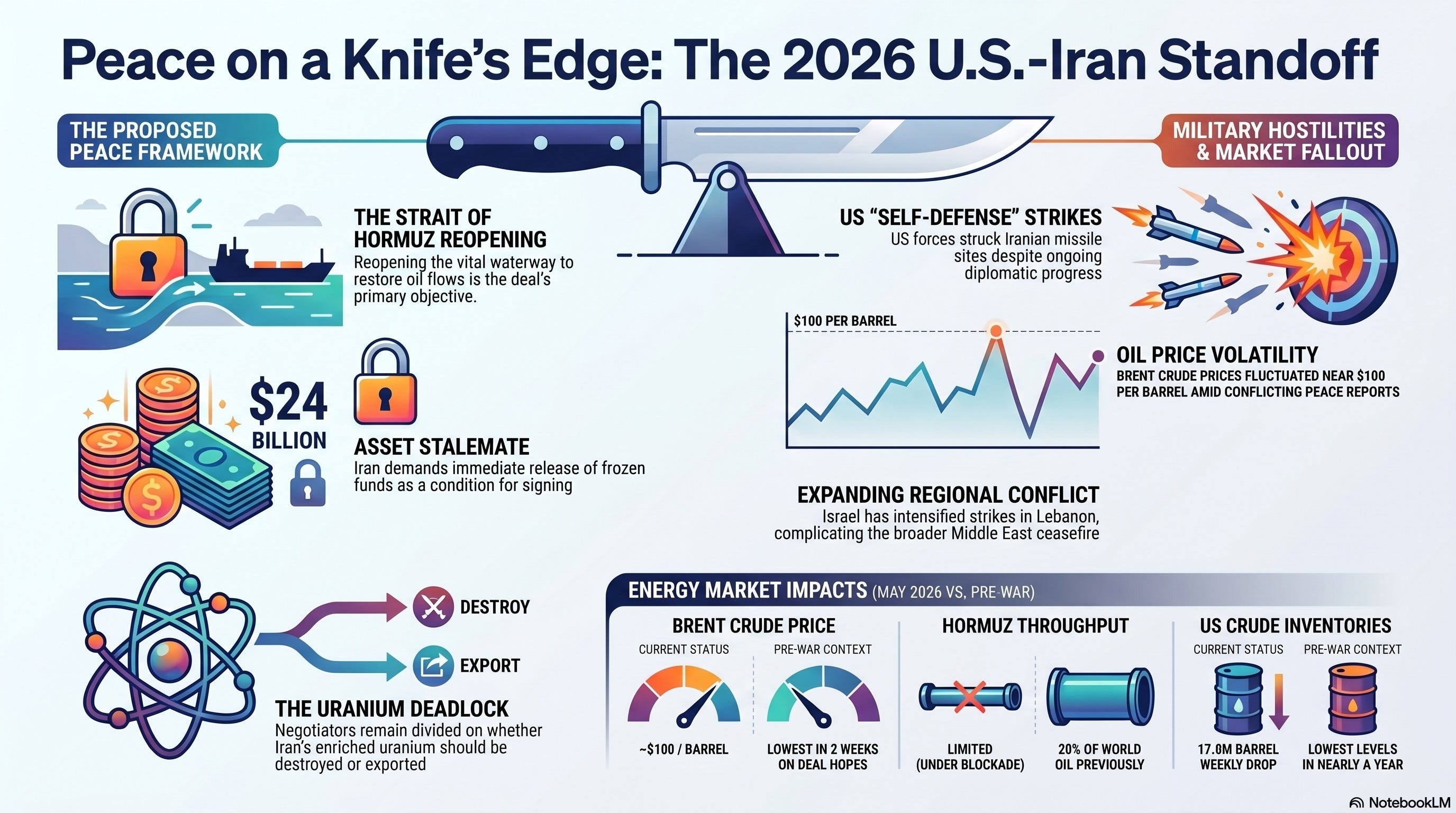
The Bloomberg reports of May 26–27 capture the oscillation between hope and hostility: “US and Iranian forces clashed near the Strait of Hormuz,” even as “negotiations were proceeding nicely” (Bloomberg Morning Briefing Americas, May 26, 2026). This dialectic—violence and diplomacy, threat and reassurance—reveals what Daniel Yergin (1991/2008) described in The Prize: The Epic Quest for Oil, Money and Power as the “security premium” that permanently structures energy markets. Yergin noted that “oil has meant power, and power has meant oil” (p. 14), a formulation that these newsletters render almost literally: the U.S. Navy assisting vessel crossings, the “self-defense strikes” against Iranian missile sites, the frozen assets negotiations in Doha.
The economic implications are stark. Brent crude hovering near $100/barrel, WTI briefly below $90, the “largest energy crisis in history” per the IEA director cited in Newsweek (May 25, 2026)—these figures represent what James Hamilton (2009), in his seminal work on oil shocks and recessions, identified as the threshold beyond which energy price spikes reliably trigger macroeconomic contraction. Hamilton’s econometric analysis demonstrated that “oil price increases that result from supply disruptions in the Middle East have historically been followed by global economic slowdowns” (p. 215). The newsletters’ repeated attention to inflation—”the biggest inflation surge since 2023,” ECB rate hike deliberations, Sri Lanka’s emergency tightening—confirms this transmission mechanism in real time.
Yet what distinguishes this moment is the performative dimension of the crisis. Trump’s Truth Social posts, Rubio’s cautious optimism, Khamenei’s warnings that “the nations and lands of the region will no longer be a shield for American bases” (Bloomberg Evening Briefing Asia, May 27, 2026)—these constitute what Philip Cerny (1995) termed “the dynamics of financial globalization,” where state actors compete not merely for territorial control but for narrative dominance in global markets. The Polymarket prediction market, referenced in multiple dispatches, represents the financialization of this performativity itself—betting on the probability of peace becoming a self-referential market mechanism.
The Canada-Germany LNG deal, reported in Bloomberg’s Canada Daily (May 27, 2026), offers a counterpoint: the Ksi Lisims project as infrastructure of diversification, an attempt to build what Helmuth Trischler (2016) called “alternative modernities” in energy systems. Yet even here, the shadow of Hormuz falls across the Pacific—the deal’s urgency derives precisely from the strait’s closure, revealing how deeply the carbon economy’s vulnerabilities are structurally embedded.
Staff Wellbeing as Competitive Differentiation
The feature on Patina Hotels & Resorts in the Maldives, headquartered by Capella Hotel Group in Singapore, presents a compelling case study in what might be termed “relational economics”—the strategic investment in labor conditions as a mechanism for value creation. The establishment of Fari Campus, a dedicated staff recreation facility on a separate island featuring “a full-sized football field, volleyball courts, two restaurants, a private staff beach” (Monocle, May 26, 2026), represents a departure from conventional hospitality industry practice. The resulting staff turnover rate of 13.3 percent—contrasted with an industry average of approximately 70 percent in the United States—demonstrates the economic rationality underlying what might superficially appear as altruistic provision.
This phenomenon resonates with the theoretical framework developed by Adam Smith in The Theory of Moral Sentiments (1759), wherein sympathy and mutual regard constitute the foundational glue of social order. Yet the more proximate intellectual genealogy extends through Frederick Winslow Taylor’s principles of scientific management, which treated labor as a variable cost to be optimized, toward the contemporary scholarship on “psychological capital” (Luthans et al., 2007) and “positive organizational scholarship” (Cameron et al., 2004). Dave Moore, global CEO of WATG, articulates this logic explicitly: “Engaged staff deliver better service. This drives repeat guest visits, loyalty and, ultimately, higher revenue” (Monocle, May 26, 2026).
The critical insight here concerns the internalization of externalities. Traditional hospitality models had historically externalized labor welfare costs—cramped staff quarters, anti-social schedules, familial separation—onto workers while capturing the value of their emotional labor in guest experiences. Patina’s model represents an attempt to recapture these externalized costs within a unified value proposition. This approach finds theoretical grounding in the work of economic historian Karl Polanyi (1944), who argued that the “disembedding” of labor from social relations constitutes one of the defining pathologies of market capitalism. The Fari Campus model can be read as a partial re-embedding of labor within a relational matrix—a corrective to what Polanyi termed “fictitious commodities.”
Furthermore, the geographic specificity of this case merits attention. The Maldives—archipelago nation dependent upon high-end tourism—occupies a particular position in the global economic geography of care labor. The model described represents a form of what Arlie Hochschild (1983) influentially analyzed as “emotional labor,” wherein workers are required to perform affect along with function. The investment in staff welfare thus represents not merely a competitive strategy but a form of labor reproduction in an industry characterized by the extraction of emotional surplus value.
Urban Regeneration and the Night-Time Economy
The Tokyo Lights 2026 festival, occupying the Nishi-Shinjuku district under the aegis of Governor Yuriko Koike, constitutes another instance of economic recalibration through cultural intervention. The transformation of what was described as “the capital’s first high-rise neighbourhood” into a site of nighttime activation represents a strategic response to what urban economists term “dead capital”—assets that depreciate through non-use during off-peak hours.
The description of the district’s historical trajectory—where “once office workers drift home, its pavements empty and much of the skyline goes strangely dark”—recalls the influential analysis of “dualistic urban development” by Jane Jacobs (1961), who argued that the economic vitality of urban neighborhoods depends upon the temporal diversity of uses. Jacobs’s insight, that successful urbanism requires the mixing of functions across the twenty-four-hour cycle, finds contemporary expression in what urban policy discourse terms the “night-time economy” (NTE).
The scholarly literature on creative cities, particularly the work of Charles Landry (2000) and Richard Florida (2002), provides conceptual apparatus for understanding this phenomenon. Tokyo Lights 2026 exemplifies what Landry terms the “imaginative city”—an urban environment that generates value through the creative juxtaposition of elements rather than their functional separation. Kenji Kohashi’s invocation of “invisible Tokyo”—the city that escapes conventional visualization—suggests a Deleuzian sensibility, wherein the festival operates as what Gilles Deleuze (1990) described as a “becoming”—a process of differentiation rather than a static identity.
The economic implications extend beyond immediate tourism revenue. The regeneration of Shinjuku Central Park—from “a sullen, underlit patch of greenery” to “an open-air oasis with a children’s pool, futsal pitch and sprawling lawn”—represents an instance of what urban economist Edward Glaeser (2011) terms “the triumph of the city.” Yet this triumph is not automatic; it requires deliberate intervention in what urban sociologist Sharon Zukin (1982) analyzed as the “symbolic economy”—the production of meaning that precedes and enables economic extraction.
The Attention Economy and Media Fragmentation
Hannah Lucinda Smith’s column on the decline of “And finally” news segments addresses the economic structure of contemporary media with theoretical sophistication. The observation that “the addictive, algorithmic stream of social media... has really rolled the end credits on the ‘And finally…’ moment” (Monocle, May 27, 2026) connects to a substantial literature on the attention economy.
Herbert Simon’s (1971) foundational observation that “a wealth of information creates a poverty of attention” anticipated the contemporary condition wherein attention constitutes the scarce resource that media platforms compete to capture. The shift from what Smith terms a “tasting menu”—the curated news bulletin—to an “open buffet”—the continuous stream of algorithmic selection—represents not merely a change in format but a structural transformation in the commodity being sold. As the economist Michael Goldhaber (1997) argued in his influential essay on the attention economy, in a world of information abundance, attention becomes the only scarce resource worth争夺.
Smith’s analysis draws upon what communication theorist Manuel Castells (1996) termed the “network society”—a social formation characterized by the flows of information, capital, and images that constitute the material infrastructure of contemporary life. The “eternal and rootless doom loop” that Smith describes represents a pathological intensification of what Castells analyzed as the “timeless time” of network communication—a temporality abstracted from the rhythms of biological and social life.
The reference to Ryan Herman’s book And Finally…—a collection of tales from the light-hearted segment of news broadcasts—introduces a nostalgic register that warrants critical examination. Smith’s lament for the skateboarding duck called Herbie, which “was still talked about in the office” decades after its broadcast in 1978, invokes what the cultural theorist Fredric Jameson (1991) termed “nostalgia mode”—a perpetual return to the past that substitutes for genuine historical imagination. The question thus arises: is the “And finally” segment a genuinely liberatory form, or does it function as what Theodor Adorno and Max Horkheimer (1944) analyzed as “culture industry” output—light entertainment that pacifies rather than liberates?
3. The Algorithmic Condition: AI, Labor, and the Papal Intervention
II. The Semiconductor Sublime: AI, Compute, and the New Extractivism
If Hormuz represents the old geopolitics of carbon, the repeated attention to AI chips, GPU futures, and semiconductor markets signals the emergence of what we might call the silicon sublime—a new regime of extraction and power mediated through compute capacity.
Micron’s trillion-dollar valuation, TSMC surpassing India as the world’s fifth-largest equity market, the “financialization of AI compute” (Semafor Business, May 27, 2026)—these developments instantiate what Nick Srnicek (2017) theorized in Platform Capitalism as the shift toward “data as the new oil” and the infrastructural requirements of machine learning. Srnicek argued that “the AI industry is characterized by massive fixed costs in the form of data centers and specialized chips” (p. 89), creating barriers to entry that reproduce oligopolistic structures. The newsletters’ attention to CoreWeave, GPU futures markets, and the “$25,000 a day” AI consultants (Bloomberg Morning Briefing Europe, May 26, 2026) confirms this analysis empirically.
More profoundly, the newsletters reveal what Kate Crawford (2021) called in Atlas of AI the “extractive practices” underlying artificial intelligence—the “human labor, environmental resources, and data” that constitute its material base (p. 8). The Figure AI livestream of robots sorting packages for “160 hours and counting” (Rest of World, May 26, 2026), the Chinese “dark factories” operating with “little human supervision,” the factory workers wearing smart glasses to train their replacements—these are not merely technological developments but what David Noble (1984/1993) identified in Forces of Production as the “social construction of technological systems,” where “technology is not simply a tool but a social process embedded in relations of power” (p. 32).
Pope Leo XIV’s encyclical Magnifica Humanitas (referenced across multiple newsletters) introduces a normative counterpoint. His warning that “no algorithm can make war morally acceptable” and his call to “disarm” AI (The Economist, May 27, 2026) resonate with what Sherry Turkle (2011) described as the need for “reclaiming conversation” in an age of technological mediation—though Leo’s intervention goes further, framing AI as a theological problem of anthropology, not merely ethics. The encyclical’s 42,300 words (DealBook, May 26, 2026) represent what Jürgen Habermas (2008) might recognize as an attempt to constitute a “post-secular” public reason, where religious authority enters deliberation about technological governance.
The geopolitical dimensions of AI compute are equally significant. China’s restrictions on AI professionals’ overseas travel, Huawei’s claimed pathway to advanced semiconductors, the ByteDance-Qualcomm deal (Bloomberg Evening Briefing Americas, May 26, 2026)—these instantiate what Graham Allison (2017) called the “Thucydides Trap” in technological form, where rising and established powers compete for dominance in transformative technologies. The newsletters’ repeated attention to U.S.-China AI rivalry suggests that what Kenneth Waltz (1979) theorized as “structural realism” in international relations—where systemic anarchy drives competitive behavior—operates with particular intensity in sectors characterized by network effects and first-mover advantages.
3.1 The Agentic Divide and the New Inequality
Perhaps the most consequential theme to emerge from the digest is the rapid proliferation of AI agents and the inequalities they threaten to entrench. Rest of World’s investigation (May 26, 2026), “The AI Agent Boom Risks Entrenching Global Inequality,” draws on the work of Nick Srnicek, a senior lecturer in digital economy at King’s College London, who identifies a multi-layered “agentic divide”: “divides between those who have agents and those who don’t; those who have good agents and those who have bad agents; those who have many agents and those who have few agents; and those who can trust their agents and those who cannot” (Srnicek, quoted in Rest of World, 2026). This taxonomy extends the analysis Srnicek (2017) developed in Platform Capitalism, where he argued that digital platforms generate not merely market concentration but structural asymmetries in the capacity to extract and monetize data. The agentic divide represents the next iteration of this logic: it is not simply that some actors have better technology, but that the technology itself creates new axes of advantage and disadvantage that compound existing inequalities.
The Samsung labor showdown in South Korea, also reported in Rest of World, illustrates the distributive question at the heart of the AI economy. As the article notes, the confrontation “reflects global concerns about who benefits from the AI industry, and how the wealth being created should be shared.” This is the question that the economist Daron Acemoglu and the public policy scholar Simon Johnson (2023) posed in Power and Progress: whether the trajectory of technological change is an inexorable force to which society must adapt, or a political choice that can be steered toward shared prosperity. Their historical survey of a thousand years of technological development demonstrates that progress has frequently been “directed” toward the interests of elites, and that the benefits of productivity gains have only been widely shared when institutions—unions, regulations, social norms—counterbalanced the natural tendency of capital to concentrate returns. The Samsung standoff is, in this light, a test case for whether such countervailing institutions can function in the age of AI.
3.2 The Papal Encyclical and the Ethics of Automation
Pope Leo XIV’s encyclical Magnifica Humanitas, released during the period covered by the digest and discussed at length in Bloomberg (May 26, 2026), the New York Times DealBook (May 26, 2026), and Newsweek (May 25, 2026), represents the most authoritative moral intervention in the AI debate to date. The encyclical’s central argument is that “the use of AI is never a purely technical matter: when it enters processes that affect people’s lives, it touches on rights, opportunities, status and freedom.” The pope specifically warned of “new forms of exclusion” arising from automated systems that “do not know compassion, mercy, forgiveness, and above all, the hope that people are able to change” (Leo XIV, 2026, as quoted in Bloomberg). John Authers, writing in Bloomberg’s Points of Return, observed that “to anyone shrugging off the influence of papal authority, it’s worth reflecting on Stalin’s mocking ‘how many divisions has the pope?’ and the Soviet Union’s eventual fate in the Cold War.”
The encyclical’s significance lies not in its novelty—its themes echo decades of Catholic social teaching from Rerum Novarum (1891) onward—but in its application of this tradition to the specific challenges of algorithmic governance. The pope’s invocation of the Tower of Babel as a metaphor for the AI race (”ambitious undertakings that promote homogeneity and compete with religion end badly”) connects contemporary technological hubris to a much older theological narrative about the dangers of collective ambition unmoored from moral restraint. This framing resonates with the philosopher Hannah Arendt’s (1958) analysis in The Human Conditionof the “world alienation” produced by modern technology—the displacement of human agency by processes that no single individual can comprehend or control. Arendt warned that the transformation of human activity into mere process threatens the very capacity for natality, the ability to begin something new, which she regarded as the essence of human freedom. The factory worker Ashish Narayan’s haunting description of wearing smart glasses to record his own movements—”it feels like working in your own grave, while you make your own casket” (quoted in Bloomberg, May 26, 2026)—is a visceral illustration of Arendt’s theoretical concern: the worker is not merely exploited but made complicit in his own obsolescence.
3.3 The Vatican Meets Silicon Valley
The DealBook newsletter’s coverage of the Vatican-Silicon Valley encounter (NYT, May 26, 2026) reveals the political economy of the encyclical’s reception. Anthropic’s co-founder Chris Olah attended the encyclical’s launch and stated, “We need informed critics who will tell the labs when we are failing.” This is a revealing endorsement: a leading AI company welcoming papal criticism as a form of external quality control. It suggests what the sociologist of science Bruno Latour (2004) called the “constitution” of techno-scientific authority—the network of institutions, norms, and discourses through which technological development is rendered legitimate or illegitimate. By appearing alongside the pope, Anthropic positions itself as the responsible actor in the AI race, gaining moral capital that may translate into regulatory advantage.
Conversely, former Trump AI czar David Sacks’s dismissal of the encyclical’s regulatory implications—he “argued that giving a government the power to regulate AI would slow innovation” (NYT DealBook, May 26, 2026)—exemplifies what the political economist Quinn Slobodian (2018) analyzed in Globalistsas the ideology of “encasing” markets from democratic interference. For Sacks and his allies, the AI race is a geopolitical zero-sum game in which regulatory restraint is not a moral virtue but a strategic liability. The conflict between these two positions—the papal vision of AI as a common good requiring democratic governance, and the Silicon Valley vision of AI as a strategic asset requiring unfettered development—is arguably the defining political contest of the current decade, and the newsletters under review capture it in real time.
4. Techno-Nationalism and the Semiconductor Chessboard
4.1 Huawei’s Breakthrough and the Fragmentation of Chip Supply Chains
The South China Morning Post reported on May 25, 2026, that “Huawei unveils new scaling law and tech that narrows gap with TSMC, Samsung,” describing it as “a major milestone in its mission to create a self-reliant semiconductor ecosystem.” Simultaneously, Semafor reported on Beijing’s “modular” strategy and the boom in China’s memory chip sector, while UBS projected that Chinese firms’ overseas revenues would reach record highs driven by technological competitiveness (SCMP, May 26, 2026). These developments cannot be understood in isolation from the geopolitical context: they are the fruits of China’s deliberate strategy of technological self-sufficiency, pursued in response to US export controls and the broader logic of techno-nationalism.
The concept of techno-nationalism was developed by the political scientist Richard Samuels (1994) in his study of Japan’s semiconductor industry, “Rich Nation, Strong Army”, where he showed how the Japanese state deliberately fostered indigenous technological capacity not merely for economic efficiency but for national security. China’s current chip strategy follows a similar logic, but on a far grander scale and in a far more adversarial geopolitical environment. As Chris Miller (2022) argued in Chip War, semiconductors have become the new oil—a strategic resource whose control determines geopolitical power. The Huawei announcement represents a partial decoupling from the US-dominated chip ecosystem, with implications that ripple outward: if Chinese firms can achieve near-parity in semiconductor manufacturing, the efficacy of US export controls as a tool of geopolitical leverage diminishes correspondingly.
4.2 The SpaceX IPO and the Financialization of Space
Bloomberg’s report that “investors are all-in on space stocks after SpaceX IPO” (May 27, 2026) and the Wall Street Journal’s analysis of “SpaceX’s AI Dreams” (May 27, 2026) reveal another dimension of techno-nationalism: the financialization of strategic technology. The SpaceX IPO, with its enormous valuation, reflects not merely the commercial potential of space launch services but the strategic premium that investors assign to companies operating at the intersection of national security and technological leadership. As the WSJ noted, SpaceX’s AI division derives revenue “substantially” from X (the former Twitter), a social-media platform “that isn’t exactly a pure-play AI venture,” suggesting that the company’s valuation rests as much on narrative and strategic positioning as on fundamental performance.
This dynamic is consistent with what the economic historian Carlota Perez (2002) described in Technological Revolutions and Financial Capitalas the “frenzy” phase of a technological revolution—the period of speculative financial investment that precedes the mature deployment of a new techno-economic paradigm. During this phase, financial capital chases the revolutionary technology, driving valuations to levels that often bear little relation to near-term profitability but that serve to concentrate resources and attention in the emerging sector. The space and AI sectors in 2026 exhibit precisely this pattern: enormous valuations, strategic government contracts, and a speculative frenzy that may or may not be justified by the underlying technology’s productive potential.
5. The Subsidy State: Europe’s New Industrial Compact
The Financial Times reported on May 25, 2026, that “Europe has learnt to love subsidies,” with EU state aid increasing dramatically. The FT View described this as a response to the “infantilism of an ‘ungovernable’ Britain” and the need for political stability to solve structural problems, as Martin Wolf argued. This European turn toward industrial subsidies is a direct consequence of the triple shock of the pandemic, the Ukraine war, and now the Iran crisis, which have collectively demonstrated the fragility of globalized supply chains and the vulnerability of economies that depend on strategic rivals for critical inputs.
The political economist Marianna Mazzucato (2013) analyzed this dynamic in The Entrepreneurial State, arguing that the state has always played a far more active role in technological development than neoliberal orthodoxy acknowledges. The question raised by the European subsidy turn is not whether state intervention is justified—Mazzucato and others have decisively refuted the myth of the self-regulating market—but whether subsidies will be deployed strategically to build productive capacity or merely to prop up incumbent firms. The FT’s concern that subsidies might “fragment the single market” reflects a genuine tension: national champions protected by state aid may become rent-seekers rather than innovators, a dynamic the economist Mancur Olson (1982) analyzed in The Rise and Decline of Nationsas the accumulation of distributional coalitions that slow economic growth by capturing the gains of collective action.
Canada’s parallel experience is instructive. The Bloomberg Canada Daily (May 27, 2026) reported that “Germany Calls for Energy and This Time, Canada Has an Answer,” while the previous day’s edition covered Canada’s confidence that oil firms can afford carbon capture. The Canadian model—combining resource extraction with environmental regulation and state-backed industrial policy—represents an attempt to navigate the contradictions of the subsidy state: how to maintain the revenues of fossil fuel production while investing in the green transition. The challenge, as the ecological economist Herman Daly (1996) argued in Beyond Growth, is that the growth imperative of industrial capitalism is fundamentally incompatible with ecological limits, and no amount of technological optimism can dissolve this contradiction—it can only delay its reckoning.
6. Resource Sovereignty and the Palm Oil Paradox
Bloomberg’s deep dive into Indonesia’s palm oil crisis (May 27, 2026) is a case study in the perverse consequences of resource nationalism. President Prabowo Subianto’s announcement that the government would take direct control over exports of palm oil, thermal coal, and some nickel products has “rattled investors and whipsawed palm markets,” with the result that “fruit is being left to rot” in the fields as refiners suspend spot purchases amid policy uncertainty. The chairman of the Indonesian Oil Palm Farmers’ Association, Mansuetus Darto, reported that collectors have stopped picking up fruit from small farmers, who lack their own transportation.
This episode illustrates what the development economist Ha-Joon Chang (2002) identified in Kicking Away the Ladderas the perennial tension between state-led development and market discipline. Chang argued that today’s developed countries universally used protectionist and interventionist policies during their own industrialization, only to prescribe free-market policies to developing countries once they had achieved dominance. Indonesia’s attempt to assert sovereignty over its commodity exports is, in this framework, a legitimate exercise of the developmental state—but one that, in this instance, has been executed so abruptly as to harm the very smallholders it presumably aims to protect. The anthropologist James C. Scott (1998) analyzed this pattern in Seeing Like a State: the tendency of state planners to impose schematic, simplified visions of economic order on complex local realities, with disastrous consequences for those at the bottom of the chain. The rotting palm fruit is a material metaphor for the gap between the state’s gaze and the lived experience of its subjects.
7. Cultural Heritage Under Fire: Kyiv and the Erasure of Memory
ARTnews reported on May 26, 2026, that a major Russian attack on Kyiv killed four people, injured about 100, and damaged cultural sites. This is not collateral damage; it is, as the Ukrainian cultural authorities have repeatedly argued, a deliberate assault on the material infrastructure of collective memory. The sociologist Karl Mannheim (1929) argued that generational consciousness is formed through shared experiences of historical events, and that the physical environment—buildings, monuments, urban landscapes—serves as the material substrate of this consciousness. When cultural sites are destroyed, it is not merely architecture that is lost but the capacity of a community to narrate its own history.
The philosopher Paul Ricoeur (2004) developed this insight in Memory, History, Forgetting, where he distinguished between the “duty of memory” and the “abuse of memory.” The destruction of cultural heritage, Ricoeur argued, is an abuse not merely of property but of the conditions of narrative identity—the capacity of a people to constitute themselves as a historical subject. The targeting of Kyiv’s cultural sites is, in this light, an attempt to erase the conditions under which Ukrainian identity can be narrated, remembered, and transmitted. It is a form of what the cultural theorist Andreas Huyssen (2003) called “present pasts” the manipulation of memory for political ends, which in the Ukrainian case takes the extreme form of physical annihilation. The art historian and cultural policy scholar Robert Bevan (2006) documented the systematic destruction of cultural heritage as a weapon of war in The Destruction of Memory, arguing that “the erasure of the physical markers of a culture is the erasure of the culture itself.” The Kyiv attacks are the latest chapter in this grim history.
8. The Depopulation Question and the Social Fabric
The Atlantic’s Derek Thompson contribution, “The Great Depopulation” (referenced in the May 27, 2026 newsletter), addresses one of the most consequential social trends of the twenty-first century: the global decline in fertility rates and the resulting population shrinkage in many developed and middle-income countries. This is not merely a demographic phenomenon but a social, economic, and cultural one with far-reaching implications. The sociologist Ulrich Beck (1992) analyzed the “risk society” as one in which the production of wealth is systematically accompanied by the production of risks; depopulation can be understood as precisely such a risk—a product of modernization (urbanization, female education, contraceptive access, economic insecurity) that undermines the demographic foundations of the very societies that produced it.
The economic implications are stark. As the economist Charles Goodhart and the analyst Manoj Pradhan (2020) argued in The Great Demographic Reversal, the aging of the global population will produce sustained inflationary pressure, as the ratio of dependents to workers rises and the deflationary tailwinds of globalization and cheap labor fade. The newsletter digest’s multiple references to labor shortages, AI-driven productivity gains, and the inflationary effects of the Hormuz crisis can be read as early symptoms of this structural shift. The FT’s report on “Labour’s tribes” (May 25, 2026) and the political instability of “ungovernable Britain” reflect the political consequences of a society struggling to distribute the costs of an aging population amid stagnant productivity.
Culturally, depopulation raises what the philosopher Byung-Chul Han (2014) called the “burnout society” problem: a civilization that has optimized individual achievement at the expense of the reproductive and communal capacities on which its long-term survival depends. Han argued that the neoliberal imperative of self-optimization produces subjects who are simultaneously exhausted and unable to reproduce—not merely biologically, but socially and culturally. The FT’s piece on the Yuppie legacy (May 25, 2026) and its observation that “their children are taking over and asking difficult questions about what their parents wrought” speaks directly to this dynamic: a generation that achieved unprecedented individual prosperity is confronted with the possibility that its way of life is, in the deepest sense, unsustainable.
9. Iceland’s Turn: Small States in a Fracturing Order
The New York Times (May 27, 2026) reported that Iceland is “seriously considering joining the E.U.,” driven in part by President Trump’s threats to Greenland and the resulting sense of vulnerability among Iceland’s 400,000 residents. Prime Minister Kristrun Frostadottir told the Times, “The Greenland crisis definitely hit a nerve.” This development illuminates the predicament of small states in a world where the post-Cold War security architecture is fragmenting.
The international relations scholar Christine Ingebritsen (1998) argued in The Nordic States and European Unitythat the small states of Scandinavia have historically pursued a strategy of “norm entrepreneurship”—using multilateral institutions to project influence disproportionate to their size. Iceland’s potential EU accession can be read as an extension of this strategy: a small state seeking the protection of a larger institutional framework in the face of great-power predation. But it also reflects a deeper shift in the European security order. As the political scientist Barry Buzan (1991) argued in People, States and Fear, small states experience the international system as a source of existential threat in ways that great powers do not. Trump’s threats to Greenland, however implausible as actual military propositions, have activated this existential anxiety—and pushed Iceland toward a strategic reorientation that would have been unthinkable a decade ago. The referendum, which could come as soon as August 2026, is thus not merely a policy choice but a civilizational statement: about whether small nations can maintain their distinctiveness within a larger political community, or whether the current geopolitical environment makes independence an unaffordable luxury.
10. Africa’s AI Sovereignty and the Post-Colonial Digital Order
The Rest of World article on “Africa’s hard road to AI sovereignty” (May 26, 2026) raises a question that goes to the heart of the global digital order: whether the continent’s “biggest tech economies” can “own their AI future” when the infrastructure they need “still belongs to Big Tech.” This is the digital frontier of the dependency theory developed by the development economist Andre Gunder Frank (1966) and the sociologist Immanuel Wallerstein (1974) in The Modern World-System. Frank and Wallerstein argued that the global capitalist system is structured by a core-periphery relationship in which peripheral economies are systematically disadvantaged by their dependence on core-controlled capital, technology, and markets. The AI sovereignty debate suggests that this structure is being reproduced in the digital domain: African nations may develop AI applications, but the foundational infrastructure—cloud computing, large language models, semiconductor supply chains—remains controlled by a handful of US and Chinese corporations.
The Semafor Africa newsletter (May 25, 2026) reported on the African Development Bank meetings held “amid Iran war backdrop” and Senegal’s political crisis, where former allies have turned to foes “in a very public African breakup.” These political dynamics are not incidental to the AI question; they are constitutive of it. As the Nigerian-American scholar Nnamdi Elleh (2022) has argued, African technological development is constrained not by a lack of talent or ambition but by the structural conditions of post-colonial governance: weak institutions, extractive economic relationships, and the political fragmentation that makes collective action difficult. The Senegalese crisis—in which a political partnership collapses publicly—illustrates the governance challenge: in the absence of stable institutional frameworks, the capacity to negotiate with Big Tech, regulate digital markets, and invest in indigenous infrastructure is severely diminished. The result is what the Kenyan scholar Wanjiru Ndlovu-Gatsheni (2018) has called “epistemic freedom” denied: a condition in which African societies are not merely economically dependent but conceptually constrained, unable to imagine and implement technological futures on their own terms.
11. The Yuppie Legacy and the Genealogy of Neoliberal Subjectivity
The Financial Times’ meditation on the Yuppie legacy (May 25, 2026)—”Before Tech Bros, before influencers and hipsters, there were Yuppies. They transformed 1980s New York and, arguably, modern America with it. But now their children are taking over and asking difficult questions about what their parents wrought”—is more than nostalgia. It is an invitation to consider the genealogy of neoliberal subjectivity: the process by which a particular mode of selfhood—competitive, individualistic, consumption-oriented—became hegemonic and the costs it has imposed.
The sociologist Luc Boltanski and the economist Ève Chiapello (1999) traced this genealogy in The New Spirit of Capitalism, arguing that capitalism perpetuates itself not merely through coercion but through the incorporation of critique. The Yuppies of the 1980s, they showed, were the bearers of a new “projective” city—a mode of justification based on flexibility, networks, and creativity—that absorbed the anti-authoritarian energies of the 1960s counterculture and redirected them toward the accumulation of capital. The result was a generation that sincerely believed it was liberated while in fact serving as the vanguard of a more totalizing form of commodification. The FT’s observation that the Yuppies’ children are “asking difficult questions” suggests the limits of this incorporation: a generation raised in the glow of neoliberal self-actualization is now confronting its ecological, social, and psychic costs.
The cultural critic Mark Fisher (2009) captured this predicament in Capitalist Realism, his influential analysis of the pervasive sense that capitalism is the only viable political-economic system—not because it is desirable, but because it has colonized the imagination so thoroughly that alternatives have become literally unthinkable. Fisher argued that this “capitalist realism” produces a condition of reflexive impotence: people know the system is dysfunctional, but they cannot imagine acting otherwise. The Yuppie children’s “difficult questions” may represent a crack in this realist edifice—a generational recognition that the mode of life they inherited is unsustainable. Whether this recognition translates into political agency or remains at the level of aesthetic critique is, however, an open question, and one that the newsletters under review do not resolve.
II. Social Dimensions: National Identity, Media Psychology, and Collective Memory
Social Fragmentation: The Rise of the Digital Public Sphere
While economists and policymakers grapple with macroeconomic models and fiscal deficits, a parallel social transformation is unfolding, fundamentally altering the nature of public discourse and community formation. This shift is primarily mediated by digital technologies, which have given rise to a fragmented media ecosystem characterized by niche communities and a concurrent decline of a unified, deliberative public sphere. The classical model of the public sphere, famously articulated by Jürgen Habermas, envisioned a space where rational-critical debate among autonomous citizens could take place, free from state control and commercial interests [51, 52]. In this idealized forum, reasoned argumentation would lead to the formation of a collective public opinion capable of holding power to account. However, as scholars like Craig Calhoun have argued, this model has often been criticized for its overly optimistic and universalist assumptions, neglecting the realities of power, inequality, and social division that permeate any public debate [31]. Today, empirical evidence strongly suggests that Habermas’s vision of a single, coherent public sphere is increasingly obsolete. Instead, we are witnessing the emergence of multiple, overlapping, and often contradictory digital public spheres, a phenomenon that has been the subject of intense theoretical and empirical study [28, 29].
This fragmentation is most evident in the contemporary media landscape. Rather than consolidating audiences around a few dominant gatekeepers, digital platforms have created a splintered environment. The proliferation of independent newsletters distributed via platforms like Substack, Mastodon, and Bluesky creates numerous touchpoints for information and opinion, but they do not necessarily coalesce into a larger public conversation [34]. This trend is reinforced by the conscious strategy of many creators who seek to build loyal followings within specific niches rather than appealing to a broad, general audience [35]. This dynamic leads to what danah boyd and Alice Marwick term “context collapse,” a condition where individuals lose a shared understanding of the communicative context, making it difficult to tailor messages for diverse audiences and hindering the development of common ground [24]. The result is a public discourse that is increasingly polarized and insular, where individuals are exposed primarily to viewpoints that reinforce their existing beliefs, a phenomenon amplified by algorithmic curation on mainstream platforms. This social atomization is further reflected in the work of Sherry Turkle, who observes that digital technologies allow for fluid identity performance, enabling young people to curate and present different facets of themselves online [23]. While this offers new possibilities for self-expression, it also raises profound questions about identity and belonging in an era where relationships are always mediated, echoing Socrates’ imperative to “know thyself” in a hyperconnected world [23].
In this fractured environment, new forms of community have emerged, which can be understood as cybercultures—cohesive social groups formed in virtual spaces that transcend geographical boundaries [22]. These communities, whether centered around a shared hobby, a political cause, or a specific subculture, develop their own distinct languages, symbols, and norms [22]. Examples range from organized social movements utilizing digital activism to challenge authority, as seen in cases like Zimbabwe, to the highly structured guilds within massively multiplayer online games [22, 42]. These cybercultures represent a form of social solidarity that operates outside traditional institutional frameworks. Drawing on Émile Durkheim’s classic sociological distinction, one might argue that these digital micro-communities foster a heightened form of mechanical solidarity, based on shared identities and beliefs, sometimes at the expense of organic solidarity, which relies on the interdependence of specialized roles in a complex society [55]. At the same time, the very existence of these communities highlights the enduring human need for connection and belonging. The newsletter itself can be viewed as a microcosm of this trend, functioning as a tool for cultivating a small-scale, high-trust community. Its success depends on its ability to create a sense of shared understanding and loyalty among its subscribers, effectively replacing the diffuse engagement of the mass public with the focused intimacy of a niche audience. This act of community-building is a direct response to the perceived failures of the larger, more impersonal public sphere.
The social dynamics of the digital age are shaped by a tension between two opposing cultural currents identified in recent scholarship: the individualization of spiritual and cultural life, which leads to people living within unique personal cultural micro-worlds, and a countervailing movement towards the transparisation of social culture, which pushes for greater openness and connection [23]. The rise of personalized news feeds, algorithmically curated content, and niche subscription services overwhelmingly favors the former. This individualization is not without its dangers. Bernard Stiegler, drawing on the Greek concept of pharmakon (a substance that is both cure and poison), warns that the digital culture dominated by large corporations erodes our hermeneutic knowledge—the capacity for deep reflection and shared understanding of experience [23]. Superficial engagement, misinformation, and divisive political spheres threaten to erode the social solidarities necessary for a healthy democracy [23]. This concern is compounded by the persistent “digital divide,” which refers to inequities in access to technology and digital literacy [22]. This divide exacerbates existing social and economic disparities, limiting the participation of marginalized communities in the digital public sphere and reinforcing asymmetrical power dynamics where Western and corporate values dominate global cultural flows, perpetuating a form of digital cultural hegemony [22]. Therefore, while digital technology offers unprecedented opportunities for connection, it also presents significant challenges to the formation of inclusive and deliberative publics, forcing a re-evaluation of what it means to participate in a democratic society in the 21st century.
The Contested Terrain of National Identity
Charlotte McDonald-Gibson’s analysis of museum curation in Washington, D.C., during the U.S. semiquincentennial (250th anniversary) celebrations, illuminates the contested terrain of national identity in pluralist societies. The Trump administration’s executive order titled “Restoring Truth and Sanity to American History” represents what political scientist Benedict Anderson (1983) termed the “official nationalism” of state institutions—a reimagining of national identity through the apparatus of governmental power.
The response of curators, particularly Theodore Gonzalves of the Smithsonian’s National Museum of American History, articulates an alternative conception of historical memory. Gonzalves’s statement that “our job is to create a space for reflection and to tell the truth about history, to tell the truth about where we’ve been as a country” invokes what the historian Hayden White (1973) described as the “historical consciousness”—an awareness of the contingent, contested, and ongoing nature of historical interpretation.
The exhibition In Pursuit of Life, Liberty and Happiness, featuring 250 items representing key moments in U.S. history, presents a strategy of inclusion rather than exclusion. The inclusion of objects such as “a dress worn by pioneering transgender actress Alexandra Billings, a wedding cake topper from a gay marriage and artefacts from the long battle for civil rights and racial justice” represents what sociologist Rogers Brubaker (1996) terms “reclassification”—the revision of categorical boundaries that constitute national membership.
This struggle over historical memory resonates with the theoretical framework developed by Maurice Halbwachs (1950), who argued that collective memory is not a passive inheritance but an active reconstruction shaped by present needs and future aspirations. The Trump administration’s vision of history—”in which founders will be portrayed as saints and any moral complexity will be airbrushed from proceedings” (Monocle, May 26, 2026)—represents what Halbwachs would recognize as a manipulation of memory for present political purposes.
The Romanian case, reported in ARTnews, presents a parallel instance of national identity contestation. The resignation of Culture Minister Andras István Demeter following leaked recordings in which he appears to mock “Romanian national interests” reveals the fragility of multicultural arrangements in post-communist Europe. Demeter’s statement—”I don’t give a damn about the national interest, because I’m Hungarian!”—represents an exposure of the ethnic nationalism that persists beneath the procedural veneer of liberal democracy.
This case connects to the influential work of political scientist Rogers Brubaker (1996) on “nationalism without nations” in post-communist Europe, wherein the ethno-national categories inherited from the socialist period continue to structure political imagination despite the institutional forms of liberal citizenship. The Alliance of Hungarians in Romania (UDMR), Demeter’s own party, called for his resignation—revealing the internal contradictions of ethnic minority politics in liberal-democratic form.
Media Consumption and National Psychology
Smith’s analysis of the decline of “And finally” segments extends beyond media economics to address what she terms “our national psyches.” The observation that “in serious and divisive times, these funny segments are among the few things that we can all agree on” invokes a Durkheimian conception of collective effervescence—the shared emotional experiences that constitute the moral fabric of society.
Émile Durkheim’s (1912) analysis of religious rituals in The Elementary Forms of Religious Life provides conceptual resources for understanding this phenomenon. The “And finally” segment, like the totemic celebrations that Durkheim analyzed, served a integrative function—uniting viewers across lines of difference through shared emotional experiences that exceeded partisan contestation. Its disappearance thus represents not merely a change in media format but a diminishment of what Durkheim termed the “collective conscience”—the shared moral representations that constitute social solidarity.
The neurological hypothesis that Smith invokes—that “our brains seem to have been rewired to seek out catastrophe and outrage”—connects to contemporary research on the psychology of media consumption. Ahern et al. (2021) found that negative news content generates greater physiological arousal and is more likely to be shared on social media platforms. This “negativity bias” (Baumeister et al., 2001) represents an evolutionary adaptation to threat detection that has been amplified by the architecture of algorithmic recommendation systems.
The critical question thus arises: can this “rewiring” be reversed? Smith suggests optimism: “However, if they have been rewired once, they can be rewired again.” This position aligns with the “nudge” scholarship of Thaler and Sunstein (2008), who argued that the architecture of choice can be modified to steer behavior toward welfare-enhancing outcomes. Yet the structural obstacles—the advertising models that incentivize outrage, the platform economics that optimize for engagement—are formidable, raising questions about whether editorial interventions can counter systemic incentives.
Collective Memory in Wartime
The Russian attack on Kyiv and its cultural institutions, reported in ARTnews, presents a brutal case study in the relationship between collective memory and armed conflict. The targeting of the National Chernobyl Museum and the National Art Museum of Ukraine (NAMU) represents what international humanitarian law terms a war crime—the deliberate destruction of cultural heritage that constitutes the collective memory of a people.
Curator Hanka Tretiak’s statement that “Russians are destroying cultural heritage that belongs not only to Ukraine, but to all of Europe and the world” invokes the concept of “world heritage” developed by UNESCO following the Hague Convention of 1954. This concept—elaborated in the work of architectural historian Kenneth Frampton (1983) on “critical regionalism”—recognizes that cultural heritage transcends national boundaries, constituting a shared human inheritance that must be protected even amid armed conflict.
The timing of the attack is significant: the NAMU had recently debuted a “performance-exhibition” by Holyi/Kostiantyn Mishukov and Oleg Tistol, “about art as a form of therapy during war.” Tretiak observed that “we saw how deeply art is capable of supporting people in times like these” (ARTnews, May 26, 2026). This formulation connects to a substantial literature on art therapy and trauma, particularly the work of Cathy Malchiodi (2012) on the “creative arts as a universal language of healing.”
The concept of cultural heritage articulated here extends beyond monumental architecture to encompass what the anthropologist Arjun Appadurai (1996) termed “mediascape” and “ideoscape”—the global flows of images and ideas that constitute contemporary cultural imagination. The destruction of museums thus represents an attack not only on objects but on the symbolic resources through which collectivities constitute their identities and process historical experience.
III. Policy Dimensions: Historical Governance, Cultural Heritage Protection, and Urban Planning
Geopolitical Realignment: The Unraveling of a Bipolar Order
The political dimension of our contemporary moment is defined by a profound and unsettling geopolitical realignment. The post-Cold War era, characterized by a unipolar world order dominated by a single superpower, is giving way to a multipolar system marked by increasing complexity, competition, and uncertainty [48, 49]. This transition is not a simple swap of one dominant power for another but a far more intricate process involving the rise of new centers of gravity and the recalibration of alliances across the globe. The Indo-Pacific region has become a primary theater for this shift, with countries actively diversifying their partnerships and recalibrating their foreign policies away from a US-centric alignment [32]. This multipolarity is testing the endurance of established international norms and raising critical questions about the future of global governance and security [45]. The probable transition from a bipolar to a multipolar international system has inspired divergent predictions regarding its consequences for global peace and stability, with some fearing increased conflict and others seeing opportunities for greater pluralism and cooperation [49].
Europe, in particular, finds itself at a crossroads in this new geopolitical landscape. It faces the challenge of defining its role and maintaining relevance in a world where its relative influence is waning [32]. A significant part of this strategic puzzle revolves around the concept of European strategic autonomy, particularly in the realms of security and defense [47]. Attempts to develop this autonomy are complicated by Europe’s deep-seated integration within the transatlantic security context, creating a complex balancing act between pursuing independent capabilities and maintaining its alliance with North America [47]. The very notion of multilateralism, once a cornerstone of international relations, is itself being recast. Traditional models are being challenged, prompting new theoretical inquiries into how to assess international cooperation in a world of competing powers [44]. Some analysts propose a move towards “integrated inquiries” that holistically examine the interplay between central institutions, social movements, and various regions to provide a more adequate background for assessing global practices [33]. This suggests a recognition that effective governance in a multipolar world may require more flexible, issue-based coalitions rather than rigid bloc politics. The Indo-Pacific, as a geopolitical and normative crossroads, serves as a crucial testbed for whether a pluralistic order, where diverse political systems can coexist, is achievable [45].
This geopolitical flux has direct and immediate consequences for global economic and social stability. The spillovers from a new war, for example, are a primary concern for institutions like the IMF, which warn of unavoidable damage to the global economy, including potential spikes in energy prices [61, 62]. Such disruptions highlight the continued interconnectedness of the world economy, even as political loyalties fragment along new fault lines. The agenda for the 2026 IMF and World Bank Group Spring Meetings explicitly included discussions on responding to profound shifts in geopolitics, underscoring the consensus that political instability poses a direct threat to economic prosperity [64]. This interconnection is also visible in the political strategies employed in the digital age. The conscious use of digital media to build a political consensus, as exemplified by Donald Trump’s political communication, demonstrates a strategic deployment of the fragmented digital public sphere for political mobilization [30]. By bypassing traditional media gatekeepers, political actors can cultivate a direct, albeit segmented, audience, tailoring messages to specific demographics and exploiting the context collapse of the digital sphere to amplify polarization [24, 30]. This approach complicates efforts to build broad-based consensus on critical issues, from climate change to international trade, further destabilizing the global system.
The political trend, therefore, is not merely a shift in the distribution of power but a movement towards a state of persistent negotiation. As argued in analyses of the transition to multipolarity, the central question is no longer which power will dominate, but how competing actors will manage their interactions and avoid catastrophic conflict [48, 49]. In this context, the medium of the newsletter becomes particularly insightful. It does not function as a tool for constructing grand, universal narratives à la the nation-states of the 20th century or the ideological blocs of the Cold War. Instead, it embodies the politics of the “in-betweens.” It is a vehicle for participating in localized negotiations of ideas, influence, and identity within a specific niche. Its power lies not in commanding a mass audience but in persuading a smaller, more engaged following. This mirrors the diplomatic reality of a multipolar world, where influence is often exerted through a network of bilateral and minilateral agreements rather than through monolithic, global institutions. The newsletter, in its small way, is a microcosm of this new political logic, reflecting a world where power is diffused, consensus is hard-won, and dialogue must occur across a multitude of fractured channels.
III. The Body Politic: Health, Labor, and Biopolitical Governance
The Ebola outbreak in the Democratic Republic of Congo, referenced across multiple newsletters, operates as a kind of negative horizon against which other developments are measured. The WHO’s elevation of threat to “very high,” the 900+ suspected cases, the attack on treatment centers (The Economist, May 26, 2026)—these instantiate what Paul Farmer (1999) called “infections and inequalities,” where “disease distribution is patterned by social structures that determine who will be exposed, who will get sick, and who will receive care” (p. 5).
The newsletters reveal a stark asymmetry: while rich nations debate AI futures and energy transitions, the DRC confronts what João Biehl (2005) described as “social abandonment”—the withdrawal of institutional care from vulnerable populations. The Trump administration’s USAID cuts, referenced in The Atlantic (May 26, 2026), exacerbate this abandonment, creating what Achille Mbembe (2003) theorized as “necropolitics”—the subjugation of life to the power of death. Mbembe argued that “the ultimate expression of sovereignty resides... in the power and the capacity to dictate who may live and who must die” (p. 11). The newsletters’ juxtaposition of vaccine development announcements with reports of treatment center attacks suggests that this sovereignty is increasingly contested, fragmented, exercised through non-state actors as much as governments.
The labor dimensions of health and technology receive less explicit attention but emerge in telling fragments. Patina Hotels’ Fari Campus in the Maldives, with its 13.3% staff turnover rate (Monocle Minute, May 26, 2026), represents what Arlie Hochschild (1983) called “emotional labor” in luxury hospitality—the management of feeling as commodity. Evan Kwee’s observation that “we ask our teams to create transformative experiences but they’re living in conditions that we would never show our guests” resonates with what Richard Sennett (1998) described as “the corrosion of character” in flexible capitalism—where “the conditions of time in the new capitalism... create conflicts between the demands of the labor process and the needs of human attachment” (p. 25).
More broadly, the newsletters’ attention to housing crises—in Australia, New Zealand, the UK—reveals what Manuel Castells (1977/2010) identified as the “urban question” in advanced capitalism, where “the process of collective consumption becomes a major stake in class struggle” (p. 459). The Sydney home costing “nearly 14 times annual disposable income” (Bloomberg Morning Briefing Asia, May 27, 2026), the “mold-ridden fixer-uppers sparking bidding wars”—these are not merely market phenomena but what David Harvey (2008) called “accumulation by dispossession,” where “the credit system becomes... a major vehicle for redistributing wealth from the poor to the rich” (p. 48).
2. The Geopolitics of the Strait: US-Iran Negotiations and the Architecture of Uncertainty
2.1 War and Deal-Making in the Gulf
The dominant thread running through the digest is the fraught US-Iran negotiation over the reopening of the Strait of Hormuz and the cessation of hostilities. Across multiple outlets—Bloomberg, The Economist, the Financial Times, The Atlantic, the Wall Street Journal, Semafor, and Newsweek—the picture that emerges is one of radical contingency: markets rally on deal optimism, then retreat on reports of fresh strikes; the president announces progress, then his own officials acknowledge “sticking points”; Iranian negotiators arrive in Qatar while US forces conduct “self-defense” strikes on Iranian missile sites (Bloomberg, May 26–27, 2026). The Wall Street Journal reported that Iran is “pursuing a deal that would bring economic relief without handing President Trump a victory” (WSJ, May 27, 2026), a formulation that reveals the extent to which the conflict has become a zero-sum drama of political face-saving rather than a constructive peace process.
This oscillation between optimism and hostility is not merely a tactical fluctuation but a structural feature of what the international relations scholar Thomas Schelling (1960) analyzed as the “diplomacy of violence”—the use of military force not to achieve a battlefield victory but to shape the expectations and calculations of the adversary at the negotiating table. In his classic work The Strategy of Conflict, Schelling demonstrated that coercion and diplomacy are not opposite poles but two faces of the same strategic interaction, in which each side seeks to manipulate the other’s perception of what is inevitable. The current US-Iran dynamic fits this pattern with remarkable precision: each strike is simultaneously a military action and a negotiating position, and each diplomatic signal is simultaneously an overture and a threat. The difficulty, as Schelling warned, is that such strategies are inherently prone to miscalculation and escalation, since the line between signaling resolve and provoking retaliation is perpetually ambiguous.
2.2 Oil Markets and the Political Economy of Uncertainty
The market reactions documented in the newsletters—Brent crude futures at $99.56, the S&P 500 rising on deal optimism, the European Central Bank contemplating rate hikes absent a peace agreement—illustrate what the economist Frank Knight (1921) distinguished as uncertainty versus risk. In Knight’s framework, risk is calculable and insurable; uncertainty is not. The Hormuz crisis has plunged global oil markets into precisely this kind of radical uncertainty, in which the probability distribution of future outcomes cannot be reliably estimated. As John Authers noted in Bloomberg’s Points of Return (May 26, 2026), “crude, inflation breakevens and implicit rates all down” on deal optimism, but the fundamental volatility of the situation means that these movements are as likely to reverse as to persist.
The macroeconomic implications are considerable. The Strait of Hormuz carries approximately 21% of the world’s oil consumption (U.S. Energy Information Administration, 2025). Any sustained disruption would constitute what the economic historian Charles Kindleberger (1973) would recognize as a systemic shock—one that propagates through the global economy not merely through price effects but through the disruption of expectations, the reallocation of capital, and the triggering of defensive policy responses. The ECB’s contemplation of rate hikes, reported in Bloomberg’s Morning Briefing Europe (May 25, 2026), is precisely such a defensive response: a central bank seeking to anchor inflation expectations in the face of an exogenous supply shock, even at the cost of constraining domestic demand. This dynamic echoes the stagflationary dilemmas of the 1970s analyzed by Robert Skidelsky (2018) in Money and Government, where the clash between supply-driven inflation and demand-deficient economies produced policy paralysis and social discontent.
2.3 The Negotiator’s Dilemma: Trump as a Strategic Actor
David A. Graham’s analysis in The Atlantic (May 27, 2026)—”Why Trump Keeps Getting Rolled in Negotiations”—cuts to the heart of the matter. Graham argues that “Donald Trump’s reputation as a dealmaker has always been exaggerated, and his attempts to end the conflict in the Middle East show why he’s vulnerable to being outsmarted by opponents.” The piece catalogs a series of failed negotiations—with North Korea, Russia, and China—and notes that Trump has had more success when acting as a third-party broker than when his own government is a participant. This pattern aligns with what the negotiation theorist Robert Mnookin (2010) identified in Bargaining with the Devil: the temptation for leaders to prioritize the emotional satisfaction of appearing tough over the substantive achievement of strategic goals. Trump’s reported reluctance to “rush into a deal” (FT, May 25, 2026) even as his own military strikes undermine the conditions for diplomacy, illustrates the trap Mnookin described—a negotiator who confuses the performance of resolve with its substance.
The Iranian strategy, as reported by the Wall Street Journal, of seeking “economic relief without handing President Trump a victory” adds a further dimension. It reflects what the political scientist Robert Jervis (1976) analyzed as the problem of “signals” versus “indices” in international politics: Iran’s willingness to negotiate is a signal (cheap to produce, easy to fake), while its continued military resistance is an index (costly, therefore credible). By maintaining both simultaneously, Tehran preserves strategic ambiguity—and keeps Washington guessing. The result is a negotiation in which, as Graham acidly observes, the president “keeps demonstrating that he is a terrible negotiator,” not because he lacks tactical cunning but because his strategic framework is fundamentally flawed: it treats negotiation as a spectacle rather than a process.
The Governance of Historical Memory
The struggle over museum curation in Washington, D.C., exemplifies what might be termed “historical governance”—the set of institutional practices through which states attempt to shape collective memory. The Trump administration’s intervention represents a particular approach to historical governance: the instrumentalization of the past for present political purposes.
This approach connects to the theoretical framework developed by Michel Foucault (1977) on governmentality—the “art of government” that operates through the management of populations and the administration of things. Historical governance, on this account, constitutes a technique of governmentality wherein the control of historical narrative enables the management of political subjectivity.
The curators’ response—insisting that “We have a review process for exhibitions at the Smithsonian. This went through that review process as always and there were no changes” (Monocle, May 26, 2026)—invokes the autonomy of professional expertise against political interference. This position draws upon what Max Weber (1919) termed “science as a vocation”—the commitment to specialized knowledge that transcends political calculation.
Yet this autonomy is not absolute. The political scientist Steven Levitsky and Lucas Zaba (2018) have documented how democratic erosion proceeds through incremental steps that respect formal institutional structures while subverting their substantive function. The demand that the Smithsonian provide “the details of every exhibition planned for the 250th anniversary, insisting that they all convey ‘a positive view of American history’” represents an attempt to impose what Jürgen Habermas (1975) would recognize as the “refeudalization” of the public sphere—the subordination of rational-critical debate to strategic-political calculation.
Cultural Heritage in Armed Conflict
The attack on Kyiv’s cultural institutions raises urgent questions about the international protection of cultural heritage in armed conflict. The 1954 Hague Convention for the Protection of Cultural Property in the Armed Conflict, and its two Protocols (1954, 1999), establish a regime of protection that has been repeatedly violated in recent conflicts.
The targeting of the Chernobyl Museum is particularly significant given the symbolic weight of the Chernobyl disaster in Ukrainian national consciousness. As examined by academic serhiy Plokhy (2017) in Chernobyl: The History of a Nuclear Disaster, the disaster and its aftermath became constitutive events in the post-Soviet imagination—a site of memory where the failures of Soviet governance became legible. The destruction of the museum thus represents not merely the attack on a building but an assault on the symbolic infrastructure through which Ukrainian identity has been constituted.
The incident connects to the broader literature on cultural cleansing—deliberate attacks on cultural heritage as a strategy of ethnic cleansing and genocide. The work of Robert Bevan (2006) on “the destruction of memory” documents how such attacks have been systematic features of modern warfare, from the burning of libraries in ancient times to the deliberate targeting of cultural monuments in contemporary conflicts.
Urban Planning and Public Space
Tokyo’s night-time economy initiative represents a case of what urban planning scholars term “creative place-making”—the deliberate cultivation of cultural activity as a strategy for urban regeneration. The policy priority articulated by Governor Koike connects to a global movement, documented by academics such as Ann Markusen and Anne Gadwa (2010), toward creative industries as urban development strategy.
The festival’s location in Nishi-Shinjuku—a district characterized by “gigantism and car-centric planning”—represents a corrective to modernist urban planning paradigms that prioritized vehicular movement over pedestrian experience. The transformation of Shinjuku Central Park from “a sullen, underlit patch of greenery” to a vibrant public space exemplifies what the urbanist Jan Gehl (1971) termed “life between buildings”—the social interactions that constitute urban vitality.
Kohashi’s aspiration that “if projects such as this became month-long or even permanent, Tokyo could better realise its potential, connecting regions, cultures and people” articulates a vision of public space as what the philosopher Hannah Arendt (1958) termed the “public realm”—the space of appearance where citizens encounter one another as equals. This vision contrasts with the privatized public spaces of contemporary urban development, documented by urban sociologist Setha Low (2000) in her analysis of “gated communities” and the transformation of public space under neoliberal governance.
IV. Cultural Dimensions: Art as Therapy, Public Art, and Historical Consciousness
Cultural Hybridization: Personalized Identity in a Globalized World
The cultural landscape of the 21st century is a complex tapestry woven from threads of globalization, digital technology, and the persistent desire for local identity. Culture is best understood as a dynamic system encompassing shared meanings, practices, beliefs, and values that are inherently adaptive and evolve in response to external influences like technological innovation [22]. The proliferation of digital platforms has acted as a powerful catalyst for this evolution, profoundly altering how culture is produced, disseminated, and consumed. Theoretical frameworks such as Actor-Network Theory (ANT) provide a useful lens for analyzing this process by mapping the relationships between human actors (such as authors, readers, and developers) and non-human technological artifacts (like e-readers, social media algorithms, and content delivery networks) [22]. ANT emphasizes that agency is distributed across this network, meaning that technology is not a passive tool but an active participant in shaping cultural norms and practices [22]. Complementing this is media archaeology, which offers a historical perspective by examining past shifts caused by new media, helping us understand the current moment as part of a broader pattern of cultural-technological change [22]. These frameworks reveal that technology’s impact on culture is deeply intertwined with questions of power, identity, and representation.
Technology plays a dual role in this cultural transformation, acting simultaneously as a force for both cultural preservation and homogenization. On one hand, it provides unprecedented tools for documenting and disseminating endangered traditions. Digitized manuscripts, online archives, and virtual reality reconstructions allow cultural heritage to be preserved and shared with a global audience, expanding accessibility beyond physical locations and privileged insiders [22]. This can empower marginalized communities to reclaim and share their histories on their own terms. On the other hand, the global dissemination of cultural content through digital platforms often reflects and reinforces asymmetrical power dynamics [22]. The dominance of a few large technology corporations, largely based in the West, can lead to the imposition of dominant cultural values and aesthetics, threatening to overshadow local identities and marginalize alternative perspectives—a process known as cultural hegemony [22]. This tension is clearly visible in the contemporary publishing industry. At the macro level, there is significant consolidation, with a few large conglomerates like Penguin Random House dominating the market [21]. Yet, at the micro level, there is a vibrant proliferation of niche publishers and independent platforms catering to specific cultural voices and communities. Imprints like Graphic Mundi, which publishes graphic novels addressing topics like human rights and politics, and Spiegel & Grau, which aims to amplify writers’ voices across various platforms, exemplify this trend [21]. Similarly, Zibby Books’ “year of reading” model fosters a close-knit community among authors and readers, transforming literary culture on women’s terms [21]. This bifurcation illustrates how the same technological forces that enable global reach also create fertile ground for local expression and resistance.
Despite the immense power of globalizing forces, cultural communities demonstrate significant agency in negotiating their relationship with technology. They resist, adapt, and renegotiate the terms of their engagement. Resistance can take the form of Indigenous groups implementing strict guidelines on the use of technology to protect sacred knowledge systems from appropriation [22]. Adaptation is seen in the development of localized apps and platforms tailored to specific linguistic or cultural needs, ensuring that technological benefits are accessible and relevant to diverse populations [22]. Perhaps most creatively, communities engage in renegotiation, blending traditional motifs with contemporary digital aesthetics to create new forms of cultural expression that are both rooted in heritage and attuned to the modern world [22]. The Wattpad Webtoon Book Group, which leverages a combined audience of 170 million to publish fan-driven stories from diverse voices, is a prime example of this adaptive strategy [21]. It harnesses the scale of a global platform to amplify local and niche creativity, demonstrating a sophisticated understanding of how to navigate the digital ecosystem. This agency is crucial for understanding contemporary cultural production, as it shows that cultures are not passive recipients of technological change but active participants in shaping their own futures.
Within this dynamic interplay of global and local, the cultural phenomenon of the newsletter emerges as a compelling case study. It represents a form of curated cultural micro-production. An author acts as a cultural curator, selecting and assembling a stream of texts, ideas, and perspectives tailored to a specific audience’s tastes and interests. This act of curation is itself a form of cultural expression that resists the impersonal, algorithmic curation of mainstream social media platforms. The newsletter provides a space for what Inkyard Press calls ‘windows’ and ‘mirrors’—offerings that give readers insight into unfamiliar worlds while also validating their own experiences and identities [21]. In doing so, it participates in the ongoing process of cultural hybridization, bringing disparate ideas and references together in a unique, personalized container. It is a product of the hyper-connected world, yet it thrives by creating a sense of intimate, curated separation. The newsletter thus embodies the central paradox of contemporary culture: it is simultaneously a product of global connectivity and a tool for forging hyper-localized, personalized identities.
IV. The Aesthetics of Authority: Museums, Memory, and the Semiotics of Power
The Monocle Minute’s reflection on the disappearance of news “And finally...” segments (May 27, 2026) opens a cultural dimension that ramifies across the newsletters. Hannah Lucinda Smith’s observation that “funny and heartwarming reports were once a staple of bulletins around the world” and their decline represents “a sad by-product of continuous news cycles and the atomisation of viewing habits” engages what Neil Postman (1985) diagnosed in Amusing Ourselves to Death as the transformation of public discourse by television—and what we might now extend to algorithmic media.
Postman argued that “television is our culture’s principal mode of knowing about itself” (p. 92), and that its epistemology privileges entertainment over exposition, image over idea. The newsletters’ own form—fragmented, episodic, optimized for scanning rather than sustained attention—embodies this transformation. Yet Smith’s nostalgia for the “swift end-of-meal espresso” of light news suggests what Svetlana Boym (2001) called “reflective nostalgia,” which “dwells on the ambivalences of human longing and belonging and does not shy away from the contradictions of modernity” (p. 49).
The Smithsonian’s resistance to Trump’s semiquincentennial censorship (Monocle Minute, May 26, 2026) offers a counter-narrative of institutional memory. Theodore Gonzalves’s insistence that “our job is to create a space for reflection and to tell the truth about history” resonates with what Tony Bennett (1995) described as “the birth of the museum” as a technology of citizenship—where “the museum was to be a space in which the working classes, in particular, might be tutored into the ways of civility and rationality” (p. 19). The Trump administration’s demand for exhibitions conveying “a positive view of American history” represents what Herbert Marcuse (1964) called “repressive tolerance”—the absorption of critique into affirmation, the neutralization of oppositional thought through its formal inclusion.
The Tokyo Lights festival, Banca March’s private garden, The Decorum in Bangkok—these “daily treats” (Monocle Minute, May 26–27, 2026) constitute what Pierre Bourdieu (1979/1984) analyzed as “distinction”—the social differentiation of taste that “classifies the classifier” (p. 6). Kenji Kohashi’s desire to illuminate “invisible Tokyo” through collaboration between “artists and public space, generations and sectors” approaches what Jacques Rancière (2004) called “the distribution of the sensible”—the reconfiguration of what can be perceived and thought within a given social order.
12. Cultural Resonances: Jazz, Cinema, and the Sacred
Scattered through the digest are cultural signals that, taken together, constitute a counterpoint to the geopolitical and economic narratives. The Financial Times’ report that “America’s most exciting jazz scene is in Chicago” (May 26, 2026), Bloomberg’s coverage of a Tokyo lights festival (May 27, 2026), and the cinematic revival noted in Bloomberg’s “The Summer We Went Back to the Movies” (May 26, 2026) all point to the persistence of cultural production amid crisis—what Theodor Adorno (1941) skeptically analyzed as the culture industry’s capacity to absorb and neutralize social contradictions.
Yet there is also a more affirmative reading, one consistent with what the cultural theorist Stuart Hall (1997) described as the “articulation” of cultural forms with political and economic structures. Jazz in Chicago is not merely entertainment; it is, as the ethnomusicologist Ingrid Monson (2007) argued in Freedom Sounds, a form of cultural practice that enacts alternative modes of sociality—improvisation, collective creation, listening—that stand in implicit critique of the market logic dominating the economic sphere. Similarly, the cinematic revival—”for the first time since the pandemic, Hollywood has got its mojo back”—speaks to a collective need for shared experience that streaming cannot satisfy, a need the sociologist Robert Putnam (2000) identified in Bowling Aloneas the decline of social capital in America and the yearning for communal forms of meaning-making that might restore it.
The pope’s encyclical, discussed above, introduces the sacred as a third register of cultural resistance. By framing AI as a moral and spiritual challenge—not merely a regulatory one—Leo XIV invokes a tradition of ethical thought that precedes and exceeds the frameworks of market efficiency and national security. The philosopher Charles Taylor (2007) argued in A Secular Agethat modernity is characterized not by the disappearance of religion but by the fragmentation of the conditions under which religious belief is plausible. The encyclical’s intervention suggests that this fragmentation may itself be reversible: that the enormity of the challenges posed by AI may create a space in which religious and moral discourse regains a public authority it had lost. Whether this represents a genuine revival of the sacred or merely a tactical alliance between institutional religion and institutional technology is, again, an open question.
V. The Republican Theater: Populism, Performance, and the Crisis of Representation
The Texas Senate primary runoff between John Cornyn and Ken Paxton, extensively covered across newsletters, exemplifies what Jan-Werner Müller (2016) identified as the “populist logic” of contemporary politics—where “populism is... a particular moralistic imagination of politics” that pits “the pure people” against “the corrupt elite” (p. 19). Trump’s endorsement of Paxton, despite (or because of) his impeachment and indictment, represents what Steven Levitsky and Daniel Ziblatt (2018) called “democratic backsliding” through the capture of party institutions by anti-system forces.
The newsletters’ attention to this contest—”the most expensive primary runoff in recent history” (The Evening, May 27, 2026)—reveals what V.O. Key (1942/1964) long ago identified as “the responsible electorate” thesis under strain. Key argued that “voters are not fools” (p. 7), but the Paxton candidacy, built on conspiracy theories and institutional destruction, tests this optimism. The prediction markets’ near-certainty of Paxton’s victory (Newsweek, May 26, 2026) suggests what Philip Tetlock (2005) found in his research on expert political judgment—that “the average expert was roughly as accurate as a dart-throwing chimpanzee” (p. 47)—while simultaneously revealing the performative dimension of such markets, where probability estimates become self-fulfilling narratives.
The broader context of Trump’s physical exam, his 3,711 stock trades, the “revenge tour” against Republican senators (Newsweek, May 26, 2026)—these instantiate what Max Weber (1919/1946) called “charismatic authority” in its decadent phase, where “the charismatic leader is deserted by his following... because pure charisma is specifically foreign to everyday routine structures” (p. 248). The newsletters’ obsessive attention to Trump’s health, his tweets, his deals suggests what Émile Durkheim (1893/1984) might recognize as the “pathological” form of social solidarity in anomie—where collective representations lose their integrative function.
VI. The Cinema of Recovery: Cultural Production and Post-Pandemic Reconstruction
The Bloomberg Screentime newsletter’s celebration of “the summer we went back to the movies” (May 26, 2026) offers a cultural coda that illuminates broader patterns of post-pandemic reconstruction. The projected $4.1–4.3 billion domestic box office, the “jam-packed” schedule of franchise installments, Spielberg and Nolan’s return to “commercial fare”—these represent what Andreas Huyssen (2003) called “present pasts,” where “the past is not simply there in memory, but it must be articulated to become memory” (p. 3).
The movie theater’s recovery is specifically the recovery of collective spectatorship, what Walter Benjamin (1935/1968) theorized as the “aura” of aesthetic experience in the age of mechanical reproduction—though Benjamin worried about aura’s decline, these newsletters suggest its potential restoration. The “45-day” theatrical window, Netflix’s “testing the waters” with Narnia, Amazon’s commitment to theatrical release—these represent what Michael Curtin (2003) called “media capital,” where “firms must navigate between the demands of Wall Street and the contingencies of cultural production” (p. 202).
Yet the newsletters also reveal contradictions. The “higher revenues mask a decline in attendance”—the rate “fallen to half what it was 25 years ago” (Screentime, May 26, 2026). This is what Robert Putnam (2000) diagnosed as “bowling alone” in cultural form—the decline of collective association even as particular venues persist. The “existential dread that gripped the film business” is not merely economic but what Fredric Jameson (1991) called the “cultural logic of late capitalism”—where “aesthetic production today has become integrated into commodity production generally” (p. 4).
Art as Therapy in Wartime
The ARTnews report on the Kyiv cultural attack includes a detail of particular significance: the NAMU had recently opened a “performance-exhibition” by Holyi/Kostiantyn Mishukov and Oleg Tistol, “about art as a form of therapy during war.” Curator Hanka Tretiak’s observation that “we saw how deeply art is capable of supporting people in times like these” articulates a conception of art that extends beyond aesthetic experience to encompass therapeutic and communal functions.
This understanding of art connects to a substantial theoretical tradition, from Aristotle’s concept of catharsis through the “art as therapy” movement of the twentieth century. The psychologist Mihaly Csikszentmihalyi (1996) has documented how aesthetic engagement generates “flow” states—immersive experiences that transcend ordinary consciousness. The application of this understanding to contexts of collective trauma has been elaborated by scholars such as Cathy Malchiodi (2012) and others who have developed art therapy interventions for populations affected by war, displacement, and disaster.
The Ukrainian case thus exemplifies what the cultural theorist Raymond Williams (1977) termed “structure of feeling”—the lived experience of a particular historical moment, which finds expression through cultural forms that are simultaneously personal and collective. The exhibition about art as therapy, held in the museum that was subsequently damaged, becomes itself an artifact of this structure of feeling—a document of how Ukrainian culture has processed the experience of ongoing conflict.
Public Art and the Transformation of Urban Space
Tokyo Lights 2026, featuring international artists including Yoichi Ochiai, represents an instance of what art historians term “public art”—works created for sites beyond the gallery or museum. The festival’s location at the Tokyo Metropolitan Government Building and Shinjuku Central Park represents a collaboration between artistic practice and governmental/institutional infrastructure that characterizes contemporary public art production.
The festival’s aspiration to illuminate “invisible Tokyo” invokes what the cultural theorist Henri Lefebvre (1968) termed “the right to the city”—the claim of urban inhabitants to participate in the production of urban space rather than merely consuming it. Kohashi’s vision of “collaboration between artists and public space, generations and sectors” represents an attempt to realize this right through the intervention of artistic practice.
The exhibition of Thomas Houseago’s giant figures in Banca March’s private garden in Madrid, referenced in the same newsletter, presents a complementary instance of public art’s integration with institutional spaces. The positioning of these “giant figures hewn in aluminium, wood and plaster, hidden among the greenery” in the garden of a private investment bank raises questions about the publicness of public art—its relationship to institutional patronage and access.
Historical Consciousness and Material Culture
The ARTnews digest reports that one of the earliest medieval manuscripts telling the tale of King Arthur is to be auctioned at Christie’s, estimated at £1.5-2 million. This manuscript, “which has been in private hands for over 700 years,” represents what the cultural theorist Walter Benjamin (1935) termed the “aura” of the original artifact—the unique presence in time and space that distinguishes it from mechanical reproduction.
Benjamin’s analysis, developed in his essay “The Work of Art in the Age of Mechanical Reproduction,” addressed the transformation of artistic experience under conditions of modern technology. Yet the auction of this manuscript raises different questions—about the commodification of cultural heritage, the ownership of collective memory, and the tension between preservation in private collections and access for public scholarship.
The parallel case of the French Revolutionary War artifacts discovered in Virginia—an “encampment of French troops who helped defeat the British during the American Revolutionary War”—presents a complementary problematic. The “eleven 244-year-old buttons from France” represent material traces of a historical moment that continues to structure contemporary political imagination. Their discovery, as America approaches its 250th anniversary, acquires particular significance as what the historian David Lowenthal (1985) termed “the heritage crusade”—the contemporary preoccupation with material traces of the past.
V. Synthesis: Interrelations and Overarching Themes
Synthesis of Interrelations: A Structural Transition Framework
The preceding analysis of the economic, social, political, and cultural dimensions, though dissected thematically, reveals a tightly integrated system where changes in one domain precipitate cascading effects across the others. The true nature of our contemporary era is not captured by examining these spheres in isolation, but by understanding their intricate feedback loops and mutual dependencies. The overarching framework that best describes this period is one of structural transition, a fundamental reordering of the underlying institutions and norms that govern global society. This transition is not a linear progression but a complex adaptive process, characterized by both continuity and rupture. The newsletter, as a cultural artifact, serves as a potent symbol and a functional tool within this transitional landscape, embodying the tensions and opportunities of a world in motion.
The interrelations between these domains create a dynamic and often volatile equilibrium. The economic dimension sets the stage for developments in the other spheres. The global economic slowdown and fiscal pressures highlighted by the IMF [19, 59] create a palpable sense of anxiety and uncertainty within the social realm. This economic mood is reflected in the cultural products people consume—from the types of books they read to the kind of news they trust—and shapes the social media environments they inhabit. Simultaneously, the economic viability of niche industries, such as specialized publishing and independent newsletter platforms, is contingent upon the very social fragmentation they exploit. The economics of attention drives the creation of these micro-publics, turning social atomization into a profitable business model. Conversely, the social and political landscapes directly shape economic outcomes. The fractured public sphere, dominated by digitally-mediated niches, creates fertile ground for political polarization, making it exceedingly difficult to build the broad-based consensus required for challenging economic reforms, such as those related to fiscal sustainability or climate change mitigation [30]. This political gridlock, in turn, deters investment and complicates long-term economic planning, feeding back into the economic domain.
The political dimension acts as a powerful amplifier and vector for these transitions. The geopolitical shift towards multipolarity, particularly in regions like the Indo-Pacific, has direct and tangible economic consequences, disrupting global supply chains and affecting the very growth forecasts discussed by the IMF [15, 32]. These economic shocks fuel nationalist sentiments that manifest socially as demands for cultural preservation and resistance to immigration, and politically as calls for “strategic autonomy” by regional powers like Europe [47]. This political and social pushback against globalization then further complicates international economic cooperation. Finally, the cultural dimension functions as a meta-trend that underpins and mediates all other spheres. The rise of cybercultures, personalized media consumption, and curated identities is the engine driving social fragmentation [22, 23]. It is the primary medium through which political mobilization now occurs, allowing movements to bypass traditional gatekeepers and build direct, albeit segmented, support bases [30, 42]. Economically, this cultural shift creates new consumer behaviors and gives rise to entirely new markets and business models, from niche publishing to influencer-driven commerce. Thus, culture is not a peripheral element but a central organizing principle of the contemporary world.
In synthesizing these interrelations, the newsletter emerges as a quintessential artifact of this structural transition. It is not a relic of a previous era but a functional instrument perfectly adapted to the conditions of the present. It thrives in an environment defined by economic uncertainty, social fragmentation, geopolitical flux, and cultural personalization. Its value proposition lies in providing a curated sense of certainty, community, and identity in a chaotic world. By analyzing its hypothetical content through the lenses of central banking, public sphere theory, multipolarity, and cultural semiotics, we gain a deeper understanding of the interconnected forces shaping our reality. The newsletter is a symptom of the structural transition, a product of its dynamics, and a tool used to navigate its challenges and opportunities. The insights generated from this multidisciplinary analysis are not merely descriptive but predictive, offering a robust framework for interpreting the trajectory of these intertwined domains as they continue to evolve in the years ahead.
The Fragmentation and Reintegration of Contemporary Experience
The newsletter content examined herein reveals a set of interconnected concerns that exceed the boundaries of any single disciplinary framework. The economic, social, political, and cultural dimensions of these concerns are not separate analytical categories but facets of a unified problematic—the condition of contemporary life under conditions of what Bauman (2000) termed liquid modernity.
The decline of the “And finally” segment in news broadcasting, the targeting of cultural heritage in Kyiv, the struggle over historical memory in Washington, and the innovation in hospitality labor practices are all symptoms of a deeper transformation in the relationship between institutions and individuals, permanence and flux, collective meaning and private experience.
The interconnections are multiple and constitutive:
1. Attention and Value: The attention economy that fragments news consumption also structures the hospitality industry, where “engaged staff deliver better service” by capturing and retaining guest attention. The economic logic is the same: in conditions of abundance, attention becomes the scarce resource that commands value.
2. Memory and Power: The struggle over historical memory in Washington and the attack on cultural heritage in Kyiv share a common terrain: the recognition that control over the past constitutes a form of power. As the philosopher Michel Foucault (1977) argued, power operates not only through the regulation of present behavior but through the administration of historical consciousness.
3. Space and Belonging: The regeneration of Tokyo’s night-time economy and the privatization of Madrid’s Banca March garden represent competing visions of urban space—one oriented toward public encounter and collective experience, the other toward exclusive access and institutional identity. These competing visions constitute the material infrastructure within which contemporary social life unfolds.
4. Labor and Identity: The innovation in hospitality labor practices and the resignation of Romania’s culture minister both raise questions about the relationship between labor and identity. The hospitality industry’s attempt to provide “transformative experiences” for guests requires the transformation of worker subjectivity—a requirement that intersects with questions of ethnic identity and national belonging in the Romanian case.
Theoretical Integration
The analysis presented here draws upon a theoretical tradition that spans multiple disciplines. From economics, the analysis incorporates the attention economy literature, theories of labor welfare investment, and the concept of externalities developed by Pigou (1920) and elaborated by Coase (1960). From sociology, the analysis draws upon Durkheim’s theory of collective consciousness, Bauman’s liquid modernity thesis, and Bourdieu’s analysis of cultural capital. From political science, the analysis engages with Anderson’s concept of imagined communities, Brubaker’s work on nationalism, and Levitsky and Zaba’s analysis of democratic erosion. From cultural studies, the analysis incorporates Benjamin’s theory of aura, Lefebvre’s spatial theory, and Williams’s concept of structure of feeling.
This theoretical eclecticism is not a weakness but a strength—the recognition that the phenomena under examination exceed the boundaries of any single disciplinary framework. As the complexity theorist Edgar Morin (2008) has argued, complex phenomena require complex thought—a willingness to traverse disciplinary boundaries and resist premature closure.
13. Synthesis: Interconnections and Implications
The newsletter digest of May 25–27, 2026, reveals a world in which the categories of economic, social, political, and cultural analysis are simultaneously indispensable and insufficient. The US-Iran crisis is at once a geopolitical confrontation, an economic shock, a moral drama, and a cultural anxiety. The rise of AI is simultaneously a technological revolution, a redistribution of wealth and power, a challenge to human dignity, and a reconfiguration of what it means to be a subject. The turn to subsidies in Europe is simultaneously a policy choice, an economic strategy, a political negotiation, and a cultural statement about the relationship between state and market. And the persistence of cultural production—jazz, cinema, papal encyclicals—amid these upheavals testifies to the irreducibility of human creativity to the logics of power and profit.
What connects these threads is the question of sovereignty in its multiple registers: geopolitical sovereignty (who controls territory and resources), technological sovereignty (who controls the infrastructure of the digital age), economic sovereignty (who controls the terms of trade and production), and cultural sovereignty (who controls the narratives through which societies understand themselves). The newsletters document a moment in which all four forms of sovereignty are simultaneously contested—a condition that the political theorist Hannah Arendt (1972) might have recognized as a “revolutionary situation,” not in the sense of an imminent upheaval but in the sense of a comprehensive crisis of legitimacy in which the old certainties no longer hold and new ones have not yet been established.
The scholarly literature surveyed in this commentary suggests several directions for understanding this moment. First, the Knightian framework of uncertainty versus risk reminds us that the radical contingency of the current geopolitical situation is not merely a problem of information but a structural condition that markets and policymakers must learn to navigate. Second, the tradition of dependency theory, updated for the digital age, reveals the deep continuities between the colonial extraction of raw materials and the contemporary extraction of data, attention, and algorithmic labor. Third, the genealogy of neoliberal subjectivity from the Yuppies to the Tech Bros illuminates the cultural mechanisms through which capitalism reproduces itself—and the points at which that reproduction falters. And fourth, the papal intervention, the jazz revival, and the cinematic renaissance all point to the persistence of forms of life and value that exceed the calculus of market and state.
To read these newsletters associatively, as this commentary has sought to do, is to resist the fragmentation that the news cycle itself imposes. It is to insist that the strike on an Iranian missile site and the rotting of palm fruit in Indonesian fields, the launch of an AI agent and the destruction of a Kyiv cultural site, the rise of a Yuppie’s child and the fall of an African political partnership, are not separate stories but facets of a single, complex, and deeply consequential historical moment. Understanding this moment requires not more information but more integration—the capacity to see the connections that the news cycle, by its very structure, obscures.
VI. Conclusion: Toward a Synthetic Understanding
The newsletter dispatches examined herein constitute a window onto contemporary global affairs that rewards careful analysis. Far from the superficial immediacy that characterizes much of contemporary journalism, these excerpts reveal underlying structural affinities across seemingly disparate domains.
The economic dimension—characterized by innovations in labor welfare, urban regeneration, and the attention economy—cannot be understood apart from its social implications: the fragmentation of collective experience, the contestation of national identity, and the transformation of media consumption. Similarly, the political dimension—marked by struggles over historical memory and cultural heritage—cannot be separated from the cultural practices through which collectives constitute their identities and process historical experience.
The synthesis attempted here suggests that contemporary challenges require what the sociologist C. Wright Mills (1959) termed the “sociological imagination”—the capacity to connect personal troubles to public issues, individual biographies to historical processes. This imagination is precisely what the contemporary media environment lacks: the ability to synthesize, to connect, to see the whole in the part.
The “And finally” segment that Smith mourns represented, at its best, a moment of synthetic vision—a pause at the end of the news cycle that permitted integration before the next fragmentation. Its loss, and the rise of the algorithmic stream that delivers catastrophe without closure, represents not merely a change in media format but a transformation in the structure of consciousness itself.
Yet the responses documented in these newsletters—curators maintaining their independence, hotels investing in worker welfare, cities regenerating their nighttime economies, communities preserving their cultural heritage—suggest that the human capacity for synthesis and solidarity persists despite the fragmenting pressures of contemporary life. These responses constitute what the philosopher Alain Badiou (2001) terms “events”—moments of novelty that exceed the established order and point toward alternative possibilities.
The task of analysis, on this account, is not merely to document the present but to identify these possibilities—to trace the fault lines along which the future might open. The newsletters examined herein, read with sufficient care, reveal such fault lines: the potential for a journalism that integrates rather than fragments, a hospitality that respects rather than extracts, a governance that remembers rather than distorts, and a culture that heals rather than wounds.
The Newsletter as Form, the Fragment as Method
These newsletter snippets, read together, constitute what György Lukács (1923/1971) might have recognized as “transcendental homelessness” in informational form—the experience of modernity as perpetual motion without destination, accumulation without integration. The newsletter as genre—dated, segmented, optimized for mobile consumption—embodies what Hartmut Rosa (2013) called “social acceleration,” where “the temporal structures of modern society are characterized by a peculiar and accelerating dynamization” (p. 15).
Yet there is also something democratic in this fragmentation, what Mikhail Bakhtin (1981) celebrated as the “dialogic” quality of novelistic discourse—multiple voices, none privileged, coexisting in tension. The newsletters juxtapose without hierarchy: Hormuz and the Hajj, Ferrari’s EV and Wendy’s decline, Ebola and the Enhanced Games. This is not chaos but what Clifford Geertz (1973) called “thick description”—the accumulation of detail that generates cultural understanding through pattern rather than proposition.
The scholar’s task, faced with such material, is what Theodor Adorno (1951/1974) practiced in Minima Moralia—”reflections from damaged life” that “the whole is the false” (p. 50). To read these newsletters integratively is already to betray them, to impose a coherence that their form resists. Yet to read them merely as fragments is to abandon the critical project, to surrender to the “administered world” that Adorno diagnosed.
The balance, perhaps, lies in what Gilles Deleuze and Félix Guattari (1980/1987) called “rhizomatic” thought—”a map and not a tracing,” where “the rhizome connects any point to any other point” (p. 21). The Strait of Hormuz connects to the GPU futures market through the energy requirements of AI data centers; the Ebola outbreak connects to the Texas primary through the politics of public health funding; Pope Leo’s encyclical connects to the Tokyo Lights festival through the question of how technology mediates human experience.
To trace these connections is not to reduce them to a single logic but to multiply their resonances, to allow the newsletters to remain what they are—fragments of a world in motion—while also making visible the structures that produce them as fragments. This is the work of criticism in an age of information overload: not to master the archive but to inhabit it, to find in its very excess the materials for thinking differently about our common condition.
[Written, Researched, and Edited by Pablo Markin. Some parts of the text have been produced with the aid of Agent, Minimax, GLM, Zhipu, Kimi, Moonshot, and Qwen, Alibaba, tools (May 30, 2026). The newsletters were sourced from ARTNews, Artforum, The Atlantic, Bloomberg, CNBC, The Economist, The Financial Times, Le Monde, Monocle, The New York Times, Newsweek, Nikkei Asia, Noema Magazine, El País, Rest of World, Radio Free Europe/Radio Liberty, Semafor, The South China Morning Post, and The Wall Street Journal. The featured infographic has been generated in NotebookLM, Google (May 30, 2026).]
[Support the Open Access Blogs: https://buymeacoffee.com/openaccessblogs.]
OpenEdition suggests that you cite this post as follows:
Pablo Markin (May 29, 2026). The Strait, the Silicon, and Converging Crises: Energy Geopolitics, the AI Agentic Divide, and the Global Struggle for Cultural Memory. Open Access Blog.