
The Trapdoor Summer: On Closed Exits, Open Wagers and Long Hours
Newsletter Review, July 19–21, 2026. Book Review: The Alibi of Capital: How We Broke the Earth to Steal the Future on the Promise of a Better Tomorrow.

I. The Waterway
At midday on July 20, the oil supertanker Acheloos and a smaller fuel tanker were struck in the Strait of Hormuz, their hulls breached by munitions that turned the waterway into a shooting gallery. The ships’ manager, Dynacom, confirmed the hits; Sinokor Group, the world’s largest owner of supertankers, began offering crews an extra six months’ pay to risk the passage. By then, three more American service members had died in the widening exchange between Washington and Tehran—one in Iraq during the controlled detonation of an Iranian drone, two others in a missile barrage on a base in Jordan—bringing the official death toll to seventeen. The Strait, through which a fifth of the world’s oil once flowed, had become a throat squeezed shut.
What began as a limited operation has hardened into what defense analyst Brynn Tannehill (2026, “The U.S. has only terrible choices with Iran”) calls an escalation trap: a conflict in which every tactical response forecloses strategic retreat. President Trump now faces the classic security dilemma that Robert Jervis described in Perception and Misperception in International Politics (1976)—actions taken to reduce vulnerability are read by the adversary as aggression, prompting counter-escalation that leaves both sides less secure than before. Iran’s deployment of hypersonic missiles with terminal maneuvering, reportedly capable of evading THAAD defenses, suggests a military learning curve that air power alone cannot flatten. Meanwhile, Yemen’s Houthis threatened to blockade Saudi Arabia via the Bab el-Mandeb Strait, converting the Red Sea into a second chokepoint. As Hannah Arendt argued in On Violence (1970), violence is inherently instrumental, but when the instrument outlives its purpose, it becomes bureaucratic and self-perpetuating. The war has reached that phase: the ninth consecutive night of strikes was described by CENTCOM in language so routinized it sounded like a maintenance schedule. The machinery of conflict now serves primarily to justify its own continued operation.
II. The Stadium
Twenty-four hours later, under the same summer haze, MetLife Stadium in New Jersey hosted a different kind of confrontation. Spain defeated Argentina 1–0 in extra time to win the 2026 World Cup, and FIFA President Gianni Infantino took the stage alongside President Trump to present the trophy. The tournament had broken attendance records and was poised to generate $15 billion in revenue—$4 billion above initial projections. Television audiences in the United States shattered previous marks; prediction markets processed more than $1.2 billion in wagers. Yet the spectacle’s political shadow was unmistakable: Trump had intervened to review a U.S. player’s suspension, and his presence drew boos from sections of the crowd.
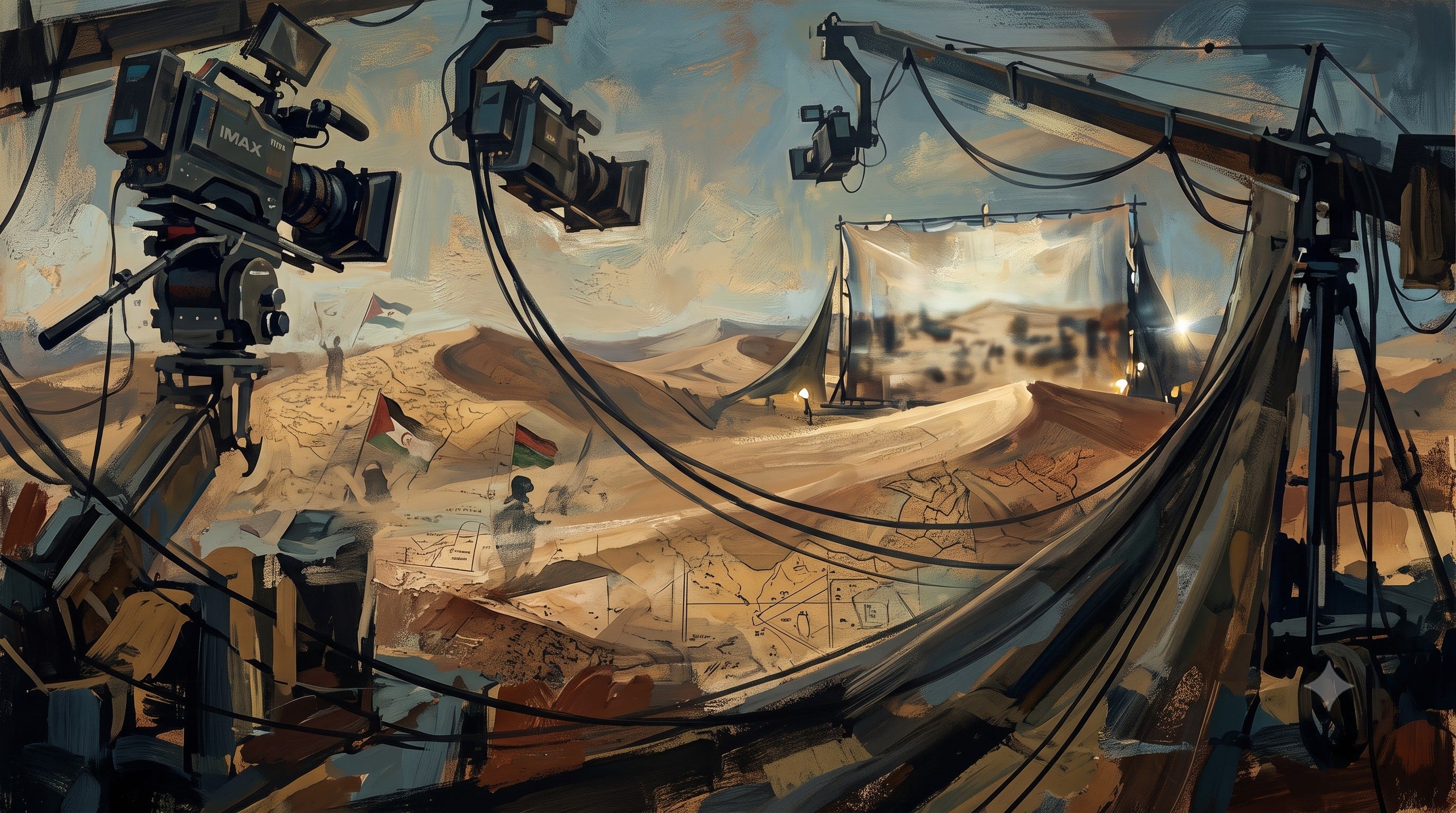
The same week, Christopher Nolan’s The Odyssey opened to $264.1 million worldwide, the biggest debut of the director’s career. Shot entirely in IMAX and filmed partly in the Western Sahara—a disputed territory claimed by Morocco—the production drew boycotts from the Algeria-backed Polisario Front, which accused the filmmakers of whitewashing colonialism. The credits listed only a “Morocco unit,” eliding the occupied status of the land. Here, the logic of spectacle absorbs territorial dispute into backdrop, converting political geography into visual texture. As Edward Said argued in Culture and Imperialism (1993), the cultural archive is implicated in the imperial project: “narrative fiction and history” together produce the “structures of attitude and reference” that make domination appear natural. The World Cup and the Hollywood epic operate at different scales but share a common grammar: both transform contested space into consumable experience. Guy Debord, writing in The Society of the Spectacle (1967), warned that “the spectacle is not a collection of images, but a social relation among people, mediated by images.” In New Jersey and in multiplexes, that mediation was total—hydration breaks inserted to accommodate advertising slots, dynamic pricing that extracted maximum revenue from nationalist fervor. The summer’s most successful spectacles did not distract from politics so much as commodify it.
III. The Circuit
While missiles flew in the Gulf, another kind of arms race was convulsing global markets. Moonshot AI’s release of Kimi K3, an open-weight model that nearly matched Anthropic’s frontier Fable system, overwhelmed the Beijing startup’s servers and sent semiconductor stocks into a rout. South Korea’s Kospi plummeted 23% in July; Hong Kong’s Hang Seng, buoyed by capital flight from chipmakers, surged 10%. The divergence was stark: Samsung and SK Hynix shed a quarter of their value while Alibaba, Xiaomi, and Meituan soared. Michael Burry, who had shorted Nvidia and the iShares Semiconductor ETF, posted that it was “a particularly good time to look to Hong Kong for cheap stocks.”
The panic was not merely financial; it was architectural. For years, the AI industry’s capital expenditure—Alphabet alone had projected $180 billion to $190 billion for the year—rested on the assumption that proprietary closed models would maintain insurmountable leads. The open-source challenge from China collapses that assumption. As Yochai Benkler argued in The Wealth of Networks (2006), “decentralized, nonproprietary, nonmarket production” can outcompete hierarchical control when network effects favor distributed innovation. Carlota Perez, in Technological Revolutions and Financial Capital (2002), described how bubble phases of technological revolutions inevitably face a “turning point” when capital investment outruns productive returns. The chip rout suggests the AI buildout is approaching that inflection. When Kai-Fu Lee observed that “OpenAI and Anthropic will be the iPhone, the Chinese models will be the Android,” he was describing not just market segmentation but a structural inversion: the premium closed ecosystem may capture profits, but the open network captures scale. For an industry that has doubled its debt load in five years, that inversion is existential.
IV. The Threshold
On Monday, July 20, Andy Burnham passed through the black door of 10 Downing Street, kissed King Charles’s hand, and became Britain’s seventh prime minister in just over a decade. By evening he had cleared Starmer loyalists from the cabinet and named John Healey, the former defense secretary, as Chancellor—a surprise signal that military spending would dominate fiscal planning. The choreography of transition remained intact, but the political temporality surrounding it had compressed to the point of absurdity. No. 10 has become a revolving door; Burnham’s “circuit breaker” rhetoric acknowledges that the wiring itself is failing.
This is not merely British exceptionalism but a symptom of what Ivan Krastev and Stephen Holmes diagnosed in The Light That Failed: A Reckoning (2019): the global democratic recession in which liberal institutions lose their capacity to deliver material security, and voters respond by treating governments as disposable. Pierre Rosanvallon, in Counter-Democracy: Politics in an Age of Distrust (2008), described how modern citizens exercise power less through electoral affirmation than through “negative” oversight—veto, protest, and rapid punishment of incumbents. Burnham inherits an overwhelming parliamentary majority and an improving economy, yet his favorability ratings were already negative before he took office, and the populist Reform UK party waits to harvest further discontent. His promised devolution “big bang”—radical decentralization to the north—recognizes that the center cannot hold. But as he discovered within hours of taking power, the Treasury’s fiscal rules and President Trump’s demands to “open up” North Sea oil constrain the autonomy that devolution is meant to deliver. The threshold of No. 10 is less a portal to power than a chokepoint where global and local pressures constrict movement.
V. The Ward
Three thousand miles west of Downing Street, flash flooding forced the New Museum in New York to close after water leaked into a gallery housing WangShui’s installation Oppose the Serpent (2024). Staff placed buckets beneath the ceiling of the $82 million OMA-designed expansion, which had already faced criticism for unfinished construction details. Meanwhile, in the Democratic Republic of Congo, residents assaulted an Ebola burial team and forced the crew to turn over a coffin; armed community members removed a child from a treatment unit and set the structure on fire. Legionella bacteria had been detected in the cooling towers of the Metropolitan Museum and the Guggenheim on Manhattan’s Upper East Side, even as frontline health workers in Bunia faced experimental vaccine trials and travel restrictions that aid groups warned would hamstring the response.
These scenes—water pooling in a Chelsea gallery, fire consuming a clinic in North Kivu—are mirror images of institutional failure under conditions of inequality. As Sheri Fink (2026, “Why epidemics breed rage at health workers”) reported in The New York Times, anger during outbreaks is rarely about science alone; it is about history, colonial extraction, and the suspicion that medicine serves outside interests. Paul Farmer, in Infections and Inequalities: The Modern Plagues (1999), termed this “structural violence”: the arrangement of political and economic forces that determine who falls ill and who receives care. Michel Foucault, in The History of Sexuality, Volume 1 (1976), traced how modern states exercise “biopower”—the administration of life itself—through institutions that manage populations. When those institutions appear to serve only the wealthy or the foreign, the biological body becomes a site of political resistance. The buckets at the New Museum and the torched Ebola ward are both symptoms of infrastructures that have been starved, privatized, or militarized to the point where they can no longer command trust.
VI. The Trapdoor
The summer of 2026 is not defined by a single crisis but by a shared topology: the chokepoint. In the Gulf, it is geographic—a strait that can be closed. In technology, it is economic—a semiconductor supply chain that can be disrupted by open-source code. In politics, it is institutional—a revolving door that accelerates without changing the room’s dimensions. In culture, it is semiotic—a spectacle that converts every dispute into content. In public health, it is biological—a border that quarantines the poor while the wealthy seek microdosed GLP-1 therapies.
Jean-Paul Sartre, in No Exit (1944), imagined hell as a locked room where human relations become inescapable. The play’s famous line—“Hell is other people”—is often misread as a statement about social antagonism; more precisely, it is about the impossibility of retreat when every glance and judgment is reciprocated and amplified. The systems of this summer have achieved a similar enclosure. The trap is not that there are no exits, but that the exits were designed out long ago—by decades of financialization that hollowed out state capacity, by imperial wars that turned chokepoints into battlefields, by platform economies that privatized the commons of attention and code. What remains is a season of trapdoors: mechanisms that appear to offer passage but open only onto the room below. The task of the coming months is not to find a door that has been overlooked, but to recognize that the walls themselves must be rebuilt.
The Strait and the Screen: A Week of Closed Passages and Open Wagers
I. The Ninth Night
At 10 p.m. Eastern on Saturday, July 19, the U.S. Central Command issued its now-familiar communiqué: strikes completed, Iranian military command centers degraded, coastal surveillance sites diminished, missile launch sites neutralized. The language was identical to the eighth night’s, and the seventh’s. “CENTCOM forces remain highly vigilant, focused, lethal, and ready” (U.S. Central Command, 2026, “Statement on Iran Strikes”). The words had become liturgical — a rosary of precision munitions recited into the dark over the Persian Gulf.
Three hundred miles to the west, in a prefabricated housing unit at Muwaffaq Salti Air Base in Jordan, two American soldiers from Army air and missile defense units were dead. An Iranian ballistic missile had slipped through the THAAD perimeter — one of three that penetrated defenses in twenty-four hours — and struck the barracks where troops slept (Meyer, 2026, “Iran Missile Struck U.S. Barracks,” Wall Street Journal). A third servicemember died the next day in Iraq, killed during the controlled detonation of an Iranian drone’s unexploded ordnance. The official American death toll in the war reached seventeen.
Seventeen is a small number. It is fewer than the dead at Grenada in 1983, fewer than the annual toll of military suicides. But small numbers, in the arithmetic of democratic war-making, are not the point. The point is trajectory, and the trajectory is Thucydidean. In the History of the Peloponnesian War, the Athenian envoys at Melos declare that “the strong do what they can and the weak suffer what they must” (Thucydides, ca. 416 BCE, History of the Peloponnesian War, Book V). Yet Thucydides’ deeper lesson — the one the Athenians learned at Syracuse, at Aegospotami — is that imperial overreach is not a failure of strength but of calculation. The Athenians could not stop because stopping meant admitting the premise was wrong.
Donald Trump cannot stop because the Strait of Hormuz was open before he started this war, and it is closed now. Visible maritime traffic through the strait, where a fifth of the world’s oil once flowed, has reached “a near standstill” (Bloomberg, 2026, “Evening Briefing Asia,” July 21). Iran’s Revolutionary Guards claim two tankers “exploded and were forced to cease movement” attempting passage. Shipowners are offering crews six months’ extra pay to sail the waterway — a sum that functions, as the Financial Times noted, as a kind of actuarial bribe against death (FT, 2026, “Shipowners Offer Huge Bonuses to Get Crews to Sail Hormuz”). And now the Houthis, Iran’s Yemeni proxies, have declared a “maritime embargo” on Saudi Arabia, threatening the Red Sea route through which the kingdom has rerouted 70 percent of its energy exports since February (Semafor, 2026, “Houthi Rebels Declare Saudi Blockade,” July 21). Two chokepoints, both imperiled. Brent crude touched $90. American gasoline crossed $4 a gallon.
The Economist reports that the Iran war has become “America’s least popular since polls began” — achieving in six months the level of public hatred that Vietnam required six years to accumulate (The Economist, 2026, “The Iran War Is America’s Least Popular Since Polls Began,” July 20). Among Democratic voters, net approval is minus 84 percent. But the more troubling figure for the White House is subtler: “for the first time, many more than half of [Trump’s] supporters approve only ‘somewhat’ of how he’s handling his job” (The Economist, 2026). The base is softening. The trap, as Brynn Tannehill wrote in The Atlantic, is that “the president faces only bad choices” (Tannehill, 2026, cited in Graham, 2026, “Trump Is Caught in the Trap He Set,” The Atlantic). Cede Hormuz and accept a fee system that shatters centuries of maritime law. Escalate to ground war and invite a quagmire. Continue the tit-for-tat and watch the attrition mount while Iran re-arms.
What makes this structurally distinct from previous American misadventures is the economic feedback loop. The war is not merely unpopular; it is inflationary in a moment when the Federal Reserve’s new chair, Kevin Warsh, has signaled hawkishness, when money-market funds overseeing $8 trillion are fleeing even modest interest-rate risk, and when the 10-year Treasury yield hovers near 4.6 percent (Bloomberg, 2026, “Rate-Risk Uncertainty,” July 21). The conflict is simultaneously a military entanglement, an energy crisis, and a monetary-policy constraint. Karl Polanyi, in The Great Transformation (1944), argued that the self-regulating market was a utopian project because it inevitably provoked a “counter-movement” from society demanding protection. The Iran war is Polanyi’s counter-movement in reverse: a political decision that has disembedded the oil market from the institutional architecture — freedom of navigation, insurance regimes, diplomatic norms — that made global trade legible. The market cannot price what it cannot predict, and the strait cannot be priced at all.
II. The Model and the Mirror
On a trading floor in Seoul, the Kospi index fell 4.5 percent on Monday, July 21, to its lowest level since late April. Samsung and SK Hynix shed more than 25 percent for the month. Four thousand miles south, the Hang Seng rallied 2.4 percent — the most globally — as Alibaba, Xiaomi, and Meituan surged more than 25 percent (Bloomberg, 2026, “Hong Kong Stocks Are Beating Korean Shares by Most in 40 Years,” July 20). The divergence is the widest since the Kospi’s inception in 1983. Capital is rotating out of the hardware of artificial intelligence and into the software of Chinese consumer platforms. The AI trade, which has powered global equities for three years, is undergoing what Charles Kindleberger, in Manias, Panics, and Crashes (1978), would recognize as the “displacement” phase: the moment when the new paradigm’s profits fail to materialize at the pace the mania priced in, and the “greater fool” begins to look around for an exit.
The catalyst was a model called Kimi K3, released by the Beijing startup Moonshot AI. Open-weight, freely downloadable, and benchmarking within a hair’s breadth of Anthropic’s frontier Fable 5 model, Kimi K3 demonstrated what Semafor’s tech editor called “an established pattern” in which Chinese systems trail American leaders by only a marginal gap (Semafor, 2026, “New China AI Model Ramps Up US Rivalry,” July 20). Days later, Alibaba previewed Qwen3.8 Max, which it described as “comparable to leading frontier AI models and second only to Anthropic’s Fable 5” (Bloomberg, 2026, “Morning Briefing Asia,” July 21). Moonshot paused new subscriptions because demand overwhelmed its compute. The company is reportedly preparing a Hong Kong IPO within six months, at a valuation exceeding $30 billion.
The structural question this poses is not whether Chinese AI is “catching up” — it plainly is — but whether the business model of closed frontier labs can survive the commoditization of capability. Christopher Mims, writing in the Wall Street Journal, framed it starkly: “If AI models turn out to be a general-purpose technology like the automobile or electricity, what can the leading AI labs uniquely offer?” (Mims, 2026, “AI’s Wider Availability Is Good for China, Not Great for OpenAI and Anthropic,” Wall Street Journal). The analogy to electricity is apt. When General Electric and Westinghouse electrified America, the generation of power became a commodity; the profits migrated to the applications — the appliances, the factories, the consumer devices that ran on the current. If Kimi K3 and Qwen3.8 are the alternating current, then the value accrues not to the lab but to the deployment layer: the restaurants, the logistics firms, the content platforms that integrate the model into workflows.
This is the thesis that BAI Capital’s Annabelle Yu Long articulated in Beijing this week: the “unintended consequence” of AI is the transformation of human interaction, and the “best time” to invest is in the experience economy that emerges as a counterweight to digital homogeneity (Cheng, 2026, “The AI Consumer Bet Might Surprise You,” CNBC). “As artificial intelligence becomes increasingly widespread, online content will become more homogeneous, and there will be more and more AI slop,” said Dino Ying, whose Hero Esports brought Belgium’s Tomorrowland festival to Shanghai. “Consumers will increasingly seek a return to genuine offline social connections” (Cheng, 2026). The logic is dialectical: the more perfect the simulation, the more precious the authentic. Walter Benjamin, in “The Work of Art in the Age of Mechanical Reproduction” (1936), argued that reproduction destroys the “aura” of the original. AI slop is the terminal stage of that destruction — infinite reproduction without any original at all. What remains, as Ying’s ticket prices suggest (currently 200-300 yuan, projected to rise tenfold), is the presence of other bodies in a shared space. The sweat, the bass, the irreducible fact of being there.
Meanwhile, IBM’s stock fell 25 percent in a single day — the worst in the company’s 114-year history — after CEO Arvind Krishna conceded that AI data-center spending was cannibalizing demand for the on-premise business hardware IBM sells (WSJ, 2026, “Big Blue Blues,” July 19). The irony is Schumpeterian: creative destruction does not spare the incumbent merely because the incumbent helped build the prior paradigm. IBM is the prior paradigm. Krishna’s problem, as Tim Higgins wrote, is that “things are going too fast and too slow — all at the same time” (Higgins, 2026, “IBM CEO Arvind Krishna Has Nowhere to Hide From AI,” Wall Street Journal). The market is asking whether the AI capital-expenditure cycle is a spending pause or a structural shift. The answer determines whether the $180-$190 billion Alphabet plans to spend this year is an investment or a bonfire.
III. The Spectacle and Its Discontents
At MetLife Stadium in New Jersey, on the evening of Sunday, July 20, Ferran Torres struck a ball past the Argentine goalkeeper in the 106th minute of extra time. Spain won its second World Cup. The crowd roared. And then, as the Spanish captain Rodri lifted the trophy, the cameras found Donald Trump on the stage beside FIFA president Gianni Infantino, and the stadium booed. Trump was “ushered away from Spain’s trophy shot” (Newsweek, 2026, “Trump Ushered Away From Spain’s Trophy Shot at World Cup,” July 20). He had attended exactly one match of the entire tournament. He had predicted an Argentine victory. He had, weeks earlier, called FIFA’s president to request the reversal of a red card shown to an American player.
The 2026 World Cup was, by every commercial metric, the most successful sporting event in history. FIFA’s revenue expectations climbed to $15 billion, up from earlier projections of $11 billion (NYT DealBook, 2026, “New Tests for A.I. Giants,” July 21). More than 15 million people filled stadiums and fan zones. Kalshi, the prediction market, added three million users and processed $1.2 billion in wagers on the tournament winner alone. Adidas sold four times as many jerseys as in 2022. Fox and Telemundo set American soccer viewership records. The expansion to 48 teams, which critics predicted would dilute quality, produced instead what John Authers called “lots of goals, and several great giantkiller stories, led by Cape Verde” (Authers, 2026, “How the Market Broadened and Nobody Noticed,” Bloomberg Points of Return, July 20).
And yet. Guy Debord, in The Society of the Spectacle (1967), argued that the spectacle is “not a collection of images, but a social relation among people, mediated by images.” The World Cup is the last surviving instance of what Benedict Anderson, in Imagined Communities (1983), called the “simultaneity” of national experience — millions watching the same event at the same moment, constructing a shared temporal reality. In an era of algorithmic fragmentation, where each scroll feeds a private universe, the World Cup is the final campfire. Sam Anderson, writing for the New York Times Magazine, captured this: “In an era of doomscrolling and algorithms feeding us exactly what we already like, it’s one of the last things that still drags people into a room together” (Mesa, 2026, “The 1600,” Newsweek, July 20). The tournament worked despite FIFA, not because of it. The hydration breaks that opened advertising slots, the dynamic ticket pricing, the Super Bowl halftime show featuring Madonna and BTS and Jason Sudeikis as Ted Lasso — these were the spectacle’s encroachments on the game. The game survived because the game is older than the spectacle.
Christopher Nolan’s The Odyssey opened the same weekend to $264 million worldwide — the director’s best global debut, surpassing even Oppenheimer and the Batman films (Bloomberg, 2026, “An Ancient Greek Date Night,” July 21). Shot entirely in IMAX, featuring Matt Damon as Odysseus and a cast including Tom Holland, Anne Hathaway, and Zendaya, the film is a three-hour adaptation of a 2,700-year-old poem. Its success is not merely commercial; it is argumentative. In a landscape where Netflix is investing in short-form video to compete with YouTube, where the average attention span is supposedly collapsing, Nolan has demonstrated — again — that audiences will sit in darkness for three hours if the storytelling earns their time. Tom Webb, writing in Monocle, called Netflix’s short-form pivot “the race to the bottom,” quoting documentary filmmaker Evan Williams: “It’s like junk food. It satisfies an immediate craving but leaves little behind. People are not stupid. They want material, they want to learn” (Webb, 2026, “Netflix’s Short-Sighted Bet on Short-Form Content,” Monocle, July 20).
The Odyssey also detonated a geopolitical controversy. Parts of the film were shot in the Western Sahara, the disputed territory claimed by Morocco and the Polisario Front. The credits read “shot on location in the Kingdom of Morocco,” making no mention of Western Sahara. The Polisario accused the producers of “whitewashing colonialism” and backed a boycott (Bloomberg, 2026, “Next Africa: Movie Hit Rekindles Feud,” July 20). Here the ancient text’s politics become uncomfortably contemporary: Odysseus is, among other things, a story about nostos — homecoming, the right to return to one’s own land. To film it in a territory whose indigenous people are denied that right is to enact, unwittingly or not, the very dispossession the poem narrates.
IV. The Seventh Prime Minister
On Monday, July 21, Andy Burnham walked through the black door of 10 Downing Street for the first time as prime minister. He is the seventh to do so in a decade. King Charles, who ascended the throne in September 2022, met the fourth premier of his reign; his mother required eleven years to reach the same number (Mueller, 2026, “Andy Burnham Becomes the UK’s Seventh Prime Minister in a Decade,” Monocle, July 21). Burnham’s first words were calibrated: “We will make this moment a circuit breaker for Britain.” He promised a “new economic model,” a ten-year plan, an end to homelessness. By day’s end he had fired much of Keir Starmer’s cabinet, named former defense secretary John Healey as chancellor, and installed Ed Miliband as foreign secretary.
The structural problem Burnham inherits is not political but fiscal. Britain’s growth is sluggish, its public debt elevated, its borrowing costs high. The Bank of England held rates at 2.25 percent for the sixth consecutive time. Inflation cooled to 2.8 percent in June, and core measures fell below 2 percent for the first time in nearly six years (Bloomberg, 2026, “Canada Daily: Hot Summer, Cool Inflation,” July 21). The economy is “no longer cold but not hot, either.” Burnham has pledged to maintain the ban on new North Sea exploration licenses, infuriating both the oil industry and trade unions. Trump, characteristically, took to Truth Social to welcome Burnham’s supposed willingness to “open up” North Sea oil, predicting it would take Britain “from a Poverty Stricken Disaster to one of the Richest Countries anywhere in the world” (Kidd, 2026, “Burnham to Take Helm of ‘Poverty Stricken Disaster,’ Says Trump,” CNBC, July 20). Labour’s deputy leader Lucy Powell promptly clarified that no such reversal was planned.
The deeper question is whether charisma can substitute for structure. Burnham is, by all accounts, a more natural communicator than Starmer — the “affable middle-aged-hipster schtick” versus “lawyerly formality” (Mueller, 2026). He inherits an overwhelming parliamentary majority and an improving economy. And yet the Financial Times warned in an editorial: “The biggest mistake of all would be to imagine the country enjoys a free fiscal lunch. In fact, it only has hard choices” (FT, 2026, “Burnham Must Remember the First Rule of Government,” July 20). This is the Mancur Olson problem: in The Rise and Decline of Nations (1982), Olson argued that stable democracies accumulate distributional coalitions — interest groups, regulatory capture, institutional sclerosis — that progressively narrow the space for reform. Britain’s seven-prime-minister decade is not a failure of individual leadership. It is the symptom of a political system in which the costs of governance have outgrown the revenues available to fund it, and in which each new leader arrives promising transformation and departs having managed, at best, triage.
The same pattern of structural constraint beneath personal drama is visible in the tariff regime. Trump’s temporary 10 percent global tariff under Section 122 of the Trade Act of 1974 expires on July 24 (Bloomberg, 2026, “Canada Daily,” July 21). On Monday, he signed an order imposing a fresh 50 percent tariff on Canadian goods — wine, hockey sticks, furniture, cement — citing “discriminatory measures” against American companies (NYT, 2026, “The Evening: Trump Orders Steep Canada Tariffs,” July 21). Brazil reciprocated against 25 percent U.S. tariffs. The architecture of postwar trade — the GATT, the WTO, the rules-based system — is being dismantled not through formal withdrawal but through the accumulation of bilateral punishments. Adam Smith, in The Wealth of Nations (1776), argued that the division of labor is limited by the extent of the market. Fragment the market, and you fragment the division. The consumer pays.
V. The Lettuce and the Legion
In the basement of the New Museum on the Bowery, water pooled on the gallery floor. Staff placed buckets beneath leaks as rain hammered Manhattan. WangShui’s installation Oppose the Serpent (2024) sat in the flooded room, undamaged but besieged. The museum closed for the weekend (ARTnews, 2026, “Flash Flooding at the New Museum,” July 20). Three miles uptown, health inspectors swabbed cooling towers at the Metropolitan Museum of Art, the Guggenheim, and the Cooper Hewitt. Legionella bacteria had been detected in 76 buildings on the Upper East Side. Three people were dead; seventy-four were ill (ARTnews, 2026).
Simultaneously, across the country, the FDA walked back a positive test linking Taylor Farms’ lettuce to the cyclospora parasite outbreak, even as the investigation continued and Taco Bell removed all Taylor Farms lettuce from its menus (WSJ, 2026, “Iran Missile Struck U.S. Barracks,” July 21; NYT, 2026, “The Evening,” July 21). In the Democratic Republic of Congo, the Bundibugyo strain of Ebola was spreading faster than in any previous outbreak. More than half of those infected were dying without ever contacting a response team. Patients fled treatment units. Residents assaulted burial crews. A community set fire to an isolation ward (NYT, 2026, “The World: Epidemics and Rage,” July 21).
The pattern is not coincidence. It is what Albert Camus, in The Plague (1947), dramatized through the character of Father Paneloux: the human need to assign meaning to suffering, and the rage that follows when meaning is withheld. “Efforts to contain Ebola in the Democratic Republic of Congo did not begin well,” wrote Sheri Fink in the New York Times. “Patients fled a treatment unit after community members set it on fire. Residents assaulted a burial team and forced the crew to turn over a coffin” (Fink, 2026, “Why Epidemics Breed Rage at Health Workers,” New York Times, July 21). The anthropologist Megan Schmidt-Sane explained: “We may view that as irrational, illogical, kind of anti-science. We know that this is about so much more than that. It’s about history and culture and politics and even just about how people love and care for others in their family who are sick” (Fink, 2026).
Susan Sontag, in Illness as Metaphor (1978), argued that disease is never merely biological; it is always also a narrative, a metaphor, a site onto which societies project their anxieties about power, purity, and blame. The Legionella in the Guggenheim’s cooling tower is not just a bacterium; it is an indictment of institutional maintenance, of the invisible infrastructure that keeps the marble floors dry and the air breathable. The cyclospora in the lettuce is not just a parasite; it is a referendum on the industrial food chain, on the 27-state distribution network that turns a single contaminated field into a national crisis. The Ebola in Bunia is not just a virus; it is, as the Times reported, “the latest shock after decades of conflict and suffering, state neglect, and colonial and postcolonial violence” (Fink, 2026). The Belgian colonial administration’s arsenic-based experiments on sleeping-sickness patients left a sediment of medical distrust that no amount of public-health messaging can dissolve in a single generation.
VI. The Rolling Bubble and the Empty Office
On the Lexington Avenue subway at 8:45 a.m., there are empty seats. This is, for New York, a small revolution. Torsten Slok of Apollo Management charted the data: weekday subway ridership remains roughly a third below pre-pandemic norms (Authers, 2026, “How the Market Broadened and Nobody Noticed,” Bloomberg Points of Return, July 20). The WFH Research project at Stanford’s Hoover Institution confirms that the percentage of paid days worked from home, while declining gently, remains far above its early-2000 levels. The behavior has calcified. The office REITs have collapsed. And yet the skyline keeps growing: One Vanderbilt dwarfs the Chrysler Building; JPMorgan’s new headquarters at 270 Park Avenue, opened last year, can accommodate 10,000 workers.
The paradox is Minskyite. Hyman Minsky, in Stabilizing an Unstable Economy (1986), argued that financial fragility accumulates precisely during periods of apparent stability — that “stability is destabilizing.” The AI trade has functioned as the economy’s stabilizing narrative for three years: earnings are concentrated, yes, but they are growing; the Magnificent Seven lag the index, yes, but the breadth is improving beneath the surface. Deutsche Bank’s Binky Chadha notes that profits for the “rest” of the S&P 500, excluding tech and AI, are projected to grow 14.3 percent this year (Authers, 2026). The ISM manufacturing index is back in expansionary territory. Consumer discretionary is delivering high-single-digit EPS growth. The bull market is broadening.
And yet. The semiconductor index fell 10 percent in a single week — its worst weekly decline in over a year. Apple briefly passed Nvidia as the world’s most valuable company, a shuffle that reflects not Apple’s ascent but the market’s reassessment of what AI spending actually buys (Semafor, 2026, “Market Sentiment on AI Changes,” July 20). Amazon’s $25 billion bond sale received a “chilly reception,” suggesting investors may be reaching their limit on financing the buildout (Bloomberg, 2026, “Morning Briefing Americas,” July 20). The Magnificent Seven have doubled their collective debt load in five years. The question is no longer whether AI will transform the economy — it plainly is — but whether the financing structure of that transformation is sustainable, or whether it is, in Minsky’s taxonomy, a “Ponzi” phase in which debt service requires ever-rising asset prices.
The office building is the physical residue of the old paradigm. The empty subway seat is its social residue. Robert Putnam, in Bowling Alone (2000), documented the collapse of American civic engagement — the emptying of the lodge, the church basement, the union hall. The work-from-home revolution is Putnam’s thesis extended into the economic sphere: the withdrawal from shared physical space into private digital space. The question the Points of Return newsletter posed is whether this is reversible, or whether “new generations will live to discover that remote working isn’t enabling them to build those same connections” (Authers, 2026). The accidental conversation, the corridor encounter, the friction of physical proximity — these are not inefficiencies to be optimized away. They are, as any economist of innovation knows, the mechanism by which ideas cross-pollinate. The office is not a cost center. It is an externality.
VII. Coda: The View from Portlligat
In 1930, Salvador Dalí bought a small beachside hut in Portlligat, a fishing village near Cadaqués on the Catalan coast. Over fifty years, he expanded it into a labyrinth of narrow corridors, gilded candelabras, taxidermied birds, and porcelain vases arranged in deliberate disorder. The house became a museum in 1997, a decade after his death (Monocle, 2026, “Keep It Surreal at Salvador Dalí’s Beach Hut,” July 20). It is, the newsletter noted, “a cabinet of curiosities.”
The week’s events, taken together, form their own cabinet of curiosities: a strait closed by war, a model released in Beijing that rattles Wall Street, a Spanish midfielder scoring in the 106th minute while an American president is booed off a stage, a seventh prime minister walking through a black door, a bacterium in a museum cooling tower, a lettuce leaf carrying a parasite across twenty-seven states, an empty subway car on a Tuesday morning, a T. rex skeleton that was not a T. rex skeleton, a CD purchased by a teenager who owns no CD player. Each object is discrete. Together, they compose a portrait of a world in which the old connective tissue — the strait, the treaty, the office, the shared broadcast, the trusted institution — is fraying, and in which new connective tissue — the open-weight model, the prediction market, the experience economy, the creator deal — is forming in its place, faster than anyone can map.
Homer’s Odysseus spent ten years trying to get home. The poem’s genius is not the voyage but the return — the recognition that home is not a place but a set of relationships, a web of obligations, a story told and retold until it becomes true. The week’s news suggests that the world, too, is in its nostos phase: trying to find its way back to a configuration of trade, trust, and shared reality that may no longer exist in the form it once took. The strait may reopen. The models may commoditize. The offices may refill. Or they may not. The only certainty is that the passage is narrow, the monsters are real, and the rowing must continue.
The Long Hours
A Dispatch on Epic Stories, Slow Bombs, and a Week When the Quick Fix Began to Crumble
On Sunday night, in a stadium in East Rutherford built for a different century of American sport, a Spanish substitute named Ferran Torres turned a low cross into a 1–0 victory, and the world’s most-watched game ended with confetti shaped like light beams falling on the trophy that the President of the United States had to hand to the winning captain. Six hours earlier, on a smaller screen several hundred miles to the south, another crowd had settled into plush seats at a Smithsonian IMAX theatre in Washington to watch Matt Damon, made up in a gold mask and a few visible lines of eyeliner, walk out of a burning cave and into a 3,000-year-old story. The receipts for that story, The Odyssey, were the cleanest financial news of the weekend: $264 million at the global box office, $124.5 million domestic, the third-largest opening for any film this year, and the largest for any R-rated picture in living memory. The receipts for the World Cup were larger still: $15 billion in revenue for FIFA, more than 15 million fans in stadiums and fan zones combined, $1.2 billion in prediction-market wagers alone, and a final that drew more American television viewers than the 2022 version, despite — or perhaps because of — record ticket prices and a global political climate that should have been hostile to such gatherings. The receipts for the bombing of Iran, which had by then been ongoing for nine consecutive nights, were of a different kind: a 17th American service member killed, Brent crude pushing back above $90 a barrel, gasoline at the pump above $4 a gallon, and an Atlantic essay by David A. Graham titled “Trump is caught in the trap he set” (Graham 2026).
The convergence of these three events on the same weekend was not, in itself, a story. They were connected, however, by a quiet intuition that has been building for some time: that we have been living, as a planet, inside an enormous experiment in speed, and the experiment is now failing. Nolan’s Greek epic was a three-hour film that audiences in the IMAX era chose over a TikTok feed. The World Cup was a month-long tournament watched in pubs, plazas, and backyards that the platforms could not have replicated. The Iran war was a fast war turned slow. Even the new British Prime Minister, Andy Burnham, framed his own arrival in the language of interruption: he promised to be a “circuit breaker” for a country on its seventh premier in just over a decade. Each of these, in its own register, was a small repudiation of the quick. Together, they constitute the report of a week in which the long form, the long game, and the long hours reasserted themselves as a kind of public good.
This dispatch is an attempt to read the week’s news as a single text, and to ask what it might mean that, in the same seven days, the world paid to be told an old story, watched a war stall, installed a prime minister whose chief selling point was patience, and discovered, again, that it cannot get rid of either the Ebola virus or the Western Sahara. The frame is Homeric only in the modest sense: the long return, the sea of troubles, the home that has changed in your absence. We have been gone a long time, and the house is not the one we left.
I. Odysseys: The Long Form Returns
The argument for the long form began, this week, in Monocle. In an essay titled “Netflix’s short-sighted bet on short-form content,” the magazine’s deputy head of radio, Tom Webb, made a simple and almost old-fashioned case: Netflix’s announced investment in short-form video, designed to compete with YouTube and TikTok, mistakes consumption for satisfaction. People, Webb observed, do not necessarily want their subscription service to do what their algorithm does. The strongest brands, he wrote, “create spaces where creativity finds a home” (Webb 2026). It is a small point. But it carries further than Webb takes it. What he is describing is the difference between a media economy organized around what the attention economy has trained us to want in the moment, and one organized around what a more reflective customer would value across a lifetime. The first produces an endless stream of fast, customized, easily replaceable content. The second produces, occasionally, a Scorsese’s Irishman — three and a half hours of gangster cliché watched by 26 million households in its first week, “proving that attention spans were not collapsing,” as Webb notes (Webb 2026). Or, this week, a Christopher Nolan film: a Greek epic, shot on film, rendered in IMAX, three hours long, released in midsummer, and arriving at the moment when, by any logic of attention, it should have failed.
It did not fail. It cleared, on its opening weekend, $264 million worldwide. As Bloomberg’s Chris Palmeri put it in “An ancient Greek date night,” Nolan has now joined the company of “Spielberg, Lucas, and Cameron” — directors whose names are themselves a market (Palmeri 2026). The interesting thing about that comparison is that all three of those directors are now, in their own ways, retired: Spielberg’s last few films have “stumbled” (Palmeri 2026); Lucas has exited the business; Cameron is “largely relegating himself to producing Avatar sequels.” Nolan is, at this point, the last commercial filmmaker who can be trusted to make a three-hour Greek epic and a three-hour biopic about the inventor of the atomic bomb and have them both turn out to be events. He does this by being old-fashioned in three specific ways: he shoots on film; he makes his films long; and he releases them, unfashionably, in midsummer, when they will not be drowned out by franchises. As Palmeri dryly noted, “the July release seems to have become as much a part of Nolan’s formula as film or flawed leading characters” (Palmeri 2026).
What is the audience for this? The same audience, presumably, that watched the 2026 World Cup. The first 48-team tournament in the competition’s history, expanded against the advice of connoisseurs (myself, I confess, among them), proved the naysayers wrong. “There were lots of goals, and several great giantkiller stories, led by Cape Verde,” as John Authers wrote in Bloomberg’s Points of Return (Authers 2026). The rounds of 32 and 16 produced more exciting matches than the later stages. “The last four teams standing were the top four in the world rankings. And the Cup went — by almost universal agreement — to the best team” (Authers 2026). What changed was not the football, which was recognizably the football of recent tournaments, but the mode of consumption. The World Cup was watched, in person, by a record 15 million people in stadiums and fan zones. It was watched, at home, in pubs and plazas and backyards. The reporters who covered it could not stop remarking on the carnivalesque street atmosphere. As one New York Times reporter quoted in a piece by Sam Anderson put it, the World Cup remains “one of the last things that still drags people into a room together” (Anderson 2026).
There is a temptation to read this, in the established idiom of media analysis, as a “return to the cinema” or a “return to the stadium.” I think that is not quite the right reading. The thing that returned is not a venue but a duration. Audiences, when given the chance, will still pay for things that take hours. They will still sit through 12-goal thrillers. They will still watch three-hour Greek films. They will still queue for table service that takes 90 minutes. The headline about the experience economy that Annabelle Yu Long of BAI Capital gave to CNBC’s Evelyn Cheng this week was that “offline experience, really to smell the sweat [and] dance in real music with real people — [that] will become the ultimate luxury” (Long 2026, quoted in Cheng 2026). The future of consumer technology, on this telling, is not shorter content delivered faster. It is longer, slower, embodied experience that cannot be reduced to a feed.
This is not a new argument. It is, in fact, an argument that has been made in slightly different forms in every decade since the mass commercialization of entertainment. Walter Benjamin, in his 1935 essay “The Work of Art in the Age of Mechanical Reproduction,” worried that the technical reproducibility of art would destroy its “aura” — its presence in time and space — and replace it with a political function (Benjamin 1935). By the 1960s, the worry had migrated from politics to attention: Herbert Marcuse, in One-Dimensional Man (1964), diagnosed a “closing of the universe of discourse” produced by the merger of commerce and culture; Neil Postman, in Amusing Ourselves to Death (1985), made the same point with a chapter title that has aged well: “Now… This.” Each generation rediscovers the same observation: that the cheap and the fast begin to feel, after a certain saturation, not exhilarating but exhausting. The doomscroll does not satisfy. The short form is not the long form. The audience, when given the choice, will still pay for the time.
What is new, perhaps, is the scale on which this rediscovery is happening, and the cultural conditions under which it is taking place. The 2026 World Cup was watched in a country that has, in the past decade, retreated from public space — a country whose downtowns have been hollowed out by remote work, whose great museums and libraries have been told, by their own government, to project AI-generated images on their facades in the name of an anniversary celebration. The same week that audiences across North America gathered in pubs and plazas to watch a football match, the Smithsonian was lighting up its Castle building with an AI-generated work by Refik Anadol, and a Washington, D.C. that once reserved its monumental facades for protest was discovering, in the words of Bloomberg’s Kriston Capps, that “the sensational nature of the building projection has been watered down as these projects have gone mainstream” (Capps 2026). The long form, in other words, is making its return into a public square that has been, in many places, paved over with short attention. It will not win by sweeping the short form away. It will win, if it wins, by offering the long form at a price the audience is willing to pay: three hours of Greek epic, $264 million at the box office; a month of football, $15 billion in FIFA revenue; a five-hour opera, a sold-out season at a regional theater.
The premium dispatch is itself a version of this. You are reading it now because someone, at some point, decided that a long, dense, considered piece of writing about a week of news was worth the hour or two it would take to read. This is a small wager against the feed. We make it because the wager is also a description of what we believe a good life is: long, dense, considered, attended to.
II. The Trap of Escalation: Bombs in a Quick-Fix War
The long form returned, this week, against the backdrop of a war that has not been allowed to become long. The U.S. campaign against Iran, which began as a “four-to-five-week” operation in February and had by the weekend run for nine consecutive nights of CENTCOM strikes, entered what the press has been calling its “routine” phase. Three American service members were killed in the past week — two in a missile strike on a base in Jordan, one in Iraq during the controlled detonation of an Iranian drone — bringing the official American death toll to 17. The fighting had now extended, through the Houthi declaration of a “maritime embargo” against Saudi Arabia, to the Bab el-Mandeb Strait at the southern end of the Red Sea, threatening, in the words of Semafor‘s Gulf newsletter, to “leave the region’s two main trade arteries disrupted at once” (”Escalation, and oil at $90” 2026).
It is, in many ways, the war Donald Trump did not want. It is also, increasingly, the war he cannot end. “Trump has only terrible choices with Iran,” the defense analyst Brynn Tannehill wrote in The Atlantic (Tannehill 2026). David A. Graham, in this week’s “Trump is caught in the trap he set,” set out the binary: cede control of the Strait of Hormuz to Iran — accepting a fee system that “breaks global precedent and centuries of American policy,” and “granting a hostile power the opportunity to close an important shipping lane at any future moment” — or embark on a major ground war that would “be politically hazardous, likely lead to more American deaths, and suck the U.S. into a long-running presence in the region” (Graham 2026). The third option — continue the low-level, tit-for-tat strikes while pretending the war is over — is the one Trump has been workshopping. As Carlo Versano, in Newsweek‘s The 1600, summarized one recent Trump remark: “We were doing a little job in stopping them from having a certain capability. Now we’re just ending it. So it’s really not the same thing” (Trump, quoted in Versano 2026).
The phrase is, as Versano noted, almost unreadable. It is also an unusually clear description of the rhetorical strategy of the present administration: when the war is not going well, redefine the war so that what is happening is no longer what is happening. This is not new. It is the standard move of leaders who have miscalculated: the Vietnam-era “we are not losing; we are winning in a different way,” the “Mission Accomplished” banner, the renaming of occupation as liberation. The novelty of the present moment is the speed at which the redefinition has had to occur, and the smallness of the constituency willing to credit it. A Washington Post/Ipsos poll, cited in The Economist this week, found that the war is “America’s least popular since polls began”; net approval among Democratic voters is a staggering −84%; and “for the first time, many more than half of [Trump’s] supporters approve only ‘somewhat’ of how he’s handling his job” (”The Iran war is America’s least popular since polls began” 2026). For comparison, the war in Vietnam took six years to reach this level of unpopularity. The Iran war has reached it in six months.
What does this mean? It means that the United States, in 2026, has stumbled into the same structural problem that has dogged its foreign interventions since 1945: a war that is too small to be decisive, too large to be ignored, and too unpopular to be sustained. It means that the policy apparatus of the world’s largest military is being run, at the moment of greatest pressure, on a combination of improvisation, rebranding, and the hope that the news cycle will move on. It means, as Graham puts it, that Trump “didn’t bother to plan or consider the dangers before he started a war, and now it has spiraled to a point where even he seems unable to find a way to wriggle out of a jam” (Graham 2026).
This is not an unfamiliar structure. It is, in fact, the structure that Thucydides identified, twenty-five centuries ago, in the Sicilian Expedition. Athens, by 415 BCE, was the world’s leading commercial and naval power. It had, in the previous seventy years, expanded its empire, subjugated its rivals, and built a network of dependencies that allowed it to project force across the eastern Mediterranean. It had also, in the same period, developed a deeply held belief in its own exceptionalism and a corresponding inability to think clearly about long-term consequences. The decision to invade Sicily, Thucydides tells us, was made in a moment of imperial overconfidence: the Athenians believed that the project would be easy, decisive, and quick (Thucydides, History of the Peloponnesian War 5.16, 6.1). It was none of those things. It dragged on for two years, drained the Athenian treasury, and ended in one of the most catastrophic defeats in ancient military history. The long war that followed, and the eventual loss of the Athenian empire, were consequences of a quick-fix decision that nobody in Athens had the political courage to revisit.
There is no reason to believe that the United States in 2026 is in the same structural position as Athens in 415 BCE. There is, however, every reason to believe that the pattern is repeating: a great power, convinced of its own indispensability, makes a series of rapid decisions to intervene abroad, refuses to articulate a clear theory of victory, and finds itself, in short order, stuck. The Iran war’s resemblance to Vietnam — which is the comparison that nearly every commentator has now reached for — is not accidental. It is structural. Both wars were entered into by a president who had promised to avoid them, justified on grounds that shifted as the fighting continued, and prosecuted with a faith in air power and technological superiority that concealed a deeper unwillingness to commit ground forces. Both wars produced a steady accumulation of American casualties that the administration preferred not to discuss. And both wars, in time, generated a domestic opposition that began on the political margins and migrated, slowly but visibly, into the political center.
The deep difference is that the United States of 2026 does not have the institutional capacity it had in 1968. As Graham notes, the Pentagon has been “keeping quiet just how many troops have been injured”; the administration has “struggled to explain to skeptical members of Congress why it needs more war funding”; the bond market has, so far, been patient, but the patience of the bond market, as the Financial Times warned, “will ultimately wear thin” (Graham 2026; FT, “How long until there is a US markets reckoning over Trump’s damage?” 2026). The state is, in many ways, smaller and less capable than the state that prosecuted Vietnam. The question is whether the war will adjust to the state, or whether the state will be asked to expand to meet the war.
I do not know the answer to that. I do know that the Iran war has done what the Vietnam war did in its early years, and what the Iraq war did in its second year: it has clarified, for a generation, that the United States’ power to project force is finite, and that the use of that power against a regional power in a long, slow, attritional war is, in practice, a different proposition from its use in a short, decisive campaign. The current administration, like the Johnson administration in 1967, is being forced to learn this in public. Clausewitz called the moment when an offensive can no longer sustain itself its “culminating point”; the strategic problem is to recognize the point before one crosses it (Clausewitz, On War 8.3). The Iran war is now at the point where the recognition cannot be delayed much longer, and where the choice is between a humiliating climb-down and a deeper commitment that nobody seems to want.
III. The Circuit Breaker: The Seventh Premier in a Decade
The week also produced, in Andy Burnham’s installation as British prime minister, a small and instructively old-fashioned political event. A new premier moved into 10 Downing Street. He gave a speech. He reshuffled his cabinet. He appointed, in a surprise, the former defence secretary John Healey as Chancellor of the Exchequer, and Ed Miliband, the former energy secretary, as Foreign Secretary — a choice that, as Semafor noted, “could irk Washington,” given that Miliband “played a key role in the UK’s resistance to getting involved in the US campaign against Iran” (”UK cabinet picks point to defense priorities” 2026). The headline of the Financial Times‘s coverage was dry and accurate: “New week, new prime minister” (FT, “New week, new prime minister” 2026). The headline of Burnham’s own speech was, as he framed it, “We will make this moment a circuit breaker for Britain” (”Burnham: UK PM’s ‘Socialist’ Style May Be Red Flag for Trump” 2026).
A circuit breaker. The phrase, in the context of British politics, is more than a metaphor. It is a description of a specific kind of intervention: a deliberate pause in a sequence of events that has been moving too fast to be controlled. The sequence, in this case, is the well-documented cycle of British premiers since 2016: Cameron, May, Johnson, Truss, Sunak, Starmer, and now Burnham — seven prime ministers in just over a decade. The Economist, this week, observed that the previous holder of the British throne, Queen Elizabeth II, took eleven years to greet her fourth prime minister; King Charles, who ascended in 2022, has now met his fourth (Andrew Mueller, “Andy Burnham becomes the UK’s seventh prime minister in a decade,” Monocle Minute, 21 July 2026). The churn is the story. The churn has been the story for so long that it has, in itself, become a kind of British policy problem. Each new prime minister arrives promising to fix what the previous one broke. Each new prime minister leaves having broken something the previous one had fixed.
Burnham’s pitch, as he set it out in his first speech, is the pitch of a man who has been watching this cycle from a safe distance. He was, until last week, the mayor of Greater Manchester. He has been an effective communicator and a competent regional administrator. He has not been, in any direct sense, responsible for the national government’s failures. He is, in the polite formulation of the Financial Times, “more charismatic than the outgoing Keir Starmer,” though “his favorability ratings are already negative” and he faces a “severe challenge from the populist Reform Party” (”UK’s new PM faces old challenges” 2026). He has a small window — he will be judged, his own allies acknowledge, on the first 100 days — to convince a country that he is not, in fact, just another iteration of the same political cycle.
What does he actually have to do? In the short term, the answer is straightforward: he has to govern in a way that does not produce the kind of market reaction that ended Liz Truss’s premiership. The bond market, the Financial Times warned in an editorial this week, “is not a free fiscal lunch. In fact, it only has hard choices” (”Burnham must remember the first rule of government” 2026). He has also, on the evidence of the first few days, to make some kind of decision on North Sea oil, where he has been encouraged by President Trump to expand drilling, and where his own party’s manifesto pledged not to license new exploration (”Burnham to maintain ban on North Sea exploration licences” 2026). He has to manage a relationship with a United States that is, by all accounts, distracted and vindictive. He has to deal with the collapse of London’s rental housing market, where the number of rooms available to rent fell 5 percent in the second quarter alone, the first such contraction in several years (”London Landlords Head for Exit,” Bloomberg Evening Briefing Europe 2026). He has to find a way to grow a British economy that has been growing more slowly than any other major European economy for almost two decades. He has to do all of this while presiding over a Labour Party that, in May’s local elections, “recorded heavy losses,” and that is now, with Burnham’s elevation, even more visibly the party of the North of England than it was under Starmer (Mueller 2026).
The deep question is whether the British political system is capable of producing the long-form policymaking that the country’s problems now require. The litany of issues — housing, infrastructure, productivity, regional inequality, the cost of energy, the cost of childcare, the cost of everything — cannot be solved in a 100-day window. They cannot even be seriously addressed in a 1,000-day window. They require, in the language of one Financial Times essayist this week, a “devolution ‘big bang’” (Pritchett 2026, in FT opinion): a willingness to distribute political authority and fiscal capacity to the regions of the United Kingdom, and a willingness to commit to a multi-decade project of regional rebalancing. This is the kind of project that, in a healthy political system, would be designed and built over the course of two or three governments, each of which might last five years and would be staffed by ministers who had time to develop expertise in their portfolios.
The British political system, as presently constituted, is not that system. It is, in fact, the opposite of that system: a system in which ministers serve an average of less than two years in their portfolios, in which the Treasury is “imperial” in its reach and impatient in its methods, in which the most consequential decisions are taken in the first budget after a general election, and in which each new government defines itself by what it reverses. The Truss experiment of 2022, in which a Chancellor produced a budget so disruptive that the bond market lost confidence in the government’s solvency within ten days, is the most dramatic recent illustration of the cost of this. But the more general cost is the gradual accumulation of decisions that are not made, of projects that are not started, of institutions that are not reformed because no one has time to reform them. This is the long-form failure of British government. Burnham’s promise to be a “circuit breaker” is, in effect, a promise to interrupt this cycle. The deep question is whether the cycle can be interrupted, or whether it will simply absorb the interrupter.
There is a parallel here with the Iran war. In both cases, the question is the same: can a system that has become organized around the short, the fast, and the immediate, and that has lost the institutional capacity for long-form action, recover that capacity under the pressure of a crisis? The British political class has, for the past decade, behaved as if a country can be run in two-year cycles. It cannot. The economic and social problems of the United Kingdom are not two-year problems. They are twenty-year problems, and they will be solved, if they are solved, by governments that are capable of thinking in twenty-year terms. Burnham’s first speech did not address this structural problem. His first budget, in the autumn, will. He has three years before the next general election. The clock is, in a sense, already running.
Max Weber, in “Politics as a Vocation” (1919), distinguished between the politician who lives “for” politics and the politician who lives “off” politics, and argued that the modern bureaucratic state had made the first kind rare. The political class, in Weber’s reading, was no longer capable of the long-form commitment that the great tasks of statecraft required. Burnham’s success, if he has one, will be to prove Weber wrong. The evidence, so far, is that the British political class is structurally hostile to the experiment.
IV. The Memory Wars: Dunes, Chips, and the Persistence of Old Disputes
The week’s longest-running story, by a comfortable margin, was the one I had almost forgotten to count. Christopher Nolan’s Odyssey was, this week, the largest financial news in entertainment. The film, as multiple critics noted, is set in a Mediterranean that is not abstract: parts of it were filmed in the Western Sahara, “a resource-rich, mostly desert expanse on Africa’s Atlantic coast that is roughly the size of the United Kingdom, claimed by Morocco and the subject of a 50-year dispute” (Karam 2026). The United Nations calls the territory non-self-governing. Morocco has, in recent years, “supercharged development” there, with new infrastructure, tourist resorts, and a “showpiece port” sprouting up in Dakhla, near where the Odyssey was filmed. The Polisario Front, which represents the indigenous Sahrawi people and is backed by Algeria, has accused the producers of “whitewashing colonialism” and is backing a boycott. The film’s credits describe the location as “the Kingdom of Morocco” and make no mention of the Western Sahara (Karam 2026).
This is, in miniature, a study in how cinema, art, and infrastructure projects now function as instruments of state legitimacy. The strategy, as Riccardo Fabiani of the International Crisis Group put it to Bloomberg‘s Souhail Karam, is to reinforce the perception that the conflict “is just a legacy from the past that needs to be settled once and for all” (Fabiani, quoted in Karam 2026). International consensus has, in fact, been shifting in Morocco’s favor since 2020, when the Trump administration first recognized Moroccan sovereignty over the territory in exchange for Moroccan normalization of relations with Israel. The October UN Security Council resolution giving the “strongest backing yet for Morocco’s proposal” was the latest in a series of diplomatic moves. The film is one more such move. It does not, by itself, settle the dispute. It does, however, make the disputed territory a location in the global cinematic imagination as a part of Morocco.
This is not an unfamiliar pattern. The Western Sahara dispute is, in the long view, an example of what Edward Said, in Orientalism (1978), described as the production of “the Orient” by imperial powers — though in this case the imperial power is the Kingdom of Morocco, not a European metropole, and Said’s frame requires a small adjustment. The structural observation, however, holds: the production of a place as belonging to a particular nation is a cultural act, and cultural acts are part of the apparatus of state. The film is part of the apparatus. So is the port. So is the tourist resort. So is the credit that describes the location as Morocco. As Said put it, “imaginative geography and history” are the media through which a polity produces the space it claims; the cinema is now, alongside the map and the museum, one of those media (Said 1978, Orientalism).
The disputes over the Western Sahara are, in the year 2026, fifty years old. They are not the only disputes of their kind. The Kashmir dispute is seventy-five years old. The Cyprus dispute is more than fifty. The Korean armistice is seventy-three. The Israeli-Palestinian conflict is seventy-eight, or fifty-eight, depending on which date one counts from. The list of such disputes, when one begins to compile it, turns out to be very long, and very stable. Most of the world’s long-running territorial disputes, the ones that will still be with us in 2050, are already more than fifty years old. They are not, in most cases, on the front pages of Western newspapers. They are, in many cases, the subject of painstaking diplomatic work and patient international institutions. The Western Sahara has the bad luck to be at the intersection of an active conflict, a major migration route, a major energy corridor, and a major film production. The combination is volatile.
The week also brought a more visible, and more immediately material, instance of the long memory at work. In Seoul, the Kospi index fell 4.5 percent on Monday, to its lowest level since late April. In Hong Kong, the Hang Seng rose 2.4 percent. So far this month, the Hang Seng is up 10 percent and the Kospi is down 23 percent. That widening gap puts the Hong Kong gauge on track for its biggest monthly outperformance over the Kospi since the Kospi was launched in 1983 (Frost 2026). The cause, as every analyst in Asia this week has been writing, is the cooling of the AI trade. The Kospi’s collapse is concentrated in the memory chipmakers — Samsung, SK Hynix, and the rest — that drove its world-beating rally of 2024 and the first half of 2026. The Hang Seng’s rise is concentrated in the consumer internet and platform companies — Alibaba, Xiaomi, Meituan — that benefited from the rotation out of the chip trade and from the announcement of Moonshot’s Kimi K3 model, an open-source large language model that, in some benchmarks, came close to the leading American systems.
The most important figure in this story, this week, was not a chip executive or a fund manager. It was Michael Burry. Burry, of The Big Short fame, posted on X on Friday: “It is a particularly good time to look to Hong Kong for cheap stocks that should do well as the shine comes off Korea, Japan & the Soxx” (Burry, cited in Frost 2026). Burry is, by now, famous for being early. He was early to the housing crisis. He has been early to the AI trade reversal. Whether he is correct is, in a sense, less important than the fact that the world’s most famous short-seller is now publicly endorsing Hong Kong over Korea.
The deeper story is about memory. Memory chips, the kind that power the AI buildout, are the latest in a long line of foundational technologies that have, in the course of their emergence, periodically restructured the geography of global capital. The cyclical pattern is well-known, and was described in its modern form by Carlota Perez in Technological Revolutions and Financial Capital (2002): a new technology emerges, demand for its inputs outstrips supply, prices rise, a small number of incumbents in a small number of geographies capture the rents, capital floods in, capacity expands, demand softens, prices collapse, the incumbents consolidate, and the geography of the industry shifts. Memory chips are at the end of the up phase of this cycle. The supply-demand imbalance is “near-chaotic,” as the chairman of SK Group, the parent of SK Hynix, put it this week; governments are treating memory access “as an ‘economic security’ issue,” and “will start pressuring other governments soon” (”The geopolitics of the AI memory shortage” 2026).
This is the moment in the cycle when the trade tends to become most political, and most dangerous. The 1980s semiconductor cycle produced a trade war between the United States and Japan that ended with the Plaza Accord and a decade of Japanese stagnation. The 2000s memory cycle produced a wave of consolidation in South Korea and a U.S.–China confrontation over DRAM pricing that the Obama administration, eventually, chose not to escalate. The 2020s memory cycle is producing, as the SK Group chairman has now confirmed, a wave of government intervention. The intervention is being driven, in large part, by the U.S.–China technology contest, in which memory chips are an input to AI, AI is an input to military and intelligence capability, and the geography of memory production is, in effect, a strategic question. South Korea, which produces the majority of the world’s high-end memory, is caught in the middle.
The week, in other words, was a week in which the long memory reasserted itself in two senses. In the Western Sahara, the long memory was a colonial dispute that cinema was being enlisted to settle. In the chip cycle, the long memory was the cyclical pattern of technology industries, and the way in which the pattern keeps producing the same political outcomes in different forms. The Nolans of the world, and the Burrys of the world, are paid to see the long memory. The rest of us are paid to read them.
V. Of Sound, Light, and the Long Cure
The last section of this dispatch is, fittingly, about the senses. The week had a long undertow of stories about how the world is now seen, heard, and felt, and about how these are the dimensions along which the long game is now being played.
Begin with sound. In Monocle, Arjan Rietveld’s “The Opinion” this week, titled “Listen up! For cities to thrive, they need to sound as good as they look,” made a simple case: that the planning of cities is, almost everywhere, a visual exercise, and that the failure to plan for sound has produced an acoustic environment that is making us sick. “According to a 2025 report, more than 20 per cent of Europeans are exposed to high levels of transport noise that exceed thresholds set under EU reporting rules,” Rietveld wrote. “This can cause stress and sleep disturbance” (Rietveld 2026). The example he offered was Zürich, which has begun to reduce speed limits on roads where the roar of traffic exceeds specific limits. The deeper argument is older. R. Murray Schafer, in The Soundscape (1977), argued that the acoustic environment of a place is part of its identity, and that the destruction of the soundscape is a form of ecological violence. The soundscape of Zürich, on Schafer’s account, is the result of “countless planning decisions that include sound in their thinking” (Rietveld 2026, paraphrasing Schafer 1977).
The argument is, in 2026, suddenly relevant. As more work happens from home, the question of what a city sounds like — and what a city’s silence costs — has become a question of urban competitiveness. The cities that have figured out how to be quiet, on Rietveld’s argument, will be the cities that retain population. The cities that have not, will not. The same logic is now being applied to light. In Bloomberg CityLab, Kriston Capps’s “Building-Wrapping Digital Projections Go Mainstream in Washington, DC” (2026) traced the migration of the building projection, once a form of protest art, into a form of institutional speech. The Washington Monument has been the site of patriotic projections for the past year, as part of the administration’s takeover of the semiquincentennial. The Smithsonian Castle was lit, this past weekend, with a Refik Anadol work. NASA has projected rockets. The State Department has projected quotes. The shift, Capps notes, is that what was once “a fugitive form of punk protest” is now “a preferred mode for institutional speech” (Capps 2026). The light show has become the speech act of the new American state.
What does this have to do with the long hours? The point is that the long hours require an environment that supports them. The hour of attention that this dispatch is asking of you is not possible in a soundscape that has been flattened by traffic noise, in a streetscape that has been flattened by visual overload, in a public square that has been flattened by projection. The long form, the long game, the long cure — all of these require, as a precondition, a public environment that has not been optimized for short attention. The cities and the institutions that are now competing for the long hours are, wittingly or not, in a contest over the sensory infrastructure of attention.
The same is true, more starkly, of the long cure. The New York Times‘s The World newsletter this week carried a remarkable essay by Sheri Fink, “Why epidemics breed rage at health workers,” which made the case that the Ebola outbreak in the Democratic Republic of Congo is not, fundamentally, a medical problem. It is a problem of public trust. The virus has, in the past several months, killed dozens of health workers and infected hundreds of others. The response has been hampered by “community resistance”: patients fleeing treatment units, family members refusing to send their sick to hospitals, burial teams being assaulted (Fink 2026). The reasons are not, Fink reports, irrational. They are the sedimented reasons of colonial medicine, of broken promises, of the long history of African encounters with Western public health.
This is a long-history argument. The historians Fink cites, including Samuel Cohn of Glasgow, have shown that “impoverished people in places as different as New York City and tsarist Russia produced similar fantasies that accused elites of plotting to cull populations of the poor” during cholera outbreaks in the 19th and 20th centuries (Fink 2026, citing Cohn). The 21st century is not exempt. The conspiracy theories about disease “travel much more quickly now, but they have always been a part of outbreaks.” What has changed, Fink reports, is that “anthropologists have tried to bridge the understanding between public health responders and the communities affected.” The work is painstaking. The results are slow. The disease is faster.
Susan Sontag, in Illness as Metaphor (1978), argued that every epidemic produces a set of moralizing narratives that attach themselves to the disease and to its sufferers, and that these narratives — about the moral character of those who fall ill, about the populations “deserving” of the disease, about the bodily comportment of the infected — are themselves part of the social damage the disease does. Charles Rosenberg, in The Care of Strangers (1987), made the parallel argument about the institutional apparatus of public health, and about how its apparent neutrality masks a deep history of class and racial bias. The Congo outbreak is, in this sense, a familiar story. The rage at health workers is the rage of populations that have been failed, over the long run, by the institutions that have come, belatedly, to care for them. The long cure is not a drug. It is a relationship.
The same week, The Economist published a piece on the “microdosing” of GLP-1 drugs — the weight-loss and diabetes medications, like Ozempic, that have become a global phenomenon. Almost 15 percent of users, by one estimate, are taking less than the recommended dose. The scientific standing of microdosing is shakier than the standard regimen. But the practice, as the column noted, “is not bad in and of itself” (”Should you microdose GLP-1 drugs for weight loss?” 2026). The deeper point, again, is about the long cure. The chronic conditions of late-modern life — obesity, diabetes, depression, anxiety — do not respond to the kind of short, decisive intervention that has organized public health since the 19th century. They require, instead, slow regimens, careful titration, sustained relationships with care providers. The American medical system, which is organized around acute episodes and brief primary-care visits, is structurally ill-suited to provide them. The microdosing of GLP-1s is one of many signs that patients are figuring this out for themselves.
And the same week, in the same newspaper, an essay on American life expectancy noted that, after 2010, U.S. life expectancy stalled. “One generation has lost out more than any other: the boomers. A single chart traces the arc of their lives (and all of ours)” (”Boomers have the good life, but it could be longer” 2026). The chart showed a generation that has more wealth than any in American history, and the same life expectancy as its parents. The long cure, in other words, has stalled. The same can be said of the long game in housing, in education, in infrastructure, in climate, in the public square.
The pattern is not, I should say, entirely grim. The week also produced small signs that the long cure is being practiced somewhere, somehow. In Ghana, in Senegal, in Nigeria, in the Democratic Republic of Congo, in Botswana, in Angola, in the small acts of burial workers and anthropologists, of community health workers and burial teams, of mothers and grandmothers, who are doing the painstaking work of earning trust, one conversation at a time. The work is invisible. It does not generate a quarterly earnings report. It does not produce a viral clip. It is the long form of public health, and it is the only thing that has ever actually controlled an epidemic.
The same is true of the long hours of attention you are spending on this dispatch. There is, I want to argue, a public good in the long form. There is a public good in the three-hour Greek epic and the month-long football tournament and the long newspaper essay and the careful, slow work of anthropology at the bedside of an Ebola patient. The public good is not nostalgia. The public good is the cultivation of the capacity to attend to things that are large, slow, and difficult — which is, in the end, most of what matters in a human life.
Conclusion: The Long Hours
It is, perhaps, a sign of the moment that the only way to describe this week’s news is to use a phrase that sounds, in 2026, almost old-fashioned. The long hours. The long form. The long game. The long cure. These are not phrases that the current decade has favored. The current decade has favored the short, the fast, the instant, the viral. The current decade has been built, in the economy and in the culture, on the assumption that we can have what we want when we want it. The week just past is a small indication that this assumption is running into the wall of the actual. Wars take longer than four-to-five weeks. Premierships last longer than 100 days. Disputes that have been running for fifty years do not get settled by a film credit. Diseases that have been running for centuries do not get cured by a single regimen. The long hours are back. They were always there. The week just past, in its small way, asked us to notice.
[Written, Researched, and Edited by Pablo Markin. Some parts of the text have been produced with the aid of Qwen, Alibaba, Agent, Minimax, and Kimi, Moonshot, tools (July 24, 2026). The newsletters were sourced from ARTNews, Artforum, The Atlantic, Bloomberg, CNBC, Deutsche Welle, The Economist, The Financial Times, Le Monde, Monocle, The New York Times, Newsweek, Nikkei Asia, Noema Magazine, El País, Rest of World, Radio Free Europe/Radio Liberty, Semafor, The South China Morning Post, The Sydney Morning Herald, and The Wall Street Journal.]
Stealing Tomorrow
A Review of Timothy Mitchell, The Alibi of Capital: How We Broke the Earth to Steal the Future on the Promise of a Better Tomorrow. London and New York: Verso, 2026. 400 pp. ISBN 978-1-83674-227-2. $34.95.
I. The Trick of Unearned Wealth
Imagine yourself as a housing developer. Your people devise a plan to borrow money, buy land, design and win approval for a new subdivision, and sell a thousand housing units. Then, perhaps years before the houses are completed and decades before the initial mortgages are repaid, you sell your shares in the venture for a tidy profit. A neat trick, this, cashing in today on bills that others will pay long into the future. You have become wealthier, but have you been a “wealth creator”? Where does the money come from for this venture: is it capital accumulated from the past, or is this money newly created the moment credit is extended by banks and offsetting debts are recorded on balance sheets?
This parable, which opens one of the most searching reviews of Timothy Mitchell’s new book, captures the central puzzle that The Alibi of Capital sets out to solve. Published by Verso in March 2026, Mitchell’s latest work arrives fourteen years after his widely read Carbon Democracy (2011), and it is in every sense a worthy successor: bolder in its claims, wider in its historical sweep, and more devastating in its implications. Mitchell, a British-born political theorist and historian who teaches at Columbia University, has spent decades studying the material and technical politics of the Middle East, the role of expert knowledge in governance, and the ways in which colonialism shaped modernity. Those interests converge here in a book that asks a question so fundamental it is almost never posed directly: what exactly is capital, and where does it come from?
The answer Mitchell offers is, by his own admission, disarmingly simple. Capital, he argues, is not accumulated wealth from the past. It is the power to extract value from the future. What we call economic growth is not the engine of this process but its alibi—a cover story that makes the extraction appear as collective flourishing. That formulation, repeated like a motif throughout the book, is both brilliant and destabilising. It disturbs not only the settled pieties of neoclassical economics but also certain habits of Marxist thought. The result is a work that deserves to be read slowly, argued with seriously, and placed alongside the most important recent contributions to our understanding of capitalism and climate.
II. Capital Is Not the Past but the Future
Mitchell’s core insight is that modern capitalism does not simply organise production. It organises time. Through corporations, debt, mortgages, infrastructure, financial markets, and technological systems, it constructs mechanisms for capturing future income in the present. Joint-stock companies, national debt, housing finance, and platform monopolies all function as devices for converting anticipated revenue streams into tradeable assets today. A future payment is discounted, bundled, stabilised by law and infrastructure, and sold in advance. The windfall accrues now. The repayment comes later.
The elegance of this argument lies in its redirection of attention. Instead of asking where capital comes from—the standard preoccupation of both classical and Marxist political economy—Mitchell asks how future life is turned into an asset. Instead of focusing on accumulation in space, on colonial expansion and globalisation, he emphasises extraction across time. The victims of this process are not only colonised peoples or exploited workers but future generations whose labour, taxes, rents, and ecological inheritance are already pledged. As the reviewer Dylan Evans has put it, “If Marx shows that capital exhausts workers faster than they can be replaced, Mitchell shows that capital exhausts the future faster than it arrives.”
This reframing has immediate consequences for how we think about some of the most urgent political questions of our time. Consider the housing example again. When a developer borrows against future revenues, the bank creates money by issuing credit. That credit is recorded as an asset on the bank’s balance sheet—an asset that can be sold for immediate profit. The “capital” here was not saved from past production; it was conjured from the future, from the promise that someone, somewhere, will eventually repay the loan with interest. The environmental destruction required to build the subdivision, the carbon emitted in construction, the depletion of the land—these costs are externalised onto the future as well. Capital, in Mitchell’s account, is a machine for consuming tomorrow.
Mitchell is careful to reject the common idea, prevalent in both Marxist and heterodox economics, that claims on the future create only “financial” or “fictitious” capital—a paper claim divorced from the “real” economy of production. On the contrary, he insists, the terraforming projects through which the future has been captured—the destruction of rivers, the colonising of territory, the building of infrastructure, the burning of carbon—are as material as any factory floor. The distinction between the real and the financial is itself part of the alibi.
III. Capitalisation, Credit, and Coercion
The mechanics of this extraction are what Mitchell calls an “apparatus of capture.” The term is deliberately chosen to avoid the vocabulary of “financialisation,” which he regards as too narrow. Financialisation suggests that the creation and swapping of financial instruments is the heart of the matter. Mitchell argues that two other elements are equally essential. First, the process depends on the manufacture of long-lasting infrastructure: railroads, bridges, oil wells, pipelines, refineries, fibre-optic cables—physical systems that endure for decades and generate predictable revenue streams. Second, there must be a legal and political framework that ensures holders of the financial instruments can enforce their claims to ongoing revenues five, ten, or even fifty years in the future.
“The apparatus is neither fully public nor private but combines aspects of both,” Mitchell writes. “It is made up of both materials and ideas; deploys both law and violence; and depends upon both careful calculation and the imaginative construction of prospective worlds.” This formulation is characteristic of Mitchell’s method: he refuses the standard boundaries between economics and politics, between the material and the discursive, between infrastructure and ideology. Capitalisation, credit, and coercion are not three separate things but three faces of a single process.
To see how this works in practice, consider the platform firm Uber. As Ed Meek notes in his review for The Arts Fuse, Uber can be valued at $166 billion on the New York Stock Exchange while not actually producing anything. It provides a service: drivers are paid to transport people and deliver food. The drivers own and maintain their own vehicles. They are classified as independent contractors, so Uber does not provide health insurance. Uber’s plan is to eventually replace its human workforce with robotaxis. That vision—of the company’s enormous value persisting without human beings—establishes its future wealth. The capitalisation of that imagined future is what generates present-day billions. The actual human labour of drivers like Juan, who commutes from Jersey City to drive for Uber and Lyft twelve hours a day, seven days a week, is the material substrate on which the future promise is built—and from which it will eventually be extracted.
The same logic operates at vastly larger scales. National debt, corporate bonds, mortgage-backed securities, and carbon credits all function as elements of the apparatus. What they share is the ability to convert a claim on future income into a present-day asset. The legal frameworks that enforce these claims—property law, contract law, international investment arbitration—are not superstructure built on top of the economic base. They are constitutive parts of the apparatus itself. Without the coercive capacity to enforce repayment, the promise of future revenue would be worthless, and the capital would vanish.
IV. Railroads, Rivers, and the Remaking of the Earth
One of the book’s great strengths is its historical range. Mitchell connects the rise of capitalisation to imperial infrastructure, to the engineering of rivers, to fossil fuel systems, to the building of railways and urban property markets. Colonial projects were not merely geopolitical adventures; they were machines for reorganising livelihoods into predictable revenue streams. Environmental destruction was not an unfortunate byproduct of development but part of the technopolitical apparatus that made futures calculable and therefore monetisable.
The turning point, in Mitchell’s account, was the development of railroads in the nineteenth century. Railroads were large-scale, durable infrastructures that required major investment up front. Once built, they offered the promise of revenues coming in for decades. They were often built as colonial enterprises, requiring the imposition of governance and military or police power to protect that revenue. The prospect of strikes also grew in importance, as workers increasingly organised against dangerous conditions, long hours, and inadequate wages; the realisation of future profits required the suppression of organised labour power. If the technical and political factors were aligned, however, the issuance of credit and debt associated with new railroads gave financial markets a way to buy and sell the future, earning profits immediately on services which workers would provide and customers would pay for decades later.
Railroads were followed by many other large-scale and durable infrastructures: bridges, wharves, assembly lines, oil wells, refineries, paved roads, electrical grids. Though some were financed by the private sector and some by governments, there were exponential increases in credit and debt. These debts were recorded as assets by financial institutions—assets which could be sold for immediate profit, as long as the buyers could be reasonably confident of the long-term collection of promised payments. Mitchell traces this history with extraordinary erudition, drawing on sources in Arabic, French, and English, and moving with equal facility between the archives of colonial administration and the technical manuals of civil engineering.
The environmental dimension of this history is particularly striking. Mitchell shows how the engineering of rivers—their damming, diverting, and dredging—was not simply a matter of technical progress. It was a way of making natural systems legible to capital, of turning the unpredictable flows of water into predictable revenue streams. The burning of carbon followed the same logic: fossil fuels provided a seemingly limitless source of energy that could power the infrastructure of extraction, while the ecological costs were deferred to a future that capital had already claimed. The climate crisis, in this reading, is not a market failure or an externality. It is a success—the success of an apparatus designed to consume the future.
V. The Alibis: Technology, Finance, and Growth
The concept of the “alibi” gives the book its title and its unifying thread. Mitchell argues that several key terms in modern economic discourse—technology, finance, the economy, and growth—function as alibis that conceal the extraction of the future. Each of these terms, in his account, performs a kind of misdirection. They are not neutral descriptions of reality but active participants in constructing a particular version of reality—one in which the theft of the future appears as progress.
Take technology. We are told that wealth arises from innovation, that new devices generate new value. But Mitchell shows that many celebrated “innovations,” such as platform firms, rely overwhelmingly on publicly funded infrastructures and achieve profitability through monopoly power and cost-shifting rather than genuine technical breakthroughs. Technology becomes a story that makes extraction appear as progress. Similarly, the term “finance” suggests a sphere of activity separate from the “real” economy—a distinction that, as noted above, Mitchell refuses. And the very concept of “the economy”—a term, he reminds us, that was almost never used until the mid-twentieth century—serves to reify a set of relationships into a thing-like object that can be measured, managed, and invoked as the final arbiter of what is politically or environmentally acceptable.
The most powerful alibi, however, is growth. GDP records debt repayment, rent extraction, and fee expansion as signs of prosperity. Future income, discounted and captured today, reappears as “economic expansion” when it is repaid at full cost. Growth, in this account, measures not collective flourishing but the repayment of previously extracted futures. It is a systematic misrecognition built into accounting conventions themselves. This is a point of profound importance for anyone working in climate policy or international development, where “economic growth” is routinely invoked as both the measure of success and the justification for continued fossil fuel extraction. Mitchell’s argument implies that the political commitment to growth is not a rational response to scarcity but a structural requirement of the apparatus itself.
VI. Method and Imagination
Mitchell’s methodology is one of the most distinctive features of the book, and it deserves attention from anyone interested in how interdisciplinary scholarship can be done well. He draws on the field of science and technology studies (STS), political economy, and postcolonial theory, but the result is not a clumsy assemblage of disciplinary frameworks. Instead, he produces something genuinely new: a way of thinking about politics that gives material and technical things more weight than they are usually accorded in conventional political theory, while refusing to treat them as autonomous forces operating independently of human agency and imagination.
This approach has been a hallmark of Mitchell’s work since his first book, Colonising Egypt (1991), which explored how modern modes of government emerged from colonial encounters with technical objects—irrigation systems, military barracks, school curricula, exhibition halls. In Rule of Experts (2002) he examined the creation of economic knowledge and the making of “the economy” and “the market” as objects of twentieth-century politics. In Carbon Democracy (2011) he showed how the possibilities for democratic politics were expanded or closed down in the construction of modern energy networks. The Alibi of Capital extends this line of inquiry by asking how the future itself became an object of political-economic capture.
The effect is to dissolve several of the binary oppositions that structure conventional thinking about capitalism. The distinction between the real economy and the financial economy collapses. The boundary between nature and technology becomes porous. The separation of the economic from the political is shown to be an artefact of particular expert practices—national accounting, econometric modelling, corporate balance sheets—rather than a reflection of how the world actually works. For policy professionals, this is both liberating and unsettling. It suggests that the conceptual tools we use to analyse problems like climate change are themselves complicit in producing those problems. The very act of measuring “the economy” or modelling “the climate” participates in the apparatus of capture.
VII. Strengths, Tensions, and Silences
The strengths of The Alibi of Capital are considerable. Mitchell’s ability to move between scales—from the intimate mechanics of a housing developer’s balance sheet to the geological timescales of carbon depletion—is unmatched. His prose, while demanding, is precise and often elegant. The historical range of the book is extraordinary: it moves from early modern joint-stock companies to contemporary platform monopolies without losing either analytical rigour or narrative coherence. And the central argument—that capital extracts value from the future rather than accumulating it from the past—genuinely reframes how one sees the world. After reading this book, it becomes difficult to look at a mortgage, a government bond, or a GDP figure in quite the same way.
There are, however, tensions in the argument. Dylan Evans has observed that Mitchell’s claim that capital is “not accumulated wealth from the past but the power to extract value from the future” is rhetorically powerful but, taken too baldly, risks flattening the temporal dimension. Fixed capital—factories, machines, infrastructure—does embody past labour, and the distinction between past and future extraction may be less absolute than the book’s framing suggests. Evans argues that the most interesting question is not whether capital comes from the past or the future but how it binds the two together. This is a fair criticism, though one might respond that Mitchell’s deliberately provocative formulation is necessary to dislodge the overwhelming bias in both economic theory and popular understanding toward seeing capital as stored-up past labour.
A more substantive limitation is the book’s relative silence on the question of political agency. The Instagram commentary attributed to one reviewer captures the problem succinctly: “Ultimately, The Alibi of Capital has a huge analytical pay-off, but a rather more modest, or at least muted, political one.” Mitchell excels at diagnosing the apparatus of capture, but he is less forthcoming about how it might be dismantled. This is partly a matter of intellectual honesty—he resists the temptation to append a simplistic programme of solutions to a complex analysis. But for readers in policy and advocacy contexts, the absence of a political vision may feel like a gap. Relatedly, the book pays relatively little attention to the gendered and racialised dimensions of future-extraction: who precisely bears the costs of deferred ecological and social debt, and how do patterns of inequality shape whose futures are stolen and whose are protected? These are questions that other scholars will need to take up.
VIII. Coda: A Book That Changes How You See
Wendy Brown, writing on the book’s dust jacket, calls The Alibi of Capital “a novel theory and history of capital, crafted from Mitchell’s extraordinary erudition, theoretical imagination, and discernment of entire constellations of power in what others pass over as minor details.” This is not hyperbole. Mitchell has a rare ability to see the world-making significance of things that most of us overlook—the design of a bond, the layout of a railroad, the engineering of a river, the architecture of a spreadsheet—and to show how these technical arrangements are constitutive of the political order we inhabit.
For anyone working on climate change, economic transformation, or the politics of infrastructure, this book is essential reading. Not because it provides answers—it is notably reticent on solutions—but because it changes the questions. Once you have grasped the idea that capital operates by consuming the future, the standard policy debates about green growth, carbon pricing, and sustainable development take on a different aspect. They begin to look less like solutions and more like variations on the alibi. That is an uncomfortable realisation, but it may be the most important contribution this book makes. As Publishers Weekly aptly describes it, The Alibi of Capital is “a paradigm-shifting critique of the logic that underlies the modern economy.” It is also, in the deepest sense, a book about time: about how the present has organised the future to serve its own appetite, and about whether that organisation can be undone before the future arrives to collect its debts.
[Written, Researched, and Edited by Pablo Markin. Some parts of the text have been produced with the aid of GLM, Zhipu, tools (July 24 2026). The featured image has been generated in Gemini, Google (July 24, 2026).]
You can support the Open Access Blogs directly — one-off [https://buy.stripe.com/28E8wOfvo6jIalv6MM3Ru01] or, if you’d rather, monthly [https://buy.stripe.com/14AbJ02IC37w0KV0oo3Ru02].
OpenEdition suggests that you cite this book review as follows:
Pablo Markin (July 24, 2026). Stealing Tomorrow. Open Economics Blog.